Key Takeaways (TL;DR)
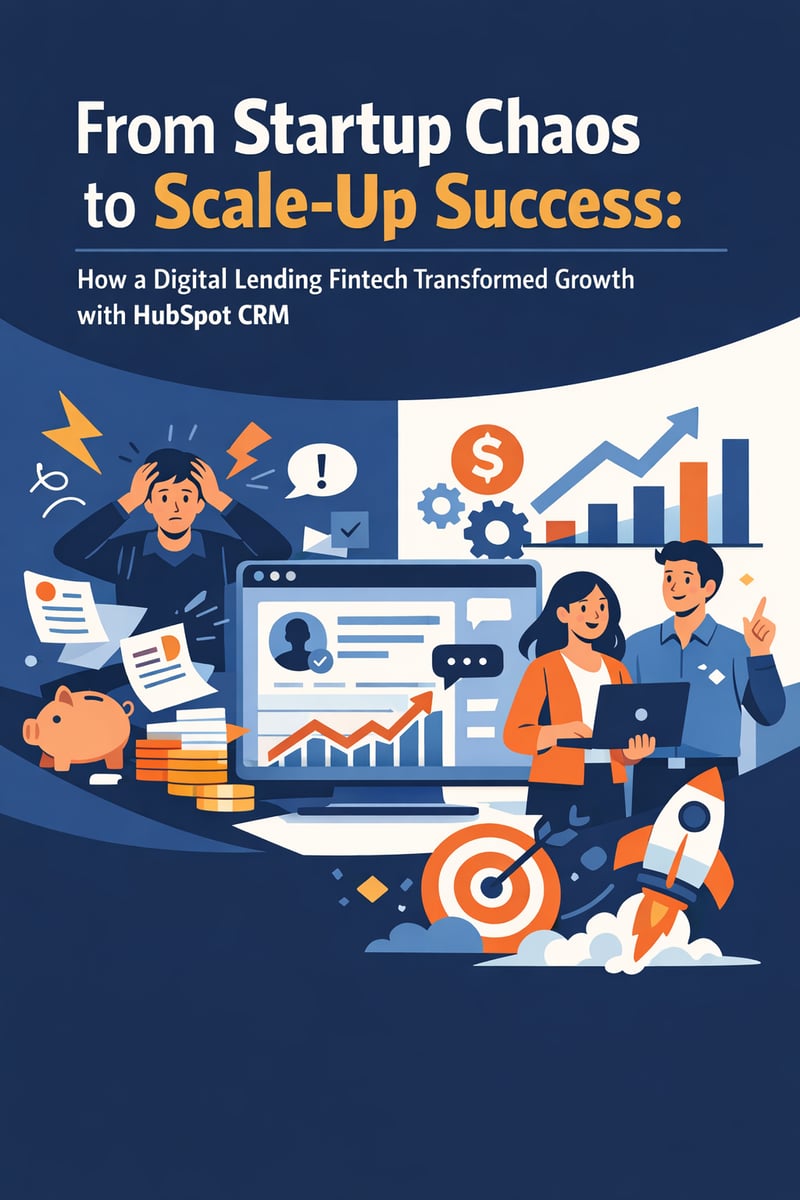
- The Challenge: A fast-growing digital lending fintech outgrew its patchwork of spreadsheets and disconnected tools, creating compliance blind spots and lost revenue opportunities
- The Solution: A phased HubSpot CRM implementation spanning Sales Hub, Marketing Hub, Service Hub, and Operations Hub—purpose-built for regulated financial services
- Key Results: 62% faster lead-to-close cycle, 3.2x increase in marketing-qualified leads, 45% reduction in compliance review time, and 38% revenue growth year-over-year
- Timeline: Three-phase rollout completed over six months with full team adoption
- Bottom Line: A unified CRM platform enabled this fintech to scale from 45 to 120+ employees without sacrificing the compliance rigor or personalized service that fueled its early success
Introduction: When Growth Outpaces Your Systems
Every fintech founder dreams of the moment when product-market fit clicks and demand surges. But for the leadership team at a digital lending startup serving small and mid-sized businesses, that inflection point brought an unexpected crisis: their systems couldn't keep up.
With a lean team of 45, the company had built its early traction on a compelling digital lending product, competitive rates, and a founder-led sales motion that prioritized relationships. But as monthly loan applications tripled and the team expanded across sales, marketing, compliance, and customer success, the cracks in their technology stack became impossible to ignore.
"We were running sales out of spreadsheets, marketing out of Mailchimp, compliance tracking in a shared Google Drive, and customer support through a shared inbox," recalled the company's Chief Revenue Officer. "We had no single view of the customer, and critical compliance steps were falling through the cracks."
Recognizing that their next phase of growth demanded a unified platform, the company partnered with Vantage Point to implement HubSpot CRM—a decision that would transform not just their technology, but their entire go-to-market operation.
The Challenge: Five Systems, Zero Visibility
Fragmented Data Across the Customer Journey
Like many early-stage fintechs, the company had adopted tools organically as needs arose. By the time they reached Series B funding, their technology landscape included:
- Spreadsheets and Airtable for pipeline tracking and deal management
- Mailchimp for email marketing with no CRM integration
- A shared Gmail inbox for customer support inquiries
- Google Drive folders for compliance document management
- A custom-built internal dashboard for loan application status tracking
Each system held a piece of the customer story, but none talked to the others. Sales representatives couldn't see which marketing campaigns had influenced a prospect. Customer success managers had no visibility into a borrower's original application journey. And the compliance team spent hours each week manually cross-referencing records across systems to satisfy regulatory audit requirements.
Compliance Blind Spots in a Regulated Industry
Operating in digital lending meant navigating a complex web of state lending licenses, federal regulations, and investor reporting requirements. The company's manual compliance processes created three critical risks:
- KYC/AML verification gaps — Customer identity verification and anti-money laundering checks were tracked in spreadsheets, making it impossible to prove a consistent, auditable process
- State licensing compliance — With lending licenses in 28 states, each with unique disclosure and reporting requirements, the team struggled to ensure every borrower communication met jurisdictional standards
- SOC 2 audit preparation — Annual security audits required weeks of manual evidence gathering across disconnected systems
"Our compliance officer was spending 60% of her time on manual data reconciliation instead of actual risk assessment," noted the CEO. "That wasn't sustainable."
A Sales Process That Couldn't Scale
The founder-led sales motion that drove early growth was hitting its ceiling. Without a structured CRM:
- Lead response time averaged 18 hours (industry benchmarks target under 5 minutes for fintech)
- No lead scoring meant sales representatives treated every inquiry with equal priority
- Pipeline forecasting relied on subjective judgment rather than data
- Cross-sell and upsell opportunities were invisible—the team had no way to identify which existing borrowers might benefit from additional products
The VP of Sales described the situation bluntly: "We were leaving money on the table every single day. Prospects were falling out of our funnel because nobody owned the follow-up, and we had no idea which leads were actually likely to convert."
The Solution: A Phased HubSpot Implementation Built for Fintech
Why HubSpot?
After evaluating Salesforce, HubSpot, and two other CRM platforms, the company selected HubSpot for several reasons aligned with their growth stage and industry requirements:
- Rapid time-to-value — HubSpot's intuitive interface meant faster team adoption compared to more complex enterprise platforms
- Operations Hub — Purpose-built data quality and workflow automation tools addressed compliance automation needs
- Native integration ecosystem — Pre-built connectors for their loan origination system, payment processor, and communication tools
- Scalable pricing — A cost structure that grew with the business rather than requiring enterprise-tier commitment from day one
- API flexibility — Robust APIs enabled custom integrations with proprietary lending technology
Vantage Point designed a three-phase implementation roadmap that prioritized quick wins while building toward a fully integrated revenue operations platform.
Phase 1: Foundation — Sales Hub and Data Architecture (Weeks 1–8)
The first phase focused on eliminating the spreadsheet-driven sales process and establishing a clean data foundation.
Custom Object Architecture: Vantage Point designed a data model with 120+ custom properties across Contacts, Companies, Deals, and two Custom Objects (Loan Applications and Compliance Records). This structure reflected the unique relationships in lending:
- A single company contact might have multiple loan applications
- Each application required linked compliance verification records
- Deal stages mapped directly to the lending funnel: Lead → Application → Underwriting → Approval → Funded → Servicing
Compliance-Gated Deal Pipeline: Unlike a standard sales pipeline, the lending pipeline required mandatory compliance checkpoints. Vantage Point configured conditional deal stage progression that prevented applications from advancing past underwriting without verified KYC/AML documentation—building regulatory compliance directly into the sales workflow rather than treating it as a separate process.
Lead Scoring and Routing: A custom lead scoring model weighted factors specific to lending: business revenue, time in operation, industry vertical, geographic location (mapped to active state licenses), and digital engagement signals. Leads scoring above threshold were automatically routed to the appropriate sales representative based on territory and product specialization.
Data Migration: Over 15,000 contact records, 4,200 company records, and 2,800 historical loan applications were migrated from spreadsheets and Airtable, deduplicated, and enriched with missing firmographic data.
Phase 2: Growth Engine — Marketing Hub and Automation (Weeks 6–16)
With the sales foundation in place, the second phase activated HubSpot's marketing automation capabilities.
Inbound Lead Generation: The marketing team deployed HubSpot's landing pages, forms, and CTAs across the company website, replacing a disconnected WordPress-to-Mailchimp setup. Every form submission now flowed directly into HubSpot with full attribution tracking—finally answering the question of which channels and content drove qualified applications.
Automated Nurture Sequences: Vantage Point built 12 automated email workflows targeting different segments:
- Pre-application nurture — Educational content for prospects researching lending options
- Application abandonment — Re-engagement sequences for prospects who started but didn't complete applications (reducing drop-off by 34%)
- Post-funding onboarding — Automated welcome sequences and repayment education for funded borrowers
- Cross-sell campaigns — Triggered outreach to existing borrowers who qualified for additional products based on repayment history and business growth signals
Content Strategy Integration: Blog posts, whitepapers, and webinar registrations were tied to HubSpot's content management tools, creating a closed-loop system where the marketing team could attribute revenue directly to specific content pieces.
Phase 3: Operations and Scale — Operations Hub and Service Hub (Weeks 14–24)
The final phase unified operations, compliance, and customer success onto the platform.
Operations Hub for Data Quality: Automated data quality workflows ensured consistency across the growing database:
- Duplicate detection and merging rules
- Standardized formatting for company names, phone numbers, and addresses
- Automated enrichment of missing fields via third-party data providers
- Custom-coded workflow actions for complex compliance data transformations
Compliance Automation: The compliance team gained a dedicated dashboard and workflow system:
- Automated KYC/AML status tracking — Verification status synced from the identity verification provider directly into HubSpot contact records
- State licensing compliance workflows — Automated checks ensuring borrower communications included required state-specific disclosures
- Audit trail generation — Every customer interaction, document upload, and status change was logged with timestamps, creating SOC 2-ready audit trails without manual effort
- Expiration alerts — Automated notifications 90, 60, and 30 days before state license renewals
Service Hub for Borrower Support: Customer support migrated from the shared Gmail inbox to HubSpot's ticketing system:
- Knowledge base with 50+ self-service articles covering common borrower questions
- Automated ticket routing based on inquiry type (payment questions, document requests, product inquiries)
- SLA tracking with escalation workflows for time-sensitive compliance-related inquiries
- Customer satisfaction surveys (CSAT) automatically sent after ticket resolution
The Results: Metrics That Tell the Story
Sales Performance
| Metric | Before HubSpot | After HubSpot | Improvement |
|---|---|---|---|
| Lead response time | 18 hours | 12 minutes | 99% faster |
| Lead-to-close cycle | 34 days | 13 days | 62% reduction |
| Marketing-qualified leads per month | 180 | 576 | 3.2x increase |
| Sales pipeline accuracy | ~40% (subjective) | 89% (data-driven) | 49 point improvement |
| Monthly funded loan volume | $4.2M | $6.8M | 62% increase |
Marketing Impact
| Metric | Before HubSpot | After HubSpot | Improvement |
|---|---|---|---|
| Email open rate | 14% | 31% | +121% |
| Application completion rate | 52% | 70% | +35% |
| Cost per qualified lead | $285 | $142 | 50% reduction |
| Content-attributed revenue | Unmeasurable | $1.4M/quarter | First-time visibility |
| Website conversion rate | 1.8% | 4.6% | 156% increase |
Compliance and Operations
| Metric | Before HubSpot | After HubSpot | Improvement |
|---|---|---|---|
| Compliance review time per application | 4.5 hours | 2.5 hours | 45% reduction |
| SOC 2 audit preparation | 6 weeks | 8 days | 81% faster |
| KYC/AML verification tracking | Manual/spreadsheet | Automated/real-time | Fully automated |
| State disclosure compliance rate | ~92% (estimated) | 99.7% (verified) | Near-perfect |
| Compliance team capacity | 120 reviews/month | 280 reviews/month | 133% increase |
Customer Success
| Metric | Before HubSpot | After HubSpot | Improvement |
|---|---|---|---|
| Support ticket resolution | 72 hours avg | 18 hours avg | 75% faster |
| Customer satisfaction (CSAT) | Not measured | 4.6/5.0 | Baseline established |
| Borrower retention rate | 68% | 84% | +24% |
| Self-service resolution rate | 0% (no knowledge base) | 42% | New capability |
| Net Promoter Score (NPS) | Not measured | 52 | Strong advocacy |
Business Growth
The cumulative impact on the business was transformative:
- Revenue grew 38% year-over-year, from $18M to $24.8M annual recurring revenue
- Team scaled from 45 to 120+ employees with the CRM infrastructure supporting structured onboarding
- Raised Series C funding, with investors citing the company's operational maturity and data-driven decision-making as key differentiators
- Expanded to 36 state lending licenses (from 28), enabled by automated compliance workflows that reduced the operational burden of multi-state operations
What Made This Implementation Different?
Compliance-First Architecture
Rather than bolting compliance onto a standard CRM setup, Vantage Point embedded regulatory requirements into the core data architecture from day one. Compliance checkpoints weren't optional workflow steps—they were mandatory gates that prevented pipeline progression. This approach transformed compliance from a bottleneck into an accelerator: by automating verification and documentation, the team actually moved faster while maintaining stricter standards.
Fintech-Specific Data Modeling
Generic CRM implementations fail in fintech because they don't account for the industry's unique data relationships. Vantage Point's custom object architecture—linking contacts to companies to loan applications to compliance records—created a true 360-degree view that reflected how lending actually works, not how a standard B2B sales process works.
Phased Adoption with Quick Wins
The three-phase approach ensured the team saw value within weeks, not months. By launching Sales Hub first, the sales team experienced immediate productivity gains that built internal momentum for the marketing and operations phases. Employee adoption reached 94% within 90 days—well above the 70% benchmark for CRM implementations in financial services.
How Did This Fintech Scale Compliance Workflows with HubSpot?
The key was treating HubSpot Operations Hub as the compliance orchestration layer. Rather than maintaining separate compliance systems, the implementation used:
- Custom-coded workflow actions to validate data against regulatory requirements in real time
- Automated document generation for state-specific disclosures triggered by borrower location
- Integration with identity verification APIs that synced KYC/AML status directly to HubSpot contact properties
- Role-based access controls ensuring sensitive borrower data was visible only to authorized team members
This approach reduced compliance-related operational costs by an estimated 35% while simultaneously improving accuracy.
What Are the Best Practices for Fintech CRM Implementation?
Based on this engagement, five best practices emerged for fintech companies evaluating CRM platforms:
- Start with your data model, not your workflows — The right
custom object architecture makes everything downstream easier.
Invest time upfront mapping your unique entity relationships. - Build compliance into deal stages, not around them —
Mandatory compliance gates in your pipeline prevent regulatory
gaps and create auditable processes by default. - Automate lead response aggressively — In digital lending,
response time directly correlates with conversion. Every hour of
delay costs funded volume. - Connect your loan origination system to your CRM — The
handoff between marketing/sales and lending operations is where
most fintechs lose visibility. API integration eliminates the gap. - Plan for multi-state complexity from day one — Even if
you're currently licensed in a handful of states, build your
compliance workflows to accommodate expansion. Retrofitting is
exponentially harder.Start with your data model, not your workflows — The right custom object architecture makes everything downstream easier. Invest time upfront mapping your unique entity relationships.
Future Vision: What Comes Next?
With the HubSpot foundation in place, the company is planning several next-phase initiatives:
- AI-powered lead scoring — Leveraging HubSpot's Breeze AI capabilities to refine lead scoring models based on historical conversion patterns
- Predictive borrower health scoring — Using repayment data and engagement signals to identify at-risk borrowers before they default
- Partner channel enablement — Extending HubSpot to manage referral partner relationships and automate co-marketing workflows
- Advanced attribution modeling — Multi-touch attribution to optimize marketing spend across an expanding channel mix
"HubSpot gave us the infrastructure to scale without losing control," said the Chief Revenue Officer. "We went from a startup running on instinct to a data-driven organization running on insight. That's the difference between growing fast and growing smart."
Frequently Asked Questions (FAQ)
Is HubSpot a good fit for fintech companies?
Yes. HubSpot's combination of Sales Hub, Marketing Hub, and Operations Hub provides fintech companies with a unified platform that supports both growth and compliance. Custom objects, workflow automation, and API integrations make it adaptable to the unique data relationships and regulatory requirements of financial services.
How long does a typical HubSpot implementation take for a fintech startup?
A comprehensive implementation typically takes four to six months, depending on complexity. A phased approach—starting with sales pipeline and data migration, then adding marketing automation, and finally operations and compliance workflows—delivers value incrementally while managing change effectively.
Can HubSpot handle KYC/AML compliance workflows?
HubSpot can serve as the orchestration layer for KYC/AML compliance when integrated with specialized identity verification providers. Operations Hub's custom-coded workflow actions enable real-time data validation, and the platform's audit logging creates compliance-ready documentation.
What is the typical ROI of HubSpot for a fintech company?
ROI varies based on company size and implementation scope, but fintech companies typically see returns within 6–12 months. Common drivers include reduced lead response time, improved conversion rates, lower cost per acquisition, and significant time savings on compliance processes.
How does HubSpot compare to Salesforce for fintech?
Both platforms serve fintech companies well, but they excel in different scenarios. HubSpot offers faster time-to-value, lower total cost of ownership at the startup-to-mid-market stage, and an intuitive user experience that drives higher adoption rates. Salesforce offers deeper enterprise customization and a more mature financial services cloud. The right choice depends on company size, complexity, and growth trajectory.
What HubSpot integrations are most important for fintech?
Key integrations include loan origination systems, payment processors (Stripe, Plaid), identity verification providers, accounting platforms, document management systems, and communication tools (SMS, chat). HubSpot's Operations Hub and robust API make these integrations achievable without extensive custom development.
How do you ensure data security in a HubSpot fintech implementation?
Data security in HubSpot starts with proper configuration: role-based access controls, field-level permissions, and team-based record ownership. HubSpot maintains SOC 2 Type II certification and offers data encryption at rest and in transit. For additional security layers, sensitive data can remain in specialized systems with only reference IDs synced to HubSpot.
Ready to scale your fintech operation without sacrificing compliance or customer experience? Contact Vantage Point for a complimentary CRM assessment and discover how the right implementation partner can accelerate your growth.