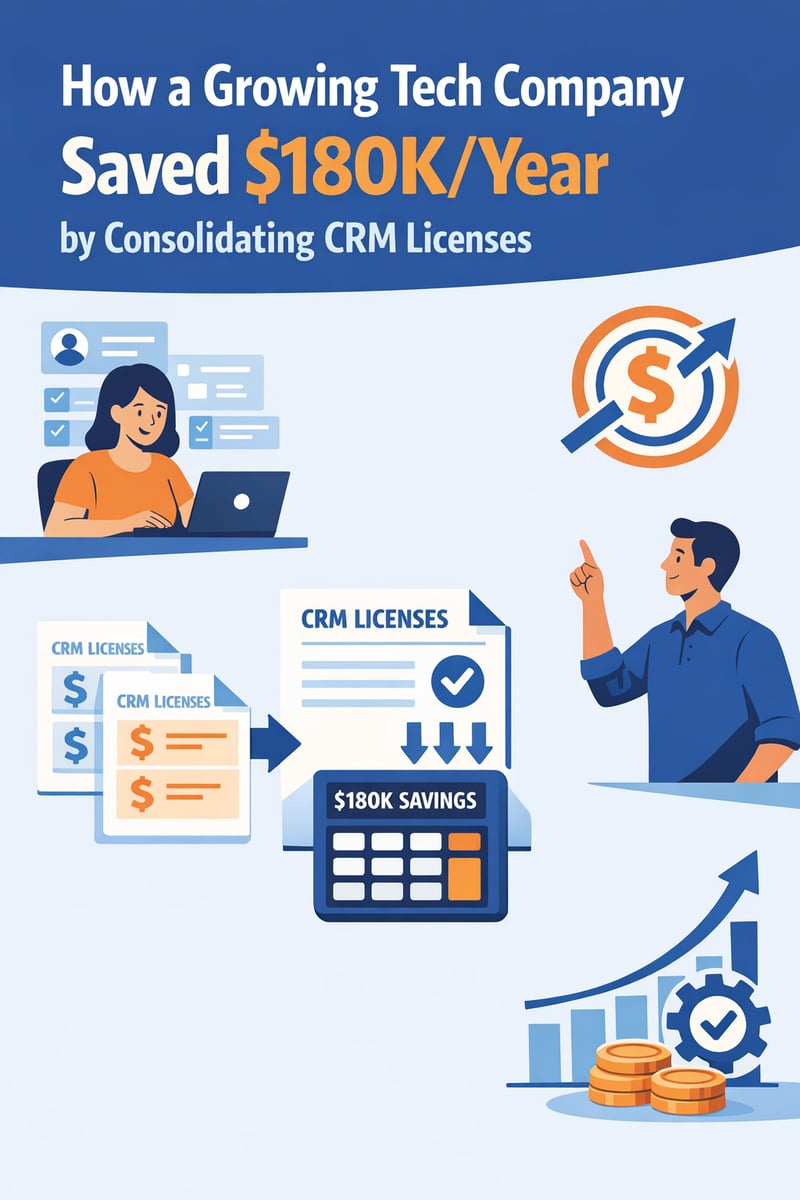
Key Takeaways (TL;DR)
- The Challenge: A fast-scaling SaaS company was hemorrhaging $180K annually on unused Salesforce licenses and redundant point solutions
- Key Results: 42% reduction in CRM licensing costs, elimination of 6 overlapping tools, and a unified data foundation
- Timeline: Full audit, migration, and optimization completed in 14 weeks
- ROI: $180K in annual savings realized within the first quarter post-implementation
- Bottom Line: Strategic license optimization isn't just about cutting costs — it's about building a leaner, more agile tech stack that scales with your business
Introduction: When Growth Outpaces Your Tech Stack
Growth is supposed to be a good thing. But for one mid-market SaaS company with 300+ employees across three offices, rapid scaling had created an unexpected problem: a bloated, tangled web of CRM licenses and point solutions that was draining the budget by nearly $15,000 every month.
The company had experienced explosive year-over-year growth, tripling its headcount in just four years. Along the way, different departments had independently purchased tools and licenses to solve immediate problems — a pattern that's all too familiar in high-growth tech environments.
"License sprawl is one of the most overlooked cost centers in scaling companies," says David Cockrum, President of Vantage Point. "Organizations don't set out to waste money. What happens is that every team optimizes for their own needs, and before you know it, you're paying for six tools that do overlapping things — and a CRM with seats nobody uses."
This is the story of how a strategic license audit and shelfware swap transformed that chaos into $180K in annual savings — and set the stage for a data-driven future.
What Was the Challenge? Unchecked License Sprawl in a Scaling Organization
The Symptoms
When the company's VP of Revenue Operations first raised the alarm, the numbers were staggering:
- 187 active Salesforce licenses — but only 112 users logging in regularly
- 6 overlapping point solutions for email tracking, proposal generation, contract management, lead scoring, data enrichment, and reporting
- 3 separate analytics dashboards maintained by different teams, none fully integrated
- No centralized visibility into total SaaS spend or usage metrics
The Root Causes
The problems didn't happen overnight. They were the predictable result of several converging factors:
- Rapid hiring without license governance: New hires were provisioned Salesforce licenses by default, regardless of whether their roles required CRM access.
- Department-level tool purchasing: Sales, marketing, customer success, and operations each procured their own solutions independently.
- No regular license audits: The company hadn't conducted a comprehensive review of its Salesforce licensing in over two years.
- Fear of disruption: Previous attempts to consolidate tools had stalled because teams were afraid of losing functionality they relied on.
"We knew we were overspending, but we didn't know the magnitude until we brought in an outside perspective. The overlapping functionality between our point solutions and what Salesforce could do natively was eye-opening."
— VP of Revenue Operations
How Did Vantage Point Approach the Solution?
Vantage Point's engagement followed its proven VALUE methodology — Vision, Adaptability, Leverage, User-Centric Design, and Excellence — applying a structured, data-driven approach to what many organizations treat as a simple cost-cutting exercise.
Phase 1: Vision — Comprehensive License Audit (Weeks 1–3)
The first step was establishing a complete picture of the technology landscape. Vantage Point conducted:
- Full Salesforce license inventory: Mapping every license type (Sales Cloud, Service Cloud, Platform, etc.) to actual usage patterns over the trailing 90 days
- Point solution audit: Cataloging all third-party tools, their costs, feature sets, and user adoption rates
- Overlap analysis: Identifying where purchased tools duplicated native Salesforce functionality or each other
- Stakeholder interviews: Understanding why teams adopted specific tools and what workflows they depended on
Key Discovery: 40% of the company's Salesforce licenses were either completely unused or assigned to users who logged in fewer than twice per month. Meanwhile, three of the six point solutions had feature sets that were 70%+ redundant with capabilities already included in their Salesforce edition.
Phase 2: Adaptability — Strategic Roadmap Design (Weeks 4–5)
Rather than simply canceling licenses and tools, Vantage Point designed a phased consolidation roadmap that minimized business disruption:
- License right-sizing plan: Matching each user to the appropriate license type based on actual usage — downgrading power licenses to Platform licenses where full Sales Cloud wasn't needed
- Shelfware swap strategy: Identifying which point solutions could be replaced by native Salesforce features, and which served genuinely unique needs worth retaining
- Migration sequencing: Prioritizing tool replacements by risk and impact, tackling low-risk, high-savings swaps first
Phase 3: Leverage — Native Feature Activation (Weeks 6–10)
With the roadmap approved, Vantage Point activated and configured native Salesforce capabilities to replace the outgoing point solutions:
| Replaced Tool | Native Salesforce Alternative | Annual Savings |
|---|---|---|
| Third-party email tracking | Salesforce Email Tracking + Activity Capture | $18,000 |
| External lead scoring tool | Einstein Lead Scoring | $24,000 |
| Standalone reporting platform | Salesforce Reports & CRM Analytics | $31,000 |
| Separate data enrichment service | Data Cloud integration | $22,000 |
Each replacement included custom configuration, data migration, and team-specific training to ensure zero loss of functionality.
Phase 4: User-Centric Design — Change Management & Training (Weeks 8–12)
The most critical phase. Vantage Point understood that license consolidation only works if people actually adopt the new workflows:
- Role-based training sessions for sales, marketing, customer success, and operations teams
- Custom quick-reference guides for each department's most common workflows
- Champions program: Power users from each team were trained first and served as peer support
- Feedback loops: Weekly pulse surveys during the transition to identify and resolve friction points quickly
Phase 5: Excellence — Governance Framework (Weeks 12–14)
To prevent license sprawl from recurring, Vantage Point implemented:
- Automated license usage monitoring with alerts when utilization dropped below thresholds
- Quarterly license review cadence built into the RevOps team's calendar
- New hire provisioning workflow with approval gates based on role requirements
- Annual tech stack audit process with clear ownership and accountability
What Were the Results? $180K in Annual Savings — And Counting
By the Numbers
| Metric | Before | After | Impact |
|---|---|---|---|
| Active Salesforce licenses | 187 | 128 | 42% reduction |
| Point solutions in use | 9 | 3 | 67% consolidation |
| Annual CRM/tool spend | $430K | $250K | $180K saved |
| Average user login frequency | 3.2x/week | 5.1x/week | 59% increase |
| Data silos | 6+ disconnected systems | 1 unified platform | Centralized visibility |
| Time to generate exec reports | 4+ hours | 15 minutes | 94% faster |
Beyond Cost Savings
The financial impact was immediate and measurable, but the downstream benefits proved equally valuable:
- Faster onboarding: New sales reps reached full productivity 3 weeks sooner with a simplified tech stack
- Better data quality: Eliminating data silos reduced duplicate records by 68% and improved lead routing accuracy
- Improved forecasting: With all activity data flowing through a single system, revenue forecasting accuracy improved from 72% to 91%
- AI readiness: The consolidated, clean data foundation positioned the company to deploy AI-powered insights — a capability that would have been impossible with fragmented data across multiple tools
"The $180K in savings got the CFO's attention, but what really changed the game was the data quality improvement. For the first time, our leadership team trusts the numbers in our dashboards."
— Director of Sales Operations
What Can Your Organization Learn from This? Key Best Practices
1. Audit Before You Cut
Resist the urge to simply cancel licenses. Without understanding actual usage patterns, you risk disrupting workflows that teams depend on.
2. Right-Size, Don't Just Reduce
Not every user needs the same license tier. Matching license types to actual job functions can yield significant savings without removing access.
3. Consolidate Strategically
Modern CRM platforms like Salesforce offer far more native functionality than most organizations realize. Before renewing a point solution, check whether your existing platform can handle it.
4. Invest in Change Management
Tool consolidation fails when users don't adopt the replacements. Budget time and resources for training, documentation, and peer support.
5. Build Governance from Day One
License sprawl is a recurring problem unless you build systems to prevent it. Automated monitoring, regular audits, and clear provisioning workflows are essential.
How Does This Connect to the Bigger Picture?
License optimization is often the first step in a broader digital transformation. For this company, the consolidated Salesforce environment became the foundation for:
- HubSpot Marketing Hub integration — aligning marketing and sales on a single customer view, powered by seamless data flow between platforms
- Data Cloud activation — leveraging the clean, unified data to build customer profiles that power personalized engagement
- AI-powered automation — deploying Einstein AI features that require high-quality, centralized data to deliver meaningful predictions
"When organizations come to us for cost optimization, they often discover that the real value isn't just the savings — it's the platform readiness they gain," notes David Cockrum. "A clean, consolidated CRM is the foundation for every AI and personalization initiative on the roadmap."
Frequently Asked Questions (FAQ)
How long does a typical CRM license audit take?
A comprehensive license audit for a mid-market organization typically takes 2–4 weeks, depending on the number of licenses, integrations, and stakeholders involved. Vantage Point's structured approach includes automated usage analysis, stakeholder interviews, and overlap mapping to ensure nothing is missed.
What is "shelfware" and why does it matter?
Shelfware refers to software licenses or tools that an organization has purchased but isn't actively using. In CRM environments, shelfware commonly includes unused license seats, redundant point solutions, and premium features that were never configured. Identifying and eliminating shelfware is one of the fastest paths to reducing SaaS spend.
Can you consolidate CRM licenses without losing functionality?
Yes — in most cases, modern CRM platforms like Salesforce and HubSpot include native features that can replace standalone point solutions. The key is conducting a thorough feature comparison and ensuring the native alternative is properly configured and users are trained on the new workflow before decommissioning the legacy tool.
What's the difference between license right-sizing and license reduction?
License reduction simply means canceling unused seats. License right-sizing is more strategic: it involves matching each user to the most appropriate license type based on their actual usage patterns. For example, a user who only views dashboards doesn't need a full Sales Cloud license — a Platform license at a fraction of the cost may be sufficient.
How often should organizations audit their CRM licenses?
Best practice is to conduct a light-touch quarterly review of license utilization metrics, with a comprehensive annual audit that includes stakeholder interviews, feature overlap analysis, and vendor contract review. Organizations experiencing rapid growth or significant headcount changes should audit more frequently.
What's the typical ROI timeline for license consolidation?
Most organizations see measurable cost savings within the first 90 days of implementation. The full ROI — including improved productivity, data quality, and downstream benefits — typically materializes over 6–12 months as teams fully adopt the consolidated workflows.
How does license consolidation relate to AI readiness?
AI and machine learning tools require clean, centralized, high-quality data to deliver accurate insights and predictions. License consolidation naturally creates this foundation by eliminating data silos and unifying customer information in a single platform — making it a critical prerequisite for any AI initiative.
Ready to Find Your Hidden Savings?
If your organization is experiencing license sprawl, redundant tools, or rising CRM costs, you're not alone — and the solution may be more straightforward than you think.
Vantage Point specializes in helping organizations right-size their Salesforce and HubSpot environments, consolidate redundant tools, and build governance frameworks that keep costs under control as you scale.
Schedule a Free License Optimization Assessment →
Discover how much your organization could save with a strategic license audit. Our team will provide a no-obligation analysis of your current CRM licensing and identify opportunities for immediate cost reduction.
This success story is based on a real Vantage Point engagement. Client details have been anonymized to protect confidentiality. Results may vary based on organization size, licensing structure, and implementation scope.