
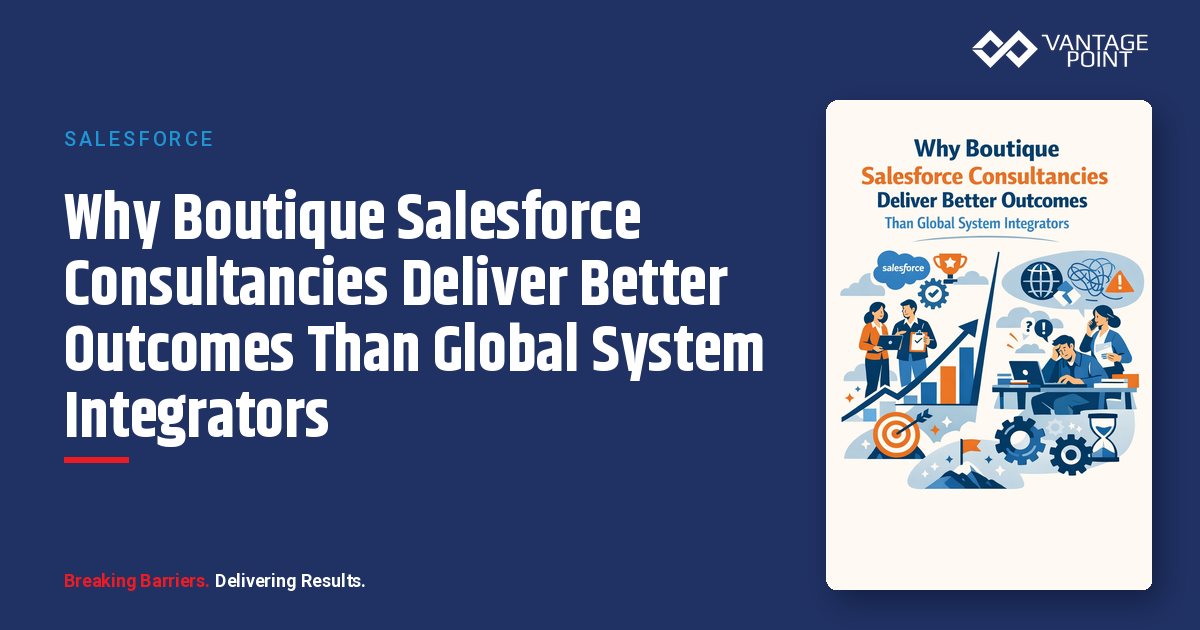
Why Boutique Salesforce Consultancies Deliver Better Outcomes Than Global System Integrators
TL;DR / Key Takeaways
| What Is It? | A data-backed comparison of boutique CRM consultancies vs. global system integrators, and why mid-market businesses consistently get better results from specialized partners |
| Key Benefit | Boutique firms deliver comparable outcomes at 30-60% lower cost with senior-only teams, faster timelines, and significantly higher client satisfaction |
| The Problem | More than half of CRM implementations fail to meet their goals, and the largest, most expensive partners aren't immune to that statistic |
| Best For | Any organization evaluating Salesforce or HubSpot consulting partners, especially those who've been burned by (or are nervous about) big-firm engagements |
| Bottom Line | When your CRM implementation needs to actually work, not just look good in a proposal, the size of your partner matters less than the seniority of the people doing the work |
What Happens When Your Boutique Consultancy Gets Acquired by a Global Systems Integrator?
If you've worked with a consulting partner you loved (one where the senior architect who scoped your project was the same person who built it) you may have experienced an uncomfortable moment: the email announcing your trusted partner has been acquired by a firm with 100,000+ employees.
It's happening more frequently. As the Salesforce ecosystem matures and consolidates, global system integrators are acquiring boutique firms to absorb their talent, client relationships, and platform expertise. The pattern is predictable: a beloved mid-market consultancy gets acquired, the founders transition out within 18 months, the senior consultants who made the firm special leave for other boutiques, and the client experience gradually shifts from personalized to processed.
This isn't speculation. It's the documented lifecycle of nearly every boutique-to-integrator acquisition in the CRM consulting space.
The question for CRM buyers isn't whether this consolidation will continue: it will. The question is: what should you actually look for in a consulting partner, and does firm size predict project success?
The data says no. In fact, it often says the opposite.
Why Do So Many CRM Implementations Fail?
Before comparing boutique firms to global systems integrators, let's establish the baseline reality: CRM implementation failure rates remain stubbornly high.
- 55% of CRM deployments fail to achieve their planned objectives, according to research compiled by Johnny Grow Consulting
- Industry analysts have cited even higher failure rates for Salesforce implementations specifically, when "failure" includes projects that go over budget, miss timelines, or fail to drive expected adoption
- Even successful implementations often deliver only a fraction of their projected ROI in the first two years
These aren't failures of technology. Salesforce, HubSpot, and other major CRM platforms are capable, mature products. The failures are almost always failures of implementation: poor requirements gathering, inexperienced consultants, insufficient change management, and misaligned expectations.
So when you're choosing an implementation partner, the most important question isn't "how big is this firm?" It's "who will actually be doing the work?"
How Do Boutique Firms and Global Systems Integrators Actually Differ?
Team Structure: Senior Architects vs. Delivery Factories
This is the single most important differentiator, and it's the one that global systems integrators work hardest to obscure in their proposals.
Boutique firms (typically 10-200 employees): - Staff projects with senior consultants who have 8-15+ years of platform experience - The person who scopes your project is often the same person who builds it - Team leads carry active certifications and hands-on technical skills - Flat organizational structures mean faster decisions and direct client access to senior talent - Typical project team: 3-7 people, mostly senior
Global systems integrators (10,000-300,000+ employees): - Win deals with senior partners and solution architects who present beautifully - Staff delivery teams with junior consultants, often 1-3 years of experience - Frequently leverage offshore delivery centers for cost efficiency - The senior architect who won your confidence may move to the next sale within weeks - Typical project team: 10-30+ people across multiple tiers, heavy on junior resources
A former Gartner analyst described it bluntly: "The bait-and-switch is the oldest play in the systems integrator handbook. You buy the A-team and get the B-team."
This isn't universally true: some large systems integrators have excellent delivery organizations. But the structural incentive is clear: large firms optimize for utilization and margin, which means deploying the most junior resources a client will accept.
Delivery Speed: Weeks vs. Quarters
Boutique firms consistently deliver faster implementations because they have fewer layers of process overhead:
| Factor | Boutique Firm | Global Systems Integrator |
|---|---|---|
| Typical implementation | 6-16 weeks | 3-12+ months |
| Decision-making layers | 1-2 | 4-6+ |
| Scope change turnaround | Days | Weeks |
| Status reporting overhead | Light | Heavy (PMO, steering committees, governance) |
| Response time to issues | 43% faster (Forrester, 2024) | Standard enterprise cadence |
A 2024 Forrester Consulting Industry Report found that boutique consulting firms demonstrated 43% faster response times to shifting client requirements compared to large-firm competitors. For CRM implementations, where requirements evolve rapidly once users start testing, this agility translates directly to better outcomes.
Cost: 30-60% Less for Comparable Outcomes
The cost differential is significant and well-documented:
- Boutique AI and CRM consulting firms deliver implementations at 30-40% lower cost than enterprise consultancies for comparable scope (AIConsultingLab, 2025)
- Industry benchmarks show boutique firms deliver comparable outcomes at 40-60% less cost while maintaining implementation continuity (Bosio Digital, 2026)
- Mid-market Salesforce implementations with boutique firms typically range $75K: $500K, compared to $250K: $5M+ for the same scope at global systems integrators
Where does the cost difference come from? Three places:
- Lower overhead. Boutique firms don't carry the cost of global offices, massive HR departments, and corporate infrastructure
- Less rework. Senior consultants make fewer mistakes, reducing the cost of fixing junior errors
- Fewer people. A team of 5 senior consultants can outproduce a team of 15 mixed-experience resources: with less coordination overhead
Client Satisfaction: The Signals Are Clear
While direct head-to-head satisfaction data between boutique and systems integrator firms is limited, the available signals are clear:
- Boutique Salesforce partners consistently earn higher ratings on platforms like G2, Clutch, and the Salesforce AppExchange than large systems integrator divisions
- Client retention rates at boutique firms are significantly higher, with repeat engagements far more common than at large systems integrators
- Net Promoter Scores (NPS) for boutique consultancies typically run well above those of large systems integrator CRM practices
The satisfaction gap isn't mysterious. When your consultant knows your business, remembers your last conversation, and picks up the phone when you call. The experience is fundamentally different from navigating a systems integrator's account management hierarchy.
When Does a Global Systems Integrator Actually Make Sense?
To be fair, there are legitimate scenarios where a global systems integrator is the right choice:
- True enterprise scale: 50,000+ users across 30+ countries with complex compliance requirements
- Multi-year, multi-cloud transformations: When you're implementing Salesforce, SAP, Workday, and ServiceNow simultaneously
- Regulatory complexity: Industries with specific governance requirements that demand dedicated compliance teams
- Political cover: Sometimes organizations need the brand name of a Big Four firm to satisfy board requirements or procurement policies
If your CRM project involves fewer than 5,000 users, operates primarily in North America, and doesn't require simultaneous multi-platform transformations, a boutique firm will almost certainly deliver a better outcome at a lower cost.
What Should You Look for in a Boutique CRM Consultancy?
Not all boutique firms are created equal. Here's what separates the best from the rest:
1. Senior-Only Staffing Model
Ask directly: "Will the people in this proposal be the people doing the work?" The best boutique firms staff every engagement with consultants who have 8+ years of experience. No junior bench, no hand-offs, no bait-and-switch.
2. Platform Depth Across the Ecosystem
The CRM landscape isn't single-platform anymore. Look for partners with genuine depth across: - Salesforce (Sales Cloud, Service Cloud, Marketing Cloud, Experience Cloud, Data Cloud) - HubSpot (Marketing Hub, Sales Hub, Service Hub, Operations Hub) - Integration platforms (MuleSoft, Workato, native APIs) - AI capabilities (Agentforce, Breeze AI, Einstein)
A consultancy that only knows one platform will recommend that platform: whether or not it's right for you.
3. Proven Methodology, Not Just Certifications
Certifications prove knowledge; methodology proves the ability to deliver. Ask about: - How they handle requirements gathering and discovery - Their approach to change management and user adoption - How they measure project success beyond "go-live" - What happens when scope changes (because it always does)
4. Track Record with Businesses Like Yours
Look for quantifiable outcomes: - How many clients have they served? - What's their average client satisfaction rating? - Can they share anonymized case studies with measurable results? - What's their client retention rate?
5. Employee-Owned or Founder-Led
This is an underrated signal. Firms where the consultants are owners, not employees of a private equity portfolio company, have fundamentally different incentives. They're building long-term client relationships, not optimizing for quarterly revenue targets.
The Acquisition Cycle: Why It Matters for Your CRM Strategy
The consolidation of boutique Salesforce firms by global systems integrators follows a predictable pattern:
Year 1: Acquisition announced. Founders stay. Client experience unchanged. PR messaging emphasizes "best of both worlds."
Year 2: Integration begins. New reporting structures, delivery methodologies, and billing practices introduced. Senior consultants start leaving for other boutiques or independence.
Year 3: Founders depart. The boutique's culture has been absorbed into the systems integrator's operating model. Original clients notice the difference.
Year 4+: The acquired firm's brand may persist, but the experience is indistinguishable from the parent systems integrator's standard delivery.
For CRM buyers, this means your partner evaluation isn't just a point-in-time decision. You need to understand: - Is this firm independently owned, or part of a larger organization? - If independent, is there risk of acquisition that would change your experience? - What happens to your account team if the firm is acquired?
The safest bet is a firm with structural independence, employee-owned, founder-led, with no private equity pressure to sell.
How Does Vantage Point Approach CRM Consulting Differently?
At Vantage Point, we've built our practice around the principles that make boutique firms successful, and we've been intentional about avoiding the patterns that erode quality:
- Senior-only consultants: Every team member is a seasoned professional. No junior resources, no bait-and-switch
- Employee-owned: Our consultants are owners, not employees. Their incentive is your long-term success, not a utilization target
- Dual-platform expertise: We're deeply certified in both Salesforce and HubSpot, plus integration platforms like MuleSoft, so we recommend what's right, not what we sell
- The VALUE Methodology: Vision → Adaptability → Leverage → User-Centric → Excellence: a proven framework that drives adoption, not just deployment
We believe the CRM consulting industry's consolidation is creating an opportunity: not a crisis. As more boutique firms get absorbed into global systems integrators, businesses that valued personalized, senior-led consulting need somewhere to go.
We're here.
Frequently Asked Questions
What is the CRM implementation failure rate?
Research compiled by Johnny Grow Consulting shows that 55% of CRM implementations fail to fully achieve their planned objectives. The most common causes are poor requirements gathering, insufficient change management, low user adoption, and misaligned expectations between the business and the implementation team: not technology limitations.
Are boutique Salesforce consultancies cheaper than global systems integrators?
Yes, typically 30-60% less expensive for comparable project scope. The cost savings come from lower overhead, more efficient senior-staffed teams that produce fewer errors, and less coordination overhead. Boutique implementations for mid-market companies typically range $75K: $500K versus $250K: $5M+ at global systems integrators.
Why do global system integrators acquire boutique Salesforce firms?
Global systems integrators acquire boutique firms primarily for talent acquisition and client relationships. The Salesforce ecosystem has a well-documented talent shortage, and acquiring a boutique firm is faster than recruiting and training individual consultants. However, the cultural integration often causes senior talent to leave within 18-24 months.
How do I evaluate whether a boutique firm or global systems integrator is right for my project?
Consider four factors: project scale (under 5,000 users typically favors boutique), geographic complexity (single-region favors boutique, multi-continent may favor systems integrator), regulatory requirements (standard compliance favors boutique, highly specialized governance may favor systems integrator), and who does the work (ask directly whether proposal team = delivery team).
What happens to client service quality when a boutique firm gets acquired?
Service quality typically remains stable for 12-18 months post-acquisition, then gradually shifts as the acquiring systems integrator integrates processes, reporting structures, and staffing models. The most common change clients notice is a shift from senior-led delivery to a blended model with more junior resources.
What is the VALUE Methodology?
The VALUE Methodology is Vantage Point's proven approach to CRM implementation: Vision (define success), Adaptability (flexible architecture), Leverage (maximize platform capabilities), User-Centric (drive adoption from day one), and Excellence (continuous improvement post-launch). It's designed to address the root causes of CRM implementation failure: not just the technical requirements.
Should I be concerned if my consulting partner is backed by private equity?
PE-backed firms face pressure to optimize for revenue growth and margins, which can lead to increased use of junior resources, offshore delivery, and pressure to upsell. Employee-owned or founder-led firms have structurally different incentives aligned with long-term client success rather than quarterly financial targets.
Vantage Point is an employee-owned CRM consultancy specializing in Salesforce, HubSpot, and integration platforms. We deliver senior-only consulting that actually works. Learn more →