Key Takeaways (TL;DR)
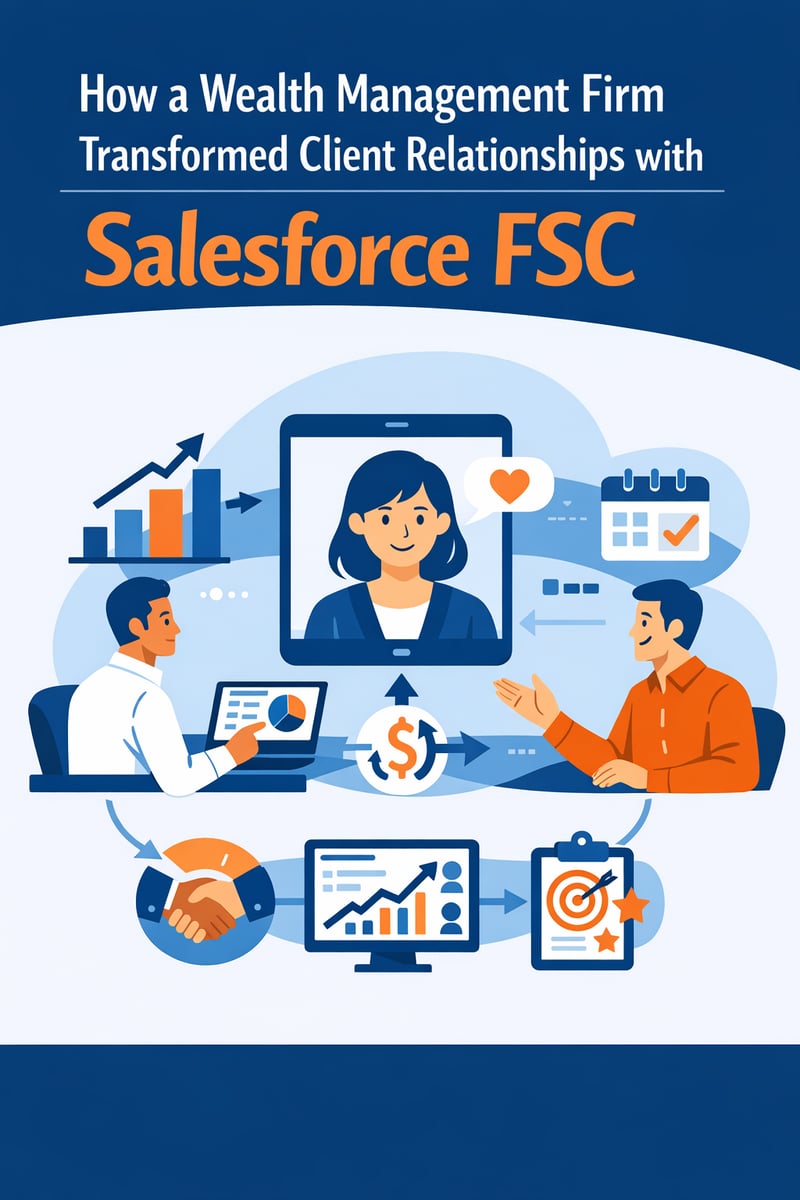
- What is it? A real-world success story of a mid-size RIA that replaced fragmented legacy systems with Salesforce Financial Services Cloud (FSC) to unify client data, automate workflows, and deliver personalized wealth management
- Key Benefit: 360-degree client visibility that transformed reactive service into proactive, relationship-driven advisory
- ROI: 147%+ return on investment within 18 months, with $1.2M in annual operational savings
- Timeline: 4-month phased implementation from planning to full adoption
- Best For: RIAs, wealth management firms, and financial advisory practices with $500M–$5B+ AUM looking to modernize client engagement
- Bottom Line: Client retention improved 18%, advisor productivity increased 25%, and AUM grew 12% year-over-year through deeper, data-driven relationships
Introduction: The Breaking Point Every Wealth Manager Knows
Picture this: A financial advisor preparing for a quarterly review with a high-net-worth client. Portfolio data lives in one system. Communication history is scattered across email threads and sticky notes. Compliance documents sit in a shared drive somewhere. The client's spouse recently called about updating beneficiaries — but that note is buried in a colleague's inbox.
This isn't a hypothetical. It's the daily reality for thousands of advisory firms still running on disconnected spreadsheets, legacy CRMs, and manual processes.
For one mid-size registered investment advisory (RIA) firm managing approximately $2.8 billion in assets under management (AUM), this fragmentation wasn't just inconvenient — it was costing them clients. High-net-worth families expected seamless, personalized service. Instead, they were getting disjointed interactions that felt transactional rather than advisory.
The firm knew something had to change. Their solution? A comprehensive transformation powered by Salesforce Financial Services Cloud (FSC).
This is the story of how they did it — the challenges they faced, the decisions they made, and the measurable results that followed. Whether you're a solo RIA or a multi-office wealth management firm, this transformation roadmap offers actionable insights you can apply to your own practice.
The Challenge: Why Legacy Systems Were Failing
Fragmented Client Data Across Multiple Platforms
The firm's 45 financial advisors relied on a patchwork of tools: a legacy CRM that hadn't been updated in years, Excel spreadsheets for financial planning, a separate portfolio management system, and email for most client communications. Client data existed in at least four disconnected systems.
The consequences were predictable:
- No single source of truth. Advisors spent an estimated 8–10 hours per week searching for client information across systems
- Missed relationship signals. Life events like retirement, inheritance, or business sales went untracked
- Household blindness. The firm couldn't see the full picture of multi-generational family relationships — a critical gap in wealth management
Reactive Rather Than Proactive Service
Without unified data, the firm operated in reactive mode. Advisors responded to client inquiries rather than anticipating needs. When a client's portfolio allocation drifted from target, no automated alert flagged it. When a client hadn't been contacted in 90 days, no system raised a warning.
In an industry where only 41% of wealth management clients report being fully satisfied with service speed and effectiveness (Salesforce Financial Services Report, 2025), reactive service is a fast track to attrition.
Compliance Complexity and Risk
With SEC and state regulatory requirements growing more stringent every year, the firm's manual compliance tracking was becoming untenable. Documenting suitability, archiving communications, and generating audit trails consumed disproportionate time — time that should have been spent on client relationships.
The Wake-Up Call
The final catalyst came when the firm lost three high-net-worth households in a single quarter — collectively representing over $120 million in AUM. Exit interviews revealed a common theme: "We didn't feel like you truly knew us."
Leadership recognized this wasn't just a technology problem. It was a relationship problem that technology could solve.
The Decision: Why Salesforce Financial Services Cloud?
Evaluating the Options
The firm evaluated several CRM and wealth management platforms, including Wealthbox, Redtail, and Microsoft Dynamics. Salesforce Financial Services Cloud emerged as the clear choice for several reasons:
| Evaluation Criteria | Why FSC Won |
|---|---|
| Industry-specific data model | Purpose-built for financial services with household, financial account, and relationship objects |
| 360-degree client view | Unified profiles with portfolio data, goals, interactions, and life events |
| Scalability | Supports growth from $500M to $50B+ AUM without re-platforming |
| Ecosystem integrations | Native connectors for custodians, financial planning tools, and market data |
| AI and automation | Einstein AI for predictive analytics, lead scoring, and next-best-action |
| Compliance framework | Built-in audit trails, permission sets, and regulatory documentation |
What Sealed the Deal
Two FSC-specific capabilities proved decisive:
- Household and Relationship Mapping. FSC's data model natively understands that wealth management revolves around households, not just individuals. A single view showing John, his spouse Maria, their adult children, the family trust, and the business entity — all linked with clear relationships — was transformative.
- Financial Goals and Action Plans. The ability to create, track, and automate workflows around specific client goals (retirement, education funding, estate planning) aligned perfectly with how the firm wanted to deliver advice.
The Implementation: A Phased Approach
The firm partnered with a Salesforce consulting partner specializing in financial services to execute a 4-month phased implementation.
Phase 1: Discovery and Data Architecture (Weeks 1–3)
The first phase focused on understanding the firm's unique processes and designing the FSC data model:
- Stakeholder interviews with advisors, operations staff, and compliance officers
- Data audit across all existing systems to identify sources of truth
- Custom object design for the firm's specific needs (e.g., alternative investment tracking, client segmentation models)
- Household hierarchy mapping for 800+ client households
Key decision: The firm chose to implement FSC's Person Account model rather than the Business Account model, better reflecting the individual-centric nature of wealth management relationships.
Phase 2: Data Migration and Integration (Weeks 4–8)
This was the most technically challenging phase:
- Data cleansing. Over 15,000 duplicate records were identified and merged. Historical data going back 10 years was standardized
- Custodian integration. Real-time portfolio data feeds were established through MuleSoft, connecting the firm's primary custodian with FSC
- Financial planning integration. The firm's financial planning software was connected to sync goal progress, projections, and plan documents
- Email integration. Outlook was connected to automatically log client communications in Salesforce
Lesson learned: Data migration took 40% longer than initially estimated. The firm's legacy CRM had inconsistent data formats accumulated over a decade. Investing extra time in data cleansing before migration proved essential for adoption success.
Phase 3: Workflow Automation and Configuration (Weeks 9–12)
With clean data flowing into FSC, the team built the automation layer:
- Client onboarding Action Plans. A standardized 15-step onboarding workflow assigned tasks to advisors, operations, and compliance — with SLA-based deadlines and escalations
- Review cycle automation. Quarterly and annual review preparation was automated, pre-populating advisor dashboards with portfolio performance, goal progress, and discussion topics
- Life event triggers. When advisors logged life events (marriage, birth, retirement, inheritance), automated workflows suggested relevant services and talking points
- Compliance monitoring. Automated alerts for missing documentation, overdue reviews, and regulatory filing deadlines
Phase 4: Training and Adoption (Weeks 13–16)
Technology is only as effective as the people using it. The firm invested heavily in change management:
- Role-based training. Advisors, paraplanners, and operations staff each received customized training focused on their specific workflows
- Champions program. Five early-adopter advisors served as internal advocates, providing peer support and feedback
- Adoption dashboards. Leadership tracked login frequency, record updates, and feature usage to identify adoption gaps early
- Feedback loops. Bi-weekly surveys gathered user feedback, with rapid iterations to address pain points
The Transformation: What Changed
Before vs. After
| Metric | Before FSC | After FSC | Improvement |
|---|---|---|---|
| Time finding client info | 8–10 hrs/week per advisor | 1–2 hrs/week per advisor | 80% reduction |
| Client review preparation | 3–4 hours per review | 45 minutes per review | 75% faster |
| Client retention rate | 89% annually | 95% annually | +18% improvement |
| New client onboarding time | 3–4 weeks | 5–7 business days | 65% faster |
| Compliance documentation | 60% manual | 95% automated | Near-complete automation |
| Advisor capacity | 85 households per advisor | 110 households per advisor | +29% capacity |
The 360-Degree Client View in Action
The most impactful change was qualitative. Here's how a typical client interaction transformed:
Before: An advisor opens a quarterly review meeting by asking, "So, what's been going on since we last spoke?" — signaling they don't already know.
After: The advisor opens with, "Congratulations on Sarah's college acceptance — I know that education fund we set up three years ago was important to you. Let's review where that goal stands, and I also wanted to discuss the rental property opportunity you mentioned to our team last month."
This shift from reactive information gathering to proactive, informed advising fundamentally changed how clients perceived the firm's value.
Household Intelligence That Drives AUM Growth
FSC's household model revealed opportunities the firm had been missing. By mapping multi-generational relationships, advisors discovered:
- $340M in "hidden" assets held by family members who weren't yet clients
- Cross-selling opportunities for estate planning, trust services, and insurance across 200+ households
- Next-generation engagement gaps — 68% of clients' adult children had no relationship with the firm (industry statistics show 70–80% of inherited assets leave the original advisor)
Armed with this intelligence, the firm launched a next-generation engagement program that brought 45 new accounts in the first six months.
What Are the Key Benefits of Salesforce FSC for Wealth Management?
Benefit 1: Unified Client Intelligence
Every interaction, document, financial account, and goal lives in one place. Advisors no longer waste time switching between systems. When a client calls, any team member can pull up a complete picture in seconds — including recent conversations with other advisors or staff.
Benefit 2: Proactive Client Engagement
Automated alerts and Einstein AI-driven insights enable advisors to reach out at the right time with the right message. Examples include:
- Portfolio drift alerts when allocations move beyond target bands
- Life event triggers that prompt timely conversations
- Client health scores that flag at-risk relationships before it's too late
Benefit 3: Scalable Growth Without Sacrificing Service
By automating administrative tasks and streamlining workflows, each advisor can manage more households without compromising service quality. The firm grew AUM by 12% year-over-year while maintaining its improved retention rate.
Benefit 4: Compliance Confidence
Automated documentation, audit trails, and permission-based access give compliance officers peace of mind. SEC examination preparation time dropped from weeks to days, with all required records accessible through standardized reports.
Benefit 5: Data-Driven Decision Making
Leadership now has real-time visibility into firm performance through customized dashboards:
- Revenue attribution by advisor, household, and service line
- Pipeline forecasting for new business development
- Client satisfaction trends correlated with engagement frequency
Best Practices for a Successful FSC Transformation
Based on this firm's experience — and broader industry patterns — here are the most critical success factors:
1. Start with Your Client Journey, Not the Technology
Map your ideal client experience first. How should a prospect move from initial contact to onboarded client? What does a perfect annual review look like? Technology should enable the experience you design, not the other way around.
2. Invest Disproportionately in Data Quality
The single biggest predictor of CRM success in wealth management is data quality. Budget 20–30% more time for data cleansing and migration than your initial estimate. Clean data drives adoption; dirty data kills it.
3. Customize for Your Practice, But Don't Over-Customize
FSC's out-of-the-box financial services data model is powerful. Resist the urge to heavily customize from day one. Start with standard objects and workflows, then iterate based on actual usage patterns.
4. Make Adoption a Leadership Priority
When the managing partners visibly use and champion the CRM, adoption follows. When they delegate it to "the tech team," it stalls. This firm's CEO personally logged into Salesforce daily during the first quarter — a signal that mattered.
5. Choose an Implementation Partner Who Knows Financial Services
Generic Salesforce consultants may understand the platform but miss the nuances of wealth management workflows, compliance requirements, and custodian integrations. Work with a partner who has deep financial services expertise.
6. Plan for the Long Game
FSC implementation isn't a one-time project — it's an ongoing evolution. Budget for continuous optimization, new feature adoption (like Agentforce AI), and regular training refreshers.
How Does Salesforce FSC Compare to Other Wealth Management CRMs?
While platforms like Wealthbox and Redtail serve the RIA market well — particularly for smaller practices — Salesforce FSC differentiates through:
- Enterprise scalability that grows with your firm
- Ecosystem breadth with thousands of AppExchange integrations
- AI capabilities through Einstein and Agentforce
- Industry-specific data model purpose-built for financial services relationships
- Multi-cloud expansion into marketing, service, and analytics
The trade-off is complexity and cost. FSC typically runs $300–$500/user/month, plus implementation costs of $50K–$200K+ depending on firm size and complexity. For firms managing $500M+ in AUM, the ROI typically justifies the investment within 12–18 months.
Frequently Asked Questions
How long does a Salesforce FSC implementation take for a wealth management firm?
A typical FSC implementation for a mid-size wealth management firm takes 3–6 months, depending on data complexity, number of integrations, and customization requirements. Phased approaches that start with core functionality and expand over time tend to be most successful.
What ROI can wealth management firms expect from Salesforce FSC?
Industry research shows FSC implementations generate 147%+ ROI on average. Specific returns come from advisor productivity improvements (15–25%), client retention increases (10–20%), compliance efficiency gains (40–60%), and capacity to manage more client households per advisor.
How does FSC handle multi-generational wealth management?
FSC's household and relationship model is specifically designed for multi-generational wealth. Advisors can map complex family structures including trusts, foundations, and business entities. This visibility helps firms retain assets across generational transfers — a critical capability given that 70–80% of inherited assets typically leave the original advisor.
What integrations are essential for wealth management FSC implementations?
The most critical integrations include custodian data feeds (portfolio positions, transactions, performance), financial planning software, document management systems, and email/calendar. MuleSoft is commonly used to build these integrations with enterprise-grade reliability.
Is Salesforce FSC suitable for smaller RIAs?
Yes, though the cost-benefit analysis shifts based on firm size. RIAs managing $250M+ in AUM with 5+ advisors typically see strong ROI from FSC. Smaller practices may find purpose-built RIA CRMs like Wealthbox or Redtail more cost-effective, with FSC becoming the right choice as they scale.
How does Salesforce FSC support compliance requirements?
FSC includes built-in audit trails, role-based access controls, automated documentation workflows, and configurable compliance alerts. It supports SEC, FINRA, and state regulatory requirements through standardized record-keeping, communication archiving, and automated reporting.
Can Salesforce FSC integrate with existing portfolio management systems?
Yes. FSC integrates with major portfolio management and reporting platforms through APIs and middleware like MuleSoft. Common integrations include Orion, Black Diamond, Tamarac, and custodian platforms like Schwab and Fidelity.
Conclusion: Your Transformation Starts with a Conversation
This firm's journey from fragmented systems to a unified, intelligent client platform didn't happen overnight. It required leadership commitment, careful planning, and the right technology partner. But the results speak for themselves:
- 18% improvement in client retention
- 25% increase in advisor productivity
- 12% AUM growth in the first year
- 147%+ ROI within 18 months
The wealth management industry is at an inflection point. Clients expect personalized, proactive service. Regulators demand robust documentation. And the next generation of clients will choose advisors based on digital experience as much as investment performance.
Salesforce Financial Services Cloud provides the foundation for meeting all of these demands — if implemented thoughtfully with the right strategy and expertise.
Ready to explore what Salesforce FSC could do for your firm? Vantage Point specializes in FSC implementations for wealth management firms, RIAs, and financial advisory practices. Our team combines deep financial services expertise with Salesforce platform mastery to deliver transformations that drive real results.
About Vantage Point
Vantage Point is a technology consulting firm specializing in CRM transformation for regulated industries. We help wealth management firms, RIAs, banks, healthcare organizations, and other regulated businesses implement and optimize Salesforce, HubSpot, MuleSoft, and Data Cloud solutions. Our team brings deep industry expertise to every engagement, ensuring technology investments translate into measurable business outcomes.
Learn more at vantagepoint.io