TL;DR / Key Takeaways
| What is it? | A strategic framework for the three make-or-break decisions that determine whether AI becomes a scalable advantage or stalls at experimentation |
| Key Insight | Only 7% of enterprises have AI-ready data, 95% of AI pilots fail to deliver ROI, and agent sprawl is replacing the silo problem — not solving it |
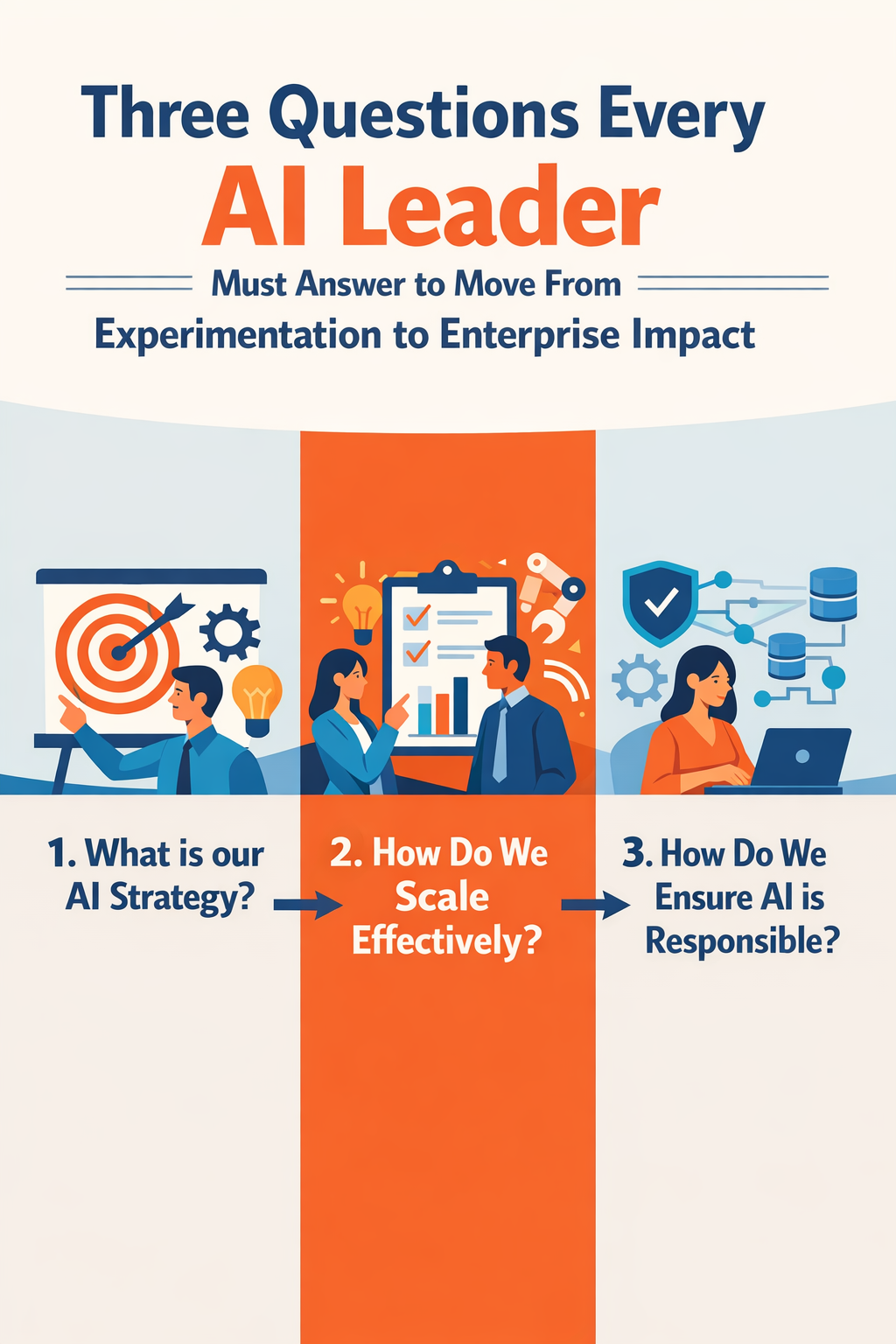
| The Three Questions | 1) Is your data ready for AI? 2) Agentic or generative AI? 3) Are you building tools or transforming the enterprise? |
| Best For | CIOs, CTOs, VP of IT, AI strategy leads, and business leaders evaluating their AI roadmap |
| Bottom Line | The organizations pulling ahead aren't deploying more AI tools — they're building the data foundation, choosing the right AI architecture, and connecting intelligence to execution |
Every week, another enterprise announces a new AI model, another copilot, another assistant, another agent. Nearly 90% of organizations are now using AI in some capacity. And yet, when you ask leaders whether their organizations are actually operating differently — whether decisions are faster, outcomes more autonomous, work models truly reinvented — the honest answer is often a hesitant "no."
The numbers tell the story: only 1% of leaders consider their organizations "mature" in AI deployment. Fewer than 15% of AI decision-makers can tie their AI investments to measurable EBITDA impact. And Gartner predicts that through 2026, organizations will abandon 60% of AI projects that lack AI-ready data foundations.
Question 1: Is Your Data Ready for AI?
Why This Question Matters Right Now
Here's a number that should stop every executive in their tracks: only 7% of enterprises say their data is completely ready for AI adoption.
That finding comes from a 2026 study by Cloudera and Harvard Business Review Analytic Services — and the gap between AI ambition and data reality is only widening. More than one-quarter of organizations (27%) report their data is "not very" or "not at all" ready for AI. Meanwhile, 73% of respondents say their organization should prioritize AI data quality more than it currently does.
What AI-Ready Data Actually Looks Like
AI-ready data isn't just "clean data." It's data that can support AI initiatives without fragility, rework, or downstream risk:
Unified, not siloed. The #1 obstacle to AI data readiness is siloed data and difficulty integrating data sources, cited by 56% of organizations. When your customer data lives in one system, operational data in another, and financial data in a third, AI can't see the full picture.
Governed with clear ownership. 44% of organizations cite a lack of clear data strategy as a top barrier. AI-ready data has documented lineage, clear ownership, and policies that define who can access, modify, and use it.
Quality-assured at the source. Over 90% of AI failures stem from poor data quality — causing hallucinations, bias, model drift, and compliance risks. Quality checks must be embedded at the point of creation, not bolted on after the fact.
Proprietary and business-specific. Generic AI trained on generic data produces generic results. The organizations getting real value are feeding models with proprietary data that reflects their actual business operations and competitive context.
Accessible across environments. Modern enterprises operate across hybrid and multi-cloud environments. AI-ready data can be accessed securely without forcing data movement or compromising control.
The Silent Killer: Invisible Data Quality Failures
Here's what makes data readiness particularly dangerous: the failures are often invisible. An AI agent that drafts communications based on outdated CRM records doesn't throw an error — it sends the wrong message. A predictive model trained on biased data doesn't crash — it systematically makes unfair decisions.
What to Do About It
- Audit your data foundation before your next AI investment — map where critical data lives, who owns it, and how it flows
- Invest in a unified data strategy — only 23% have one, but 53% are actively developing one
- Prioritize data governance as a strategic initiative — protecting sensitive data (59%), data quality (46%), and governance (41%) are the top priorities
- Build your "data moat" — in a world where every competitor has access to the same AI models, your proprietary data becomes your competitive advantage
The bottom line: You can have the most sophisticated AI in the world, but if your data isn't ready, you're building a Formula 1 engine on a bicycle frame. Fix the foundation first.
Question 2: Agentic AI or Generative AI — Where Should You Invest?
The Landscape Has Shifted
If 2024 was the year every organization discovered generative AI, 2025-2026 is the year they had to decide what comes next. The adoption trajectory for agentic AI is steep: 42% of organizations deployed agentic AI by Q3 2025, nearly quadrupling from the previous year. Deloitte forecasts 25% of GenAI enterprises will deploy AI agents in 2025, growing to 50% by 2027. Gartner predicts 40% of enterprise applications will feature task-specific agents by end of 2026.
But here's where leaders stumble: they treat this as an either/or choice when it's actually a sequencing decision.
Core Differences at a Glance
| Dimension | Generative AI | Agentic AI |
|---|---|---|
| Purpose | Creates content — text, images, code, analysis | Executes goals — autonomous multi-step workflows |
| Interaction | Reactive: responds to prompts | Proactive: pursues objectives independently |
| Human Role | Human prompts, AI generates | Human sets goals, AI executes |
| Strength | Speed and creativity at scale | Autonomy and decision-making at scale |
| ROI Timeline | Weeks to months for productivity gains | Months to quarters for operational transformation |
The Decision Framework
Invest in generative AI when:
- You need to accelerate content creation, analysis, or ideation at scale
- Human experts need AI-augmented decision support (not autonomous decisions)
- You're in early AI maturity and need quick, visible productivity wins
- The work is creative, exploratory, or requires nuanced human judgment
Invest in agentic AI when:
- You have well-defined, repeatable multi-step processes that span systems
- Your data foundation is mature enough to support autonomous decision-making
- You need 24/7 execution without human bottlenecks
- You're ready to rethink workflows, not just accelerate existing ones
Use Cases That Clarify the Decision
Sales operations: GenAI drafts personalized outreach and summarizes calls. Agentic AI monitors pipeline, prioritizes accounts, triggers sequences through CRM, and escalates stalled deals — autonomously.
Customer service: GenAI powers chatbots that answer questions. Agentic AI resolves issues end-to-end — identifying the problem, pulling account data, executing a resolution, and updating the case record.
IT operations: GenAI summarizes incident reports. Agentic AI monitors logs, detects anomalies, initiates remediation, and involves humans only for novel situations.
Supply chain: GenAI creates demand forecasts. Agentic AI detects shipping delays, identifies alternative suppliers, drafts negotiation emails, and presents a ready-to-sign contract.
The Governance Reality Check
Agentic AI requires fundamentally different governance: agent identity management, audit trails for autonomous decisions, kill switches and escalation protocols, and multi-agent orchestration oversight. 65% of organizations expect agentic AI to augment or replace many business processes in the next two years — but only a fraction have the governance frameworks to manage it safely.
The bottom line: Don't choose between generative and agentic AI — sequence them. Build generative AI capabilities first, then layer agentic orchestration on top once your data and governance foundations are mature.
Question 3: Are You Building Tools or Transforming the Enterprise?
The Most Expensive Mistake in AI Strategy
Companies deploy AI tools into existing workflows, measure productivity improvements, celebrate early wins, and then hit a ceiling they can't break through. Cycle times don't compress. Operating models don't evolve. You've made individual tasks faster without fundamentally changing how your organization operates.
The Agent Sprawl Problem
Nearly two-thirds of companies remain stuck in isolated AI pilot phases. The pattern: deploy a copilot, celebrate productivity gains, deploy more copilots across departments, hit the ceiling when tools don't share context, and discover you've created agent sprawl — a new form of the same silo problem.
More intelligence + more complexity + no compounding value = expensive fragmentation.
What Enterprise AI Transformation Looks Like
The organizations pulling ahead share four characteristics:
1. Intelligence connects to execution. Most AI stops at the recommendation. Enterprise AI executes work end-to-end — across every system and department. Ask: "Does our AI architecture connect intelligence to execution, or does it stop at recommendation?"
2. Governance is structural, not supervisory. Governance is embedded at the point of execution — not a human reviewer checking outputs. Ask: "Are our AI capabilities governed at the point of action, or are we relying on human review to catch errors?"
3. AI learns your business. Most LLMs are trained on the internet. Enterprise AI needs your context — continuously discovering what exists across your business. Ask: "Are we compounding intelligence over time, or deploying point solutions that plateau?"
4. People are elevated, not replaced. AI eliminates mundane work to free human capacity for creativity, judgment, innovation, and relationship-building. The real opportunity is exponential outcomes that humans and AI create together.
The Platform Decision
The answer to agent sprawl isn't fewer agents — it's a unified platform that connects AI, data, and workflows to governance structures. This is why Salesforce, HubSpot, and other major platforms are investing in AI-native architectures. The competitive advantage isn't the model — it's the platform that gives the model enterprise context and execution authority.
The bottom line: Stop asking "which AI tool should we deploy?" Start asking "are we building the organizational architecture that allows AI to act with confidence, at scale, within the governance structures our business requires?"
The Three-Question Framework: Your Strategic Roadmap
Phase 1: Foundation (Months 1-3) — Answer Question 1
- Conduct a comprehensive data audit across all systems
- Identify and resolve data silos, quality issues, and governance gaps
- Establish clear data ownership and lineage documentation
- Build (or finalize) your AI data strategy
Phase 2: Architecture (Months 3-6) — Answer Question 2
- Deploy generative AI for quick-win productivity gains
- Identify high-value processes suitable for agentic automation
- Build governance frameworks appropriate for each AI type
- Begin pilot programs for agentic workflows
Phase 3: Transformation (Months 6-12) — Answer Question 3
- Evaluate whether AI investments are compounding or plateauing
- Consolidate agent sprawl onto a unified platform
- Redesign workflows around AI capabilities
- Measure transformation metrics: cycle time, operating model evolution, new value creation
How Vantage Point Helps Leaders Answer These Questions
At Vantage Point, we help organizations move from AI experimentation to enterprise impact across both Salesforce and HubSpot ecosystems:
Data Foundation Assessment. We audit your CRM data, integration architecture, and governance practices to identify exactly where your data falls short — and build a practical remediation plan with deep expertise in MuleSoft and Data Cloud.
AI Strategy & Platform Architecture. Whether you're evaluating Salesforce Agentforce, HubSpot Breeze AI, or broader enterprise platforms, we help you sequence investments based on maturity, governance readiness, and business objectives.
Enterprise Transformation. With 150+ clients, 400+ engagements, and a 4.71/5.0 satisfaction rating, our senior-only, US-based team brings the strategic depth to redesign workflows — not just automate them.
Ready to answer the three questions for your organization?
Frequently Asked Questions
What does "AI-ready data" mean in practical terms?
AI-ready data is unified across systems (not siloed), governed with clear ownership and policies, quality-assured at the source, proprietary to your business operations, and accessible across hybrid environments. Only 7% of enterprises currently meet this standard.
Should my organization invest in agentic AI or generative AI first?
Most organizations should start with generative AI for quick productivity wins, then layer agentic AI as their data and governance foundations mature. Agentic AI builds on generative AI — it doesn't replace it. The key is sequencing, not choosing.
What is AI agent sprawl and why is it a problem?
Agent sprawl occurs when organizations deploy multiple disconnected AI agents across departments — each optimizing individual tasks but none sharing context, enforcing consistent policies, or producing compounding intelligence. It creates a new form of the silo problem.
Why do 95% of AI pilots fail to deliver ROI?
The primary reason is architectural, not technical. Companies deploy AI into existing workflows and measure task-level gains, but never fundamentally change how the organization operates. Without connecting intelligence to execution across the enterprise, AI investments plateau.
How long does it take to build an AI-ready data foundation?
A practical program typically takes 1-3 months for assessment and strategy, followed by 3-6 months of active remediation. The timeline depends on data landscape complexity, number of systems, and governance maturity. 53% of organizations are actively developing their AI data strategy now.
What's the difference between deploying AI tools and enterprise AI transformation?
Tool deployment makes tasks faster within existing workflows. Enterprise transformation redesigns workflows around AI, connects intelligence to execution across systems, embeds governance at the point of action, and compounds organizational intelligence over time.
How do I evaluate whether my organization is ready for agentic AI?
Ask three questions: (1) Is your data unified, governed, and quality-assured? (2) Do you have repeatable processes spanning multiple systems? (3) Do you have governance frameworks for autonomous AI decisions — including audit trails, escalation protocols, and agent identity management? If all three are yes, you're ready.
Vantage Point helps businesses move from AI experimentation to enterprise impact. With deep expertise across Salesforce, HubSpot, AI, and integration architecture, our senior consultants help you build the data foundation, choose the right AI architecture, and transform operations.
vantagepoint.io