Key Takeaways (TL;DR)
- Key Insight: 60–75% of custom CRM code becomes technical debt within two years, draining budgets and stalling innovation.
- Why Now: With Salesforce and HubSpot releasing AI-native marketplace solutions at an unprecedented pace, the build vs. buy calculus has fundamentally shifted in 2026.
- Impact: Custom CRM builds carry 40–60% higher total cost of ownership over three years compared to marketplace solutions from AppExchange or HubSpot Marketplace.
- Action Required: Audit your existing customizations now—organizations in regulated industries face 2.4x higher "compliance tax" on custom code.
- Bottom Line: Default to buy for 85% of CRM needs. Build only when you have a genuine competitive moat that no marketplace solution can address.
Introduction: The Customization Trap That's Quietly Draining Your Budget
Every CRM implementation begins with the best of intentions. Your team identifies a gap in out-of-the-box functionality, a developer writes a few lines of custom code, and suddenly you have a solution tailored to your exact needs. Fast-forward two years, and that elegant customization has become a tangled web of dependencies that breaks with every platform update, requires specialized developers to maintain, and costs more annually than the original build.
This is the CRM customization trap—and it's more pervasive than most executives realize.
According to recent industry analysis, 68% of custom CRM projects exceed their original budget by 40% or more due to maintenance costs alone. For organizations in healthcare, financial services, and insurance—where compliance requirements add additional layers of complexity—the financial impact can be even more severe.
At Vantage Point, we've guided over 150 clients through 400+ Salesforce and HubSpot engagements. One pattern we see repeatedly: organizations invest heavily in custom builds when a proven marketplace solution would deliver faster time to value, lower risk, and dramatically reduced total cost of ownership.
In this guide, we'll break down the true costs of CRM customization, provide a practical framework for build vs. buy decisions, and share actionable recommendations—especially for regulated industries where the stakes are highest.
What Are the Hidden Costs of CRM Customization?
When organizations evaluate CRM customization, they typically budget for development hours and initial deployment. But the real costs accumulate silently over time in four key areas:
1. Technical Debt Accumulation
Technical debt—the accumulated cost of shortcuts, outdated code, and deferred refactoring—is the single largest hidden cost of CRM customization.
The numbers are stark:
- 60–75% of CRM customizations become technical debt within two years, requiring significant rework or complete replacement.
- Custom Salesforce organizations require an average of 1,200 developer hours annually for maintenance—2.5x more than standard configurations.
- Custom HubSpot implementations see 1.8x higher maintenance hours compared to marketplace-based solutions.
- Only 25% of custom Apex code survives three years without requiring a major refactor.
Every line of custom code is a future maintenance obligation. As your CRM platform evolves—Salesforce alone releases three major updates per year—custom code must be tested, updated, and sometimes rewritten to remain functional.
2. Upgrade Failure and Downtime
Custom code doesn't just cost money—it costs agility. When Salesforce or HubSpot releases new features, organizations with heavy customizations face a difficult choice: delay the upgrade (missing new capabilities and security patches) or invest significant resources in compatibility testing.
| Metric | Custom Build | Marketplace Solution |
|---|---|---|
| Annual maintenance (% of initial build) | 25–35% | 5–10% |
| Developer hours per year (mid-market) | 1,200 | 300 |
| Upgrade failure rate | 28% | 4% |
| Feature abandonment rate | 45% | 15% |
The 28% upgrade failure rate for custom Salesforce builds is particularly concerning. Each failure means downtime, emergency developer engagement, and potential data integrity issues—all while your competitors continue operating normally.
3. The Compliance Tax
For organizations in regulated industries, custom CRM code carries what analysts call the "compliance tax"—the ongoing cost of validating, auditing, and certifying custom solutions against regulatory frameworks like HIPAA, SOC 2, and PCI-DSS.
Industry research shows organizations in regulated sectors face 2.4x higher compliance validation costs on custom CRM code compared to pre-certified marketplace solutions. This "compliance tax" delays ROI by an average of 14 months.
Here's what this looks like by industry:
Healthcare: - Custom Salesforce Health Cloud builds cost an estimated $750K+ per year extra in compliance overhead for PHI handling. - A significant percentage of custom EHR-CRM integrations accumulate over $1M in debt from HIPAA non-compliance remediation.
Financial Services: - Custom solutions have been shown to increase audit costs by 3x compared to certified marketplace alternatives. - Organizations using uncertified custom code face substantially higher risk of regulatory fines.
Insurance: - Custom HubSpot applications in P&C insurance carry 27% higher TCO from integration debt. - Pre-certified marketplace solutions achieve 92% compliance pass rates versus 71% for custom builds.
4. Opportunity Cost and Innovation Drag
Perhaps the most insidious hidden cost is what your team isn't doing while maintaining custom code. Every hour spent debugging a custom trigger or patching a broken integration is an hour not spent on strategic initiatives, AI adoption, or customer experience improvements.
Industry analysis reveals that customization correlates with 15–20% lower organizational agility scores. In an era where AI-powered CRM capabilities are evolving monthly, that agility deficit compounds rapidly.
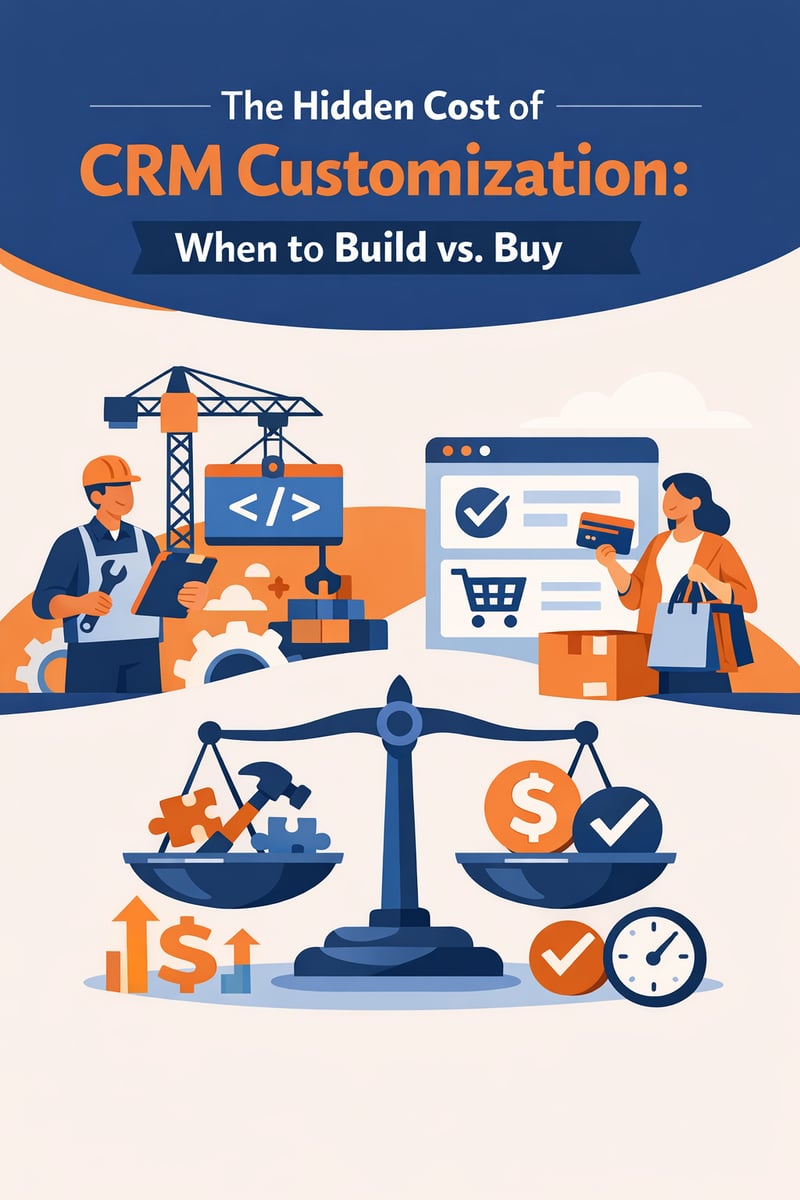
How Does the Total Cost of Ownership Compare: Build vs. Buy?
Let's put concrete numbers to the build vs. buy comparison. The following analysis reflects a typical mid-market organization over a three-year horizon:
Salesforce: Custom Build vs. AppExchange
| Component | Custom Build | AppExchange Solution |
|---|---|---|
| Year 1 (development/implementation) | $400K | $150K |
| Year 2 (maintenance + updates) | $120K | $50K |
| Year 3 (maintenance + tech debt) | $140K+ | $50K |
| Hidden costs (rework, downtime) | $100K+ | Minimal |
| 3-Year Total | $760K+ | $250K |
| TCO Savings | — | ~67% lower |
HubSpot: Custom Build vs. Marketplace
| Component | Custom Build | Marketplace Solution |
|---|---|---|
| Year 1 (development/implementation) | $300K | $120K |
| Year 2 (maintenance + updates) | $90K | $40K |
| Year 3 (maintenance + tech debt) | $100K+ | $40K |
| Hidden costs (rework, downtime) | $75K+ | Minimal |
| 3-Year Total | $565K+ | $200K |
| TCO Savings | — | ~65% lower |
The pattern is consistent: marketplace solutions deliver 40–67% lower TCO while providing faster time to value, built-in compliance certifications, and vendor-managed maintenance.
Research from leading analysts found that AppExchange-heavy Salesforce organizations achieved 25% faster ROI—18 months versus 28 months for custom-heavy deployments. The ROI multiplier for buy decisions was estimated at 2.8x over three years, compared to just 1.4x for custom builds.
When Should You Build Custom CRM Solutions?
Despite the compelling case for marketplace solutions, there are legitimate scenarios where custom development is the right choice. The key is to be disciplined about when building truly adds value.
Build When:
- Proprietary competitive advantage is at stake. If the
customization represents genuine intellectual property that
differentiates you in the market—such as a proprietary risk scoring
algorithm or a unique underwriting workflow—building may be
justified. - No marketplace solution addresses your need. Before
building, thoroughly evaluate at least 3–5 marketplace
alternatives. If none covers more than 70% of your requirement, a
custom build may be warranted. - Ultra-high volume or performance requirements exist.
Organizations processing 1M+ transactions daily may need
custom architecture that marketplace solutions can't support. - You have a dedicated, long-term development team.
Custom solutions require ongoing investment. Without a
committed team, technical debt will accumulate rapidly.
Buy When (the majority of cases):
- The requirement is common across your industry. If other
companies in your vertical need the same functionality, a
marketplace solution likely exists and benefits from economies of
scale. - Compliance certification is required. Pre-certified marketplace
solutions eliminate the compliance tax and reduce audit risk. - Speed to value matters. Marketplace solutions deploy in 1–4
weeks versus 3–12 months for custom builds. - Your budget is under $200K. At this level, custom builds almost
never achieve positive ROI. - You need to integrate with multiple systems. Marketplace
solutions with native APIs and pre-built connectors (like those
leveraging MuleSoft) reduce integration complexity dramatically.The requirement is common across your industry. If other companies in your vertical need the same functionality, a marketplace solution likely exists and benefits from economies of scale.
What Is the Build vs. Buy Decision Framework for Regulated Industries?
For organizations in healthcare, financial services, and insurance, we recommend a structured evaluation that weighs compliance considerations heavily:
Step 1: Compliance Impact Assessment
| Regulation | Marketplace Advantage | Custom Build Risk |
|---|---|---|
| HIPAA | 200+ AppExchange apps with BAA agreements; pre-built audit trails | Full BAA negotiation required; custom audit trail development |
| SOC 2 | 95% of marketplace apps carry Type II certification | Continuous monitoring burden falls on your team |
| PCI-DSS | Tokenized payment apps with scope isolation | Scope expansion risk if handling card data directly |
| State Privacy Laws | Vendor-managed compliance updates | Manual tracking and code updates required |
Step 2: Total Cost Scoring Matrix
Score each criterion on a 1–10 scale. A total score above 70% favoring marketplace solutions should trigger a buy decision:
| Criterion | Weight | Buy Score | Build Score |
|---|---|---|---|
| Time to value | 20% | 1–4 weeks | 3–12 months |
| Compliance readiness | 25% | Pre-certified | Custom audits |
| 3-year TCO | 25% | 40–60% lower | Higher |
| Customization fit | 15% | 80%+ of needs | 100% of needs |
| Maintenance burden | 15% | Vendor-managed | Team-managed |
Step 3: The 90% Rule
Run a three-month proof of concept with your top marketplace candidate. If the marketplace solution covers 90% or more of your requirements, abandon the build. The remaining 10% can typically be addressed through configuration, low-code extensions, or complementary tools.
What Best Practices Should Organizations Follow in 2026?
The CRM landscape is evolving rapidly, and the build vs. buy equation has shifted decisively. Here are our top recommendations:
1. Adopt a "Buy First, Build Surgically" Mindset
Leading analyst firms now recommend marketplace solutions for 85% of CRM customization needs. Reserve custom development for genuine competitive differentiators—typically less than 10% of your total CRM functionality.
2. Embrace Composable CRM Architecture
The most successful organizations in 2026 are using a "buy + low-code extend" model: marketplace solutions for the core, with lightweight extensions using Salesforce Lightning Web Components, HubSpot Operations Hub, or low-code platforms to fill gaps. Industry research shows 60% of top-performing organizations use this hybrid approach.
3. Limit Custom Code to Less Than 10% of Your Org
Best practices from the Salesforce and HubSpot ecosystems consistently recommend keeping custom code below 10% of your total org. Use declarative tools—Salesforce Flow, Einstein AI, HubSpot Workflows—wherever possible.
4. Audit Existing Technical Debt Quarterly
Use platform-native tools like Salesforce Optimizer or HubSpot's Health Score to identify and prioritize technical debt. Many organizations discover that 40–50% of their custom code can be replaced with marketplace solutions that didn't exist when the original customization was built.
5. Factor in the AI Revolution
With AI capabilities being embedded directly into Salesforce (Einstein) and HubSpot (Breeze AI) at an accelerating pace, custom code risks conflicting with AI-native platform features. Marketplace solutions are more likely to stay aligned with platform AI roadmaps, ensuring your organization can adopt new capabilities as they emerge.
6. Prioritize Compliance-First Solutions
For regulated industries, the cost of non-compliance far outweighs any savings from custom development. Always evaluate marketplace solutions' compliance certifications before even considering a custom build. Look for BAA agreements, SOC 2 Type II reports, and PCI-DSS attestations.
Frequently Asked Questions
What percentage of CRM customizations become technical debt?
Research consistently shows that 60–75% of CRM customizations become technical debt within two years. This means the code requires significant rework, refactoring, or replacement to remain functional and compatible with platform updates. Only about 25% of custom Apex code in Salesforce survives three years without a major refactor.
How much more does custom CRM development cost compared to marketplace solutions?
Over a three-year period, custom CRM builds typically have 40–67% higher total cost of ownership than equivalent marketplace solutions. The gap widens in regulated industries where compliance validation adds significant ongoing costs. A custom Salesforce solution averaging $760K+ over three years might cost only $250K using AppExchange alternatives.
When is it worth building a custom CRM solution instead of buying?
Custom development is justified in fewer than 10–15% of cases—specifically when the customization represents proprietary intellectual property, no marketplace solution covers more than 70% of requirements, or you have ultra-high-volume needs exceeding 1M+ daily transactions. Always run a proof of concept with marketplace alternatives before committing to a custom build.
How do compliance requirements affect the build vs. buy decision?
Compliance requirements strongly favor buying. Pre-certified marketplace solutions on AppExchange and HubSpot Marketplace eliminate the "compliance tax"—the ongoing cost of custom code validation against frameworks like HIPAA, SOC 2, and PCI-DSS. Organizations in regulated industries face 2.4x higher compliance validation costs on custom code, and pre-certified solutions achieve 92% compliance pass rates versus 71% for custom builds.
What is the recommended ratio of custom code to marketplace solutions?
Industry best practices recommend keeping custom code to less than 10% of your total CRM organization. Use declarative tools (Salesforce Flow, HubSpot Workflows) and marketplace solutions for the remaining 90%+. The most successful organizations adopt a "buy + low-code extend" model where marketplace apps provide core functionality and lightweight custom extensions fill specific gaps.
How can organizations reduce existing CRM technical debt?
Start with a quarterly audit using platform-native tools like Salesforce Optimizer or HubSpot's Health Score. Prioritize replacing custom code with marketplace alternatives, especially for non-differentiating functionality. Many organizations find that 40–50% of their custom code can now be replaced with solutions that didn't exist when the original customization was built. Consider engaging a Salesforce or HubSpot partner experienced in technical debt remediation to accelerate the process.
What role does AI play in the build vs. buy decision in 2026?
AI has shifted the balance further toward buying. Both Salesforce (Einstein) and HubSpot (Breeze AI) are embedding AI capabilities directly into their platforms and marketplace ecosystems. Custom code risks conflicting with AI-native platform features, while marketplace solutions stay aligned with vendor AI roadmaps. Organizations with heavy customizations report 15–20% lower agility in adopting new AI capabilities.
Conclusion: The Strategic Imperative to Rethink Customization
The evidence is clear: the era of "build everything custom" is over. In 2026, with AI-native marketplace solutions maturing rapidly, the organizations that thrive will be those that invest in configuration over customization, leverage marketplace ecosystems strategically, and reserve custom development for genuine competitive differentiators.
For regulated industries, the stakes are even higher. The compliance tax on custom code, combined with accelerating technical debt, creates a compounding cost that erodes ROI year after year.
The good news? It's never too late to course-correct. Whether you're evaluating a new CRM capability or looking to reduce technical debt in your existing org, the build vs. buy framework outlined here provides a clear path forward.
The question isn't whether you can afford to buy—it's whether you can afford not to.
Ready to audit your CRM technical debt and optimize your build vs. buy strategy? Contact Vantage Point to schedule a complimentary CRM health assessment. With 150+ clients and 400+ engagements across Salesforce and HubSpot, we help regulated industries maximize CRM ROI while maintaining compliance.
Visit us at vantagepoint.io to learn more about our Salesforce, HubSpot, MuleSoft integration, and AI personalization services.