Apollo Inside HubSpot's AI Prospecting Agent: What Revenue Teams Need to Know in 2026
TL;DR — Key Takeaways
- What is it? HubSpot's AI Prospecting Agent (public beta as of April 14, 2026) is an autonomous Breeze agent that monitors target accounts for buying signals — funding, leadership changes, hiring activity — and surfaces in-market companies with AI-generated context. Apollo is one of three embedded data providers powering automatic contact enrichment inside that workflow.
- Key benefit: When the agent identifies an in-market account and your CRM is missing the right buying-committee contacts, Apollo data fills the gap automatically — no tab-switching, no manual enrichment, no broken handoffs between tools.
- Cost/Investment: Apollo credits are consumed per enrichment trigger, consistent with other Apollo API integrations. HubSpot Prospecting Agent usage is metered through Breeze credits. Customers connect Apollo via Settings → Integrations inside the Prospecting Agent.
- Best For: HubSpot Sales Hub and Service Hub customers running outbound or hybrid GTM motions, especially teams that already use Apollo as a contact and intent foundation.
- Bottom Line: This is a product-level validation of Apollo as a default GTM data layer for HubSpot — and a meaningful step in HubSpot's move from rules-based automation to autonomous, agentic selling.
What Is HubSpot's AI Prospecting Agent and Why Does the Apollo Integration Matter?
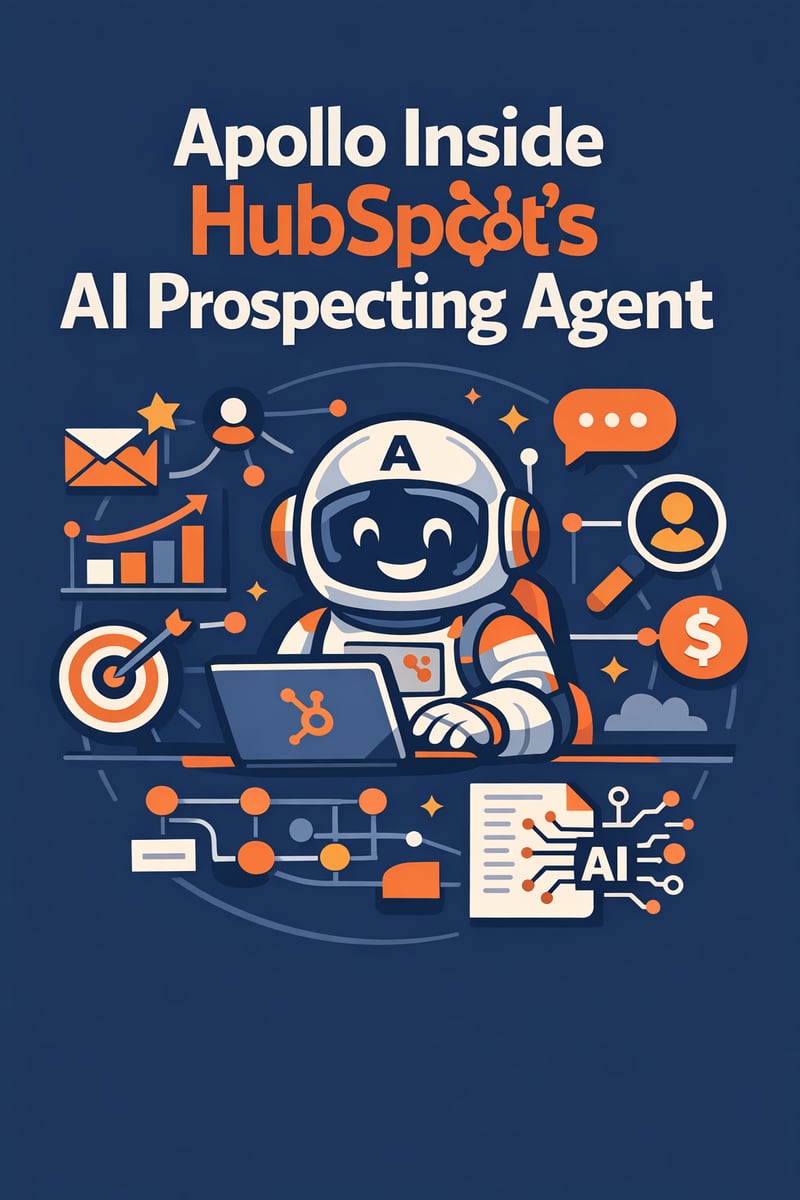
HubSpot's AI Prospecting Agent is part of the Breeze agent suite. It runs autonomously against your target account list, watches for buying signals in the market, and surfaces accounts that look ready to engage now — with reasoning a rep can act on immediately.
The challenge with every autonomous prospecting workflow is the same: the agent is only as effective as the contact data it has to work with. If the CRM doesn't have the right decision-makers at an in-market account, the rep gets a signal and no path to act on it.
That gap is what the embedded Apollo integration closes. When the Prospecting Agent identifies an in-market company and the buying committee is missing or thin in HubSpot, Apollo data is pulled directly into the workflow to enrich contacts. The rep sees a complete buying committee inside HubSpot without leaving the platform.
For revenue teams that already use Apollo, this changes Apollo's role from a stand-alone prospecting tool to an embedded part of HubSpot's core AI selling motion.
How Does the Apollo Integration with the HubSpot Prospecting Agent Work?
The flow is built to be invisible to the rep:
- Signal monitoring. The Prospecting Agent watches your defined ideal customer profile and target account list for triggering events — funding rounds, leadership changes, hiring spikes, product launches, technographic shifts, and other intent signals.
- In-market account surfacing. When an account crosses a threshold, the agent surfaces it to the assigned rep with AI-generated context on why this account is worth reaching out to right now.
- Contact gap detection. The agent checks whether your CRM has the right buying-committee roles for that account.
- Automatic Apollo enrichment. Where contacts are missing, Apollo data is pulled into HubSpot to populate the committee — with verified emails, roles, and the structured fields you'd expect on a HubSpot contact record.
- Rep action inside HubSpot. The rep sees the account, the rationale, and the people, then engages from HubSpot — sequences, calls, tasks, or handoffs to other agents.
Apollo is one of three embedded data providers HubSpot is using for the public beta. Apollo credits are consumed per enrichment trigger, which matches how every other Apollo API integration is metered.
Why Did HubSpot Embed Apollo Specifically?
This is the part of the announcement that signals more than a feature release. Embedding Apollo into the core prospecting flow — rather than offering it as an add-on data source in a marketplace — is a product-level statement that Apollo's B2B data, contact coverage, and intent signals are good enough to back HubSpot's flagship AI selling agent.
For HubSpot customers, the practical reading is straightforward: Apollo is no longer just one of many enrichment options. It's a default layer inside the agent experience that HubSpot is positioning as the future of outbound and account-based motion.
For RevOps and GTM leaders evaluating a data provider stack, that's a meaningful procurement signal. It's also a moment to revisit how Apollo is licensed, how credits are budgeted, and how the integration is governed at the account level.
What Do Admins Need to Do to Turn On the Apollo + Prospecting Agent Integration?
For HubSpot portals where the AI Prospecting Agent beta is enabled, here's the admin checklist:
- Verify Prospecting Agent beta access. Confirm Breeze is enabled in your portal and that the Prospecting Agent is available in your instance. Some HubSpot portals will see this earlier than others as the beta rolls out.
- Inventory Apollo licensing. Confirm seat counts, credit pools, and renewal timing for Apollo. The embedded integration consumes credits the same way the existing API does, so projected usage needs to be modeled before turn-on.
- Connect Apollo as a data provider. Inside the Prospecting Agent, go to Settings → Integrations and connect your Apollo account. Use a service account where possible so credentials don't follow individual employee changes.
- Define the target account list and ICP. The Prospecting Agent needs an explicit definition of who you sell to. Tighten the ICP before turning the agent loose, or the signal-to-noise ratio will be poor.
- Map enrichment governance. Decide which roles or seniority levels are allowed to trigger enrichment, which contact properties Apollo is permitted to write or overwrite, and where Apollo-sourced records should be flagged for downstream reporting.
- Configure handoffs. Decide what happens after the agent enriches a contact and surfaces an account — does it route to a sequence, a task, a SDR queue, or another Breeze agent? Without a handoff plan, signals get surfaced and nothing happens.
- Set credit alerts. Stand up usage alerts in both HubSpot and Apollo so you can see consumption before you blow through a credit pool mid-quarter.
- Brief the reps. This changes what reps see in the Prospecting workspace. Spend ten minutes showing them what the agent is doing on their behalf, where Apollo-sourced contacts show up, and how to give feedback on bad accounts.
How Should RevOps Leaders Think About Apollo Credit Consumption Inside HubSpot?
Embedded enrichment will materially change Apollo usage patterns for most customers. A few rules of thumb:
- Expect a baseline lift in credit burn. The Prospecting Agent will trigger enrichment on accounts that reps would never have manually researched. That is the point — but it also means more credits consumed per active rep per week.
- Cap enrichment depth per account. It's easy to over-enrich an account with twelve contacts when you really need three. Set governance rules that limit how many contacts per account the agent can pull.
- Track Apollo-sourced pipeline. Tag contacts and companies sourced through the embedded integration so finance can connect Apollo spend to sourced and influenced pipeline. This is the single most important reporting habit to put in place at turn-on.
- Coordinate with marketing. If marketing is also enriching from Apollo through a separate workflow, you'll double-pay for the same contact unless you deduplicate at the integration layer.
What Are the Risks and How Do You Mitigate Them?
The integration is powerful, but a few risks to plan around:
- Stale or incorrect contact data. Any third-party enrichment can introduce records that don't match your reps' ground-truth knowledge. Build a feedback loop so reps can flag bad data and the agent learns over time.
- Compliance exposure. Make sure Apollo data flowing into HubSpot is compatible with your data subject rights program, consent records, and any regional restrictions on prospecting outreach.
- Agent fatigue. If the Prospecting Agent surfaces too many accounts or the rationale is generic, reps will tune it out. Constrain the ICP definition and signal thresholds tightly at launch and loosen over time.
- Credit overspend. Without alerting and per-rep caps, embedded enrichment can burn a quarter of Apollo credits in a few weeks. Build the guardrails before the agent runs at full bore.
Where Does This Fit in the Broader Move to Agentic Selling?
The Apollo integration is one example of a larger pattern. HubSpot's agent platform — and the equivalent moves from Salesforce, Microsoft, and the AI-native players — is reshaping the GTM stack into three layers:
- The system of record (HubSpot CRM).
- The system of intelligence (Breeze agents, including the Prospecting Agent).
- Embedded data and tooling providers (Apollo, calling platforms, enrichment, signal providers) that feed the agents directly.
Customers that historically thought of their RevOps stack as a long list of point tools should expect that list to compress sharply. The tools that win embedded placement inside the agent layer will get used more. The ones that don't will get used less.
If you're scoping a HubSpot Prospecting Agent rollout right now, the practical implication is to treat Apollo as part of the same procurement and design conversation, not as a separate workstream to figure out later.
Frequently Asked Questions
Is the HubSpot AI Prospecting Agent generally available? As of April 14, 2026, the Prospecting Agent is in public beta. Roll-out varies by portal and product tier.
Do I have to use Apollo to use the Prospecting Agent? No. Apollo is one of three embedded data providers HubSpot has selected for the beta. You can run the agent without an Apollo connection, but contact enrichment coverage will depend on whichever providers you have connected.
Will the integration overwrite existing contact data in HubSpot? That depends on your enrichment governance settings. Configure which properties Apollo is allowed to write or overwrite before enabling the integration.
How are Apollo credits consumed inside the agent? Credits are consumed per enrichment trigger, consistent with how Apollo's existing API integrations work. Set up usage alerts in both platforms before you turn it on.
Can I limit which reps the agent runs on behalf of? Yes — you can scope the Prospecting Agent to specific teams, territories, or pods. Most customers should pilot with a single team before broadening access.
How is this different from the existing Apollo + HubSpot integration? The classic Apollo + HubSpot integration is rep-initiated. The Prospecting Agent integration is agent-initiated: the agent decides when to enrich and which accounts to surface. The data path is the same, but the workflow is autonomous instead of manual.
Does this replace SDRs? No. It changes what SDRs spend time on. The agent handles signal monitoring and contact discovery; SDRs focus on quality outbound, multi-thread engagement, and account development.
What's the fastest way to pilot this? Pick a tight ICP, one rep team, a defined credit budget, and a two-week observation window. Measure surfaced accounts, accepted accounts, enriched contacts, replies, and sourced pipeline. Adjust ICP and thresholds before broadening.
How Vantage Point Helps HubSpot and Apollo Customers Operationalize Agentic Prospecting
Vantage Point is a senior-led, AI-augmented HubSpot and Salesforce consultancy. We help revenue teams turn agent features like the HubSpot Prospecting Agent into measurable pipeline — not just enabled toggles. Typical engagements include:
- ICP refinement and target account list construction for agent-driven prospecting.
- Apollo + HubSpot architecture, governance, and credit budgeting.
- Breeze agent design, handoff orchestration, and rep enablement.
- Reporting and attribution so leadership can see Apollo- and agent-sourced pipeline cleanly.
If you're rolling out the HubSpot AI Prospecting Agent and want a partner who has done the work across both the agent layer and the data layer, reach out for a complimentary scoping conversation.
Sources: HubSpot AI Prospecting Agent public beta announcement (April 14, 2026); Apollo partner communications confirming embedded data provider status; Vantage Point engagement experience with HubSpot Sales Hub and Apollo customers.