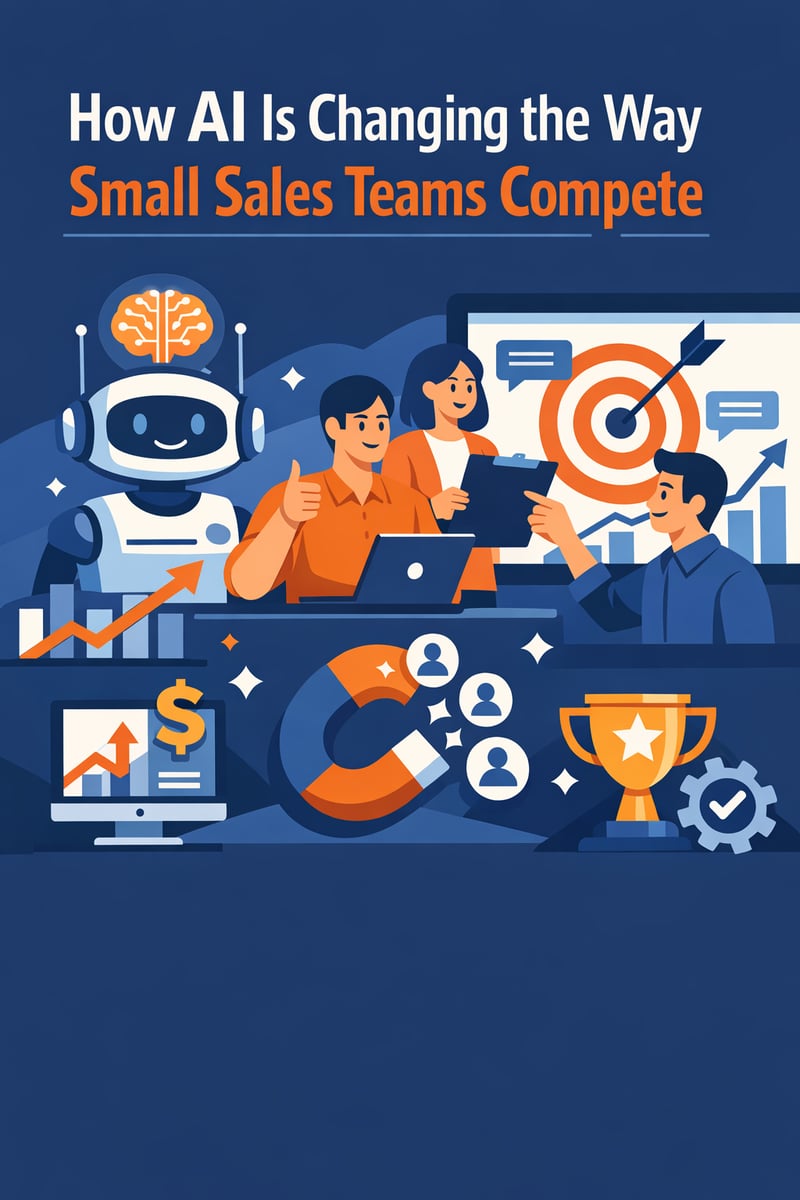
How AI Is Changing the Way Small Sales Teams Compete
By David Cockrum, Founder & CEO, Vantage Point
TL;DR / Key Takeaways
| What is it? | AI-powered sales tools that give small teams enterprise-grade capabilities — deal scoring, autonomous prospecting, and dynamic sequences — at mid-market budgets |
| Key Benefit | Teams using AI sales tools are 3.7x more likely to hit quota and save 2+ hours per rep per day on admin work |
| Cost / Investment | $15–50/user/month for core AI sales tools; full stack $2,500–$8,000/month for a 10–20 person team |
| Best For | Small and mid-size sales teams (5–50 reps) competing against larger organizations with bigger budgets |
| Bottom Line | The AI sales playing field has been leveled. The question isn't whether your team can afford AI — it's whether you can afford to compete without it |
The 75% Problem Every Small Sales Team Faces
Here's a number that should make every sales leader uncomfortable: salespeople spend only 25% of their working hours actually selling.
The remaining 75% disappears into CRM updates, proposal prep, prospect research, email management, scheduling, and reporting — administrative tasks that generate zero direct revenue.
For enterprise teams with 200+ reps, that inefficiency is absorbed by scale. For a small team of 5–15 salespeople? That 75% tax is the difference between hitting quota and missing it.
This is the fundamental problem AI sales tools solve — and they're solving it in ways that would have been science fiction five years ago.
What AI Sales Tools Actually Do (Beyond the Hype)
Let's cut through the marketing buzzwords. AI sales tools fall into three categories that matter, ranked by impact:
1. Predictive Deal Scoring: Know Who to Call First
Traditional lead management is either gut-feel-based ("I think this one's hot") or simplistic scoring (opened an email = 10 points). Both approaches waste time on low-probability prospects while hot opportunities cool off in the queue.
AI deal scoring analyzes hundreds of signals simultaneously: - Website behavior and page-level engagement patterns - Email open velocity and content interaction depth - Company growth trajectory and recent organizational changes - Technology stack signals and integration readiness - Third-party intent data from research behavior across the web
The result is a dynamic score that updates in real time, telling your reps exactly who to contact today — not who to eventually get around to.
The impact is measurable: - 20–30% improvement in conversion rates - Significant reduction in time wasted on low-probability leads - Reps spending their highest-energy hours on the highest-value prospects
2. AI Prospecting Agents: Your Always-On Research Team
This is where the game has fundamentally changed for small teams.
Platforms like HubSpot's Breeze Prospecting Agent don't just automate email sends. They autonomously: - Research qualified prospects across multiple data sources - Monitor buying intent signals in real time - Craft personalized outreach that references what actually changed in the prospect's world - Adapt follow-up sequences based on engagement patterns
What this means for a 10-person team: You now have prospecting capacity that previously required a dedicated SDR team of 3–5 people. The AI handles the research, qualification, and initial outreach. Your reps step in when a human conversation adds value.
HubSpot's Breeze suite specifically targets this use case: - Buyer Intent Identification — tracks which companies are actively researching your solutions - Lead Capture & Qualification — converts website visitors into qualified meetings 24/7 - Data Enrichment — fills CRM gaps automatically with complete contact and company details - Personalized Outreach at Scale — generates tailored messages without proportional time investment
3. Conversation Intelligence: Learn From Every Call
Every sales conversation contains data that used to be partially remembered, inconsistently logged, and never systematized.
AI conversation intelligence platforms now: - Transcribe and analyze every call automatically - Identify patterns across hundreds of conversations - Flag which questions top closers ask that average performers skip - Detect competitor mentions that correlate with deal losses - Provide data-driven coaching instead of impressionistic feedback
The coaching revolution: Instead of "you need to ask better discovery questions," a sales manager can now say: "In your last 15 calls, you averaged 7 minutes on discovery. Our top closers average 18 minutes. The specific question types that differ are X, Y, and Z."
New hire ramp time drops from 6–9 months to 3–4 months. That alone can be worth the entire AI investment for growing teams.
The Numbers That Changed Everything
The data on AI sales adoption has reached a tipping point. This isn't early-adopter territory anymore — it's table stakes:
| Metric | Stat | Source |
|---|---|---|
| AI users hitting quota | 3.7x more likely | Gartner |
| First-year positive ROI | 86% of teams | Sopro |
| Daily exceeding targets | 2x more likely (with daily AI use) | LinkedIn 2025 |
| Time saved per rep per day | 2 hours 15 minutes | Industry research |
| AI-personalized response rates | 15–25% (vs. 3–5% generic) | Sopro |
| Revenue boost from AI | 5–15% increase | McKinsey |
| Forecast accuracy improvement | 51% → 79% | Industry benchmarks |
| Prospecting research by AI (by 2027) | 95% | Gartner projection |
That last number deserves emphasis: Gartner projects that 95% of seller research will be AI-driven by 2027. Teams that aren't building this capability now will face a steep adoption curve when it becomes standard.
How HubSpot Sales Hub AI Levels the Playing Field
If your team is on HubSpot (or considering it), the Breeze AI platform has evolved dramatically. Here's what's actually available today:
Breeze Copilot
An AI assistant with full CRM context. It doesn't just answer generic questions — it answers questions about your pipeline, your prospects, your deals.
- "What deals are at risk this quarter?" → Analyzed from real engagement data
- "Draft a follow-up for [prospect]" → Personalized based on conversation history
- "What happened in my pipeline while I was on PTO?" → Complete summary
Breeze Prospecting Agent
The autonomous prospecting engine that: - Researches and identifies qualified prospects matching your ICP - Monitors for buying signals across your website and content - Generates personalized outreach sequences - Adapts messaging based on engagement patterns - Routes qualified meetings directly to the right rep
Breeze Customer Agent
24/7 lead qualification that: - Engages website visitors in real time - Qualifies against your specific criteria - Books meetings with the right rep while interest is high - Handles multiple conversations simultaneously
Predictive Lead Scoring
AI-powered scoring that: - Analyzes behavioral patterns across your entire contact database - Dynamically updates scores based on real-time engagement - Prioritizes leads for sales follow-up based on conversion probability - Learns and improves over time from your team's actual win/loss data
The key differentiator for small teams: These capabilities are included in Sales Hub tiers that mid-market companies are already paying for. No separate AI license, no enterprise-only add-on, no six-figure implementation project.
The Salesforce Einstein Alternative
For teams on the Salesforce platform, Einstein provides the parallel capability set:
- Predictive Analytics — deal scoring and forecasting based on pipeline signals
- Guided Selling — AI-recommended next actions for each opportunity
- Conversation Intelligence — automated call transcription and coaching insights
- Einstein Copilot — natural language CRM interaction and task automation
Einstein's strength is depth within the Salesforce ecosystem. If your team runs Sales Cloud, the AI capabilities are natively integrated with your existing data model — no middleware, no data syncing, no integration headaches.
Your 30-Day AI Sales Activation Plan
Don't try to transform everything at once. Here's the phased approach that actually works:
Week 1–2: The Honest Audit
Before you touch any AI tool, answer three questions: 1. Where do your reps spend their non-selling time? (Track for one week — the answers will surprise you) 2. What's your current conversion rate at each pipeline stage? (This is your baseline) 3. Where do deals die? (The stage with the highest drop-off is your highest-impact AI intervention point)
Week 3: Targeted Activation
Pick one AI capability to activate — the one that addresses your #1 friction point: - Too much time on admin? → Activate CRM automation (auto-logging, auto-tasks) - Not enough qualified pipeline? → Activate AI prospecting agent - Deals stalling mid-pipeline? → Activate predictive scoring + conversation intelligence - Forecast accuracy terrible? → Activate AI forecasting
Week 4: Measure and Expand
After one week of focused use: - Compare activity metrics to your Week 1 baseline - Identify what's working and what needs adjustment - Add a second AI capability based on results - Set your 60-day performance target
The 90-Day Milestone
At 90 days, you should see: - 25–30% reduction in time spent on administrative tasks - 15–25% improvement in stage conversion rates - Measurable improvement in forecast accuracy - A clear ROI picture for scaling to the full team
The Five Failure Modes to Avoid
We've guided hundreds of teams through CRM implementations. The AI sales failures we see follow predictable patterns:
1. Tool Before Process Buying AI before defining what you're solving is the #1 cause of disappointment. The tools work. The use case wasn't clear enough.
2. Big Bang Deployment Rolling out five AI tools to 30 reps on the same Monday creates chaos. Pilot with 3–5 reps, one tool, for 30 days. Scale after.
3. Ignoring Adoption If reps perceive AI as surveillance, they'll find workarounds. Frame it as "giving you back 2 hours a day" not "tracking your performance."
4. Wrong Metrics Measuring emails sent instead of deals closed. AI can inflate activity metrics without improving results. Measure outcomes.
5. Dirty CRM Data AI trained on garbage data produces garbage scores. Clean your CRM before activating AI scoring. 70%+ field completeness on key records is the minimum threshold.
What AI Can't Replace (And Shouldn't Try To)
Let's be honest about the limitations:
- AI can't replace relationship quality. Complex deals are won on trust, credibility, and human judgment. AI gets you to the conversation faster and better prepared — but the conversation is still yours.
- AI can't fix a weak value proposition. Better targeting just means you'll hear "no" faster from better-qualified prospects.
- AI can't compensate for broken culture. If your team rewards gaming metrics over genuine customer value, AI will just game metrics more efficiently.
The best salespeople using AI share a consistent pattern: they automate everything that isn't the relationship, then bring maximum human value to the relationship itself.
The Competitive Window Is Closing
Here's the strategic reality: AI sales tools are moving from competitive advantage to table stakes.
- Companies implementing effectively now capture the performance premium while competitors catch up
- They build organizational competence that compounds — teams that learn AI tools today will use next-generation tools more effectively than those starting from scratch
- Gartner projects that by 2028, AI agents will outnumber human sellers 10:1 across B2B organizations
The window where "having AI" is a differentiator is approximately 18–24 months. After that, not having it is simply a liability.
For small teams, this is actually good news. You can implement faster than enterprise organizations. No 12-month procurement cycles, no committee approvals, no legacy system constraints. A 10-person sales team can be fully AI-augmented within 90 days.
The question isn't whether your team can afford AI sales tools. It's whether you can afford to let larger competitors outwork you while your reps spend 75% of their day not selling.
See These AI Sales Tools in Action
Want to see exactly how HubSpot's Breeze AI transforms a small sales team's daily workflow?
Join us for a live demo and strategy session:
🎯 HubSpot + Vantage Point: Sell Smarter, Market Better, Activate AI
📅 Tuesday, April 21, 2026 | 10:00–11:00 AM EDT 🎤 David Cockrum (Vantage Point, Founder & CEO) + Stasia Kovtunenko (HubSpot)
What you'll see live: - HubSpot Sales Hub AI features in action — deal scoring, prospecting agents, dynamic sequences - Real workflows a small team can activate in week one - The specific AI features that deliver the fastest ROI - Live Q&A with a HubSpot platform expert
Free bonus for attendees: - ✅ AI Readiness Checklist - ✅ Free 60-minute strategy consultation with a written 90-day AI roadmap
Limited seats. Sales leaders, RevOps managers, and CRM administrators will get the most value from this session.
Frequently Asked Questions
What are the best AI sales tools for small teams in 2026?
The most impactful AI sales tools for small teams (5–50 reps) in 2026 include HubSpot Breeze AI for integrated CRM intelligence, Salesforce Einstein for teams on Sales Cloud, Gong for conversation intelligence, and Apollo.io for AI-powered prospecting. The best choice depends on your existing CRM platform and primary friction point. Teams on HubSpot should start with Breeze's built-in capabilities before adding specialized tools.
How much do AI sales tools cost for a mid-size team?
For a 10–20 person sales team, core AI sales tools cost $15–50 per user per month for individual capabilities. A full AI sales stack including conversation intelligence, lead scoring, and outreach automation typically runs $2,500–$8,000 per month in licensing, plus $15,000–$40,000 in Year 1 implementation and training costs. Many platforms like HubSpot include AI features in existing subscription tiers.
What ROI can small sales teams expect from AI tools?
Research shows 86% of sales teams using AI report positive ROI within their first year. Typical results include 20–30% improvement in conversion rates, 2+ hours saved per rep per day on administrative tasks, 15–25% response rates on AI-personalized outreach (vs. 3–5% generic), and 5–15% revenue increases. Teams using AI tools are 3.7x more likely to hit their quota according to Gartner.
How does HubSpot Breeze AI compare to Salesforce Einstein for sales?
Both platforms provide strong AI sales capabilities but serve different segments. HubSpot Breeze AI excels for mid-market teams wanting an all-in-one platform with AI included in existing tiers — no separate AI license needed. Salesforce Einstein is better for teams already invested in Sales Cloud who need deep native integration with complex Salesforce configurations. Choose based on your current CRM platform, team size, and implementation resources.
Can AI really replace SDRs for small sales teams?
AI doesn't replace SDRs — it replicates the prospecting capacity of 3–5 SDRs for a fraction of the cost. AI prospecting agents handle research, qualification, and initial outreach autonomously. Human reps step in when conversations require relationship building, complex problem solving, or creative deal structuring. For small teams that can't afford a dedicated SDR function, AI prospecting is transformative.
How long does it take to implement AI sales tools?
A focused implementation takes 30 days for initial activation and 90 days for full optimization. Week 1–2 is process audit and baseline measurement. Week 3 is targeted activation of your highest-impact AI capability. Week 4+ is measurement, optimization, and expansion to additional capabilities. Avoid "big bang" deployments of multiple tools simultaneously — the #1 failure mode in AI sales implementation.
What CRM data quality is needed before activating AI sales tools?
Minimum threshold: 70%+ field completeness on key contact and company records (company size, industry, role, email). You also need at least 12 months of historical conversion data for AI scoring models to calibrate effectively. Clean duplicate contacts, remove invalid emails, and ensure consistent pipeline stage definitions before activating AI. Dirty data produces inaccurate AI scores and unreliable forecasts.
About Vantage Point
Vantage Point is a Salesforce and HubSpot consulting firm that helps businesses implement, optimize, and integrate their CRM platforms. With 150+ clients and 400+ successful engagements, our senior-only team specializes in making technology work for growing sales teams — whether that's CRM configuration, AI activation, or building the integrations that connect your entire revenue engine.
Ready to see what AI can do for your sales team? Contact us for a free consultation →