Key Takeaways (TL;DR)
- What is it? A security-by-design methodology for implementing Salesforce, HubSpot, and integrated CRM solutions that meet regulatory requirements from day one
- Key Benefit: Avoid costly post-implementation remediations and audit failures by embedding compliance into your CRM architecture upfront
- Regulations Covered: SEC, FINRA, HIPAA, GDPR, CCPA, SOX, NAIC, and state privacy laws
- Timeline: 3-6 months for compliant CRM implementations vs. 6-12+ months for remediation-heavy projects
- Best For: Financial services firms, healthcare organizations, insurance companies, and any business handling sensitive customer data
- Bottom Line: Organizations that build compliance into CRM foundations reduce audit failures by 80% and avoid six-figure remediation costs
Introduction: Why Security Can't Be an Afterthought
For organizations in regulated industries—whether you're managing client portfolios, patient records, or policyholder information—your CRM isn't just a sales tool. It's a repository of sensitive data that regulators scrutinize, auditors examine, and bad actors target.
Yet we consistently see organizations treat compliance as a checkbox exercise, bolted on after their CRM is already live. The result? Expensive remediations, failed audits, and—in worst cases—headline-making data breaches that erode client trust.
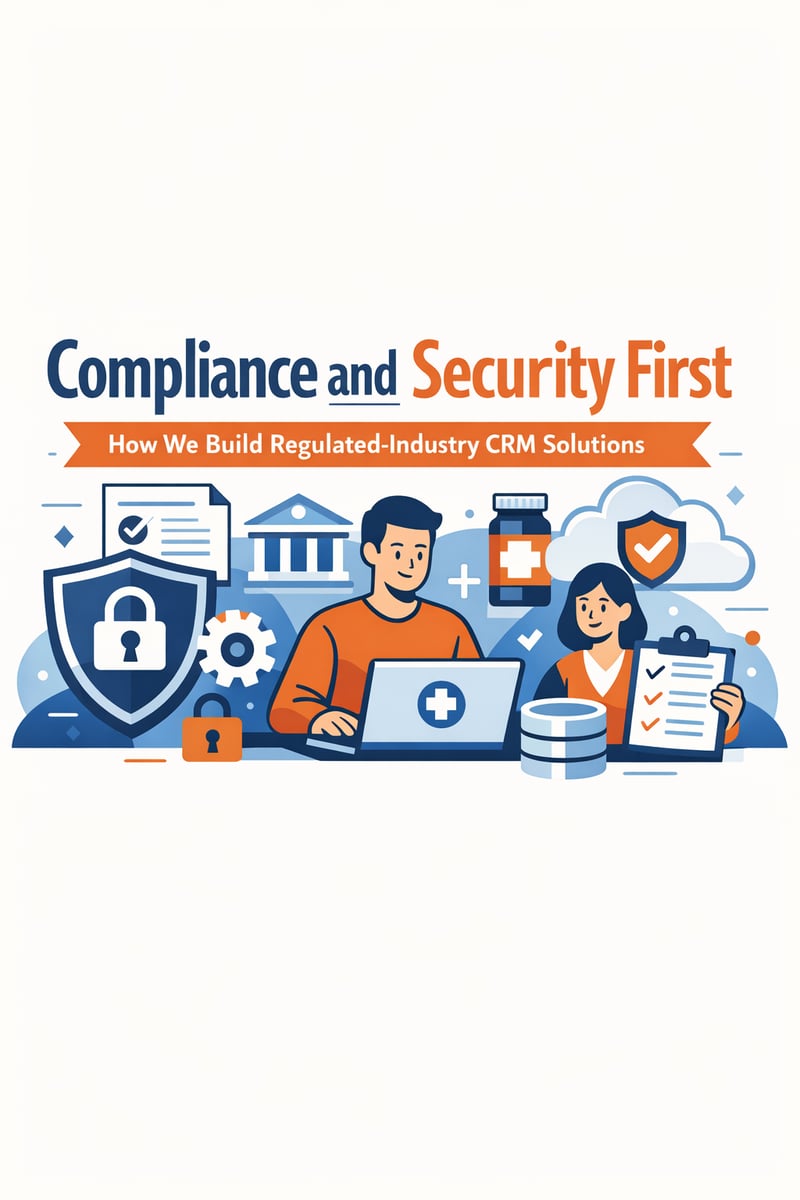
At Vantage Point, we take a fundamentally different approach. Compliance and security aren't features we add later—they're the foundation we build everything upon.
In this guide, we'll show you exactly how we architect CRM solutions for regulated industries, the specific controls we implement, and why this approach delivers better outcomes for financial services firms, healthcare organizations, insurance companies, and beyond.
The Real Cost of Compliance Failures in CRM
Before diving into our methodology, let's be clear about what's at stake. Regulatory penalties have reached historic levels:
| Regulation | Maximum Penalty | Recent High-Profile Fine |
|---|---|---|
| HIPAA | $1.9M per violation category | $4.75M (2024 settlement) |
| GDPR | €20M or 4% of global revenue | €1.2B (Meta, 2023) |
| SEC | No statutory maximum | $400M+ (multiple 2024 cases) |
| FINRA | No cap | $70M (recordkeeping failures, 2024) |
Beyond fines, consider the operational impact:
- 42% of organizations experiencing compliance failures report significant customer churn
- Average remediation costs exceed $150,000 for mid-market firms
- Audit preparation consumes 3x more resources for non-compliant systems
The message is clear: investing in compliance-first architecture costs a fraction of fixing problems later.
Our Five-Pillar Compliance Framework
When we implement Salesforce Financial Services Cloud, HubSpot CRM, or custom integrated solutions for regulated industries, we follow a structured framework that ensures compliance from day one.
Pillar 1: Regulatory Mapping Before Configuration
Every engagement begins with comprehensive regulatory mapping—not generic best practices, but specific requirements for your industry, jurisdiction, and business model.
What this looks like in practice:
- Financial Services: We document SEC Rule 17a-4, FINRA 3110, DOL fiduciary requirements, and applicable state regulations before touching Salesforce
- Healthcare: HIPAA Privacy and Security Rules, HITECH Act requirements, and state-specific patient privacy laws guide every HubSpot configuration
- Insurance: NAIC Model Laws, state insurance regulations, and SOX requirements for publicly traded carriers shape our architecture decisions
This isn't paperwork for paperwork's sake. These requirements directly inform:
- Which fields require encryption
- What audit logging must capture
- How long records must be retained
- Who can access which data elements
Pillar 2: Security-by-Design Architecture
Security controls are built into the CRM architecture from the first sprint—not retrofitted later.
Core security controls we implement:
Role-Based Access Control (RBAC)
We design granular permission sets that follow the principle of least privilege. A client service associate sees different data than a compliance officer, who sees different data than a portfolio manager.
Encryption at Rest and in Transit
All sensitive data fields are encrypted using platform-native encryption (Salesforce Shield, HubSpot's enterprise security) plus additional encryption for high-risk data elements.
Multi-Factor Authentication (MFA)
We mandate MFA for all CRM access—no exceptions. This single control prevents the vast majority of unauthorized access attempts.
Field-Level Security
Beyond object-level permissions, we configure field-level security to protect individual data elements. Social Security numbers, account numbers, and health information receive additional protection layers.
Pillar 3: Audit Trail Implementation
Regulators don't just want you to be compliant—they want proof. Our implementations include comprehensive audit capabilities that make compliance demonstrable.
Audit requirements we address:
- Immutable logging: Every record creation, modification, and deletion is logged with timestamps and user attribution
- Access tracking: Who viewed what, when, and from where
- Export controls: All data exports are logged and can be restricted by role
- Retention policies: Automated enforcement of regulatory retention periods (7 years for FINRA, 6 years for HIPAA, etc.)
MuleSoft Integration Audit Capabilities
When integrating your CRM with other systems—trading platforms, EHR systems, policy administration—we implement additional audit logging through MuleSoft:
- API call logging for all data transfers
- Payload encryption for sensitive data in transit
- Error handling that doesn't expose sensitive data
- Comprehensive integration monitoring dashboards
Pillar 4: Third-Party Risk Management
Your CRM doesn't operate in isolation. It integrates with dozens of other systems, each introducing potential compliance risks.
Our integration security approach:
Vendor Assessment
Before connecting any third-party system to your CRM, we assess:
- SOC 2 Type II certification status
- Data handling practices
- Encryption standards
- Breach notification procedures
API Security
All integrations built through MuleSoft follow security best practices:
- OAuth 2.0 authentication
- API rate limiting
- Input validation and sanitization
- Encrypted credentials management
Data Flow Documentation
We create detailed data flow diagrams showing exactly where sensitive data moves, enabling your compliance team to demonstrate control to auditors.
Pillar 5: Ongoing Compliance Monitoring
Compliance isn't a one-time achievement—it's an ongoing commitment. Our implementations include monitoring capabilities that catch issues before they become problems.
Automated compliance monitoring includes:
- Access anomaly detection: Alerts when users access unusual data volumes or patterns
- Configuration drift monitoring: Notifications when security settings change
- Retention compliance tracking: Automated flagging of records approaching retention deadlines
- Permission audit reports: Regular reviews of user access levels
Industry-Specific Implementation Approaches
While our framework applies across regulated industries, the specific implementation varies based on regulatory requirements.
Financial Services: Wealth Management, RIAs, and Broker-Dealers
Key regulatory considerations:
- SEC Books and Records Rules (17a-3, 17a-4)
- FINRA Supervision Requirements (3110, 3120)
- DOL Fiduciary Rule implications
- State investment adviser regulations
CRM-specific controls:
- Lexicon monitoring for communications
- Advertising review workflows
- Suitability documentation capture
- Household relationship mapping with proper privacy controls
Salesforce Financial Services Cloud features we configure:
- Client Lifecycle Management with compliance checkpoints
- Compliant document storage with retention automation
- Advisor supervision dashboards
- Regulatory reporting integration
Healthcare: HIPAA Compliance for Patient Engagement
Key regulatory considerations:
- HIPAA Privacy Rule (patient rights, minimum necessary)
- HIPAA Security Rule (technical, administrative, physical safeguards)
- HITECH breach notification requirements
- State health privacy laws (often stricter than federal)
CRM-specific controls:
- PHI field identification and encryption
- Minimum necessary access enforcement
- Patient consent tracking and honoring
- Business Associate Agreement workflows
HubSpot and Salesforce Health Cloud features we configure:
- HIPAA-compliant email with encrypted delivery options
- Patient portal integration with proper authentication
- Consent management across marketing and care communications
- Audit logging sufficient for OCR investigations
Insurance: Policy and Claims Management Compliance
Key regulatory considerations:
- NAIC Model Laws (Market Conduct, Privacy)
- State insurance department requirements
- SOX controls for public carriers
- Anti-fraud compliance requirements
CRM-specific controls:
- Policyholder privacy preference management
- Agent licensing verification integration
- Claims documentation with immutable audit trails
- Anti-fraud screening workflows
The Technology Stack: Platforms That Enable Compliance
Our implementations leverage enterprise platforms with robust native security capabilities.
Salesforce Financial Services Cloud and Health Cloud
Salesforce provides foundational security through:
- Shield Platform Encryption: Field-level encryption with customer-managed keys
- Event Monitoring: Comprehensive API and user activity logging
- Permission Set Groups: Granular access control at scale
- Data Residency Options: Meet data localization requirements
HubSpot Enterprise
HubSpot's enterprise tier enables compliance through:
- SOC 2 Type II certified infrastructure
- HIPAA-eligible environment (with proper configuration)
- Advanced user permissions and partitioning
- Comprehensive audit logging
MuleSoft Anypoint Platform
For integration, MuleSoft provides:
- ISO 27001, SOC 1/2, PCI DSS, HIPAA certifications
- API Manager with policy enforcement
- Secrets Manager for credential protection
- Anypoint Security for edge protection and tokenization
Salesforce Data Cloud
For unified customer data with compliance controls:
- Consent-aware data unification
- Privacy center integration
- Audit trail for all data transformations
- Segment-level access controls
Implementation Timeline: What to Expect
A compliance-first CRM implementation typically follows this timeline:
| Phase | Duration | Key Activities |
|---|---|---|
| Discovery and Regulatory Mapping | 2-3 weeks | Requirements documentation, compliance framework selection |
| Architecture Design | 2-4 weeks | Security architecture, data model with compliance controls |
| Core Build | 6-8 weeks | Platform configuration, security implementation, integrations |
| Compliance Validation | 2-3 weeks | Control testing, audit simulation, documentation |
| Training and Enablement | 2 weeks | User training with compliance focus, admin documentation |
| Go-Live and Monitoring | Ongoing | Production deployment, monitoring activation |
Total: 14-20 weeks for a comprehensive, compliant implementation
This may seem longer than quick start implementations, but consider: organizations that skip compliance planning spend an average of 6-12 additional months on remediation activities.
Best Practices for Maintaining CRM Compliance
Implementation is just the beginning. Here's how we help clients maintain compliance over time:
1. Quarterly Access Reviews
Review all user permissions quarterly. Remove access for departed employees immediately. Audit privileged access monthly.
2. Annual Compliance Assessments
Conduct formal assessments against current regulations. Regulatory requirements change—your CRM configuration should evolve accordingly.
3. Continuous User Training
Train users not just on CRM functionality, but on compliance requirements. Security is only as strong as your weakest user.
4. Change Management Controls
All configuration changes should go through formal change management with compliance review for sensitive modifications.
5. Incident Response Planning
Have documented procedures for potential breaches. Know who to notify, how to investigate, and how to remediate.
Frequently Asked Questions
What is a compliance-first CRM implementation?
A compliance-first implementation is an approach where regulatory requirements and security controls are designed into the CRM architecture from the beginning, rather than added after the system is live. This means conducting regulatory mapping, implementing encryption and access controls, building audit capabilities, and validating compliance—all before users access the system.
How long does a compliant CRM implementation take?
For regulated industries, expect 14-20 weeks for a comprehensive implementation that includes proper security architecture, compliance validation, and user training. While this is longer than basic deployments, it's significantly faster than implementing a non-compliant system and then spending 6-12 months on remediation.
Can HubSpot be HIPAA compliant?
Yes, HubSpot can be configured for HIPAA compliance when using their enterprise tier with appropriate technical and administrative safeguards. This requires proper configuration of access controls, audit logging, encryption, and execution of a Business Associate Agreement (BAA) with HubSpot. However, HIPAA compliance isn't automatic—it requires deliberate implementation choices.
What regulations apply to CRM systems in financial services?
Financial services CRM systems must address SEC Rules 17a-3 and 17a-4 (books and records), FINRA Rules 3110 and 3120 (supervision), potentially DOL fiduciary requirements, GDPR/CCPA for customer privacy, and state-specific regulations. The specific requirements depend on your firm's registration status and business activities.
How do you ensure CRM integrations remain compliant?
We ensure integration compliance through several controls: vendor security assessments before connecting any third-party system, API security best practices (OAuth, encryption, rate limiting), comprehensive logging of all data transfers, data flow documentation, and ongoing monitoring for anomalies. MuleSoft's Anypoint Platform provides many of these controls natively.
What is the cost of CRM compliance failures?
Costs vary by regulation and severity, but can include: direct fines (HIPAA up to $1.9M per violation category, GDPR up to 4% of global revenue), remediation costs averaging $150,000+ for mid-market firms, customer churn (42% report significant impact), reputational damage, and executive liability in severe cases.
How often should we audit our CRM for compliance?
We recommend: continuous automated monitoring for access anomalies and configuration changes, quarterly formal access reviews, annual comprehensive compliance assessments, and immediate reviews following any regulatory changes affecting your industry.
Conclusion: Building Trust Through Compliant CRM
In regulated industries, your CRM is more than software—it's a trust repository. Clients trust you with their financial futures, their health information, their family's security. Regulators trust you to maintain accurate records and protect sensitive data. Your organization trusts the CRM to enable growth without creating liability.
A compliance-first approach honors all of these trust relationships. It delivers:
- Audit readiness from day one
- Reduced remediation costs over the system lifecycle
- Client confidence in your data handling practices
- Regulatory peace of mind for leadership and boards
At Vantage Point, we've built CRM solutions for financial services firms, healthcare organizations, and insurance companies that pass audits, protect sensitive data, and enable business growth. Our methodology isn't about checking boxes—it's about building systems you can trust.
Ready to implement a CRM that meets your compliance requirements? Contact us to discuss your regulatory landscape and how we can help you build a compliant foundation for client engagement.
About Vantage Point
Vantage Point is a CRM implementation and integration consultancy specializing in regulated industries. We help financial services firms, healthcare organizations, insurance companies, and other regulated businesses implement Salesforce, HubSpot, MuleSoft, and Data Cloud solutions that meet compliance requirements while enabling exceptional client experiences. Learn more at vantagepoint.io.