
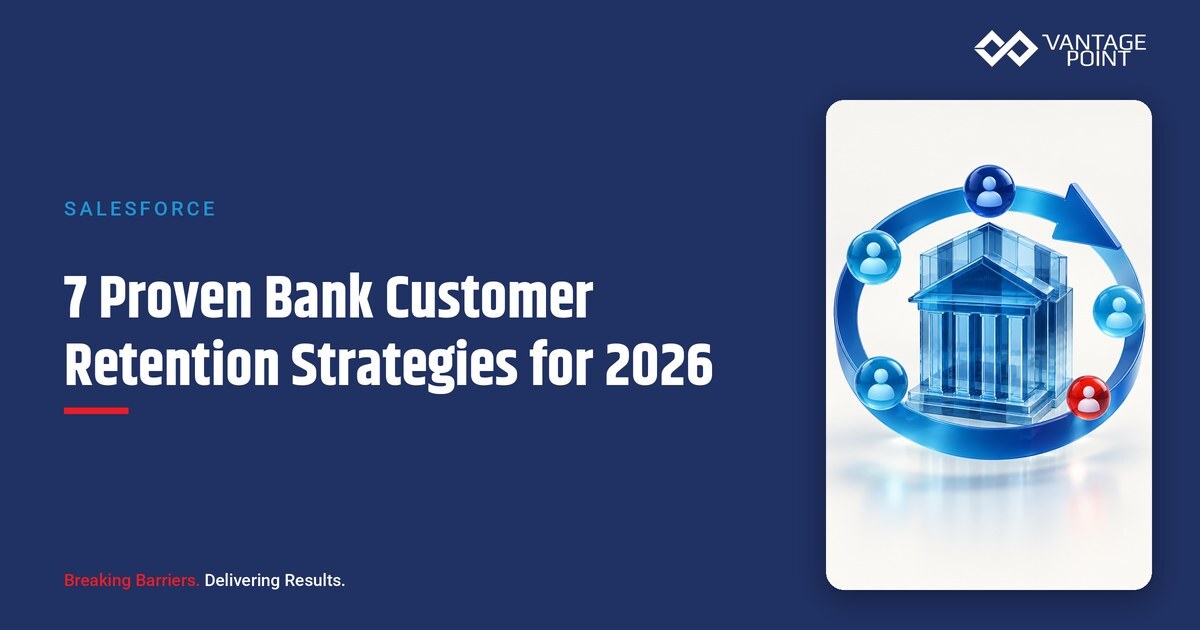
Bank customer retention is the defining growth challenge of 2026. With switching behavior at a 10-year high and acquisition costing far more than retention, the institutions that win will be the ones that keep the customers they already have. This guide covers seven proven, technology-enabled bank customer retention strategies, and how CRM platforms like Salesforce Financial Services Cloud and HubSpot make each one operationally possible at scale.
Quick Answer
Bank customer retention strategies are the programs banks and credit unions use to reduce churn and grow customer lifetime value. The seven most effective for 2026 are: hyper-personalized digital experiences, proactive financial wellness programs, omnichannel engagement consistency, predictive churn analytics, relationship-based pricing and loyalty rewards, seamless digital onboarding, and community engagement. This guide is for banking executives, retail banking leaders, and marketing or CX teams deciding where to invest retention budget, and it shows how Vantage Point implements these strategies on Salesforce Financial Services Cloud and HubSpot.
- What it is: A guide to the seven most effective, technology-enabled bank customer retention strategies for 2026, and the CRM capabilities that power them.
- Why it matters: Retaining an existing banking customer costs far less than acquiring a new one, and U.S. switching behavior is at a 10-year high, with 1 in 4 households considering a change of primary institution.
- Timeline: Most strategies can be implemented within 3-6 months on a modern CRM platform.
- Best for: Banks, credit unions, and financial institutions reducing attrition through AI-driven personalization, predictive analytics, and omnichannel engagement.
- Bottom line: Institutions that combine CRM-powered retention programs with proactive relationship management see meaningful reductions in churn and measurable gains in cross-sell ratios and NPS.
Introduction: Why Customer Retention Is the #1 Priority for Banks in 2026
The banking industry is facing a retention crisis. According to RFI Global, U.S. banking switching behavior has hit a 10-year high, with 1 in 4 households actively considering changing their primary financial institution. Meanwhile, over 40% of Americans now use non-traditional digital banking providers, and 65% of Millennials hold fintech accounts: creating unprecedented competitive pressure on traditional banks and credit unions.
The math is unforgiving: acquiring a new banking customer costs far more than retaining an existing one. When you factor in the lost lifetime value (mortgages, auto loans, investment products, credit cards, and wealth management services) every departed customer represents tens of thousands of dollars in unrealized revenue.
Yet most financial institutions still allocate the majority of their marketing budget toward acquisition rather than retention. In 2026, that equation must flip.
This guide walks you through seven proven, technology-enabled retention strategies that leading banks and credit unions are deploying right now, and shows you exactly how CRM platforms like Salesforce Financial Services Cloud and HubSpot make them operationally possible at scale.
Strategy 1: Hyper-Personalized Digital Experiences
Why It Matters
Generic banking experiences are a relic of the past. Today's customers (conditioned by Netflix, Amazon, and Spotify) expect their bank to understand their financial needs and proactively deliver relevant solutions. According to SBS research, 74% of consumers across generations want more personalized experiences from their banks, and BCG reports that personalized promotional offers in banking generate up to 3x the returns compared to mass-market campaigns.
How to Implement It
AI-Driven Product Recommendations Deploy machine learning models that analyze transaction history, life events (home purchase, new baby, career change), and financial behavior patterns to recommend the right products at the right time. A customer who just received a large deposit may be ready for a high-yield savings product; a customer regularly paying rent may benefit from a first-time homebuyer mortgage program.
Personalized Digital Dashboards Move beyond one-size-fits-all online banking. Create customizable dashboards that surface the financial insights, tools, and products most relevant to each customer segment, from Gen Z budgeting tools to pre-retiree wealth management resources.
Dynamic Content and Communication Use CRM-powered marketing automation to tailor email, in-app messages, and SMS based on individual customer profiles, behaviors, and preferences: not just demographics.
CRM Enabler
Salesforce Financial Services Cloud's Einstein AI and Data Cloud unify customer data from core banking, digital channels, and third-party sources to power real-time personalization engines. HubSpot's Smart Content and behavioral triggers enable dynamic email and web personalization based on CRM properties and engagement history.
Strategy 2: Proactive Financial Wellness Programs
Why It Matters
Banks that position themselves as trusted financial partners, not just transactional service providers, create emotional loyalty that rate-shopping alone can't break. Financial wellness programs transform the bank-customer relationship from a commodity exchange into a value-added partnership.
How to Implement It
Integrated Budgeting and Savings Tools Offer in-app budgeting features, automated savings rules (round-ups, goal-based saving), and spending category analysis that help customers take control of their finances without leaving your platform.
Credit Score Monitoring and Improvement Provide free credit score monitoring with actionable tips for improvement. This is particularly powerful for credit unions serving members in credit-building phases: it demonstrates a genuine commitment to their financial success.
Financial Literacy Content and Workshops Create a content hub with articles, videos, webinars, and interactive tools covering topics like debt management, retirement planning, investing basics, and homebuying. Offer in-branch and virtual financial wellness workshops to deepen engagement.
Proactive Financial Health Check-Ins Use CRM automation to trigger periodic financial health assessments and check-in calls from relationship managers when customer profiles indicate potential financial stress or opportunity.
CRM Enabler
HubSpot's content management and marketing automation tools make it easy to deliver segmented financial wellness content, track engagement, and nurture customers along educational journeys. Salesforce FSC enables relationship managers to track financial goals, set service milestones, and receive AI-generated next-best-action recommendations.
Strategy 3: Omnichannel Engagement Consistency
Why It Matters
Banking customers don't think in channels: they think in experiences. A customer who starts a loan application on their mobile app, asks a question in-branch, and follows up via the contact center expects a seamless, connected journey. According to 2025 consumer research, most U.S. consumers prefer digital channels as their primary banking method, but a meaningful share still favor in-person branches and many still use ATMs every month. The answer isn't digital-only or branch-only: it's connected everywhere.
How to Implement It
Unified Customer Profiles Across Channels Ensure that every touchpoint (mobile app, online banking, branch visit, phone call, chatbot interaction) reads from and writes to a single, unified customer record. No customer should ever have to repeat themselves.
Cross-Channel Journey Orchestration Map and automate key customer journeys (onboarding, loan application, issue resolution, product upgrade) across channels, with intelligent handoffs and context preservation at every transition point.
Consistent Brand and Service Standards Establish service-level standards that apply uniformly across digital and physical channels, ensuring customers receive the same quality of attention whether they're chatting with a bot or sitting across from a banker.
Branch-Digital Integration Equip branch staff with tablets or CRM dashboards that show real-time digital activity, so in-person conversations can pick up right where the digital interaction left off.
CRM Enabler
Salesforce Financial Services Cloud provides a 360-degree customer view that unifies data from core banking, digital channels, marketing, and service interactions. MuleSoft integration connects legacy core systems with modern CRM and digital platforms for real-time data synchronization: the kind of work covered by Vantage Point's system integration and data migration services. HubSpot's CRM platform consolidates marketing, sales, and service touchpoints with full activity timeline visibility.
Strategy 4: Predictive Churn Analytics
Why It Matters
By the time a customer calls to close their account, it's almost always too late. The most effective retention strategies identify at-risk customers weeks or months before they leave: while there's still time to intervene. With most of the largest banks now integrating AI strategies, predictive churn analytics has moved from competitive advantage to operational necessity.
How to Implement It
Early Warning Signal Monitoring Build predictive models that flag customers exhibiting churn indicators such as: - Declining login frequency or transaction volume - Reduced direct deposit amounts or frequency - Increased competitor product inquiries - Single-product relationships (the highest-risk segment) - Unresolved complaints or negative service interactions - Reduced balance trends over 30/60/90-day windows
Risk Scoring and Tiered Response Assign churn risk scores to every customer and build automated response playbooks by risk tier: - Low risk: Personalized engagement content and product recommendations - Medium risk: Proactive outreach from a relationship manager, special rate offers - High risk: Priority intervention: executive outreach, retention offers, financial health review
Automated Re-Engagement Campaigns Trigger automated "We miss you" campaigns for dormant accounts, "Maximize your membership" emails for underutilized services, and pre-approved product offers for customers showing signs of unmet needs.
Closed-Loop Feedback When customers do leave, conduct exit surveys and feed the insights back into your churn models to continuously improve prediction accuracy.
CRM Enabler
Salesforce Einstein's predictive scoring and next-best-action capabilities can identify at-risk accounts and recommend the most effective intervention. Data Cloud ingests behavioral signals from across the customer journey in real time. HubSpot's lead scoring and workflow automation enable automated re-engagement sequences triggered by behavioral signals. Vantage Point builds these models through its AI-driven personalization and analytics services.
Strategy 5: Relationship-Based Pricing and Loyalty Rewards
Why It Matters
In a rate-driven market, competing solely on APY or loan rates is a race to the bottom, and it attracts the exact customers who will leave the moment a competitor offers 10 basis points more. Relationship-based pricing rewards loyalty and depth of relationship, making it progressively more valuable for customers to consolidate their financial lives with your institution.
How to Implement It
Tiered Relationship Benefits Create transparent tiers (Silver, Gold, Platinum, or custom branding) based on total relationship value: combined deposits, loans, investments, and product holdings. Each tier unlocks progressively better rates, fee waivers, and exclusive services.
Relationship Discounts on Lending Offer rate reductions on mortgages, auto loans, and personal loans based on the number of products a customer holds or their tenure with the institution. Example: 0.25% rate discount for customers with 3+ products; an additional 0.10% for customers with 5+ years of tenure.
Non-Financial Loyalty Perks Go beyond rate incentives with experiential rewards: early access to new products, exclusive financial planning sessions, priority service queues, partner discounts (local businesses, travel), and community event invitations.
Transparent Value Communication Use CRM-driven communications to proactively show customers how much they're saving through their relationship. Annual statements, in-app dashboards, and quarterly reviews that quantify the tangible benefits of loyalty.
CRM Enabler
Salesforce FSC's household and relationship management features enable institutions to calculate total relationship value across all household members and products. Automated workflows can trigger tier upgrades, send benefit notifications, and alert relationship managers to cross-sell opportunities. HubSpot enables automated lifecycle communication and loyalty program management through custom properties and workflow automation.
Strategy 6: Seamless Digital Onboarding and Service
Why It Matters
The first 90 days of a new banking relationship are make-or-break for long-term retention. Customers who don't fully activate their accounts, set up direct deposit, or engage with digital banking features within that window are significantly more likely to churn. Yet many institutions still treat onboarding as a one-time event rather than a structured, multi-touch journey.
How to Implement It
Frictionless Account Opening Reduce digital account opening to under 5 minutes with pre-populated forms, digital ID verification, e-signatures, and instant account funding. Every additional step in the process increases abandonment.
Structured 90-Day Onboarding Journey Design an automated, multi-channel onboarding sequence that guides new customers through key activation milestones: - Week 1: Welcome email/video, mobile app download prompt, digital banking setup - Week 2: Direct deposit setup guidance, bill pay activation, card activation - Week 3: Introduction to budgeting tools, savings goals, spending insights - Month 2: Personalized product recommendations based on early behavior - Month 3: Financial health check-in, satisfaction survey, relationship manager introduction
Self-Service Portals and Instant Resolution Invest in robust self-service capabilities (knowledge bases, FAQ chatbots, video tutorials, and AI-powered virtual assistants) that resolve common issues instantly without requiring a phone call or branch visit.
Proactive Issue Detection Monitor for setup failures, stalled activations, and service friction points in real time. If a customer starts but doesn't complete direct deposit setup, trigger a helpful follow-up, not a generic reminder, but a step-by-step guide addressing the specific point where they stopped.
CRM Enabler
Salesforce FSC supports automated onboarding workflows with milestone tracking, task assignment, and next-best-action recommendations for relationship managers. HubSpot's sequences and workflows enable sophisticated drip campaigns with branching logic based on customer actions and engagement. For institutions without in-house CRM admin capacity, managed services and ongoing support keep these journeys running and improving after launch.
Strategy 7: Community Engagement and Trust Building
Why It Matters
Trust remains the foundational currency of banking, and in an era of digital-first relationships, building it requires intentional effort beyond the transaction. Community-focused institutions, particularly credit unions, have a natural advantage here, but even large regional banks can create meaningful local connections that differentiate them from faceless fintech competitors.
How to Implement It
Local Partnership Programs Partner with local businesses, nonprofits, schools, and civic organizations to create mutual value. Sponsor small business accelerator programs, offer financial literacy workshops at community centers, and co-create savings programs with local employers.
Financial Education Events and Workshops Host regular community events, both in-person and virtual, covering topics relevant to your local market: first-time homebuyer seminars, small business financial planning, college savings strategies, and retirement readiness workshops.
ESG and Social Impact Initiatives Today's customers, especially Millennials and Gen Z, increasingly choose financial institutions aligned with their values. Communicate your institution's commitments to environmental sustainability, community development lending, affordable housing, financial inclusion, and equitable access.
Customer Advisory Boards and Feedback Loops Create formal mechanisms for customers and members to shape your institution's direction. Customer advisory boards, regular surveys, town halls, and transparent responsiveness to feedback demonstrate that you value the relationship beyond the balance sheet.
Local Content and Storytelling Use your blog, social media, and email channels to tell local stories. Customer success stories (with permission), community impact reports, employee volunteer highlights, and local economic insights that position your institution as a community pillar.
CRM Enabler
HubSpot's marketing hub excels at community content management, event promotion, social media engagement tracking, and nurture campaigns tied to community activities. Salesforce Experience Cloud enables branded community portals for customer engagement, education, and self-service.
Metrics to Track: Measuring Retention Success
Implementing retention strategies without measurement is flying blind. Here are the critical KPIs every bank and credit union should monitor:
| Metric | What It Measures | 2026 Benchmark Target |
|---|---|---|
| Net Promoter Score (NPS) | Customer loyalty and willingness to recommend | 40+ |
| Customer Churn Rate | Percentage of customers who leave annually | Below 10% |
| Customer Lifetime Value (CLV) | Total revenue from a customer over their relationship | Track by segment; aim for 15%+ YoY increase |
| Digital Adoption Rate | Percentage of customers actively using digital channels | 80%+ |
| Cross-Sell Ratio | Average number of products per customer | 3.0+ products per household |
| 90-Day Activation Rate | Percentage of new customers fully activated within 90 days | 70%+ |
| First Contact Resolution | Percentage of service issues resolved on first interaction | 80%+ |
| Customer Effort Score (CES) | How easy it is for customers to accomplish their goals | Below 2.0 (5-point scale, lower is better) |
Building a Retention Dashboard
Use your CRM's reporting capabilities to build a real-time retention dashboard that tracks these metrics at the institution, branch, segment, and individual customer level. Salesforce FSC's Tableau CRM (Einstein Analytics) and HubSpot's custom reporting dashboards both support the multi-dimensional analysis needed to turn data into action.
Evaluating retention technology for your institution? Talk to Vantage Point about a retention strategy assessment →
How CRM Platforms Power Retention at Scale
Salesforce Financial Services Cloud
Salesforce FSC is purpose-built for financial services and provides: - 360-degree client profiles with unified financial account data, interactions, and life events - Household relationship mapping to understand total family value and cross-sell opportunities - Einstein AI for predictive scoring, next-best-action, and personalized recommendations - Data Cloud for real-time data unification across core banking, digital, and third-party sources - Financial Deal Management for tracking loan and product pipelines - MuleSoft integration for connecting legacy core banking systems to modern CRM
HubSpot CRM
HubSpot offers a powerful, user-friendly CRM platform ideal for growth-focused institutions: - Marketing Hub for personalized email, content, social, and ad campaigns - Sales Hub for pipeline management, sequences, and relationship tracking - Service Hub for ticketing, knowledge base, and customer feedback management - Smart Content for dynamic website and email personalization - Workflow automation for sophisticated onboarding, nurture, and retention campaigns - Custom reporting for real-time dashboards and retention metric tracking
When to Use Which Platform
| Capability | Salesforce Financial Services Cloud | HubSpot CRM |
|---|---|---|
| Best fit | Regional and enterprise banks, credit unions with complex household and compliance needs | Community banks and credit unions prioritizing marketing-led growth and fast adoption |
| Complex compliance requirements | ✅ Enterprise-grade governance, shield, audit trails | ✅ Growing capabilities; suitable for most community-institution needs |
| Legacy core system integration | ✅ MuleSoft for core banking and third-party connections | ✅ Operations Hub and native integrations; lighter middleware needs |
| Household/relationship mapping | ✅ Native feature: households, relationships, total relationship value | ⚡ Possible with custom objects and associations |
| Marketing automation | ⚡ Requires Marketing Cloud / Account Engagement add-on | ✅ Native strength: email, journeys, smart content in one platform |
| Ease of adoption | ⚡ Steeper learning curve; benefits from an implementation partner | ✅ Intuitive UX; faster time-to-value for lean teams |
| AI / predictive analytics | ✅ Einstein AI, Data Cloud, next-best-action | ⚡ Breeze AI: capable, but less depth for predictive churn modeling |
| Cost profile | ⚡ Higher investment; strongest ROI at scale and complexity | ✅ Flexible tiers; cost-effective for smaller institutions |
Choose Salesforce FSC if you need native household mapping, deep compliance controls, and enterprise-grade AI across a complex book of business. Choose HubSpot if your retention motion is marketing-led, your team is lean, and speed of adoption matters more than enterprise depth. Many institutions run both (HubSpot for marketing and Salesforce for the system of record) connected through a HubSpot: Salesforce integration.
How Vantage Point Helps Banks and Credit Unions Win at Retention
At Vantage Point, we specialize in helping banks, credit unions, and financial institutions implement CRM-driven retention strategies that deliver measurable results. As a boutique, senior-led Salesforce and HubSpot consulting partner, our team brings deep expertise across Salesforce Financial Services Cloud, HubSpot CRM, MuleSoft integration, Data Cloud, and AI-powered personalization.
What We Deliver
- CRM Strategy & Implementation: Our Salesforce implementation and advisory services and HubSpot services design and deploy retention-focused CRM solutions tailored to your institution's size, complexity, and customer base: from community credit unions to regional banks.
- Data Unification & Integration: Through system integration and data migration with MuleSoft and Data Cloud, we connect your core banking platform, digital channels, marketing tools, and third-party data sources into a single, actionable customer view.
- AI & Predictive Analytics: Our AI-driven personalization and analytics practice builds and trains churn prediction models, personalization engines, and next-best-action frameworks that turn data into proactive retention actions.
- Omnichannel Journey Design: We map and automate customer journeys across digital and physical channels, ensuring consistency and reducing friction at every touchpoint.
- Retention Dashboard & Reporting: We build custom dashboards that give your leadership real-time visibility into churn risk, NPS, CLV, and cross-sell performance.
- Ongoing Optimization: Retention isn't a one-time project. Our managed services and ongoing support team provides continuous testing and optimization to keep improving your retention outcomes.
Ready to Reduce Churn and Grow Customer Lifetime Value?
Implementing these seven retention strategies requires more than good intentions. It takes the right CRM platform, clean unified data, and automation that actually gets used. Vantage Point helps banks and credit unions design and deploy retention programs on Salesforce Financial Services Cloud and HubSpot, from strategy and implementation through ongoing optimization.
Ready to build your retention engine? Schedule a retention strategy assessment or call (469) 499-3400.
Frequently Asked Questions (FAQ)
What is the average customer churn rate for banks in 2026?
Annual customer churn varies by institution, and U.S. switching behavior is at a 10-year high. Credit unions typically see somewhat lower attrition due to stronger member relationships. Institutions that implement proactive, CRM-driven retention strategies (predictive churn scoring, personalized engagement, structured onboarding) can meaningfully reduce churn relative to their baseline.
How much does it cost to acquire a new banking customer vs. retaining one?
Acquiring a new banking customer costs considerably more than retaining an existing one. When you factor in the lifetime value of a retained customer (including cross-sell revenue from mortgages, investments, insurance, and credit products) the return on retention investment is substantially higher than equivalent acquisition spend.
What role does AI play in bank customer retention?
AI plays three central roles in bank customer retention: predictive churn scoring identifies at-risk customers weeks or months before they leave, personalization engines deliver tailored product recommendations and communications, and next-best-action frameworks guide relationship managers toward the most effective interventions. In 2026, most of the largest banks have integrated AI strategies into their operations, making these capabilities an operational necessity rather than a differentiator.
How long does it take to implement a CRM-driven retention strategy?
Most banks and credit unions can implement a foundational CRM-driven retention strategy within 3-6 months, covering CRM deployment, core data integration, and initial automation workflows such as onboarding journeys and re-engagement campaigns. More advanced capabilities like predictive churn analytics and AI personalization typically follow in months 6-12 as data models mature and behavioral history accumulates.
What is the ROI of investing in customer retention for banks?
The ROI of bank customer retention investment comes from four sources: reduced churn, increased cross-sell ratios, higher NPS scores, and growth in customer lifetime value. Because acquiring a new banking customer costs considerably more than retaining one, even modest churn reduction can pay back the CRM and program investment, though exact returns depend on institution size, starting churn rate, and execution quality.
How do financial wellness programs impact customer retention?
Financial wellness programs improve bank customer retention by building emotional loyalty. They position the institution as a trusted financial partner rather than a transactional provider. Banks and credit unions offering robust wellness tools such as budgeting features, credit score monitoring, and financial education see higher engagement rates, stronger NPS scores, and reduced churn, particularly among Millennial and Gen Z customers who value financial guidance.
What metrics should banks track to measure retention success?
Banks should track eight essential retention metrics: Net Promoter Score (NPS), customer churn rate, customer lifetime value (CLV), digital adoption rate, cross-sell ratio, 90-day activation rate, first contact resolution rate, and customer effort score (CES). These metrics should live in a real-time CRM dashboard segmented by customer type, channel, and product so leaders can spot churn risk and act before customers leave.
About Vantage Point
Vantage Point is a boutique, senior-led CRM consulting firm specializing in Salesforce and HubSpot. We help banks, credit unions, wealth management firms, insurance companies, and other organizations transform their customer relationships through technology. Our services include CRM strategy, Salesforce Financial Services Cloud implementation, HubSpot deployment, MuleSoft integration and data migration, Data Cloud activation, and AI-powered personalization. Learn more at vantagepoint.io.