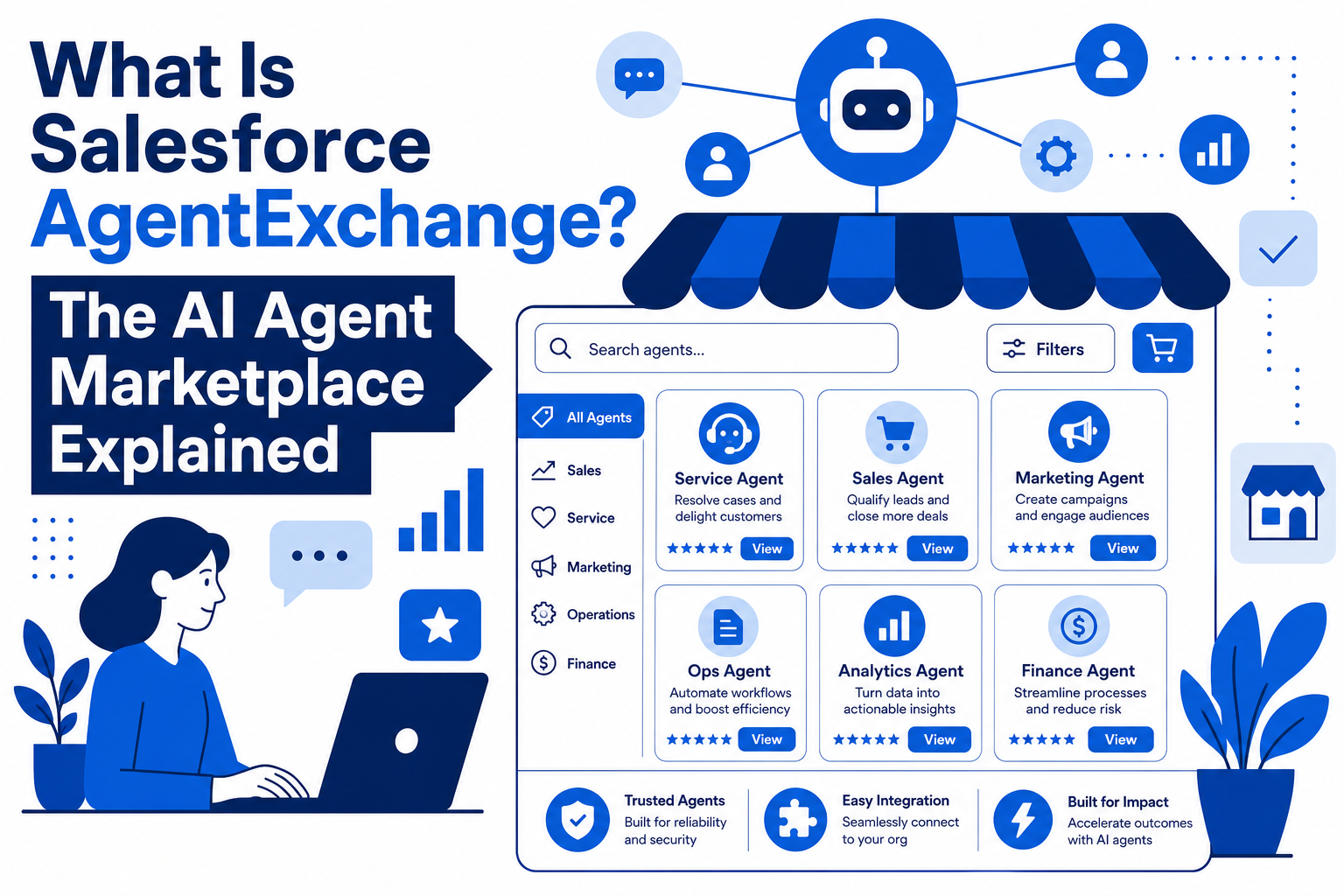
Quick answer: AgentExchange is Salesforce's trusted marketplace and community for Agentforce, the place to discover, evaluate, and install AI agents and agent building blocks from Salesforce partners. Launched in March 2025, per Salesforce's announcement, it extends the AppExchange model into the AI agent era: instead of just apps, buyers find prebuilt agents plus the components that assemble them (actions, topics, and templates) with partner listings subject to Salesforce's security review. Since April 2026, AgentExchange is also the single marketplace that absorbed AppExchange and Slack Marketplace. For buyers, the opportunity is speed; the discipline required is the same as any install that touches CRM data: evaluate security, data access, and pricing before you deploy.
What is AgentExchange, exactly?
Per Salesforce's March 2025 announcement, AgentExchange is "the trusted marketplace and community for Agentforce," built into Salesforce and launched with hundreds of partners. If AppExchange has been the answer to "don't build that app, someone already has," AgentExchange applies the same logic to AI agents: rather than designing every agent behavior from a blank page, teams can start from components that partners have already built, tested, and put through review.
Two things distinguish it from a generic AI tool directory:
- It is native to the Salesforce ecosystem. Listings are built for Agentforce, Salesforce's platform for AI agents, so what you install runs inside the environment where your CRM data, permissions, and audit trails already live.
- It carries marketplace governance. Salesforce applies partner vetting and security review to listings. A meaningful difference from downloading an agent framework from a repository and wiring it to your CRM yourself.
How does AgentExchange relate to AppExchange and Agentforce?
The three names get tangled, so here is the clean separation:
- Agentforce is the platform: where AI agents are built, configured, and run inside Salesforce.
- AgentExchange is the marketplace. Where you find agents and agent components built by partners for that platform.
- AppExchange is Salesforce's twenty-year-old app marketplace. Since April 2026, it has been part of the unified AgentExchange, alongside Slack Marketplace, as explained in the next section.
A practical way to think about it: AppExchange answered "what apps should we add to Salesforce?" AgentExchange answers "what work should we delegate to agents in Salesforce, and what building blocks get us there fastest?" Understanding what agents cost to run is part of the same decision; our guide to Agentforce pricing and Flex Credits covers the consumption model in detail.
Is AppExchange now AgentExchange? What changed in April 2026
Yes. Salesforce first launched AgentExchange in March 2025 as the marketplace for Agentforce. In April 2026, it relaunched AgentExchange as one unified marketplace that brings together AppExchange, Slack Marketplace, and the Agentforce ecosystem, per Salesforce's announcement. What changed:
- One catalog. Salesforce cites 10,000+ Salesforce apps and experts, 1,000+ prebuilt agents, subagents, tools, and MCP servers, and 2,600+ Slack apps and agents in the combined marketplace.
- Smarter discovery. Semantic search powered by Data 360 matches listings to business intent rather than keywords, and AgentExchange now surfaces relevant listings inside Agentforce Builder and in Slack. Salesforce says conversational search is coming in fall 2026.
- Simpler purchasing. Buyers can request private offers with tailored pricing, with unified billing and automated provisioning once an offer is accepted.
- More partner investment. A $50 million AgentExchange Builders Initiative funds and supports partners building new AI solutions for the marketplace.
What it means for your org: the storefront change doesn't alter apps already installed in your Salesforce org. The practical change is where and how you discover, compare, and buy new apps and agents, and the evaluation discipline below applies to both.
What can you actually find on AgentExchange?
Listings go beyond finished agents. The component types matter, because they determine how much assembly your team does:
| Listing type | What it is | When it fits |
|---|---|---|
| Agents | Complete, ready-to-deploy AI agents for a function or industry | You want a working agent for a common use case with minimal build effort |
| Agent templates | Packaged starting points bundling topics, actions, and instructions | You want a proven skeleton but expect to customize behavior in Agent Builder |
| Actions | Individual tasks an agent can perform: integrations, flows, API calls | Your agent design is solid but needs a specific capability, like updating an external system |
| Topics | Groupings of actions and instructions that define how an agent handles a job, within guardrails | You are composing your own agent and want vetted behavior modules |
| Prompt templates | Prebuilt prompts for consistent, reusable agent and assistant interactions | You want standardized language and structure without writing prompts from scratch |
Because the catalog evolves quickly, verify current listing types and categories on agentexchange.salesforce.com when you begin evaluating.
How should you evaluate an AgentExchange listing?
Marketplace vetting is a floor, not a substitute for your own diligence. An agent is not a passive app: it takes actions on your data. Before installing, work through four lenses:
- Security posture. Confirm the listing has passed Salesforce's security review, then go further: What permissions does it request? Does it call external services, and if so, where does data go? Does the vendor document its data handling?
- Data access scope. Map exactly which objects and fields the agent or action can read and write. Prefer listings that operate on narrowly scoped permission sets over those requesting broad administrative access. If a demo requires "just make it a System Administrator," treat that as a finding.
- Pricing model. Listings vary. Some are free components, others carry subscription or usage-based pricing, and agent activity may also consume Agentforce capacity on your side. Model total cost against realistic volumes before committing, not list price alone.
- Vendor durability. Agents need maintenance as the platform evolves. Look at the partner's track record, release cadence, reviews, and support terms. A brilliant agent from a vendor who disappears is technical debt with a friendly name.
What governance should be in place before installing agents?
The organizations getting value from marketplace agents share a pattern: they treated the first install as a governance exercise, not a shopping trip.
- Define an intake process. Who can propose an agent install, who reviews it, and what questions must be answered? A one-page checklist beats an email thread.
- Start in a sandbox. Install and exercise the agent against representative (ideally masked) data before it touches production records.
- Scope permissions deliberately. Create a dedicated permission set for each agent reflecting minimum necessary access: never reuse a human admin profile.
- Set human-in-the-loop boundaries. Decide which actions an agent may complete autonomously and which require review, especially anything customer-facing or financially consequential.
- Instrument from day one. Establish how you will monitor agent activity, error rates, and escalations, and who reviews that reporting.
- Plan the exit. Know how to disable the agent quickly and what data or process depends on it before you depend on it.
None of this needs to be heavyweight. For a mid-market org, it is a checklist, a sandbox habit, and a named owner. Governance sized to the risk, which grows with each agent you add.
Frequently asked questions
Is AgentExchange replacing AppExchange?
In effect, yes. In April 2026, Salesforce unified AppExchange, Slack Marketplace, and the Agentforce ecosystem into one AgentExchange marketplace. Apps already installed in your org aren't affected by the storefront change; what changes is where you discover, compare, and buy new apps and agents.
Do AgentExchange listings go through a security review?
Salesforce applies partner vetting and security review to marketplace listings, consistent with its AppExchange practices. That review is a strong baseline, but it does not replace your own evaluation of the permissions, data access, and external connections a specific listing requires in your org.
Do we need Agentforce licenses to use what we find on AgentExchange?
AgentExchange components are built for the Agentforce platform, so running agents generally requires appropriate Agentforce licensing or consumption capacity, and individual listings may carry their own pricing. Confirm both the listing's terms and your Salesforce agreement's current terms before budgeting a rollout.
Should we buy a prebuilt agent or build our own in Agent Builder?
It depends on how standard your use case is. Common patterns (service triage, appointment handling, common sales tasks) are good candidates for prebuilt agents or templates. Processes that differentiate your business usually justify composing your own agent, often accelerated by marketplace actions and topics rather than built entirely from scratch.
How do we pilot a marketplace agent with low risk?
Pick one process with clear success metrics, install in a sandbox, scope a minimal permission set, run with human review on all agent actions for a defined period, and compare outcomes against your baseline. Expand autonomy only after the agent earns it with data.
How Vantage Point helps
Choosing agents is an architecture decision disguised as a purchase. Vantage Point's Salesforce implementation and advisory team helps mid-market organizations evaluate AgentExchange listings against their data model and security requirements, stand up the governance checklist before the first install, and pilot agents with measurable success criteria. Senior consultants only. No junior handoffs; the experts you meet are the experts who deliver. If Agentforce is on your roadmap, we can help you separate the listings worth piloting from the ones worth skipping.