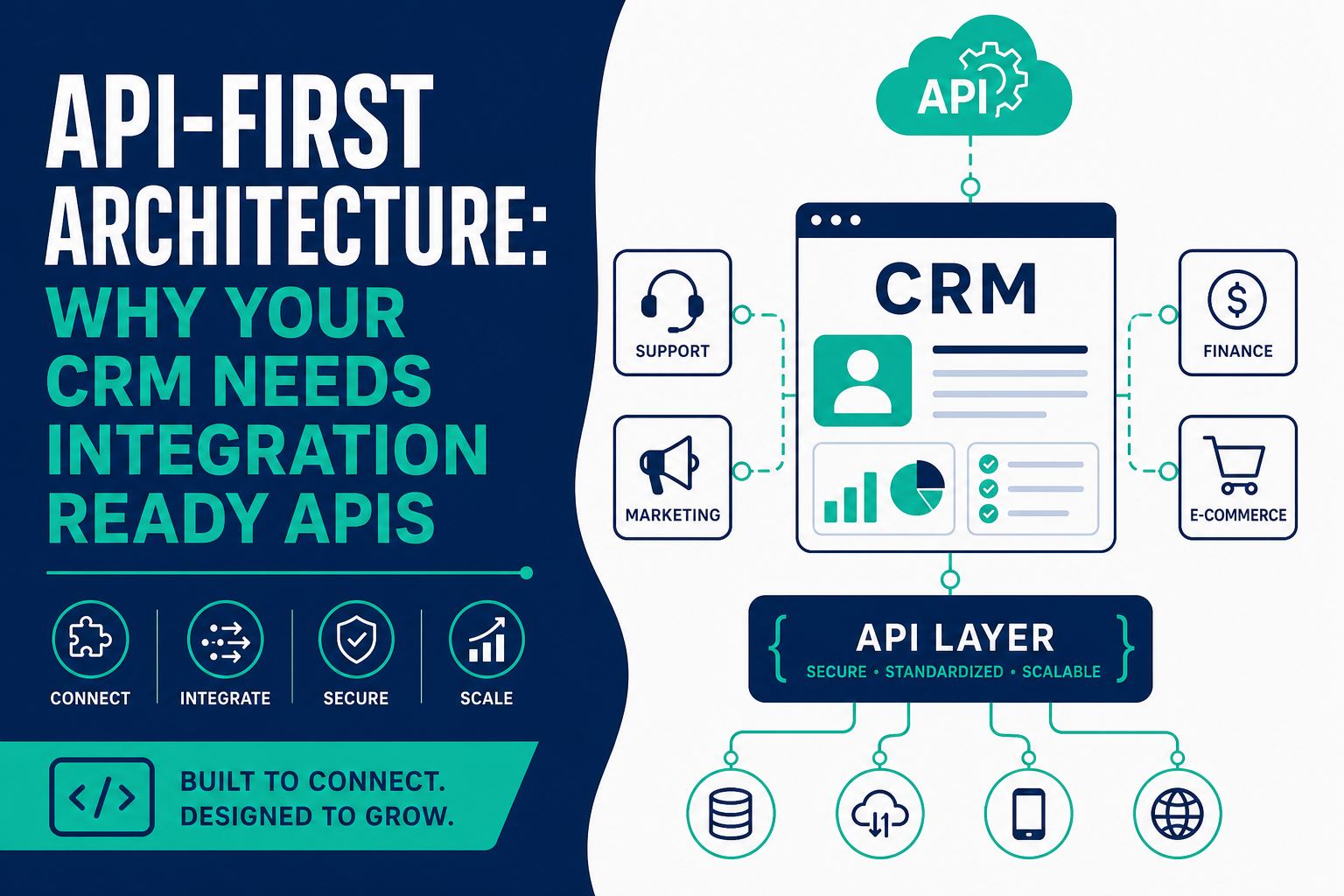
API-first architecture means a CRM or business system is designed so every function is accessible through well-documented APIs first, with the user interface built on top of those same APIs rather than as a separate, tightly coupled layer. This matters for any business planning to integrate its CRM with finance systems, marketing tools, data warehouses, or AI platforms — which today is nearly every business.
Choosing a CRM or evaluating your current one through an API-first lens changes what "flexible" and "future-proof" actually mean in practice. This guide explains what API-first architecture is, why it matters for CRM decisions, and what to look for when evaluating a platform's integration readiness.
Quick Answer
What it is: API-first architecture is a design approach where a system's capabilities are built and exposed as APIs before — or alongside — the user interface, so any function available to a user is also available to other systems.
Who it matters for: IT leaders and RevOps teams selecting or evaluating a CRM, especially those planning multiple integrations with ERP, marketing, data, or AI systems.
What decision it supports: How to weigh integration flexibility as a selection criterion when choosing between CRM platforms or planning a CRM replatforming project.
Why Vantage Point is relevant: Vantage Point implements Salesforce, HubSpot, and MuleSoft integration architecture and helps businesses design systems that scale as integration needs grow.
TL;DR
- What it is: A CRM or system design approach where APIs are the primary interface, not an afterthought bolted onto a UI-first product.
- Why it matters: Integration needs grow over time — a CRM that isn't API-first gets harder and more expensive to connect to new systems as your stack grows.
- Best for: Businesses planning to integrate CRM with finance, marketing automation, data warehouses, or AI tools, now or in the near future.
- Decision point: Evaluate CRM platforms on API completeness, documentation quality, and rate limits — not just user interface features.
- How Vantage Point helps: Our system integration and data migration services help assess and implement API-first integration architecture across Salesforce and HubSpot.
What Is API-First Architecture?
API-first architecture means a platform's core functionality is built as a set of APIs from the start, and the user interface consumes those same APIs rather than having privileged, undocumented access to underlying data and logic. In a true API-first system, anything a user can do in the UI, an external system can also do through the API.
This is different from platforms where APIs were added later as a layer on top of an existing UI-first product. In those cases, APIs are often incomplete, inconsistently documented, or missing functionality that only exists in the interface.
Why This Matters in 2026
Most businesses now run CRM alongside marketing automation, finance systems, data warehouses, support tools, and increasingly AI agents that need to read and write CRM data. Every one of these connections depends on the CRM's API layer.
A CRM with a weak or incomplete API becomes a bottleneck: integrations require workarounds, custom middleware, or manual data entry to bridge gaps the API doesn't cover. Composable, API-first architecture allows businesses to add, replace, or upgrade individual pieces of their stack (a new marketing tool, a new AI layer, a new reporting platform) without rebuilding the whole system.
How to Evaluate API-First Readiness
- Check API completeness. Confirm that core objects, workflows, and automations are accessible via API, not just visible in the UI.
- Review documentation quality. Well-documented, versioned APIs reduce integration time and risk.
- Understand rate limits and scalability. Confirm API rate limits support your integration volume, especially for real-time or high-frequency use cases.
- Evaluate webhook and event support. Real-time integration depends on the platform supporting outbound webhooks or event streams, not just inbound API calls.
- Assess middleware compatibility. Confirm the platform integrates cleanly with common middleware and iPaaS tools like MuleSoft and Workato.
API-First vs. Monolithic CRM Architecture
| Criteria | API-First / Composable | Monolithic (UI-First) |
|---|---|---|
| Integration flexibility | High — APIs expose full functionality | Limited — gaps between UI and API features |
| Speed of adding new integrations | Faster once initial architecture is in place | Slower, often requires workarounds |
| Vendor lock-in risk | Lower — components can be swapped | Higher — deep coupling to one vendor's ecosystem |
| Initial implementation complexity | Can be higher upfront | Often simpler to start with |
| Best fit | Businesses expecting to integrate with many systems and AI tools | Very simple, single-system use cases with few integration needs |
What Businesses Should Do Next
- Audit your current CRM's API documentation and confirm what percentage of UI functionality is actually available via API.
- If evaluating a new CRM, request API documentation and sample integration scenarios as part of the vendor evaluation, not as an afterthought.
- Map out your expected integration roadmap for the next two to three years — finance, marketing, AI, data — and weigh platform choices against that roadmap.
- Involve both IT and business stakeholders in evaluating integration readiness, since both bear the consequences of a platform that's hard to connect.
How Vantage Point Helps
Vantage Point helps businesses evaluate, implement, and integrate Salesforce and HubSpot with the rest of their technology stack using API-first, composable architecture. Our system integration and data migration services and Salesforce implementation and advisory work help ensure your CRM choice supports the integrations you need today and the ones you'll need in two years.
If your team is evaluating how this applies to Salesforce, HubSpot, integrations, or CRM governance, Vantage Point can help assess the right next step and build a practical implementation plan.
FAQ
What does "API-first" actually mean for a CRM? It means the CRM's functionality is built and exposed through APIs first, with the user interface built on top of the same APIs — so external systems have the same level of access as a user working in the app.
Why does API-first architecture matter for CRM selection? Most businesses will eventually need to integrate their CRM with finance, marketing, data, and AI systems. A CRM with weak or incomplete APIs makes every one of those integrations harder and more expensive over time.
Is Salesforce API-first? Salesforce is built on a platform architecture with extensive APIs covering most core functionality, which supports a wide range of integration and composable architecture use cases.
Is HubSpot API-first? HubSpot has invested heavily in its API layer and developer platform, supporting integrations across its CRM, marketing, sales, and service hubs.
What's the difference between composable and monolithic CRM architecture? Composable architecture allows individual components (CRM, marketing automation, data platform) to be swapped or upgraded independently. Monolithic architecture tightly couples these functions, making changes to one part riskier and more disruptive to the rest.
How do I know if a CRM's API is "good enough" for my needs? Review whether the API covers the objects and workflows you plan to integrate, check documentation quality, confirm rate limits fit your expected volume, and test real integration scenarios before committing.
Does API-first architecture increase implementation cost? It can require more upfront architectural planning, but it typically reduces the cost and complexity of future integrations, which matters most for businesses expecting to grow their technology stack over time.