Key Takeaways (TL;DR)
- What is it? Anthropic released 10 pre-built, "private-label" AI agent templates for financial services — bundling skills, data connectors, and subagents into ready-to-deploy packages that firms can white-label as their own
- Key Benefit: Financial institutions can deploy AI agents for pitchbooks, KYC screening, month-end close, and more in days instead of months — and every agent needs CRM data to function
- Wall Street Validation: $1.5B joint venture with Blackstone, Goldman Sachs, and Hellman & Friedman; production deployments at JPMorgan Chase, Goldman Sachs, Citi, AIG, and Visa
- The Schwab Contrast: Charles Schwab launched surface-level AI portfolio insights the same day — two fundamentally different strategies that reveal where the industry is headed
- Best For: Financial services firms, wealth managers, broker-dealers, and RIAs seeking AI-powered automation that integrates with Salesforce and HubSpot CRM
- Bottom Line: AI agents are only as good as the data they access. Connecting Claude to your CRM isn't optional — it's the entire value proposition. That's where Vantage Point comes in.
Introduction: The Day AI Agents Became a Product You Could Buy
On May 5, 2026, something happened that will reshape how financial services firms think about both AI and CRM for years to come.
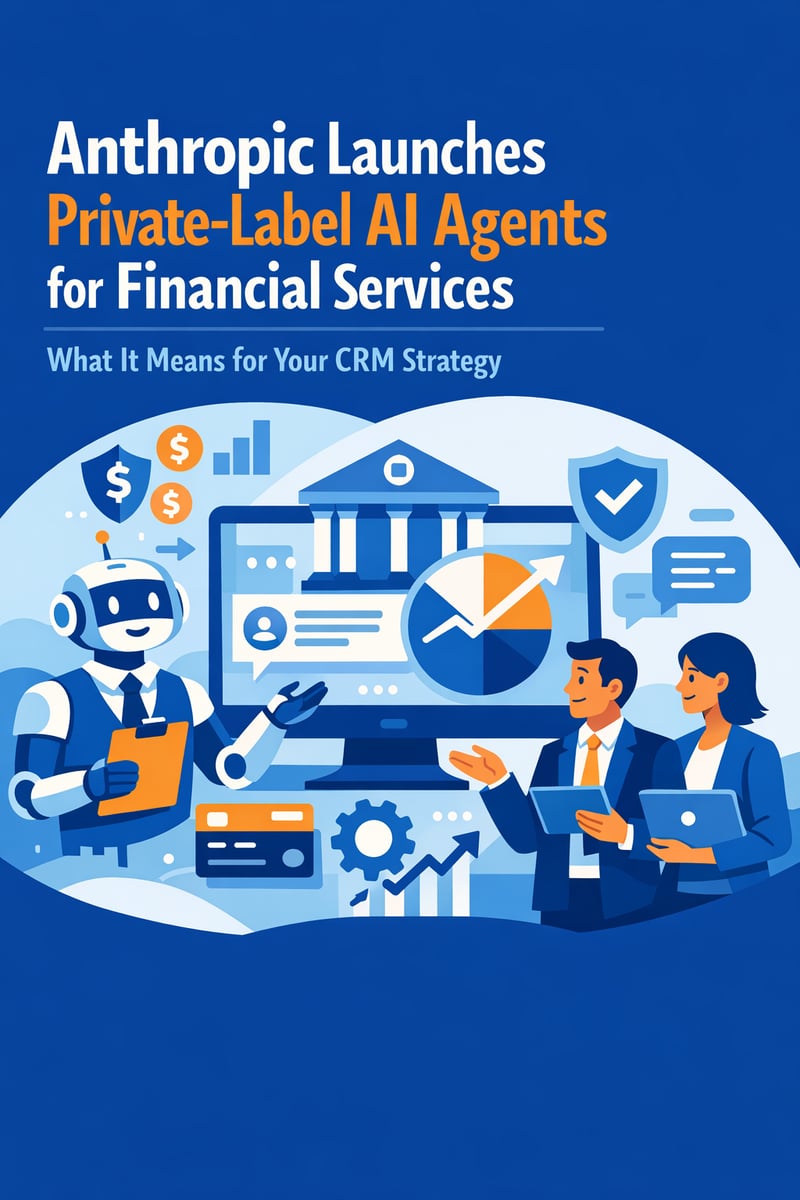
Anthropic — the AI company behind Claude, now commanding 40% of enterprise AI market share according to Menlo Ventures — didn't just announce a new model. They launched a complete product line: ten pre-built AI agent templates purpose-built for financial services, available as plugins in Claude Cowork and Claude Code, or as fully managed agents on the Claude Platform.
One hour later, Charles Schwab fired back with its own AI announcement — a generative AI portfolio insights tool for retail investors.
The timing may have been coincidental. The contrast was not.
As RIABiz journalist Brooke Southall framed it: "There are two wars. One is technology. The other is about managing hearts and minds."
"We saw this convergence coming," says David Cockrum, founder of Vantage Point. "Anthropic isn't selling API access anymore — they're selling entire workflows. And every single one of those workflows needs CRM data to function. That's the story nobody else is telling, and it's the story that matters most to our clients."
In this article, we'll break down exactly what Anthropic's private-label AI agents are, how they compare to Schwab's incremental approach, what the $1.5 billion Wall Street investment signals, and — most importantly — what this means for your CRM strategy in 2026 and beyond.
What Are "Private-Label AI Agents" — and Why Should You Care?
The Architecture: Skills + Connectors + Subagents
The term "private-label" is doing a lot of heavy lifting here, so let's be precise about what Anthropic actually built.
Each agent template is a reference architecture that packages three components:
- Skills — Instructions and domain knowledge for a specific task (e.g., how to build a pitchbook, how to screen KYC files)
- Connectors — Governed, real-time access to the data the task requires (market data, CRM records, compliance databases)
- Subagents — Additional Claude models called by the main agent for specialized sub-tasks like comparables selection or methodology checks
This is fundamentally different from giving employees access to a chatbot. These are autonomous workflow engines that firms can adapt to their own modeling conventions, risk policies, and approval flows — then deploy under their own brand.
"Each agent template is a reference architecture," Anthropic stated in its announcement. "Firms can adapt any of them to their own modeling conventions, risk policies, and approval flows."
The Ten Financial Services Agents
Anthropic launched agents spanning front office, middle office, and back office operations:
Research and Client Coverage:
- Pitch Builder — Creates target lists, runs comparables, and drafts pitchbooks
- Meeting Preparer — Assembles client and counterparty briefs
- Earnings Reviewer — Reads transcripts and filings, updates models, flags changes
- Model Builder — Creates and maintains financial models from filings and data feeds
- Market Researcher — Tracks sector developments, synthesizes news and filings
Finance and Operations:
- Valuation Reviewer — Checks valuations against comparables and firm standards
- General Ledger Reconciler — Reconciles GL accounts and runs NAV calculations
- Month-End Closer — Runs close checklists, prepares journal entries, produces close reports
- Statement Auditor — Reviews financial statements for consistency and audit-readiness
- KYC Screener — Assembles entity files, reviews documents, packages compliance escalations
Why "Private-Label" Changes Everything
Previously, firms adopting AI had two options: use a general-purpose chatbot (limited utility) or build custom AI solutions from scratch (expensive, time-consuming). Anthropic's private-label approach creates a powerful third option: pre-built, customizable agent templates that firms deploy under their own brand with their own data.
"This is the equivalent of going from bespoke tailoring to high-quality ready-to-wear," says David Cockrum. "Firms get 80% of the way there immediately, and partners like Vantage Point handle the critical last 20% — connecting these agents to the CRM data that makes them actually useful."
The Schwab Contrast: Two Radically Different AI Strategies
What Schwab Actually Launched
On the same day Anthropic unveiled its agent platform, Charles Schwab announced its first generative AI capability for retail investors:
- AI-powered summaries of portfolio performance for up to five holdings
- Summaries of market and industry news related to S&P 500 equity holdings
- Context and commentary from Schwab Center for Financial Research
Jonathan Craig, Head of Retail Investing at Charles Schwab, encapsulated the firm's philosophy: "Our clients have made it clear that they want the efficiency of AI combined with guidance from our professionals. As we roll out AI-powered tools, our focus is on being intentional about how technology and human expertise come together."
Platform Play vs. Incremental Enhancement
| Dimension | Anthropic | Schwab |
|---|---|---|
| Approach | Platform (B2B agent templates) | Feature (B2C portfolio insights) |
| Autonomy Level | Agents execute multi-step workflows | AI summarizes existing data |
| Target User | Analysts, compliance officers, operations teams | Retail investors |
| Data Architecture | Connectors to 20+ financial data providers | Proprietary Schwab data only |
| Customization | Full white-labeling and workflow adaptation | None — standard for all clients |
| CRM Integration | Central to agent functionality | Not applicable |
As Vanguard AI product leader Hitesh Dundi told RIABiz: "Claude going all out, or Schwab announcing broad AI initiatives, generated yawns because slapping a generalized LLM on top of legacy infrastructure simply doesn't solve the core issue."
The core issue? Data architecture. And that's where CRM strategy becomes inseparable from AI strategy.
The $1.5 Billion Wall Street Validation
The Joint Venture That Changes the Game
Just one day before the agent launch, Anthropic announced a $1.5 billion joint venture with Blackstone, Hellman & Friedman, and Goldman Sachs to create a new AI-native enterprise services company. The investor roster reads like a who's who of global capital:
- Blackstone — ~$300M contribution
- Hellman & Friedman — ~$300M contribution
- Goldman Sachs — $150M contribution
- Additional investors: Apollo Global Management, General Atlantic, Leonard Green, GIC, Sequoia Capital
"Enterprise demand for Claude is significantly outpacing any single delivery model," said Anthropic CFO Krishna Rao.
Production Deployments at the World's Largest Institutions
The same day, Jamie Dimon — CEO of JPMorgan Chase — shared a stage with Anthropic CEO Dario Amodei at Anthropic's financial services briefing in New York. Dimon described logging into Claude Code himself over the weekend and building a comprehensive dashboard of asset swaps and Treasury data in 20 minutes.
Claude is now in production at:
- JPMorgan Chase — AI across risk, fraud, marketing, and operations
- Goldman Sachs — Three-wave deployment from tech to operations to investment decisions
- Citi — Production financial services deployments
- AIG — CEO Peter Zaffino reported Claude scored 88% accuracy vs. human experts on insurance claims
- Visa — Enterprise-wide deployment
- Citadel — Analysts using Claude for Excel to build and update coverage models
- BNY — Digital employees working cases end-to-end
- Carlyle — Core AI stack for investing, operations, and portfolio management
- Bridgewater — Production deployment
- Walleye Capital — 100% employee adoption of Claude Code across 400-person hedge fund
- Commonwealth Bank of Australia and NBIM (Norwegian sovereign wealth fund)
The Benchmark Advantage
Underpinning it all is Claude Opus 4.7, which leads the Vals AI Finance Agent benchmark at 64.4% — the highest score of any AI model on financially-specific agentic tasks. It also tops the GDPval-AA evaluation for economically valuable knowledge work.
The Data Ecosystem: Why CRM Is the Missing Link
Anthropic's Connector Network
AI agents are only as good as the data they can access. Anthropic has built the broadest data ecosystem in financial services:
Existing connectors: FactSet, S&P Capital IQ, MSCI, PitchBook, Morningstar, Chronograph, LSEG, Daloopa
New connectors announced May 5:
- Dun & Bradstreet — Verified business identity, D-U-N-S® Numbers
- Fiscal AI — Real-time fundamentals across public equities
- Financial Modeling Prep — Quotes, fundamentals, statements, filings, transcripts
- Guidepoint — 100,000+ compliance-reviewed expert interview transcripts
- IBISWorld — Industry-level revenue, ratios, risk scores across thousands of sectors
- SS&C Intralinks — DealCenter AI data rooms for diligence
- Third Bridge — Primary-source expert interviews
- Verisk — Property, casualty, and specialty insurance data
And the marquee partnership: Moody's launched an MCP (Model Context Protocol) app that brings proprietary credit ratings and data on 600+ million public and private companies directly into Claude.
The CRM Gap Nobody's Talking About
Here's what every financial services firm deploying these agents will discover within weeks: market data connectors aren't enough.
Every single one of these ten agent templates needs access to your client data, engagement history, pipeline information, and relationship records. That data lives in your CRM — Salesforce, HubSpot, or both.
Consider just the Pitch Builder agent:
- It needs your client relationship data (Salesforce/HubSpot) to know who you're pitching
- It needs your engagement history to understand the relationship context
- It needs your pipeline data to prioritize which pitches matter most
- It needs your previous proposals to maintain consistency
Without CRM integration, you have an agent that can build a generic pitchbook. With CRM integration, you have an agent that builds a personalized, relationship-aware pitchbook that reflects everything your firm knows about that client.
"This is precisely why we invested so heavily in becoming a Claude Partner Network member and maintaining deep Salesforce and HubSpot expertise," says David Cockrum. "We saw early that the real value in AI agents wouldn't be the models — it would be connecting those models to the systems where client relationships actually live."
The Talent Migration: From Salesforce to Anthropic (and What It Signals)
The Executive Pipeline
One detail that received less attention but speaks volumes about the CRM-AI convergence: the executives leading Anthropic's commercial push came directly from Salesforce.
- Paul Smith, Anthropic's Chief Commercial Officer, spent 8 years at Salesforce before joining Anthropic, where he led the financial services briefing and described the "staircase of autonomy" for AI in finance
- Chris Ciauri, Anthropic's Managing Director for International, spent over a decade at Salesforce
This isn't coincidental. The people who understand enterprise CRM distribution best are now running commercial operations at the company building AI agents that need CRM data to function.
Vantage Point has previously explored this trend in depth in our analysis, "Why Salesforce's Regulated-Industries Talent Is Migrating to Anthropic." The pattern is clear: the most ambitious enterprise technology executives see CRM and AI converging, and they're positioning themselves at the intersection.
What This Means for Salesforce Agentforce
Salesforce's own AI agent platform, Agentforce, represents one approach to the agent-CRM integration challenge: build agents natively within the CRM. Anthropic's approach is the inverse: build best-in-class agents and connect them to CRMs via connectors and MCP.
Both approaches have merit. The firms that win will be those that can navigate both — leveraging Agentforce for CRM-native workflows while connecting Claude agents for specialized financial tasks that require frontier model capabilities.
This is where having a partner fluent in both Salesforce and Anthropic becomes essential.
What This Means for Your CRM Strategy in 2026
The Five Strategic Imperatives
Based on Anthropic's announcements and the broader market trajectory, financial services firms should act on five fronts:
1. Audit Your Data Architecture Now
As Hitesh Dundi emphasized, AI depends on underlying data quality. Before deploying any agent — whether Anthropic's templates or Salesforce Agentforce — you need clean, unified CRM data. This means:
- Deduplicating records across Sales Cloud and Service Cloud
- Establishing golden records for key client relationships
- Ensuring your HubSpot or Salesforce instance has complete engagement history
2. Build Your CRM-AI Integration Layer
Every Anthropic agent template needs data connectors. Your CRM is the most important data source these agents will access. Plan your integration architecture now:
- MuleSoft or Workato for Salesforce-to-Claude data flows
- HubSpot API connections for marketing and engagement data
- Data Cloud for unified customer profiles that agents can query
3. Start with High-Impact Agent Use Cases
Don't try to deploy all ten agents simultaneously. Begin with the ones closest to your core workflows:
- Wealth managers and RIAs: Meeting Preparer + Pitch Builder
- Banks and lenders: KYC Screener + Credit Memo workflows
- Insurance firms: Statement Auditor + claims processing
- Asset managers: Earnings Reviewer + Model Builder
4. Plan for the Autonomy Staircase
Paul Smith's "staircase of autonomy" framework is crucial. Today's agents assist and accelerate. Tomorrow's agents will execute autonomously. Your CRM needs to be ready for both — with proper permissions, audit trails, and approval workflows built in.
5. Choose Partners at the Intersection
The most dangerous mistake is treating AI deployment and CRM optimization as separate projects. They are the same project. Choose implementation partners who understand both.
How Vantage Point Bridges AI Agents and CRM
Vantage Point sits at the exact intersection that Anthropic's announcement has made critical: the bridge between frontier AI agents and the CRM systems they need to function.
As a member of the Claude Partner Network with deep expertise in both Salesforce (Sales Cloud, Service Cloud, Experience Cloud, Data Cloud) and HubSpot CRM, Vantage Point helps financial services firms:
- Design CRM architectures that are AI-agent-ready from day one
- Build integration layers connecting Claude agents to Salesforce and HubSpot data via MuleSoft and MCP
- Implement Salesforce Agentforce for CRM-native workflows alongside Claude for specialized financial tasks
- Configure Data Cloud to create the unified customer profiles that AI agents require
- Establish governance frameworks ensuring AI agents access CRM data within compliance boundaries
"The firms that move fastest won't be the ones with the biggest AI budgets. They'll be the ones that connect their CRM systems to frontier AI models most effectively, most securely, and most quickly," says David Cockrum. "That's been our thesis from day one, and Anthropic's launch just proved it."
Frequently Asked Questions (FAQ)
What are Anthropic's private-label AI agents for financial services?
Anthropic released 10 pre-built AI agent templates designed for financial services workflows including pitchbooks, KYC screening, month-end close, earnings analysis, and credit memo drafting. Each template bundles skills (domain knowledge), connectors (data access), and subagents (specialized sub-task models) into a deployable package that firms can customize and brand as their own.
How do private-label AI agents differ from regular AI chatbots?
Unlike chatbots that respond to individual queries, private-label AI agents execute multi-step workflows autonomously. A KYC Screener agent, for example, can assemble entity files, review source documents, cross-reference compliance databases, and package escalations — all without human intervention between steps. Firms can adapt agents to their own risk policies, compliance standards, and approval workflows.
Do these AI agents require CRM integration to work effectively?
Yes. While Anthropic provides connectors for market data (FactSet, Morningstar, S&P Capital IQ, etc.), agents that handle client-facing workflows — pitchbooks, meeting prep, client coverage — need access to your CRM data (Salesforce, HubSpot) to function at their full potential. Without CRM integration, agents produce generic outputs that miss the relationship context that makes them valuable.
How does this compare to Salesforce Agentforce?
Salesforce Agentforce builds AI agents natively within the CRM, while Anthropic's approach builds specialized agents externally and connects them to CRMs via connectors and MCP (Model Context Protocol). Many firms will benefit from both: Agentforce for CRM-centric workflows and Claude agents for specialized financial tasks requiring frontier model capabilities. A partner like Vantage Point can help architect a strategy that leverages both platforms.
What did Charles Schwab announce on the same day?
Schwab launched its first generative AI capability for retail investors — AI-powered portfolio insights that summarize performance, relevant news, and Schwab research commentary. While useful, this is a consumer-facing information tool, fundamentally different from Anthropic's enterprise agent platform that automates entire workflows.
What is the $1.5 billion Anthropic joint venture?
Anthropic, Blackstone, Hellman & Friedman, and Goldman Sachs formed a joint venture to create a new AI-native enterprise services company. With additional investment from Apollo, General Atlantic, Leonard Green, GIC, and Sequoia, the vehicle is designed to deploy Claude directly into mid-market companies — many of which are portfolio companies of these PE firms.
How can my firm prepare its CRM for AI agent deployment?
Start by auditing data quality — clean, deduplicated records with complete engagement history. Ensure your Salesforce or HubSpot instance has robust API access configured. Plan your integration architecture (MuleSoft, Workato, or direct API connections). Establish data governance policies that define what CRM data AI agents can access. Contact Vantage Point for a readiness assessment.
Conclusion: The Bridge Between AI and CRM Has Never Been More Critical
Anthropic's private-label AI agent launch marks a definitive shift. AI in financial services is no longer about chatbots, copilots, or incremental feature additions. It's about autonomous agents executing entire workflows — and every one of those workflows depends on CRM data.
The firms that capture the most value from this shift won't be those with the biggest AI budgets. They'll be the ones that connect their CRM systems to frontier AI models most effectively, most securely, and most quickly.
With a $1.5 billion Wall Street investment, production deployments at JPMorgan Chase and Goldman Sachs, a 64.4% benchmark-leading score, and 40% enterprise market share, Claude's position in financial services is no longer speculative. It's established.
The question isn't whether your firm will deploy AI agents. It's whether your CRM is ready for them when you do.
Ready to connect your CRM to the AI agent revolution? Contact Vantage Point to assess your Salesforce or HubSpot readiness for Anthropic's financial services agents.
About Vantage Point
Vantage Point is a CRM and automation consultancy specializing in Salesforce, HubSpot, and AI integration for businesses across all industries. As a Claude Partner Network member with expertise in Sales Cloud, Service Cloud, Experience Cloud, Data Cloud, MuleSoft, and HubSpot CRM, Vantage Point sits at the intersection of AI platforms and the CRM systems they need to deliver value. Learn more at vantagepoint.io.