Key Takeaways (TL;DR)
- What is it? Claude Opus 4.6 and 4.7 are Anthropic's most capable AI models — purpose-built for enterprise-grade reasoning, coding, and long-horizon agentic workflows
- Key Benefit: 1M-token context window, 14.5-hour sustained task execution, and industry-leading accuracy at scale enable transformations previously impossible with AI
- Pricing: $5 per million input tokens / $25 per million output tokens via API; Enterprise plans from $50K/year for 50+ seats
- Timeline: Opus 4.6 launched February 2026; Opus 4.7 went GA on April 16, 2026
- Best For: Organizations seeking AI-powered CRM automation, agentic workflows, document processing, and code generation at enterprise scale
- Bottom Line: Businesses pairing Claude Opus with expert implementation partners like Vantage Point are seeing dramatic productivity gains — from 45% faster development cycles to 3x more production tasks solved
Introduction
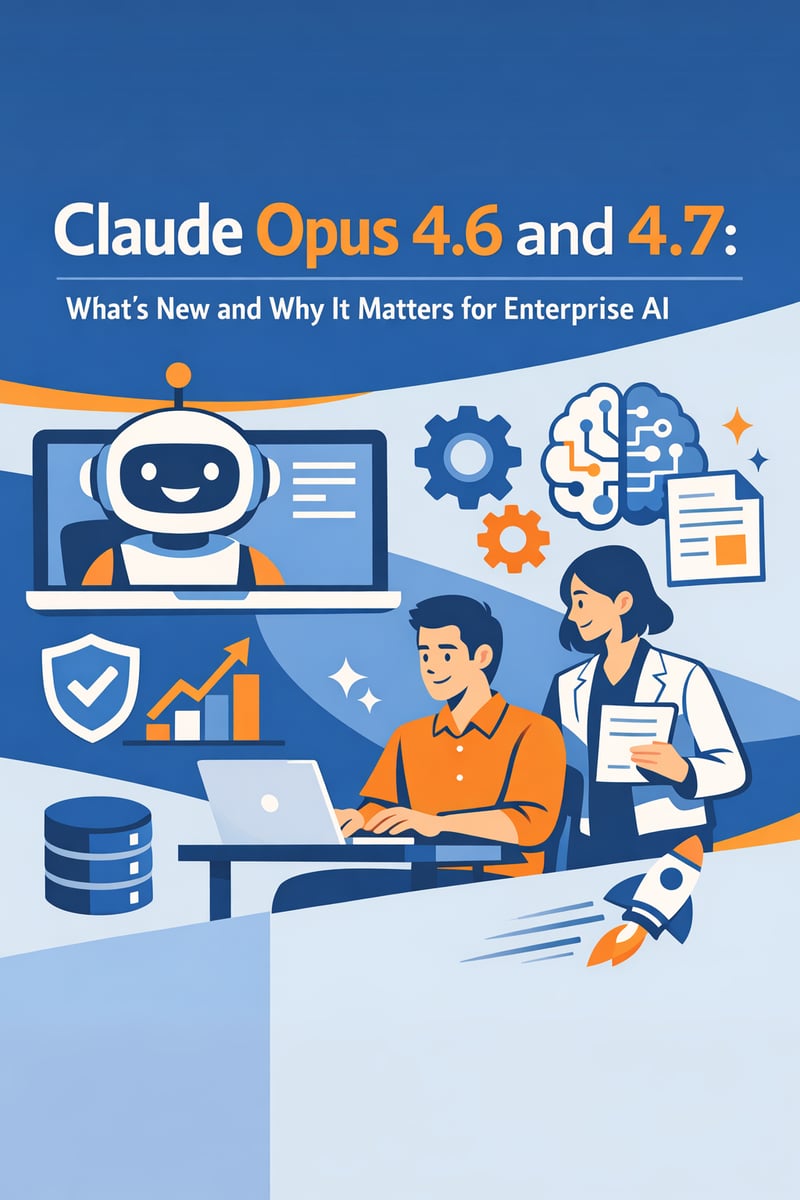
The enterprise AI landscape shifted dramatically in early 2026. On February 5, Anthropic launched Claude Opus 4.6 — a model that shattered benchmarks for context length, sustained task execution, and long-document accuracy. Just two months later, on April 16, Claude Opus 4.7 arrived with targeted improvements that pushed coding and vision capabilities even further.
For businesses investing in CRM automation, data integration, and AI-driven workflows, these releases represent more than incremental upgrades. They fundamentally expand what's possible: processing entire contract libraries in a single prompt, running multi-hour automated workflows without human intervention, and achieving accuracy levels that make AI-generated outputs production-ready.
In this post, we break down everything new in Claude Opus 4.6 and 4.7, explain why these capabilities matter for enterprise AI strategy, and show how organizations can leverage these models through expert implementation partners like Vantage Point.
What Is Claude Opus 4.6?
The February 2026 Flagship Release
Claude Opus 4.6 launched on February 5, 2026, as Anthropic's most intelligent and capable model to date. It was designed from the ground up for the enterprise use cases that matter most: complex reasoning, sustained agentic execution, and large-scale document understanding.
Core specifications:
| Feature | Claude Opus 4.6 |
|---|---|
| Context Window | 1,000,000 tokens |
| Max Output Tokens | 128,000 |
| MRCR v2 Accuracy (1M tokens) | 78.3% — highest among frontier models |
| Sustained Task Window | 14.5 hours |
| Adaptive Thinking | Yes — with "max" effort level |
| API Pricing (Input / Output) | $5 / $25 per million tokens |
Why the 1M Token Context Window Changes Everything
Previous frontier models capped out at 128K–200K tokens. Claude Opus 4.6's million-token context window means organizations can process:
- Entire contract libraries — hundreds of pages of legal agreements analyzed in a single prompt
- Complete CRM data exports — full pipeline histories, customer interaction logs, and support ticket archives
- Multi-year financial reports — annual filings, quarterly statements, and audit documents together
- Large codebases — entire application repositories for refactoring, migration, or documentation
And it's not just the size — it's the accuracy at scale. The 78.3% MRCR v2 score means Claude Opus 4.6 maintains superior information retrieval accuracy even at maximum context length. Other models degrade significantly when pushed beyond 200K tokens.
The 14.5-Hour Task Window
Perhaps the most enterprise-relevant capability is the sustained task window. Claude Opus 4.6 can execute agentic workflows for up to 14.5 hours — the longest of any frontier model. This enables:
- Overnight data migrations — automated ETL pipelines that run while your team sleeps
- Comprehensive audit processes — multi-step compliance checks across thousands of records
- End-to-end testing suites — automated QA workflows that validate entire applications
- Complex research tasks — multi-source analysis that requires sequential web research, data synthesis, and report generation
What's New in Claude Opus 4.7?
The April 2026 Evolution
Released on April 16, 2026, Claude Opus 4.7 builds on 4.6's foundation with targeted improvements in coding, vision, and agentic reliability.
Key benchmark improvements:
| Benchmark | Opus 4.6 | Opus 4.7 | Improvement |
|---|---|---|---|
| SWE-bench Verified | 80.8% | 87.6% | +6.8 points |
| CursorBench | 58% | 70% | +12 points |
| XBOW Visual Acuity | 54.5% | 98.5% | +44 points |
| Production Tasks Solved | Baseline | 3x more | 300% increase |
Vision and Document Processing Upgrades
Opus 4.7 dramatically improved high-resolution image support:
- Resolution increased from 1,568px to 2,576px (3.75 megapixels)
- Pixel-perfect coordinate mapping — 1:1 pixel accuracy for screenshot and document understanding
- Enhanced chart and diagram analysis — reliably extracts data from complex visual formats
For CRM implementations, this means Claude can now accurately read scanned documents, parse complex dashboards, and process visual data with near-human accuracy.
New Effort Levels and Task Budgets
Opus 4.7 introduced the xhigh effort level — a new tier that balances maximum intelligence with practical speed and cost for coding and agentic tasks. Combined with task budgets (now in public beta), organizations can set token limits for agentic loops, ensuring Claude prioritizes critical steps and finishes gracefully within budget constraints.
How Claude Opus Powers Enterprise CRM and Automation
CRM Data Processing at Scale
With a million-token context window, Claude Opus transforms how organizations interact with their CRM data:
- 360° Customer Analysis: Feed Claude an entire customer's interaction history — emails, support tickets, purchase records, meeting notes — and get comprehensive relationship insights in seconds
- Pipeline Intelligence: Analyze complete sales pipelines to identify bottlenecks, forecast accurately, and recommend next-best actions
- Data Quality Automation: Process thousands of CRM records to detect duplicates, fill missing fields, and standardize formatting
Agentic Workflow Automation
The sustained task window enables true "set it and forget it" automation:
- Lead Scoring and Routing: Multi-step workflows that research prospects, score leads against ideal customer profiles, and route to the right team
- Customer Onboarding: Automated sequences that create accounts, configure services, send communications, and update CRM records
- Reporting and Analytics: End-to-end report generation that queries multiple data sources, synthesizes findings, and delivers formatted outputs
Integration with Salesforce and HubSpot
Claude Opus integrates seamlessly with the CRM platforms businesses already use:
- Salesforce Agentforce: Claude-powered agents can operate within Salesforce workflows, leveraging Data Cloud insights for personalized automation
- HubSpot CRM Connectors: Direct integration enables AI-assisted contact management, deal updates, and marketing automation
- MuleSoft and API-Based Integration: Claude's tool-use capabilities connect to any system with an API, enabling cross-platform orchestration
How Does Claude Opus Compare to Other Enterprise AI Models?
Context Window Leadership
Claude Opus 4.6 and 4.7 offer the largest production-ready context window available — 1 million tokens. This is 5–8x larger than most alternatives, and critically, Claude maintains accuracy at scale rather than degrading.
Safety-First Architecture
Anthropic's Constitutional AI approach means Claude is designed to be helpful, harmless, and honest by default. For enterprises, this translates to:
- Reduced hallucination risk — Claude is more likely to say "I don't know" than fabricate information
- Built-in content safeguards — appropriate for customer-facing deployments without extensive guardrails
- Transparent reasoning — adaptive thinking shows Claude's work, enabling audit and validation
Enterprise Compliance
Claude Enterprise includes the infrastructure regulated businesses require:
- SOC 2 Type II compliance
- HIPAA BAA availability for qualifying organizations
- SSO and SCIM for enterprise identity management
- Audit logging and custom data retention policies
- 99.99% uptime SLA for Enterprise customers
What Does Claude Opus Cost for Enterprise Use?
API Pricing
Both Opus 4.6 and 4.7 maintain the same API pricing:
| Tier | Cost |
|---|---|
| Input Tokens | $5 per million |
| Output Tokens | $25 per million |
| Prompt Caching (Write) | $6.25 per million |
| Prompt Caching (Read) | $0.50 per million |
Cost optimization tip: Prompt caching dramatically reduces costs for repetitive workflows. Cached reads cost just 10% of standard input pricing — ideal for CRM automation that processes similar record structures repeatedly.
Enterprise Plans
| Plan | Pricing | Key Features |
|---|---|---|
| Team | $25–$125/seat/month | Collaboration, integrations, team admin |
| Enterprise | From $50K/year (50+ seats) | SSO, SCIM, audit logs, BAA, SLA, custom retention |
Estimating Your Investment
For a typical mid-size CRM automation deployment:
- 10,000 daily API calls × average 2,000 tokens per call = ~20M tokens/day
- Monthly token cost: ~$600–$3,000 depending on input/output ratio
- Enterprise platform cost: $50K–$150K/year depending on seat count and features
Compared to the manual labor these workflows replace, most organizations see positive ROI within 90 days.
Best Practices for Enterprise Claude Opus Deployment
1. Start with High-Impact, Low-Risk Use Cases
Begin with internal workflows — data processing, report generation, code documentation — before deploying customer-facing applications. This builds organizational confidence and establishes best practices.
2. Leverage Prompt Caching for Cost Control
Structure your prompts so system instructions and context templates can be cached. This reduces per-request costs by up to 90% for repetitive CRM operations.
3. Use Adaptive Thinking Strategically
Not every task needs maximum reasoning effort. Use standard effort for simple queries, high effort for analytical tasks, and xhigh (Opus 4.7) for complex agentic workflows. This optimizes both cost and latency.
4. Implement Human-in-the-Loop for Critical Decisions
While Claude Opus can handle sophisticated workflows autonomously, establish approval checkpoints for high-stakes actions: large financial transactions, customer communications, or data deletions.
5. Build with MCP for Future-Proof Integration
Anthropic's Model Context Protocol (MCP) provides a standardized way to connect Claude to your business tools. Building integrations on MCP ensures compatibility with future model upgrades and reduces maintenance overhead.
6. Partner with Certified Implementation Experts
The difference between a proof-of-concept and a production deployment is expertise. Working with implementation partners like Vantage Point — who understand both the AI capabilities and the CRM platforms they connect to — accelerates time-to-value and reduces risk.
FAQ: Claude Opus 4.6 and 4.7 for Enterprise AI
What is the difference between Claude Opus 4.6 and 4.7?
Claude Opus 4.6 (February 2026) established the foundation: 1M-token context, 14.5-hour task window, and 78.3% MRCR v2 accuracy. Opus 4.7 (April 2026) added targeted improvements — 87.6% on SWE-bench Verified, 98.5% visual acuity, the new xhigh effort level, and task budgets for agentic workflows. Both share the same API pricing.
How much does Claude Opus cost for enterprise use?
API pricing is $5 per million input tokens and $25 per million output tokens. Enterprise plans start at approximately $50,000/year for 50+ seats, including SSO, SCIM, audit logging, and a 99.99% uptime SLA. Prompt caching can reduce costs by up to 90% for repetitive workflows.
Can Claude Opus integrate with Salesforce and HubSpot?
Yes. Claude Opus integrates with both platforms through direct API connections, Anthropic's Model Context Protocol (MCP), and third-party integration platforms like MuleSoft and Workato. Salesforce Agentforce can leverage Claude for enhanced AI-powered automation, and HubSpot's connector enables direct CRM operations from Claude's interface.
Is Claude Opus secure enough for regulated industries?
Claude Enterprise is SOC 2 Type II compliant and offers HIPAA BAA for qualifying organizations. It includes SSO, SCIM, audit logging, custom data retention policies, and a 99.99% uptime SLA. Anthropic's Constitutional AI approach also reduces hallucination and harmful output risks.
What can Claude Opus do with a 1 million token context window?
One million tokens is approximately 750,000 words — enough to process entire contract libraries, complete CRM data exports, multi-year financial reports, or large application codebases in a single prompt. Claude maintains high accuracy (78.3% MRCR v2) even at maximum context length.
How long can Claude Opus run autonomous tasks?
Claude Opus 4.6 supports sustained agentic task execution for up to 14.5 hours — the longest of any frontier model. This enables overnight data migrations, comprehensive audit processes, end-to-end testing suites, and multi-source research workflows.
How can Vantage Point help with Claude Opus implementation?
Vantage Point specializes in implementing Claude AI alongside Salesforce, HubSpot, MuleSoft, and Data Cloud. As an agile boutique consultancy, Vantage Point provides hands-on expertise in designing Claude-powered CRM automations, building MCP integrations, and deploying enterprise AI workflows that deliver measurable ROI.
Conclusion
Claude Opus 4.6 and 4.7 represent a genuine step change in enterprise AI capability. The million-token context window, 14.5-hour sustained task execution, and production-ready accuracy make use cases possible today that were theoretical just months ago.
But capability without implementation is just potential. The organizations seeing the fastest returns are those that pair Claude's power with deep CRM and integration expertise — ensuring the AI connects to the right data, executes the right workflows, and delivers the right outcomes.
Vantage Point helps businesses design, build, and deploy Claude-powered solutions across Salesforce, HubSpot, MuleSoft, and Data Cloud. Whether you're exploring your first AI automation or scaling enterprise-wide, our team brings the technical depth and platform expertise to turn Claude's capabilities into business results.
Ready to explore what Claude Opus can do for your organization? Contact Vantage Point to start the conversation.
About Vantage Point
Vantage Point is an agile boutique consultancy specializing in CRM, automation, integration, and AI solutions. As implementation partners for Salesforce, HubSpot, Anthropic (Claude AI), Aircall, and Workato, we help businesses of all sizes transform their operations through technology. From Sales Cloud and Service Cloud to MuleSoft integration and Data Cloud analytics, Vantage Point delivers hands-on expertise that turns complex technology into measurable business outcomes. Learn more at vantagepoint.io.