
Key Takeaways (TL;DR)
- What is it? An automated lead qualification system that uses Anthropic's Claude AI to analyze, score, and route incoming leads within HubSpot workflows: eliminating manual screening and accelerating response times
- Key Benefit: Reduce lead qualification time from hours to minutes while improving scoring consistency and conversion rates by up to 35%
- Cost: $50, $150/month for tools (Zapier/Albato + Claude API) or custom API integration for enterprise-scale workflows
- Timeline: Basic automation in 2-4 hours with no-code tools; advanced API-driven workflows in 1-2 weeks
- Best For: Sales and marketing teams of any size looking to automate lead scoring, prioritization, and routing across their CRM
- Bottom Line: Combining Claude's advanced reasoning with HubSpot's workflow engine creates an intelligent qualification layer that ensures every lead gets the right response at the right time: freeing your team to focus on selling
Introduction
Lead qualification is the backbone of an efficient sales operation. But for most teams, it's also a massive time drain. According to HubSpot's 2025 State of Sales report, sales reps spend only 33% of their time actively selling, the rest disappears into admin work, manual research, and inbox triage.
The problem isn't a lack of leads. It's the gap between when a lead arrives and when a sales rep can meaningfully engage. Every hour spent manually researching a prospect's company, assessing their fit, and deciding whether they're worth pursuing is an hour not spent closing deals.
What if AI could handle that entire qualification process in seconds?
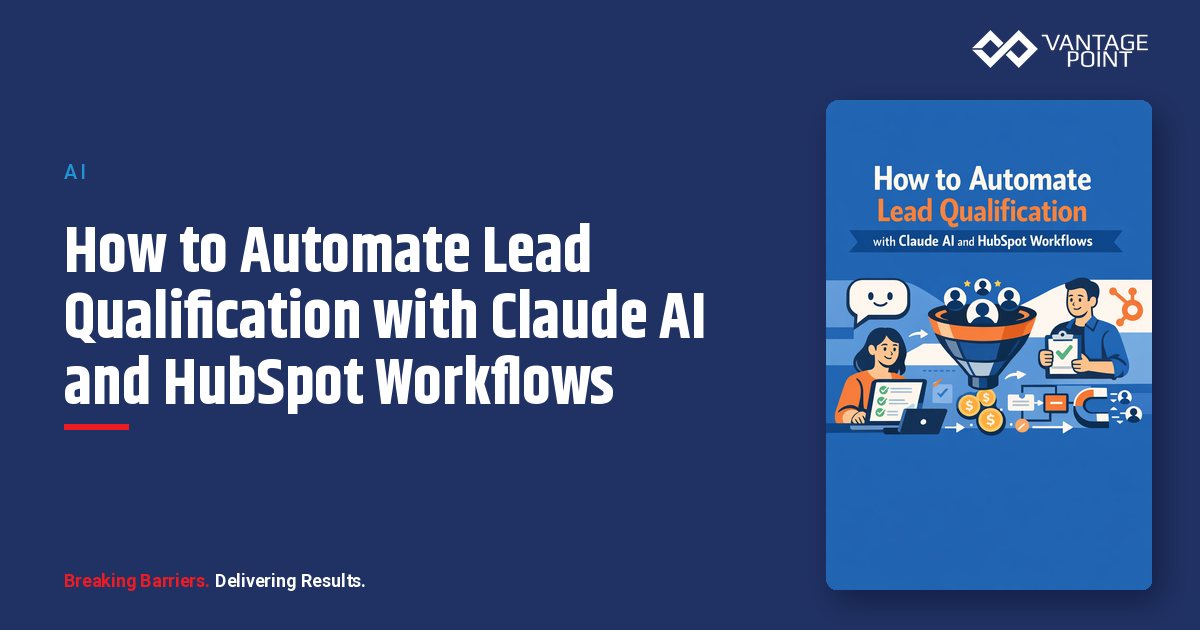
By combining Anthropic's Claude AI with HubSpot Workflows, you can build an automated lead qualification system that analyzes prospect data, assigns intelligent scores, drafts personalized outreach, and routes qualified leads to the right rep: all without manual intervention.
In this guide, you'll learn exactly how to set up this system step by step, whether you prefer a no-code approach with Zapier or Albato, or a custom API integration for enterprise-scale operations. We'll cover scoring criteria design, workflow architecture, real-world use cases, and the best practices that separate a good AI qualification system from a great one.
What Is AI-Powered Lead Qualification?
The Evolution from Manual to Intelligent Scoring
Traditional lead qualification follows a linear, rule-based process: a lead fills out a form, someone manually reviews their information, and a rep decides whether to follow up. This approach has three fundamental flaws:
- Speed: Manual review creates delays that let hot leads go cold
- Consistency: Different reps apply different criteria, leading to inconsistent qualification
- Scale: As lead volume grows, quality suffers because teams can't keep up
AI-powered lead qualification replaces this bottleneck with an intelligent layer that processes leads in real time. Instead of rigid if-then rules (like "company size > 100 employees = qualified"), AI analyzes the full context of a lead's data (firmographics, behavior, engagement patterns, and even the language they use in form submissions) to produce nuanced, accurate qualification decisions.
Why Claude AI for Lead Qualification?
Not all AI models are equally suited for business-critical workflows like lead qualification. Anthropic's Claude stands out for several reasons that matter to sales and marketing teams:
- Advanced reasoning: Claude doesn't just match keywords. It understands context, can interpret nuanced prospect data, and produces structured scoring outputs that integrate cleanly into CRM fields
- Long context windows: With support for up to 200K tokens, Claude can analyze an entire lead's history, engagement data, and enrichment details in a single prompt: no chunking or data loss
- Safety-first architecture: Built with Constitutional AI principles, Claude produces reliable, consistent outputs with fewer hallucinations: critical when qualification decisions drive sales pipeline investment
- Structured output: Claude excels at returning data in JSON, tables, and formatted summaries that map directly to HubSpot custom properties
- Enterprise compliance: Anthropic offers SOC 2 Type II compliance and does not train on API-submitted data, making it suitable for organizations with strict data governance requirements
As a strategic partner of Anthropic, Vantage Point helps businesses leverage Claude AI across their Salesforce and HubSpot environments. Building intelligent automation that goes beyond basic scoring to create truly adaptive sales workflows.
How It Works: Claude AI + HubSpot Workflow Architecture
The Core Architecture
The automated lead qualification system operates on a trigger-process-action pattern:
| Component | Role | Example |
|---|---|---|
| Trigger | An event in HubSpot starts the workflow | New contact created, form submission, lifecycle stage change |
| AI Processing | Claude analyzes lead data and returns structured output | Score lead 0-100, categorize priority, suggest next action |
| Action | HubSpot workflow executes based on Claude's output | Update properties, assign owner, enroll in sequence, create task |
This architecture can be implemented in two ways:
- No-code approach: Using Zapier or Albato as middleware between HubSpot and Claude
- Custom API approach: Connecting Claude's API directly to HubSpot via webhooks or custom code actions
Both approaches produce the same outcome, the choice depends on your technical resources, volume requirements, and budget.
No-Code Implementation with Zapier
Zapier connects over 8,000 applications through visual workflows called "Zaps." With native Claude (Anthropic) integration and MCP (Model Context Protocol) support, Zapier provides the fastest path to AI-powered lead qualification.
Step 1: Define Your Trigger
In Zapier, select HubSpot as your trigger app and choose the appropriate event:
- New Contact: Score every lead as they enter your CRM
- New Form Submission: Score leads from specific high-intent forms (demo requests, pricing inquiries)
- Updated Contact Property: Re-score when engagement data changes
Step 2: Add Claude as a Processing Step
Add an Anthropic (Claude) action step and configure your scoring prompt. Structure the prompt to include lead information (name, company, job title, industry, company size, lead source, form message, pages viewed, and email engagement) and request a JSON response with score, priority, reasoning, pain points, recommended action, and suggested outreach.
Include explicit scoring criteria in your prompt:
- Decision-maker titles (VP, Director, C-Suite): +20 points
- Company size 50-500 employees: +15 points
- Company size 500+: +20 points
- High-intent lead source (demo request, pricing page): +25 points
- Multiple page views in last 7 days: +10 points
- Email engagement above average: +10 points
Step 3: Map Claude's Output Back to HubSpot
Add a HubSpot "Update Contact" action and map Claude's JSON response to custom properties: ai_lead_score, ai_priority, ai_reasoning, ai_suggested_outreach, and ai_qualified_date.
Step 4: Add Conditional Routing
Use Zapier's Paths feature to create different workflows based on score ranges:
- Score 80-100 (Hot): Assign to senior AE, create urgent task, send Slack notification
- Score 50-79 (Warm): Enroll in nurture sequence, assign to SDR for follow-up
- Score 0-49 (Cold): Add to long-term drip campaign, no immediate action required
No-Code Implementation with Albato
Albato offers a more budget-friendly alternative at approximately $25/month, with direct Claude AI connectors designed for CRM workflows. The setup process follows the same trigger-process-action pattern:
- Trigger: New Contact Created in HubSpot
- Process: Send data to Claude via Anthropic integration, receive structured scoring output
- Action: Update HubSpot contact properties with AI-generated scores and insights
Albato also supports niche CRM platforms that Zapier may not cover, making it valuable for organizations with specialized tech stacks.
Pro Tip: For a complete walkthrough of connecting Claude to your CRM with Zapier and Albato, see our companion guide: No-Code AI Automation: Connecting Claude to Your CRM with Zapier and Albato
Custom API Implementation for Enterprise Scale
For organizations processing high lead volumes or requiring more sophisticated scoring logic, a custom API integration provides maximum flexibility and control.
Architecture Overview:
- HubSpot workflow triggers a webhook when a new lead meets enrollment criteria
- Your middleware (Node.js, Python, or serverless function) receives the lead data
- The middleware sends structured prompts to Claude's API
- Claude returns qualification analysis
- The middleware writes scores and insights back to HubSpot via the Contacts API
This approach scales to thousands of leads per day and allows for more complex scoring models that incorporate enrichment data, historical conversion patterns, and multi-model analysis.
Designing Your AI Lead Scoring Criteria
The Four Dimensions of Intelligent Scoring
Effective AI lead scoring evaluates prospects across four key dimensions. Here's how to weight each for your Claude prompts:
1. Demographic Fit (25-30% Weight)
- Job title and seniority: Decision-makers and influencers score higher
- Department: Roles aligned with your product's value proposition
- Geographic location: Regions where you have sales coverage or market fit
2. Firmographic Fit (25-30% Weight)
- Company size: Measured by employee count or revenue
- Industry alignment: Industries where your solution delivers the most value
- Technology stack: Companies already using complementary tools
3. Behavioral Engagement (20-25% Weight)
- Website activity: Pages viewed, time on site, return visits
- Content engagement: Downloads, webinar attendance, email opens/clicks
- High-intent actions: Pricing page visits, demo requests, competitor comparison views
4. Timing and Intent Signals (15-20% Weight)
- Recency of engagement: More recent activity scores higher
- Velocity of engagement: Increasing activity frequency signals buying intent
- Explicit signals: Budget confirmed, timeline stated, direct inquiries
Building Your Scoring Matrix
| Criteria | Weight | Score Range | Examples |
|---|---|---|---|
| Title: C-Suite / VP | High | +20-25 | CEO, CTO, VP Sales, VP Marketing |
| Title: Director / Manager | Medium | +10-15 | Director of Ops, Sales Manager |
| Company: 500+ employees | High | +20 | Enterprise accounts |
| Company: 50-499 employees | Medium | +15 | Mid-market accounts |
| Source: Demo Request | High | +25 | Direct high-intent action |
| Source: Content Download | Medium | +10 | Research-stage engagement |
| Behavior: Pricing Page | High | +15 | Strong buying signal |
| Behavior: 3+ Page Views/Week | Medium | +10 | Active research phase |
| Timing: Engagement < 24 hours | High | +10 | Recent and active |
Prompt Engineering for Consistent Scoring
The quality of your AI lead qualification depends heavily on prompt design. Follow these principles:
- Be explicit about output format: Always request JSON to ensure consistent, parseable responses
- Include scoring rubrics: Don't let Claude guess: provide clear criteria and point values
- Set guardrails: Tell Claude what NOT to do (e.g., "Do not assign scores above 50 for leads without a business email domain")
- Include examples: Provide 2-3 example leads with expected scores to calibrate Claude's judgment
- Request reasoning: Always ask Claude to explain its score: this creates an audit trail and helps you refine criteria
HubSpot Workflow Configuration
Setting Up the Automation in HubSpot
Once your Claude integration is connected (via Zapier, Albato, or custom API), configure your HubSpot workflows to act on the AI-generated scores:
Workflow 1: High-Priority Lead Fast Track (Score 80+)
- Trigger: Contact property
ai_lead_scoreis updated AND greater than or equal to 80 - Actions:
- Set lifecycle stage to "Sales Qualified Lead"
- Assign contact owner based on territory/round-robin
- Create task: "High-priority lead: review AI qualification and reach out within 1 hour"
- Send internal notification via Slack or email
- Enroll in high-priority sequence
Workflow 2: Warm Lead Nurture (Score 50-79)
- Trigger: Contact property
ai_lead_scoreis between 50 and 79 - Actions:
- Set lifecycle stage to "Marketing Qualified Lead"
- Enroll in automated email nurture sequence
- Create task: "Follow up within 48 hours"
- Add to retargeting audience
Workflow 3: Long-Term Cultivation (Score 0-49)
- Trigger: Contact property
ai_lead_scoreis less than 50 - Actions:
- Add to educational email drip campaign
- Set re-engagement trigger for 30 days
- Monitor for score increases via re-scoring workflow
Workflow 4: Re-Scoring on Engagement Changes
- Trigger: Contact property changes (email opened, page viewed, form submitted)
- Actions:
- Send updated data to Claude for re-scoring
- If score increases above threshold, trigger appropriate workflow
- Log score history for trend analysis
Custom Properties to Create in HubSpot
Before activating your workflows, create these custom contact properties:
| Property Name | Type | Description |
|---|---|---|
ai_lead_score |
Number | Claude's qualification score (0-100) |
ai_priority |
Dropdown | High / Medium / Low |
ai_reasoning |
Multi-line text | Claude's explanation of the score |
ai_pain_points |
Multi-line text | Identified prospect challenges |
ai_suggested_outreach |
Multi-line text | AI-drafted first-touch message |
ai_qualified_date |
Date | When AI qualification was performed |
ai_score_history |
Multi-line text | Log of score changes over time |
Real-World Use Cases
Use Case 1: SaaS Company: Scaling Inbound Lead Processing
Challenge: A growing SaaS company receives 500+ inbound leads per week from content downloads, webinar registrations, and demo requests. Their 4-person SDR team can't keep up with manual qualification, and response times have stretched to 48+ hours.
Solution: Deploy Claude AI via Zapier to automatically score and route every inbound lead. High-intent demo requests (score 80+) get assigned to an AE within minutes. Content-download leads (score 40-60) enter an AI-personalized nurture sequence.
Results:
- Lead response time reduced from 48 hours to under 15 minutes for high-priority leads
- SDR team redirected 60% of manual research time to direct prospect engagement
- Demo-to-opportunity conversion rate increased by 28%
Use Case 2: Professional Services Firm: Qualifying Referral Leads
Challenge: A consulting firm receives referral leads through multiple channels: email introductions, website forms, and partner recommendations. Each lead requires research into the company's size, current technology stack, and potential project scope.
Solution: New leads are automatically enriched and scored by Claude, which analyzes company details, the referring source, and any context provided in the referral message. Claude drafts a personalized acknowledgment and suggests the best partner to handle the engagement.
Results:
- Average qualification time dropped from 2 hours to 5 minutes per lead
- Referral response rate improved by 42% due to faster, personalized follow-ups
- Partner satisfaction increased as leads were matched to expertise more accurately
Use Case 3: E-Commerce B2B: Prioritizing High-Value Accounts
Challenge: A B2B distributor receives hundreds of account applications monthly. Their team manually reviews each application to assess creditworthiness, order potential, and strategic fit: a process that takes 3-5 business days.
Solution: Claude analyzes application data, enrichment details, and publicly available company information to produce an initial qualification score and risk assessment. High-potential accounts are fast-tracked for approval while low-fit applications receive automated responses.
Results:
- Application review time reduced by 75%
- High-value account onboarding time cut from 5 days to 1 day
- Sales team focuses exclusively on accounts with genuine buying potential
Building a Continuous Learning Loop
Why Your Scoring Model Must Evolve
AI lead scoring isn't "set it and forget it." Market conditions change, your ideal customer profile evolves, and the signals that predict conversion shift over time. Building a feedback loop ensures your Claude-powered qualification gets smarter with every closed deal.
Monthly Scoring Review Process
- Export closed-won and closed-lost deals from the last 30 days with their original AI scores
- Analyze score accuracy: What percentage of high-scoring leads converted? Did any low-scoring leads close unexpectedly?
- Feed results to Claude: Share the outcome data and ask Claude to identify patterns and suggest scoring adjustments
- Update your prompts: Refine criteria weights, add new signals, or remove factors that don't correlate with conversion
- Document changes: Track prompt versions and scoring criteria updates for your team's reference
Key Metrics to Monitor
| Metric | Target | Why It Matters |
|---|---|---|
| Lead-to-opportunity conversion by score range | 80+ score: >40% conversion | Validates scoring accuracy |
| Average response time for hot leads | < 15 minutes | Measures automation speed |
| Score-to-close correlation | Positive correlation | Ensures scores predict outcomes |
| False positive rate | < 15% | High scores that don't convert |
| False negative rate | < 10% | Low scores that do convert |
| SDR time saved per week | 5-10 hours per rep | Quantifies ROI |
Best Practices for AI Lead Qualification
1. Start Simple, Then Layer Complexity
Don't try to build the perfect scoring model on day one. Start with 3-5 core criteria, validate against real outcomes, and add sophistication over time.
2. Always Include Human-in-the-Loop
AI should augment your sales team, not replace their judgment. Use AI scores to prioritize and inform, but let reps make final decisions on high-stakes opportunities.
3. Keep Your Data Clean
Claude's output quality directly reflects your input data quality. Implement data validation rules in HubSpot to ensure required fields are populated consistently. Missing data leads to unreliable scores.
4. Respect Data Privacy
Never send sensitive personal information (SSNs, financial account numbers, health records) to Claude in qualification prompts. Use internal IDs and anonymized data where possible, and ensure your data handling complies with applicable regulations.
5. Test Before You Scale
Run your AI qualification in "shadow mode" first, let Claude score leads in parallel with your manual process for 2-4 weeks. Compare results before switching to automated routing.
6. Document Everything
Maintain a registry of your active automation workflows, scoring prompts, and criteria weights. This helps with onboarding new team members, troubleshooting issues, and maintaining consistency.
7. Re-Score on Engagement Changes
A lead's score should be dynamic. Configure workflows to re-trigger Claude scoring when significant engagement events occur: pricing page visits, demo requests, or multi-page browsing sessions.
Frequently Asked Questions
How accurate is AI lead scoring compared to manual qualification?
AI lead scoring typically achieves 85-92% accuracy when properly calibrated against historical conversion data. The key advantage isn't just accuracy: it's consistency. While human reps may apply different criteria depending on workload or mood, Claude applies the same scoring logic to every lead, every time. Most teams see a 20-35% improvement in lead-to-opportunity conversion rates after implementing AI qualification.
How much does it cost to set up Claude AI lead qualification with HubSpot?
For a no-code setup using Zapier ($29.99/month Professional plan) plus Claude API credits ($20/month Pro or pay-per-use), budget approximately $50: $100/month. Albato offers a more affordable entry at ~$25/month. Custom API integrations for enterprise scale typically cost $2,500, $15,000 for initial setup, with ongoing API costs based on volume. Most organizations see positive ROI within the first month through time savings alone.
Can Claude handle lead qualification in multiple languages?
Yes. Claude supports dozens of languages and can analyze lead data, generate scores, and draft outreach messages in the lead's preferred language. Simply specify the language context in your scoring prompt (e.g., "The lead submitted their form in Spanish: draft outreach in Spanish").
Do I need a developer to set this up?
Not for basic implementations. Zapier and Albato are fully no-code platforms. You build automations by selecting apps, triggers, and actions from visual interfaces. Most teams can create their first working AI qualification workflow in 2-4 hours. For advanced implementations (custom API webhooks, multi-model scoring, deep CRM customization), development resources are recommended.
How does this compare to HubSpot's native lead scoring?
HubSpot's built-in lead scoring uses rule-based point systems and, with Breeze AI, adds predictive elements. Claude AI qualification is complementary. It adds a deeper reasoning layer that can interpret unstructured data (form messages, engagement context), generate personalized outreach, and provide human-readable explanations for every score. Many teams use HubSpot's native scoring for basic prioritization and Claude for deeper qualification analysis.
What happens if the Claude API is temporarily unavailable?
Build fallback logic into your workflow. If Claude doesn't respond within a set timeout (e.g., 30 seconds), queue the lead for processing when the API recovers, or apply default scoring rules based on basic lead properties. This ensures no leads are lost or delayed due to temporary API issues.
How often should I update my scoring criteria?
Review and refine your scoring model monthly for the first quarter, then quarterly once performance stabilizes. Track closed-won/lost outcomes against AI scores to identify patterns, and adjust criteria weights when you notice scoring drift. Document every change for team transparency.
Conclusion
Automating lead qualification with Claude AI and HubSpot Workflows isn't just about saving time. It's about fundamentally improving how your sales team engages with prospects. By replacing manual screening with intelligent, AI-powered scoring, you ensure every lead receives the right level of attention at the right time.
The businesses seeing the biggest results from AI qualification share three traits: they start with clear scoring criteria, they build feedback loops that improve accuracy over time, and they keep humans in the loop for high-stakes decisions.
Whether you start with a simple Zapier automation or build a full custom API integration, the path from manual qualification to AI-powered scoring is shorter than you might think, and the impact on your pipeline velocity, conversion rates, and team productivity can be transformative.
Ready to automate your lead qualification process? Contact Vantage Point at vantagepoint.io to learn how our team can help you design, implement, and optimize Claude AI-powered workflows across your HubSpot or Salesforce environment.
About Vantage Point
Vantage Point is a CRM consultancy and strategic Anthropic partner that helps businesses transform their customer relationships through intelligent technology. Specializing in Salesforce, HubSpot CRM, MuleSoft integration, Data Cloud, and AI-powered automation with Anthropic's Claude, Vantage Point delivers scalable, compliant CRM solutions for organizations of any size and industry. Learn more at vantagepoint.io.