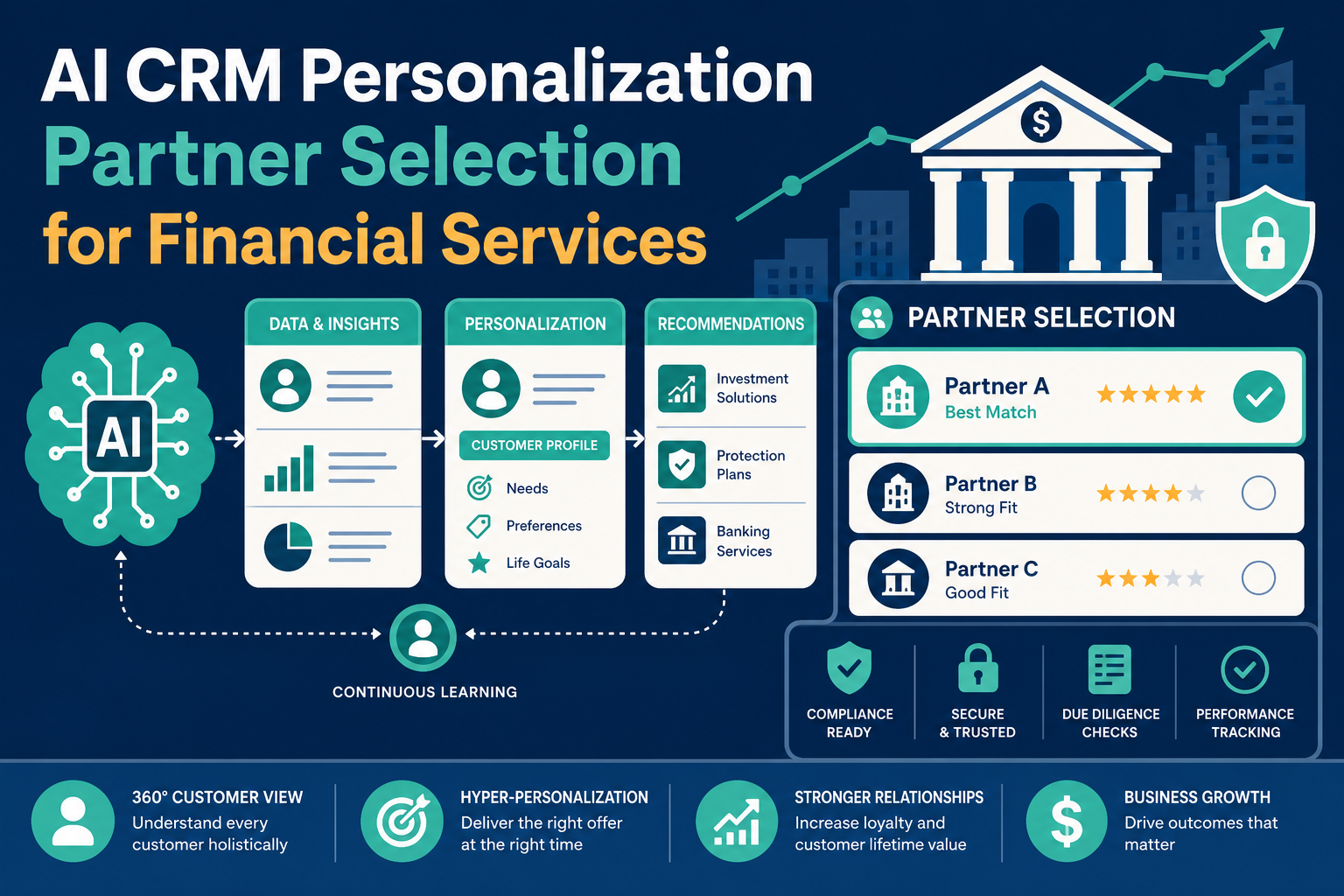
Key Takeaways (TL;DR)
- What this guide covers: A step-by-step, compliance-first framework for evaluating, shortlisting, and governing AI-driven CRM personalization partners across data readiness, integration approach, and regulatory risk
- Who it’s for: Financial services CRM leaders, digital transformation executives, compliance officers, and procurement teams evaluating personalisation projects
- Key framework: The 7-dimension Partner Evaluation Scorecard — covering regulatory expertise, platform depth, data architecture, AI maturity, integration capability, governance model, and total cost of ownership
- Critical insight: Most failed CRM personalization implementations in financial services trace back to partner selection mistakes, not technology limitations
- Bottom line: Choosing the right CRM partner is the single highest-leverage decision in any AI personalization initiative — this guide gives you the structured methodology to get it right
Introduction: Why Partner Selection Is the Make-or-Break Decision
AI-driven personalization is no longer a competitive advantage in financial services — it’s table stakes. McKinsey reports that 71% of consumers expect personalized interactions, and financial institutions that deliver hyper-personalized experiences see 5–15% revenue increases and up to 50% reductions in customer acquisition costs.
Still weighing whether you need a dedicated partner at all? Start with Platform Onboarding vs. an Implementation Partner, then come back to this evaluation framework.
But here’s the uncomfortable truth most vendors won’t tell you: the technology isn’t the hard part. Salesforce Einstein, HubSpot’s AI tools, and Data Cloud are mature, proven platforms. The hard part is selecting the right implementation partner — one who understands the intersection of AI capabilities, CRM architecture, and the regulatory constraints unique to financial services.
This guide provides a structured, compliance-first methodology for evaluating CRM partners and agencies that specialize in AI-driven personalization for financial services. Whether you’re a bank exploring Salesforce Financial Services Cloud, a wealth management firm evaluating HubSpot for client engagement, or a fintech scaling AI personalization implementation, this framework will help you make the right choice.
Section 1: Why Financial Services Personalization Requires Specialized Partners
The Regulatory Complexity Gap
Generic CRM consultancies can implement personalization features. But financial services personalization operates under constraints that most partners have never navigated:
| Regulatory Requirement | Impact on Personalization | What Your Partner Must Know |
|---|---|---|
| FINRA Rules 2210/2211 | Marketing communications must be fair, balanced, and not misleading | AI-generated content requires human review workflows and approval chains |
| SEC Marketing Rule (206(4)-1) | Performance data and testimonials must meet specific standards | Personalized recommendations must include required disclosures |
| GDPR / CCPA / State Privacy Laws | Consent management, data minimization, right to deletion | Data architecture must support granular consent at the field level |
| SOX (Sarbanes-Oxley) | Financial reporting integrity and audit trails | Every personalization decision must be traceable and auditable |
| OCC/FDIC Fair Lending | AI models cannot produce discriminatory outcomes | Partner must implement bias testing and model explainability |
| NYDFS Cybersecurity (23 NYCRR 500) | Encryption, access controls, incident response | Third-party risk management extends to CRM partner access |
The bottom line: A partner who has only delivered personalization for retail, SaaS, or e-commerce companies will significantly underestimate these requirements in both timeline and budget. Demand financial services–specific credentials.
Vantage Point helps financial services firms scope and govern AI-driven personalization — see our AI-Driven Personalization & Analytics services.
The Three Failure Modes
Based on patterns across hundreds of financial services CRM engagements, failed AI personalization projects cluster into three root causes:
- Compliance afterthought — The partner builds personalization workflows first and retrofits compliance later. This always results in rework, delays, and sometimes regulatory findings.
- Data architecture mismatch — The partner designs personalization around a data model that doesn’t reflect how financial services data actually flows (custodian feeds, advisor hierarchies, household relationships, book-of-business structures).
- Integration underestimation — Financial services firms typically operate 15–30 systems. Partners who can’t architect clean integrations between the CRM, core banking/portfolio management systems, compliance platforms, and marketing automation create Frankenstein architectures that collapse under scale.
Section 2: The 7-Dimension Partner Evaluation Scorecard
Use this scorecard to evaluate every CRM partner and agency on your shortlist. Score each dimension 1–5, with 5 being the strongest.
Dimension 1: Regulatory & Compliance Expertise
What to evaluate: - Does the partner have documented experience with FINRA, SEC, SOX, GDPR, and state privacy regulations? - Can they demonstrate compliance-first architecture in past projects? - Do they have compliance specialists on staff (not just developers who “know about” regulations)? - Have they passed a financial services firm’s third-party vendor due diligence process?
Red flags: - “We’ll work with your compliance team to figure it out” (translation: they’ve never done it) - No examples of audit trail implementation in personalization workflows - Unable to explain how their AI models handle fair lending requirements
Dimension 2: Platform Depth & Certification
What to evaluate: - What CRM platforms do they specialize in? (Salesforce Financial Services Cloud, HubSpot, Microsoft Dynamics) - How many certified consultants do they have on the specific platform you’re evaluating? - Do they hold advanced or summit-tier partner status? - Can they demonstrate depth across the full platform ecosystem (Sales Cloud, Service Cloud, Marketing Cloud, Data Cloud, MuleSoft, Experience Cloud)?
Key question to ask: “Show me a personalization architecture diagram from a financial services engagement using [your platform]. Walk me through how data flows from the source system to the personalized touchpoint.”
Dimension 3: Data Architecture & Readiness Assessment
What to evaluate: - Does the partner conduct a formal data readiness assessment before scoping the project? - Can they handle the data structures unique to financial services (household relationships, advisor-client hierarchies, custodial account data, transaction categorization)? - Do they have experience with Customer Data Platforms (CDPs) and data unification across siloed systems? - How do they approach data quality, deduplication, and enrichment?
The litmus test: Ask the partner to describe how they would unify client data across a CRM, a portfolio management system, a custodian feed, and a marketing automation platform — while maintaining consent compliance. If they can’t answer this fluently, they’re not ready for financial services.
Dimension 4: AI & Machine Learning Maturity
What to evaluate: - What specific AI/ML capabilities do they implement? (Predictive lead scoring, next-best-action, churn prediction, content personalization, sentiment analysis) - Do they use native platform AI (e.g., Salesforce Einstein, HubSpot Breeze AI) or build custom models? - Can they explain their approach to model explainability and bias testing? - How do they handle model governance, retraining, and performance monitoring?
Critical for financial services: Demand that any AI models used in client-facing personalization are explainable. “Black box” models are a regulatory risk. Your partner should be able to articulate exactly why a specific recommendation was made to a specific client.
Dimension 5: Integration Capability
What to evaluate: - What integration platforms do they work with? (MuleSoft, Dell Boomi, custom APIs) - Can they demonstrate experience integrating CRMs with financial services–specific systems? (Core banking, portfolio management, custodian platforms, compliance systems, document management) - How do they approach real-time vs. batch integration for personalization use cases? - What is their error handling and data reconciliation methodology?
Financial services integration complexity:
| System Category | Common Platforms | Integration Challenge |
|---|---|---|
| Core Banking | FIS, Fiserv, Jack Henry | Legacy APIs, batch-heavy, complex data models |
| Portfolio Management | Black Diamond, Orion, Tamarac | Real-time position data, multi-custodian feeds |
| Custodian Feeds | Schwab, Fidelity, Pershing | Daily batch files, account-level reconciliation |
| Compliance | Smarsh, Global Relay, NICE | Archiving requirements for personalized communications |
| Marketing Automation | HubSpot, Pardot, Marketo | Consent synchronization, suppression lists |
Dimension 6: Governance & Change Management Model
What to evaluate: - What is their project governance structure? (Steering committee, sprint cadence, escalation paths) - Do they assign senior consultants to your engagement, or do they sell senior and staff junior? - How do they manage change management and user adoption? - What does their post-implementation support model look like?
The “senior-only” question: In financial services, you cannot afford junior consultants learning on your engagement. Ask specifically: “Will the consultants who present in the sales process be the same ones delivering the work? What is the average years of experience on the proposed team?”
Dimension 7: Total Cost of Ownership & ROI Methodology
What to evaluate: - Do they provide transparent pricing with clear scope boundaries? - How do they handle scope changes and change orders? - Do they have a methodology for measuring ROI of personalization initiatives? - What are the ongoing costs after implementation (licensing, managed services, model retraining)?
Cost structure to request:
| Cost Component | One-Time | Recurring | Notes |
|---|---|---|---|
| Discovery & data readiness | ✅ | Should be a separate, bounded engagement | |
| Platform licensing | ✅ | Confirm tier requirements for AI features | |
| Implementation | ✅ | Fixed-price vs. T&M — demand clear boundaries | |
| Data migration & integration | ✅ | The most commonly underestimated line item | |
| Training & change management | ✅ | Critical for adoption | |
| Managed services & support | ✅ | Ongoing optimization, model retraining | |
| Compliance monitoring | ✅ | Audit trail maintenance, regulatory updates |
Section 3: The Evaluation Process — From Long List to Signed SOW
Step 1: Define Your Personalization Vision (Week 1–2)
Before engaging partners, align internally on:
- Use cases: Which personalization scenarios matter most? (Client onboarding, next-best-action for advisors, churn prevention, personalized content delivery)
- Platforms: Have you already selected a CRM, or is the partner helping you choose?
- Data state: What is the current state of your client data? Clean and unified, or siloed and messy?
- Timeline: Are you operating under a regulatory deadline or competitive pressure?
- Budget range: Establish a realistic range based on market research
Step 2: Build Your Long List (Week 2–3)
Identify 6–10 potential partners using:
- CRM vendor partner directories (Salesforce AppExchange Partner Listings, HubSpot Solutions Directory)
- Industry analyst reports (Gartner, Forrester, IDC for financial services CRM)
- Peer referrals from other financial services organizations
- Industry conferences (Dreamforce, INBOUND, financial services technology conferences)
Step 3: RFI/RFP Process (Week 3–5)
Issue a structured RFI covering:
- Financial services experience (specific sub-industries, engagement count, reference clients)
- Platform certifications and partner tier
- Compliance and regulatory approach
- Proposed team composition and bios
- Sample project plan and timeline for a comparable engagement
- Pricing model and indicative budget range
- Data security certifications (SOC 2 Type II, ISO 27001)
Step 4: Shortlist and Deep-Dive (Week 5–7)
Narrow to 3 finalists and conduct:
- Architecture workshop — Have each finalist present a proposed architecture for your specific use cases
- Reference calls — Speak with 2–3 financial services clients per finalist
- Team interviews — Meet the actual consultants who would work on your engagement
- Proof of concept (optional) — For complex implementations, a bounded POC can reveal true capability
Step 5: Selection and Contracting (Week 7–9)
Key contract provisions for financial services:
- Data handling and security obligations — Clearly define how client data is accessed, processed, and protected
- Compliance responsibility matrix — Who is responsible for what regulatory requirements
- IP ownership — Ensure custom AI models and configurations belong to you
- Exit provisions — Define knowledge transfer and transition support if the relationship ends
- SLA commitments — Response times, uptime guarantees, escalation procedures
Section 4: Ongoing Governance — The First 12 Months and Beyond
Selecting the partner is only the beginning. Effective governance ensures the engagement delivers results.
Month 1–3: Foundation Phase Governance
- Weekly steering committee meetings with executive sponsors from both sides
- Bi-weekly compliance checkpoints reviewing data handling and workflow designs
- Monthly progress reports against defined milestones and KPIs
- Establish a shared risk register and mitigation tracker
Month 4–6: Implementation Phase Governance
- Sprint reviews with business stakeholders (not just technical teams)
- User acceptance testing with compliance team participation
- Parallel run of AI models with manual review of recommendations
- First regulatory review of personalization outputs
Month 7–12: Optimization Phase Governance
- Quarterly business reviews with ROI measurement
- AI model performance monitoring (accuracy, bias testing, drift detection)
- Compliance audit of personalization communications
- Roadmap planning for next phase of personalization capabilities
Post-Year-One: Sustained Governance
- Semi-annual partner performance reviews
- Annual AI model revalidation
- Regulatory change impact assessments
- Continuous improvement sprints for personalization effectiveness
Section 5: What to Expect from a Best-in-Class Partner
The right AI-driven CRM personalization partner for financial services will:
- Lead with compliance — Regulatory requirements shape the architecture from day one, not as a bolt-on
- Bring financial services data fluency — They understand household relationships, advisor hierarchies, book-of-business structures, and custodian data feeds without needing to be taught
- Staff senior consultants — The people on your project have 10+ years of CRM experience and deep financial services domain knowledge
- Deliver measurable outcomes — They commit to KPIs like engagement lift, conversion improvement, churn reduction, and advisor productivity gains
- Provide ongoing partnership — Implementation is the beginning, not the end. The best partners offer managed services, model retraining, and continuous optimization
- Maintain platform versatility — They work across Salesforce, HubSpot, and supporting platforms (MuleSoft, Data Cloud, Tableau) because financial services firms rarely operate on a single platform
Frequently Asked Questions
How long does it typically take to implement AI-driven personalization in a financial services CRM?
A pilot implementation focused on a single use case (e.g., next-best-action for advisors or personalized onboarding) typically takes 3–6 months. Enterprise-wide deployment across multiple channels and business lines requires 12–18 months. The timeline is heavily influenced by data readiness — firms with clean, unified data move significantly faster.
What should a financial services firm budget for an AI personalization project?
Budgets vary based on scope, but a focused pilot typically ranges from $150K–$400K including platform licensing, implementation, and data preparation. Enterprise-wide deployments with multiple integrations and AI models range from $500K–$2M+. The most important budgeting principle is to invest adequately in data readiness and compliance architecture upfront — cutting corners here is the most common source of major cost overruns later.
How do we ensure AI-driven personalization doesn’t create regulatory risk?
Three critical safeguards: (1) Implement human-in-the-loop review for all AI-generated client-facing communications before they go live, (2) Build comprehensive audit trails that capture every personalization decision, the data inputs, and the model logic, and (3) Conduct quarterly bias testing on all AI models to ensure fair lending and suitability compliance. Your implementation partner should have documented methodologies for all three.
Can smaller financial services firms (under $1B AUM) benefit from AI personalization?
Absolutely. Cloud-based CRM platforms like Salesforce and HubSpot have made AI personalization accessible at every scale. Smaller firms often see faster ROI because they can implement more quickly and have fewer integration complexities. Start with one high-impact use case — typically client onboarding personalization or advisor next-best-action recommendations — and expand from there.
What’s the difference between native CRM AI and custom-built AI models?
Native AI (Salesforce Einstein, HubSpot Breeze AI) provides pre-built personalization capabilities that are faster to deploy and maintain. Custom AI models offer deeper customization but require data science resources and ongoing model management. For most financial services firms, the optimal approach is to maximize native AI capabilities first and layer custom models only for highly differentiated use cases where native tools fall short.
How do we evaluate whether a partner truly has financial services expertise vs. just claiming it?
Ask three questions: (1) “Name three financial services–specific compliance requirements that directly impact CRM personalization architecture,” (2) “Walk me through a data model you built for a wealth management firm including household relationships and advisor hierarchies,” and (3) “Show me an example of an audit trail you implemented for personalized client communications.” Partners with genuine expertise will answer these fluently with specific examples.
Should we choose a partner that specializes in one CRM platform or one that works across multiple platforms?
For financial services firms, multi-platform expertise is valuable because most organizations use multiple systems. A firm running Salesforce for advisor CRM and HubSpot for marketing automation needs a partner who can architect personalization across both platforms with unified data. However, ensure the partner has deep certified expertise in your primary platform — breadth without depth creates implementation risk.
Conclusion: Make the Decision That Matters Most
AI-driven personalization will define the next decade of financial services customer experience. The platforms are mature. The use cases are proven. The question isn’t whether to invest — it’s who will help you get there.
The partner you select will shape your data architecture, your compliance posture, your AI governance framework, and ultimately your clients’ experience. Use the evaluation methodology in this guide to make that decision with rigor, not vendor charisma.
The best time to start evaluating partners was six months ago. The second-best time is now.
About the Author
David Cockrum is the founder and CEO of Vantage Point, a CRM consulting firm specializing in Salesforce and HubSpot implementations for regulated industries. A former Chief Operating Officer in financial services with over 13 years as a Salesforce user, David founded Vantage Point to bridge the gap between powerful CRM platforms and the unique compliance, data, and integration challenges facing financial services organizations. Under his leadership, Vantage Point has served over 150 clients across 400+ engagements with a 95% client retention rate.