Access requests, software installs, hardware orders, and password resets are usually predictable. Yet many employees still have to find the right portal category, complete a long form, wait for a handoff, and ask again for status. The result is a request backlog that feels larger than the work itself.
AI agents can change the service-request side of ITSM by turning a request into a governed conversation. An employee describes the need in ordinary language; the agent gathers the required details, validates the allowed path, launches approved workflow steps, and communicates progress. Where policy or judgment requires a person, the agent prepares a better handoff instead of bypassing the control.
Quick Answer
AI-powered IT request fulfillment uses a governed AI agent to understand an employee’s request, retrieve approved knowledge and system context, trigger authorized workflow steps, and keep the employee informed. It matters to IT leaders who want a better self-service experience without relaxing access, procurement, or compliance controls. The practical decision is not whether to automate every request; it is which high-volume, policy-bound requests are ready for conversational intake and controlled fulfillment.
Salesforce describes Agentforce employee agents as permission-aware assistants for Salesforce, Slack, and mobile. With appropriate integrations, an Agentforce ITSM design can simplify the front door to IT while retaining human review.
Key Takeaways (TL;DR)
- What it is: AI agents turn IT request fulfillment into a conversation that captures context, validates policy, launches a workflow, and communicates progress.
- Best starting point: Standard access, approved software, password help, and defined equipment requests are strong candidates when the underlying process is clear.
- What stays controlled: Identity verification, permissions, approvals, procurement rules, audit history, and exception routing remain part of the design.
- Employee experience: People can ask in natural language and receive a clear confirmation and status trail instead of navigating a complex catalog alone.
- IT impact: Teams spend less time translating complete requests and more time handling exceptions, improving service design, and protecting the environment.
- Bottom line: The goal is not a chatbot that creates tickets faster; it is a request journey that completes authorized work and hands off the rest with context.
Why Do IT Request Backlogs Persist?
A service request asks IT to provide something standard or approved. It is different from an incident, which restores a disrupted service. In practice, both often enter the same crowded portal and queue.
The delay comes from handoffs. The employee selects the wrong item or omits details. An analyst interprets the request; a manager, application owner, security team, or purchaser approves it; and a technician copies details into other systems. The requester then waits for a status update.
A service catalog and approval workflow are important controls. The problem is that a form-first process asks employees to understand internal taxonomy before IT understands the need.
How Does Traditional Request Fulfillment Create Delays?
| Step | What happens | Common friction |
|---|---|---|
| Find a service | The employee searches a portal and selects a category. | They may not know whether the need is access, software, hardware, or an incident. |
| Complete a form | The employee supplies fields, attachments, and a reason. | Information is missed or already exists in another system. |
| Triage and approve | IT validates policy and routes to the appropriate owner. | Each person reconstructs the context or requests more detail. |
| Fulfill and close | IT provisions access, assigns an asset, or creates a purchase task. | Work is rekeyed across systems and status messages are inconsistent. |
The opportunity is to put an intelligent, policy-aware layer in front of the catalog. Salesforce’s overview of Agentforce IT Service describes request management as an omnichannel way for employees to submit, track, and fulfill requests.
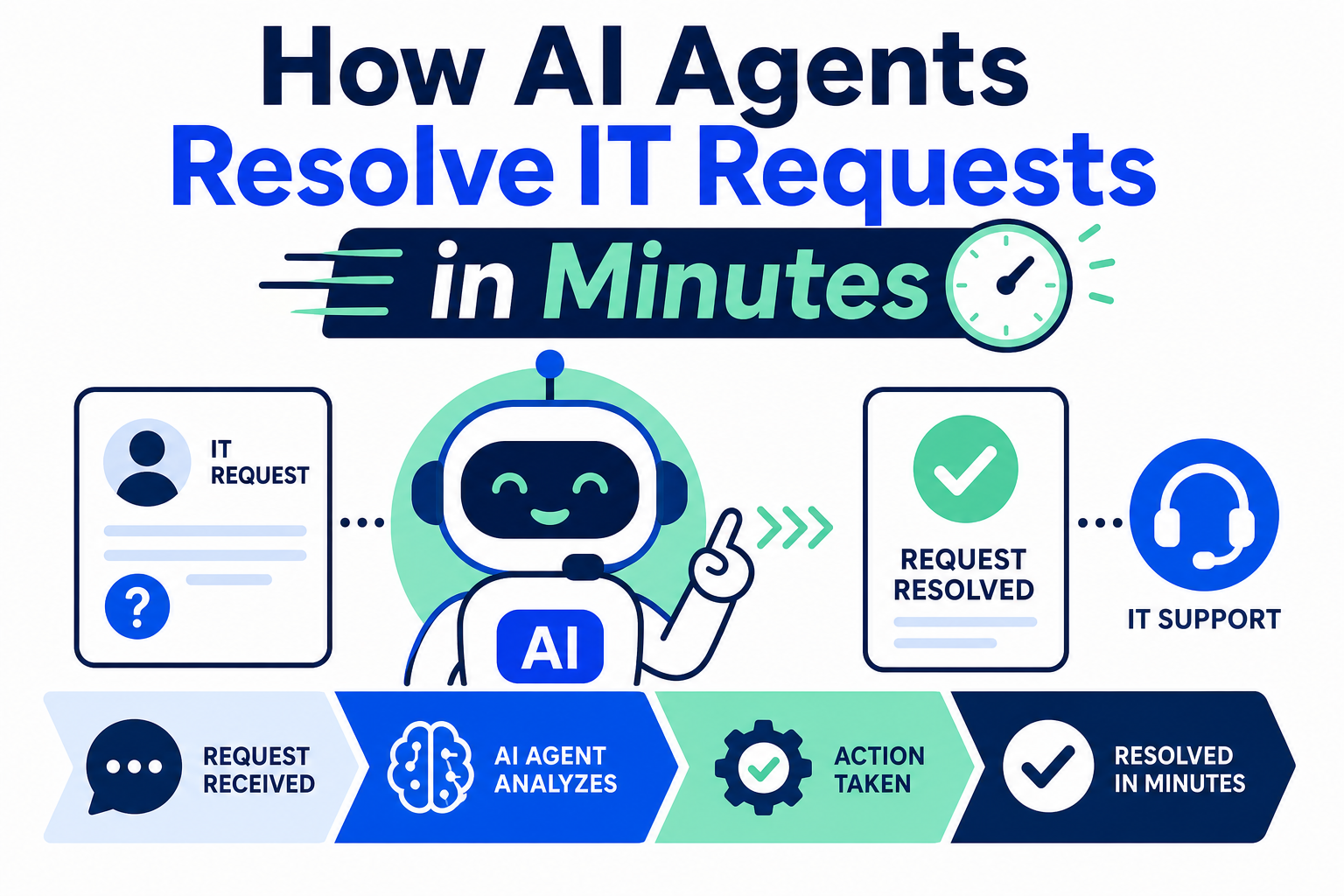
How Do AI Agents Handle a Request From Intake to Resolution?
An AI agent should use defined topics, approved actions, and trusted data—not invent a process. A sound request journey has four stages.
1. Understand the need in natural language
An employee might write, “I start on the analytics team next week and need access to the reporting workspace.” The agent recognizes the intent, asks only for missing details, and confirms the requester’s identity and available context through approved systems. The employee does not have to decide which internal form owns the work.
2. Validate policy and choose the path
The agent checks request type, role, device posture, entitlement rules, and catalog conditions. A request that satisfies preapproved rules can advance. A request outside the standard path can go to the correct approver with the requested access, business reason, and supporting context already assembled.
3. Orchestrate approved actions
For an authorized workflow, the agent can create a request, ask for manager approval, call a scoped identity-management API, create an asset task, or notify procurement. Salesforce explains that agents can select configured actions and subagents; the implementation task is defining exactly which actions are allowed.
4. Confirm, track, and escalate
The employee receives confirmation of what was understood, the next step, and any dependency. The agent can report status in the same conversation. If validation fails or expert judgment is needed, the fulfiller receives the interaction history instead of a vague ticket and a new round of questions.
This is the practical distinction: an AI agent creates value when it completes a bounded service journey or improves the handoff, not merely when it summarizes a form.
Which Requests Are Good Candidates for Agentic Fulfillment?
Start with high-volume requests that have a stable policy, reliable data source, known approvals, and a clear recovery path. Password help and account access may be fast to evaluate; hardware requests can involve inventory and procurement dependencies. Both can benefit from a conversation, but they should not have the same automation boundary.
| Request type | Agent role | Controls that still matter |
|---|---|---|
| Password or account help | Verify identity, guide an approved reset, or create a support record. | Authentication, account-recovery policy, rate limits, and escalation. |
| Application access | Identify the role, validate eligibility, gather a reason, and launch provisioning or approval. | Least privilege, owner approval, segregation-of-duties rules, audit trail. |
| Standard software | Check approved catalog status and device eligibility, then initiate installation. | License availability, endpoint policy, security review. |
| Hardware replacement or order | Check assets and stock, then create the fulfillment or purchasing task. | Asset lifecycle, budget authority, inventory, vendor, and shipping controls. |
A good pilot resolves a narrow problem exceptionally well. Start with a defined set of collaboration-tool access requests rather than the entire catalog. That makes it possible to test wording, approvals, integrations, audit evidence, and support ownership before expansion.
Why Does Conversational Self-Service Work Better Than a Complex Form?
Self-service fails when it shifts process knowledge onto the employee. A person should be able to say, “My new laptop cannot access the secure network,” or “I need the design application used by my team,” without knowing the catalog taxonomy.
A conversation can clarify intent in context, display standard options, surface approved knowledge, and explain why an approval is needed. It can use the employee’s language while recording normalized data in the ITSM system. Salesforce says employee agents can be deployed where people already work, including Salesforce, Slack, and mobile. Portal options should remain accessible, but conversation gives employees a clearer start and a persistent place to check status.
How Do Integrations Make the Workflow Real?
An agent needs a trusted action layer. A practical design usually connects four domains:
- Identity and access management: Identity signals, role context, entitlements, and controlled actions to grant, modify, or revoke access.
- Asset and endpoint management: Device ownership, lifecycle state, inventory, compliance, and workflows for replacement or software deployment.
- Procurement and finance: Approved catalogs, vendors, budget ownership, purchase status, and purchasing controls.
- ITSM, knowledge, and workflow: The request record, approvals, knowledge articles, assignment, notification history, and reporting.
The agent should not receive broad standing access. It should call narrowly scoped, authenticated actions with input validation. An access request might check eligibility, create an approval, then provision after it is recorded. A hardware request might read stock and create a purchase task—not silently order equipment.
Vantage Point can connect an Agentforce ITSM journey to existing systems through system integration and data migration services and help teams avoid automating around inconsistent source data.
How Can Automation Preserve Security and Compliance?
Fast fulfillment is only valuable when it is trustworthy. AI should make controls easier to apply consistently, not hide them behind a chat window.
- Use permission-aware context. The agent should never expose data or actions beyond the requester’s approved rights. Salesforce’s employee-agent guidance says agents can use user-specific context and follow the user’s permissions and organizational security settings.
- Set explicit action boundaries. Define which requests the agent may answer, create, route, or fulfill. Require human review for elevated access, policy exceptions, sensitive applications, unusual quantities, or uncertain identity.
- Put policy into governed workflow. Knowledge can explain a policy; workflow logic should enforce entitlement rules, approvals, and escalation criteria.
- Retain traceability. Preserve the request, decisions, approvals, invoked actions, exceptions, and outcome in the system of record.
- Fail safely. When an integration is unavailable, data conflicts, or the request is ambiguous, preserve the context and route the case instead of guessing.
Salesforce describes the Einstein Trust Layer as an additional guardrail for employee agents. That is part of a wider governance model, not a substitute for identity design, security review, testing, and ownership. Explore Vantage Point’s compliance and security solutions for broader control design.
How Does This Change the IT Team’s Role?
AI request fulfillment does not remove the need for IT service professionals. Instead of translating complete requests and rekeying details, teams can manage exceptions, refine knowledge, investigate failed integrations, and improve the service journey.
The service team becomes the steward of automation boundaries: deciding which requests are ready for straight-through fulfillment and monitoring outcomes. Complex cases and sensitive decisions still need skilled people.
What Should an Organization Do First?
- Choose one service journey with a clear owner, policy, and completion path.
- Map every handoff across people, systems, approvals, exceptions, and status messages.
- Confirm the foundation: catalog, knowledge, identity data, integrations, and action permissions must be reliable enough for the agent to use.
- Document the automation boundary: what may the agent answer, create, route, or fulfill; and when must a person take over?
- Pilot and expand deliberately: test real variations, review failures and escalations, incorporate employee feedback, then add adjacent requests.
For a wider capability view, see our guide to Agentforce ITSM capabilities. Strong programs start with a service problem, not a technology demonstration.
How Vantage Point Helps With Agentforce ITSM
Vantage Point is a boutique, senior-led Salesforce and HubSpot consulting partner. We help organizations define the request journey, assess source data and integrations, design approvals and controls, configure Agentforce actions, test exception paths, and prepare teams for adoption.
Our Agentforce ITSM services focus on governed, usable employee experiences rather than generic AI demonstrations. If your team is evaluating a request-fulfillment pilot, we can help identify the right first workflow and build a foundation that can scale.
Talk to Vantage Point about Agentforce ITSM
Frequently Asked Questions
What is AI-powered IT request fulfillment?
AI-powered IT request fulfillment uses an AI agent to understand an employee’s service request, validate approved context and policy, invoke authorized workflow actions, and communicate progress. It is best suited to routine, well-defined services; complex or exceptional work can be escalated to a person.
Can an AI agent approve access requests automatically?
An AI agent can route or fulfill an access request automatically only when the organization has defined an approved policy and the requester meets its conditions. Elevated permissions, sensitive systems, segregation-of-duties conflicts, and unusual requests should still require the appropriate human approval and an auditable record.
Will conversational self-service replace the service catalog?
Conversational self-service does not need to replace the service catalog. It can make the catalog easier to use by interpreting an employee’s need, gathering required details, and initiating the correct workflow. The catalog, approvals, and request record can remain the controlled system of record.
Which systems should an AI IT agent integrate with first?
Start with the systems needed for the selected journey: usually ITSM, identity or access management, approved knowledge, and relevant asset or endpoint data. Add procurement or finance only when inventory, budget authority, or purchase tasks are needed.
How does Agentforce protect employee request data?
Salesforce states that Agentforce employee agents can use the individual user’s context and follow the same permissions and organizational security settings that apply to that user. Organizations still need to restrict actions, log decisions, test integrations, and align the deployment to their own security and compliance policies.
What should IT measure after launching an AI request agent?
Measure request completion quality, handoff and escalation reasons, approval bottlenecks, employee clarity, reopened requests, and integration failures. Those measures show whether the agent is improving the service journey rather than simply generating more automated tickets.
Official Salesforce Sources
- Salesforce: Agentforce IT Service Management
- Salesforce Trailhead: Explore core Agentforce IT Service processes
- Salesforce Trailhead: Get started with Agentforce for Employees
- Salesforce: How AI agents address employee self-service IT tickets
About Vantage Point
Vantage Point is a boutique, employee-owned Salesforce and HubSpot consulting partner. Our senior-led team helps organizations improve CRM, AI, integration, data, and service operations with practical strategy and implementation support. Visit Vantage Point to explore our services.