
Key Takeaways (TL;DR)
- What is agentic marketing? A marketing operating model where governed AI agents help plan, personalize, execute, analyze, and optimize customer engagement across channels.
- Key Benefit: Teams can move from static campaigns to adaptive experiences that respond to customer context and business rules.
- Requirements: Clean CRM data, consent management, content governance, journey strategy, human oversight, and clear success metrics.
- Timeline: Most teams should start with a 6-10 week pilot before expanding to broader lifecycle or account-based programs.
- Best For: Marketing, sales, service, and customer success teams that need more personalized engagement without adding manual complexity.
- Bottom Line: Agentic marketing is not "set it and forget it." It is a governed partnership between strategy, data, AI, and human review.
Meta Description: Agentic marketing uses AI agents to plan, personalize, act, and optimize campaigns with governed human oversight across the customer journey.
Why agentic marketing is becoming a board-level topic
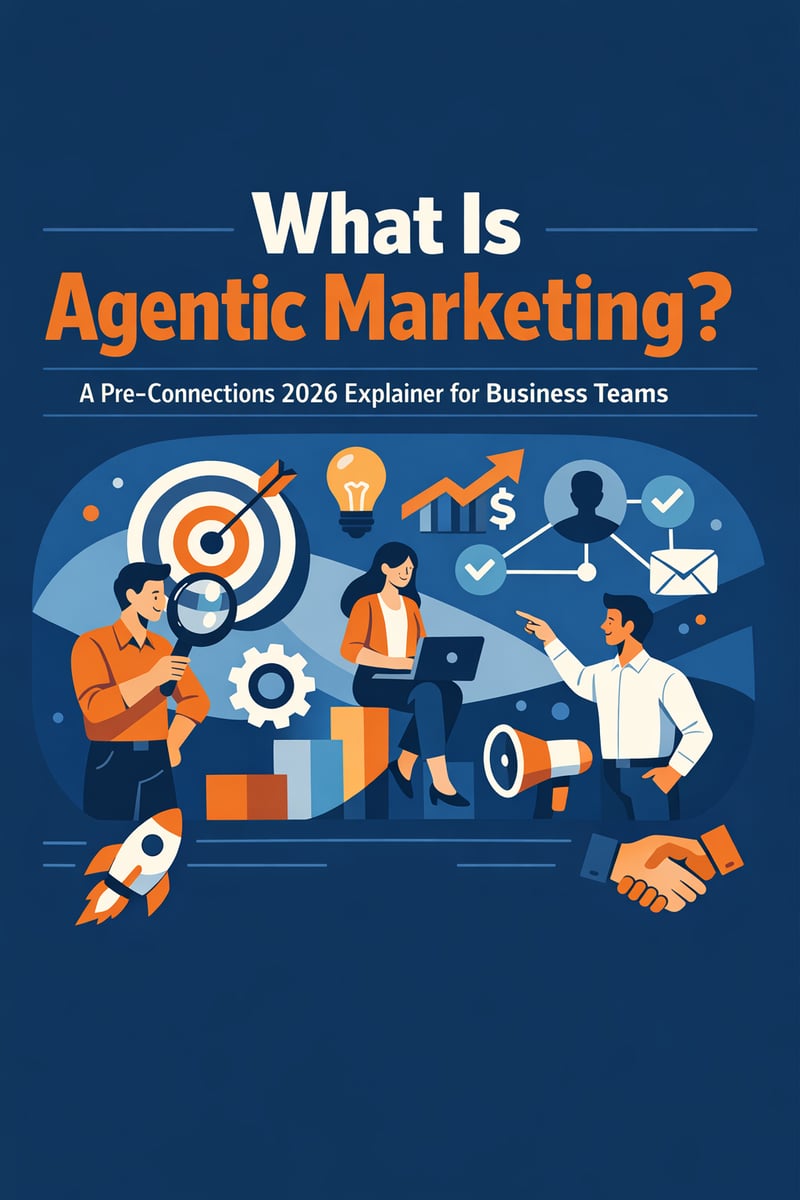
Marketing automation changed how teams scaled email, nurture, segmentation, and campaign operations. Agentic marketing is the next evolution: AI agents that can reason over goals, customer context, rules, and available tools to recommend or take actions.
As Salesforce Connections 2026 approaches with a focus on always-on, adaptive, agentic experiences, many business teams are asking a practical question: what does agentic marketing actually mean, and what should we prepare before adopting it?
The short answer: agentic marketing uses AI agents to help marketers move from rigid, prebuilt journeys to adaptive experiences. But the long answer matters more. Without data quality, consent, governance, and a clear operating model, agentic marketing can create noise faster than it creates value.
What is agentic marketing?
Agentic marketing is a strategy and technology model in which AI agents assist with or perform marketing tasks based on goals, context, constraints, and feedback. These agents may help with audience selection, content recommendations, journey orchestration, testing, lead routing, customer follow-up, and performance analysis.
Traditional automation follows explicit rules: if a contact does X, send Y. Agentic marketing can work more dynamically: given a goal, customer profile, engagement history, available content, compliance rules, and business priority, the agent recommends or initiates the next best action.
The point is not to remove marketers. The point is to let marketers define strategy and guardrails while AI helps scale analysis, personalization, and execution.
How is agentic marketing different from traditional marketing automation?
| Traditional automation | Agentic marketing |
|---|---|
| Rule-based journeys | Goal-oriented agents and adaptive workflows |
| Static segments | Dynamic audiences based on context and behavior |
| Manual content selection | AI-assisted content matching and generation |
| Scheduled reporting | Continuous analysis and recommended optimization |
| Human execution at every step | Human oversight with delegated actions where appropriate |
| Limited cross-functional context | CRM, service, product, and engagement data in one decision model |
Traditional automation still matters. Agentic marketing builds on it by adding reasoning, context, and adaptive decision-making.
What data does agentic marketing need?
Agentic marketing depends on trusted data. Useful data sources include:
- CRM account, contact, lifecycle, opportunity, and service history.
- Consent, preference, subscription, and compliance records.
- Web, email, event, webinar, and content engagement.
- Product usage or customer activity signals.
- Support cases, call outcomes, and customer health indicators.
- Campaign performance and attribution data.
- Content metadata such as topic, persona, stage, offer, and compliance approval.
Data does not need to be perfect before a pilot begins, but the pilot must be designed around data that is trustworthy enough for the action being delegated.
What can agentic marketing agents actually do?
Practical use cases include:
- Audience discovery: Identify segments that match a campaign goal or show signs of intent.
- Journey recommendations: Suggest the next best journey based on lifecycle stage and behavior.
- Content matching: Recommend content based on role, interest, account status, and previous engagement.
- Campaign QA: Flag missing personalization, broken links, inconsistent offers, or compliance concerns.
- Lead follow-up: Draft or trigger follow-up actions based on engagement and sales readiness.
- Performance analysis: Explain why a campaign is underperforming and recommend tests.
- Service-to-marketing handoff: Identify customers who may benefit from education, onboarding, or retention programs.
Start with recommendations before autonomous execution. As trust grows, teams can delegate low-risk tasks under clear guardrails.
What governance is required?
Agentic marketing needs governance across strategy, data, content, permissions, and measurement. Key questions include:
- Which actions can an agent recommend, draft, or execute?
- What data can the agent access?
- Which audiences require human approval before outreach?
- How are consent and preferences enforced?
- What content is approved for use?
- How are agent decisions logged and reviewed?
- What metrics define success or failure?
- Who owns exceptions and escalations?
Governance is not a barrier to innovation. It is what allows agentic marketing to scale responsibly.
What should teams do before Connections 2026?
Use the event as a forcing function to prepare:
- Inventory current journeys, segments, data sources, and automation rules.
- Identify where manual campaign work creates bottlenecks.
- Clean up consent, preference, and lifecycle fields.
- Review content taxonomy and approval status.
- Define one pilot use case with measurable outcomes.
- Decide which actions require human review.
- Align marketing, sales, service, data, and IT stakeholders.
- Create a roadmap for CRM, Data Cloud, Marketing Cloud, and AI integration.
The best teams will not wait for the keynote to start thinking about readiness.
Best practices for agentic marketing
- Start with a business problem. Do not deploy agents simply because the feature is new.
- Choose a bounded pilot. Examples: reactivation, event follow-up, onboarding education, or high-intent lead follow-up.
- Keep humans in the loop. Review recommendations before delegating execution.
- Ground AI in CRM data. Context improves relevance and reduces generic output.
- Respect consent and preferences. Every agent action must follow communication rules.
- Measure both output and outcome. Track time saved, engagement, conversion, satisfaction, and quality.
- Document guardrails. Treat agent instructions like operational policy.
How Vantage Point helps
Vantage Point helps organizations prepare for agentic marketing by aligning CRM data, Marketing Cloud or HubSpot workflows, Data Cloud, AI governance, journey design, and integration architecture. We help teams choose realistic pilot use cases, configure the right foundation, and move from experimentation to measurable adoption.
FAQ
Is agentic marketing the same as generative AI content?
No. Generative AI content is one capability. Agentic marketing is broader: agents can analyze context, recommend actions, orchestrate workflows, and optimize engagement under defined guardrails.
Will agentic marketing replace marketers?
No. Marketers remain responsible for strategy, audience understanding, brand, governance, creative direction, and performance decisions. AI agents help scale execution and analysis.
What is a good first agentic marketing pilot?
A strong pilot is specific, measurable, and low risk. Examples include event follow-up prioritization, content recommendations for known contacts, or campaign performance analysis.
What systems need to be connected?
Most pilots need CRM, marketing automation, consent data, content assets, analytics, and sometimes product or service data. Integration depth depends on the use case.
How should teams measure success?
Measure time saved, campaign velocity, engagement, conversion, handoff quality, content performance, and user trust in recommendations.
What is the biggest risk?
The biggest risk is giving AI agents too much autonomy before data, permissions, content, and review processes are ready.
Conclusion
Agentic marketing promises more adaptive, personalized customer engagement, but success depends on readiness. Teams need clean data, governed workflows, clear pilot use cases, and human oversight.
If your team wants to understand what agentic marketing means for your CRM, marketing, and customer engagement strategy, Vantage Point can help you assess readiness and build a practical roadmap.
About Vantage Point
Vantage Point helps organizations modernize CRM, automation, integration, analytics, and AI across Salesforce, HubSpot, MuleSoft, Data Cloud, Anthropic Claude, Aircall, and Workato. We design practical systems that improve visibility, reduce manual work, and help teams serve clients more effectively.