Key Takeaways (TL;DR)
- What is an agentic enterprise? An organization where AI agents and human employees work as collaborative partners—agents autonomously handle complex, multi-step workflows while humans focus on strategy, creativity, and relationship-building.
- Key Benefit: 24/7 operational intelligence across sales, service, marketing, and IT—without scaling headcount proportionally.
- Cost: $50K–$500K+ depending on platform, scope, and number of agents deployed.
- Timeline: First agent live in 30–90 days; enterprise-scale agentic operations in 6–18 months.
- Best For: Any business with repetitive cross-functional workflows, high customer interaction volume, or growing operational complexity.
- Bottom Line: By 2026, Gartner predicts 40% of enterprise applications will integrate task-specific AI agents—up from less than 5% in 2025. Organizations that build the right data foundation now will lead their markets.
Introduction: The Buzzword That's Actually Real
Every few years, enterprise technology produces a term so overused it loses all meaning. "Digital transformation." "Cloud-first." "Omnichannel." By the time a concept becomes a conference keynote title, most organizations are still trying to figure out what it actually means for their business.
In 2026, that term is "agentic enterprise."
But here's the difference: unlike past buzzwords, the agentic enterprise isn't aspirational—it's already happening. PwC's 2025 survey found that 4 out of 5 companies are already adopting AI agents in some capacity, with nearly 90% planning to increase AI-related budgets specifically because of agentic AI's potential. Salesforce CEO Marc Benioff has called AI agents "the beginning of an unlimited workforce."
So what does "agentic enterprise" actually mean? How is it different from the automation you've been doing for years? And more importantly—how do you know if your organization is ready?
This guide cuts through the noise to give you a clear, practical understanding of the agentic enterprise: what it is, how it works, what platforms enable it, and how to build your roadmap from one agent to twenty-one and beyond.
What Is an Agentic Enterprise? (Definition)
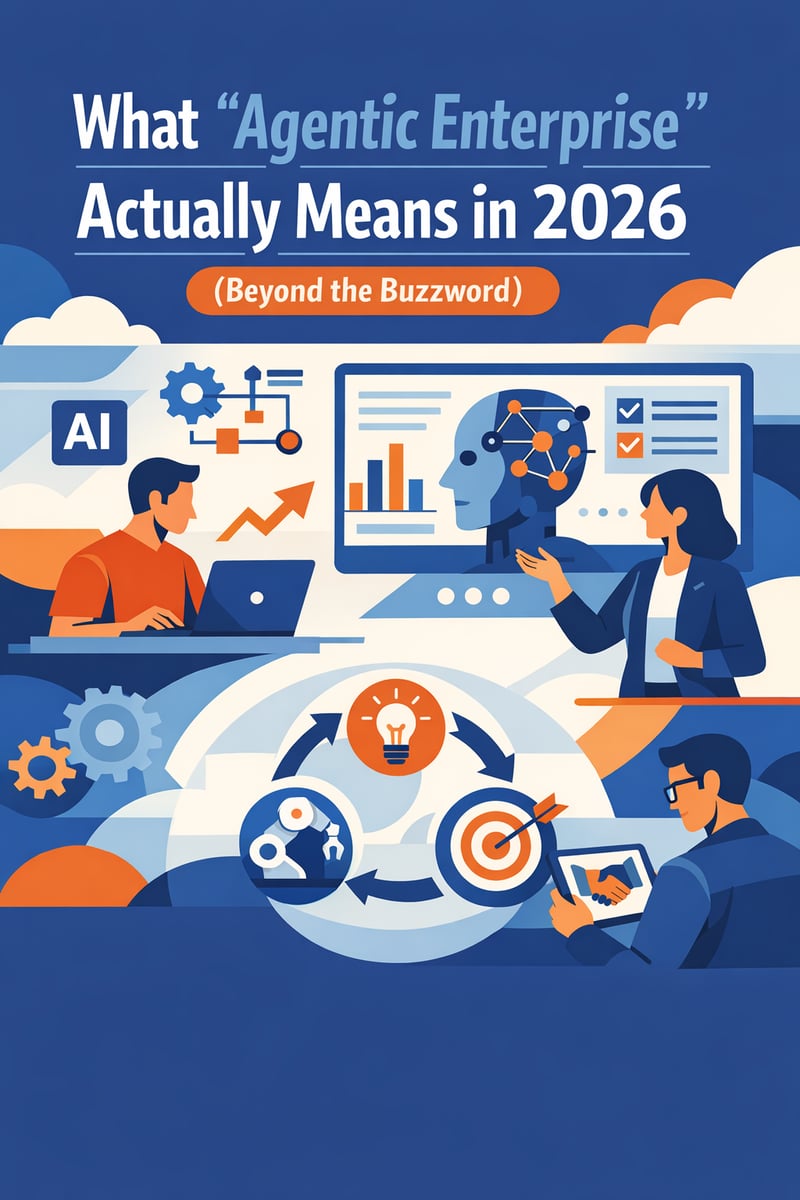
An agentic enterprise is an organization that deploys AI agents as collaborative digital workers alongside human employees. These agents autonomously plan, reason, execute multi-step tasks, and adapt in real time—operating across departments and systems to drive continuous business outcomes.
This is fundamentally different from traditional automation. Where legacy automation follows rigid, pre-programmed rules (if X happens, do Y), agentic AI systems can:
- Plan and reason through complex, multi-step problems
- Make decisions based on context, not just triggers
- Take initiative proactively—flagging risks, following up on leads, escalating issues
- Learn and adapt from outcomes and feedback
- Collaborate with humans and other agents across organizational boundaries
The World Economic Forum describes this as the dawn of the "cognitive enterprise"—organizations that continuously learn, adapt, and improve by deploying agentic AI at the core of operations.
MIT Sloan Management Review puts it more bluntly: agentic AI systems "can plan, act, and learn on their own. They are not just tools to be operated—they are entities that can shape outcomes."
Agentic AI vs. Traditional Automation: What's the Difference?
This is the question every executive should be asking. If you've already invested in workflow automation, robotic process automation (RPA), or rule-based chatbots, you might wonder: isn't "agentic AI" just the next version of the same thing?
No. And the distinction matters.
| Capability | Traditional Automation | Agentic AI |
|---|---|---|
| Decision-making | Follows predefined rules | Reasons through novel situations |
| Adaptability | Rigid; breaks when conditions change | Adapts strategies in real time |
| Scope | Single tasks or workflows | Multi-step, cross-system processes |
| Human oversight | Requires constant configuration | Operates autonomously with guardrails |
| Learning | Static until manually updated | Continuously improves from feedback |
| Collaboration | Executes in isolation | Coordinates with humans and other agents |
| Initiative | Reactive only | Proactive—identifies opportunities and risks |
Example: A traditional automation might route a support ticket to the right queue based on keywords. An agentic AI assistant would read the ticket, pull the customer's full history from your CRM, identify that this is their third complaint in 30 days, draft a personalized response with a retention offer, escalate to a human manager with a summary and recommendation, and log the interaction—all before a human touches it.
That's the difference between automation and agency.
How AI Agents Work Alongside Humans (Not Instead of Them)
The most important thing to understand about the agentic enterprise is this: it's not about replacing people. It's about giving every person an AI partner.
In an agentic enterprise:
- Sales teams have AI agents that qualify leads 24/7, research prospects, draft personalized outreach, manage follow-up cadences, and surface deals at risk—so reps spend time on relationships, not data entry.
- Service teams have AI agents that resolve routine inquiries autonomously, gather context before escalation, and provide human agents with full summaries and recommended actions.
- Marketing teams have AI agents that analyze campaign performance, generate content variations, optimize send times, and personalize messaging at scale.
- IT teams have AI agents that handle tier-1 support tickets, monitor system health, and proactively resolve common issues through Slack, Teams, or email.
- Operations teams have AI agents that monitor data quality, flag anomalies, orchestrate cross-department workflows, and keep systems synchronized.
BCG describes this as AI "installing intelligent virtual assistants that can analyze data and make decisions"—but the key is that humans remain in the loop for judgment, strategy, and relationship management.
The Human-AI Collaboration Model
The most effective agentic enterprises operate on a tiered collaboration model:
- Autonomous execution: Agents handle high-volume, low-risk tasks independently (scheduling, data entry, routine responses)
- Supervised autonomy: Agents make recommendations and draft actions, humans approve or modify (deal pricing, escalation decisions, content publishing)
- Strategic partnership: Agents surface insights and analysis, humans make strategic decisions (market positioning, resource allocation, partnership strategy)
This model ensures AI amplifies human capability without introducing uncontrolled risk.
Real-World Applications: Where Agentic AI Is Delivering Results
Customer Service Agents
AI service agents now resolve up to 84% of customer interactions without human escalation in early enterprise deployments. They provide 24/7 conversational support across chat, email, SMS, and phone—pulling customer data from the CRM to personalize every interaction.
Sales Agents
Agentic sales assistants qualify inbound leads, research prospects, draft outreach sequences, and manage pipeline hygiene automatically. They ensure no lead goes cold, no follow-up is missed, and every rep has a full picture of their accounts.
Marketing Automation Agents
Beyond traditional marketing automation (which sends emails on a schedule), agentic marketing systems analyze engagement patterns, adjust campaigns in real time, generate personalized content, and allocate budget dynamically based on performance.
IT Service Agents
AI agents embedded in Slack and Microsoft Teams handle employee IT requests—password resets, access provisioning, troubleshooting—reducing IT costs and improving resolution times from hours to minutes.
Commerce Agents
Conversational shopping agents guide customers through product selection, answer questions, and complete purchases—increasing conversion rates and average order values.
Platform Options: Building Your Agentic Enterprise
Three primary approaches exist for deploying AI agents in 2026, each with different strengths:
Salesforce Agentforce
Salesforce's Agentforce platform is the most mature enterprise-grade agentic AI solution. Its evolution has been rapid:
- Agentforce 1.0 (Oct 2024): First enterprise AI agent platform
- Agentforce 2.0 (Dec 2024): Enhanced Atlas Reasoning Engine
- Agentforce 2dx (Mar 2025): Agents embedded in any workflow
- Agentforce 3.0 (Jun 2025): Enhanced interoperability and governance
- Agentforce 360 (Oct 2025): Unified platform integrating humans, agents, and data
Best for: Organizations with complex workflows, multiple Salesforce clouds, and enterprise-scale requirements.
Cost: ~$2 per conversation; requires Enterprise+ licensing; 3–6+ months implementation.
HubSpot Breeze AI
HubSpot's Breeze AI platform prioritizes speed and accessibility with 20+ built-in AI agents across sales, service, and marketing.
Best for: Growing businesses that want fast AI adoption without heavy technical investment.
Cost: ~$1 per conversation; Professional+ plans starting at $800/month; ~36 days to activation.
Custom AI Agents
For organizations with unique requirements, custom AI agents built on platforms like Anthropic's Claude, OpenAI, or open-source frameworks offer maximum flexibility.
Best for: Organizations with specialized workflows that platform-native agents can't address.
Platform Comparison at a Glance
| Factor | Salesforce Agentforce | HubSpot Breeze | Custom Agents |
|---|---|---|---|
| Time to first agent | 3–6 months | ~36 days | 2–6 months |
| Technical complexity | High (requires consultant) | Low (no-code) | Very high |
| Enterprise scalability | Excellent | Good | Depends on architecture |
| Cost per conversation | ~$2 | ~$1 | Variable |
| Multi-agent orchestration | Native (Agent Fabric) | Emerging | Build your own |
| Best for | Complex enterprise | Fast-growing SMBs | Niche requirements |
The Data Foundation: Why Most Agent Pilots Fail
Here's the uncomfortable truth: most AI agent pilots fail because of data, not AI.
Research shows that poor data architecture is the primary reason agentic initiatives stall. AI agents are only as good as the data they can access.
What an Agentic Data Foundation Requires
- Unified customer data: A single source of truth across sales, service, marketing, and operations. Solutions like Salesforce Data Cloud or HubSpot's unified CRM provide this.
- Clean, structured records: Duplicate contacts, missing fields, and inconsistent formats cripple agent reasoning. Data hygiene isn't optional—it's the foundation.
- Real-time integration: Agents need current data, not yesterday's batch sync. Integration platforms like MuleSoft connect systems in real time.
- Governed access: Agents must respect permissions, comply with data policies, and maintain audit trails.
- Cross-system connectivity: MuleSoft's Agent Fabric provides a single control plane to discover, orchestrate, and govern agents across platforms.
MuleSoft's Role in the Agentic Enterprise
MuleSoft has become the connective tissue of the agentic enterprise:
- MCP Connector: Turns existing APIs into Model Context Protocol servers, allowing any AI agent to discover and invoke enterprise systems securely
- Agent-to-Agent (A2A) support: Enables agents from different platforms to communicate and collaborate
- Agent Fabric: A unified catalog that automatically detects, registers, and governs AI agents across your ecosystem
- Flex Gateway: Standardizes secure communication between agents and systems
Think of MuleSoft as the "air traffic controller" for your digital workforce—ensuring every agent has the data it needs, operates within policy, and coordinates with the rest of your organization.
The Agentic Roadmap: From 1 Agent to 21 and Beyond
You don't become an agentic enterprise overnight. The most successful organizations follow a phased approach:
Phase 1: Foundation (Months 1–3)
Deploy your first agent on a high-impact, low-risk use case.
- Identify a single workflow with clear inputs, outputs, and success metrics
- Common starting points: customer support FAQ resolution, lead qualification, meeting scheduling
- Establish governance framework
- Build or verify your data foundation
Phase 2: Expansion (Months 3–9)
Scale to 3–5 agents across multiple departments.
- Deploy agents in sales, service, and marketing
- Enable cross-department workflows
- Implement human-in-the-loop review processes
- Establish metrics dashboard for agent performance
Phase 3: Orchestration (Months 9–18)
Move from individual agents to coordinated agent teams.
- Deploy 10–15+ agents operating across the organization
- Implement agent-to-agent communication
- Use MuleSoft Agent Fabric to manage agent discovery and governance
- Integrate agents with analytics to measure business impact
Phase 4: Agentic Enterprise (18+ Months)
Achieve the full agentic enterprise vision.
- 20+ agents operating as a "digital workforce" alongside human teams
- Agents proactively identify opportunities and risks
- Continuous optimization through AI-driven insights
- Organization-wide culture of human-AI collaboration
Is Your Organization Ready? The Agentic Readiness Assessment
Before investing in AI agents, honest self-assessment is critical. Evaluate your organization across these five dimensions:
1. Data Maturity
Is your CRM data clean, complete, and deduplicated? Do you have a unified view of customers across departments?
Score yourself: 1 (siloed, messy data) → 5 (unified, clean, real-time data)
2. Process Documentation
Are your key workflows documented and standardized? Can you articulate the rules, exceptions, and decision points?
Score yourself: 1 (tribal knowledge) → 5 (fully documented, standardized processes)
3. Technology Infrastructure
Are you on modern CRM platforms with API access? Do you have integration middleware connecting systems?
Score yourself: 1 (legacy, disconnected) → 5 (modern, integrated, API-first)
4. Organizational Readiness
Is leadership aligned on AI adoption? Do teams understand AI as augmentation, not replacement?
Score yourself: 1 (resistant to change) → 5 (AI-enthusiastic, change-ready culture)
5. Governance and Compliance
Do you have data governance policies? Can you implement access controls and audit trails for AI actions?
Score yourself: 1 (no governance framework) → 5 (mature governance, compliance-ready)
Interpreting Your Score
| Total Score | Readiness Level | Recommended Action |
|---|---|---|
| 5–10 | Early Stage | Focus on data cleanup and CRM optimization before agents |
| 11–17 | Emerging | Start with one well-scoped pilot agent; build foundation |
| 18–22 | Ready | Deploy 2–3 agents; build toward cross-department orchestration |
| 23–25 | Advanced | Scale aggressively; pursue full agentic enterprise roadmap |
Frequently Asked Questions (FAQ)
What does "agentic" mean in business?
"Agentic" refers to AI systems that can act autonomously—planning, reasoning, and executing multi-step tasks without constant human direction. In business, it describes AI agents that operate as digital workers alongside human employees, making decisions, taking actions, and adapting to changing conditions within defined guardrails.
How is agentic AI different from chatbots?
Chatbots respond to user inputs based on predefined scripts or simple language matching. Agentic AI systems proactively plan and execute complex tasks, pull data from multiple systems, make decisions based on context, and take real-world actions without being explicitly asked for each step.
Will AI agents replace human jobs?
The agentic enterprise model is designed for augmentation, not replacement. AI agents handle repetitive, high-volume tasks so humans can focus on strategy, creativity, and relationship-building. Organizations deploying agentic AI typically see role evolution—employees shift from manual execution to agent supervision and strategic work.
How much does it cost to implement AI agents?
Costs vary significantly by platform and scope. HubSpot Breeze starts at ~$1 per conversation with Professional+ plans from $800/month. Salesforce Agentforce runs ~$2 per conversation with Enterprise+ licensing. Custom agents require development investment ranging from $50K to $500K+ depending on complexity.
What's the difference between Salesforce Agentforce and HubSpot Breeze?
Agentforce offers deeper enterprise-scale autonomy with multi-step, multi-system reasoning and requires 3–6 months implementation. Breeze prioritizes speed and accessibility, deploying in ~36 days with no-code configuration. Agentforce suits complex enterprise workflows; Breeze suits fast-growing businesses wanting quick AI adoption.
How long does it take to become an agentic enterprise?
Most organizations deploy their first agent within 30–90 days. Scaling to cross-department agent orchestration typically takes 9–18 months. Achieving a full agentic enterprise—with 20+ agents as a coordinated digital workforce—usually requires 18–24 months of phased transformation.
What data do AI agents need to work effectively?
AI agents require clean, unified, real-time data. This means a deduplicated CRM, integrated systems (via middleware like MuleSoft or Workato), governed APIs, and a single source of truth for customer and operational data. Poor data quality is the number one reason agent pilots fail.
Can small and mid-size businesses use agentic AI?
Absolutely. Platforms like HubSpot Breeze are specifically designed for accessibility. Small teams can start with a single support or sales agent and scale as they see results.
How do you measure AI agent ROI?
Track metrics including: resolution rate, time-to-resolution, cost-per-interaction, customer satisfaction scores, employee time freed for strategic work, and revenue impact. Most organizations see measurable ROI within 3–6 months of deployment.
Conclusion: The Agentic Enterprise Is Not Coming—It's Here
The term "agentic enterprise" isn't a prediction. It's a description of what leading organizations are building right now. With 80% of companies already adopting AI agents and Gartner forecasting 40% of enterprise applications will integrate task-specific agents by the end of 2026, the question isn't whether your organization will become agentic—it's how quickly and how strategically.
The organizations pulling ahead share three things in common:
- They started with data. Clean CRM data, unified systems, and real-time integrations create the foundation every agent needs.
- They started small. One well-chosen agent pilot, measured rigorously, builds confidence and momentum.
- They thought in terms of human-AI partnership. Not replacement—augmentation. Every agent deployed makes human teams more effective.
Whether you're evaluating Salesforce Agentforce for enterprise-scale orchestration, HubSpot Breeze for rapid deployment, or custom AI agents for specialized workflows, the playbook is the same: build your foundation, deploy your first agent, measure relentlessly, and scale with purpose.
Ready to build your agentic roadmap? Vantage Point helps businesses across every industry design and implement agentic AI strategies—from first pilot to full-scale digital workforce. As certified Salesforce and HubSpot partners with deep expertise in MuleSoft integration and AI deployment, we guide organizations from concept to operational agentic enterprise.
About Vantage Point
Vantage Point is a technology consulting firm specializing in CRM implementation, integration, and AI-powered automation. As certified partners of Salesforce, HubSpot, MuleSoft, Anthropic (Claude AI), and Aircall, we help businesses of all sizes transform their operations through intelligent technology. From Data Cloud unification to Agentforce deployment to custom AI agent development, Vantage Point delivers the expertise organizations need to thrive in the agentic era.
Learn more at vantagepoint.io