Key Takeaways (TL;DR)
- What is it? Agentic analytics is a next-generation approach to business intelligence where AI agents don't just visualize data—they autonomously monitor, analyze, decide, and act on insights in real time
- Key Benefit: Closes the "last mile" gap between seeing an insight on a dashboard and taking action in your CRM, ERP, or operational systems
- Key Platforms: Tableau Next (Salesforce's agentic analytics platform), Agentforce, and Data 360 form the core technology stack
- TC26 Preview: Tableau Conference 2026 (May 5–7, San Diego) will showcase live agentic analytics demos, hands-on trainings, and Agentforce consultations
- Best For: CRM teams seeking to automate routine decisions, accelerate pipeline actions, and embed AI-driven insights directly into daily workflows
- Bottom Line: Organizations adopting agentic analytics report faster time-to-action, more consistent decision-making, and measurable ROI through automated, data-driven operations
Meta Description: What is agentic analytics? Learn how AI agents go beyond dashboards to act on CRM data—plus what to expect at Tableau Conference 2026 (TC26).
Introduction: Why Dashboards Alone Aren't Enough Anymore
Your organization has invested heavily in business intelligence. You've built dashboards, trained teams on data literacy, and connected your CRM to analytics platforms. But here's the uncomfortable truth: most insights never translate into action.
According to Tableau's own product leadership, the "last mile" of analytics—the gap between seeing an insight and doing something about it—remains the biggest unresolved challenge in business intelligence. Dashboards sit outside the flow of daily work. Insights are siloed, disconnected from the operational systems where decisions actually happen.
Agentic analytics changes this equation entirely. Instead of waiting for someone to notice a trend, interpret it, and manually take action, AI-powered agents can sense changes in your data, decide on the appropriate response, and execute that response—all within the systems your teams already use.
With Tableau Conference 2026 (TC26) just weeks away (May 5–7 in San Diego), this is the perfect time to understand what agentic analytics means for your CRM strategy and how it will reshape the way your teams interact with data.
In this explainer, we'll break down:
- What agentic analytics actually is (and what it isn't)
- How Tableau Next, Agentforce, and Data 360 work together
- Practical use cases for CRM teams across any industry
- What to expect at TC26
- How to prepare your organization for this shift
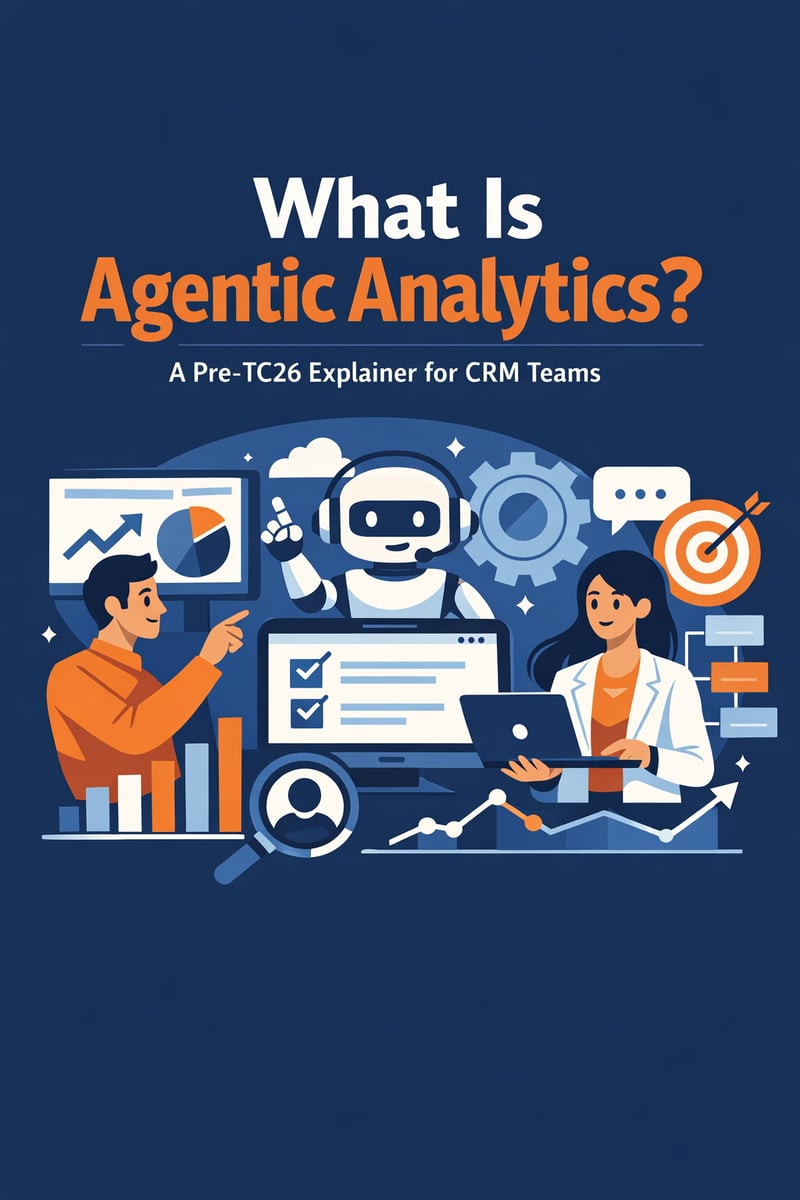
What Is Agentic Analytics?
The Definition
Agentic analytics is an approach to data analytics where AI agents move beyond surfacing insights to autonomously sensing, analyzing, deciding, and acting on your behalf. These goal-oriented systems operate independently: they monitor data streams, detect changes or anomalies, determine what actions to take based on your business objectives, and execute those actions—often without manual intervention.
Think of it this way:
| Traditional BI | Agentic Analytics |
|---|---|
| Shows you what happened | Tells you what's happening and acts on it |
| Requires manual interpretation | Autonomously interprets context |
| Static dashboards and reports | Dynamic, real-time monitoring |
| User-initiated queries | Proactive alerts and automated actions |
| Insights siloed from operations | Actions embedded in operational systems |
What Makes It Different from AI Copilots or Chatbots?
Not all AI in analytics is created equal. Here's how agentic analytics compares to other AI-powered tools:
- Chatbots answer scripted or generative questions on demand—they wait for you to ask
- AI Copilots (like conversational BI) assist with query writing and data exploration—they support your analysis
- Agentic Analytics monitors data, plans responses, and triggers workflows across your business systems—it acts on your strategy
The critical distinction: agentic analytics doesn't just help you make decisions faster—it can make and execute routine decisions for you, within guardrails you define.
How Does Agentic Analytics Work? The Technology Stack
Tableau Next: The World's First Agentic Analytics Platform
Tableau Next represents Salesforce's reimagining of analytics for the agentic era. Launched as a composable, API-first platform, Tableau Next integrates the #1 analytics platform with Agentforce, Salesforce's digital labor platform.
Key Tableau Next capabilities (as of April 2026):
- Model Context Protocol (MCP): A secure, open integration that allows any AI agent to query Tableau's analytics engine directly. Your AI gets accurate, context-grounded answers while keeping data protected by the Agentforce Trust Layer.
- Inspector in Slack: Proactive, natural-language alerts delivered directly to Slack DMs when metric thresholds are breached. You can ask follow-up questions immediately.
- Concierge with Semantic Model Scoping: Govern which semantic models your agents can access, ensuring they only answer questions using vetted, AI-ready data.
- Sales Insights App with Forecasting: Pre-built analytics for sales leaders, automatically integrating Salesforce Forecasting data for metrics like Gap to Quota and Pipeline Coverage.
- Dashboard Extensions: Custom-built Lightning Web Components that allow operational write-back—meaning you can update external systems without leaving your analytics view.
Agentforce: The Action Engine
Agentforce is Salesforce's autonomous AI agent platform. Powered by the Atlas Reasoning Engine and deeply integrated with Salesforce Flow and MuleSoft, Agentforce agents can:
- Interpret analytics insights from Tableau Next
- Trigger actions across Sales Cloud, Service Cloud, and Marketing Cloud
- Orchestrate multi-step business processes end-to-end
- Escalate complex decisions to humans when appropriate
When combined with Tableau Next, Agentforce transforms dashboards from passive displays into intelligent interfaces where actions happen—either through direct user interaction or delegated to agents running in the background.
Data 360: The Unified Data Foundation
Agentic analytics is only as good as the data powering it. Data 360 (formerly Data Cloud) provides the unified data foundation by:
- Aggregating customer data from every touchpoint into a single 360° profile
- Enabling real-time data activation across Salesforce apps and third-party systems
- Feeding trusted, harmonized data into Tableau Next semantic models and Agentforce agents
- Supporting real-time segmentation, identity resolution, and calculated insights
Together, these three components create a closed loop: Data 360 unifies the data → Tableau Next analyzes it → Agentforce acts on it.
Why CRM Teams Should Pay Attention
The Insight-to-Action Gap in CRM
For CRM teams—whether in sales, service, or marketing—the insight-to-action gap is painfully real:
- Sales managers see pipeline dashboards but must manually identify at-risk deals and remind reps to follow up
- Service leaders track case volume trends but rely on manual triage to route cases appropriately
- Marketing teams review campaign performance dashboards but adjust budgets and targeting on weekly or monthly cycles
Every moment of delay between insight and action represents lost revenue, degraded customer experience, or wasted spend.
How Agentic Analytics Closes the Gap
With agentic analytics embedded in your CRM workflow, the same scenarios transform:
- Sales: An agent continuously monitors pipeline velocity, flags deals where engagement has dropped, and automatically sends personalized follow-up emails or schedules re-engagement calls—without the rep needing to check a dashboard
- Service: An agent detects rising case volumes in a specific category, automatically adjusts case routing rules, surfaces relevant knowledge articles, and escalates to a manager only when patterns exceed defined thresholds
- Marketing: An agent monitors campaign ROI in real time, pauses underperforming ads, reallocates budget to top performers, and triggers A/B test variants—all before the weekly review meeting
Cross-Functional Benefits
| Team | Agentic Analytics Benefit |
|---|---|
| Sales | Automated lead scoring updates, pipeline risk alerts, AI-generated outreach |
| Service | Proactive churn detection, intelligent case routing, self-healing workflows |
| Marketing | Real-time campaign optimization, budget reallocation, dynamic personalization |
| Operations | Anomaly detection, SLA monitoring, automated escalation |
| Finance | KPI breach alerts, revenue forecasting adjustments, compliance flag automation |
What to Expect at Tableau Conference 2026 (TC26)
Tableau Conference 2026 runs May 5–7 in San Diego and is squarely focused on agentic analytics. Here's what CRM teams should have on their radar:
Keynotes and Product Announcements
- TC Opening Keynote will feature live demos of agentic analytics in action
- Devs on Stage showcases upcoming product innovations from Tableau developers
- "True to the Core" offers a live Q&A with Tableau product leaders
Hands-On Experiences
- 300+ expert-led sessions covering everything from getting started with agentic analytics to advanced scaling strategies
- 150+ hands-on trainings for building agents, semantic models, and automated workflows
- Tableau Bootcamp (May 3–4) for intensive pre-conference skill-building
Personalized Agentforce Consultations
Book one-on-one sessions with Salesforce experts to explore how agentic analytics applies to your specific organization and CRM deployment.
Key Sessions to Watch For
- Agentic analytics implementation strategies
- Tableau Next MCP deep dives
- Data 360 integration patterns for unified customer views
- Real-world customer success stories
Pro tip: Even if you can't attend in person, Salesforce+ will stream keynotes and select sessions. Follow the #TC26 hashtag for live updates.
How to Prepare Your Organization for Agentic Analytics
Step 1: Audit Your Data Readiness
Agentic analytics depends on clean, unified, real-time data. Before investing in agents, ask:
- Is your CRM data deduplicated and regularly cleansed?
- Do you have a single source of truth for customer records?
- Are your key data sources connected and flowing in near-real time?
If not, consider a Data 360 implementation or data quality initiative as your first step.
Step 2: Identify High-Impact, Rules-Based Decisions
Start with decisions that are frequent, predictable, and follow clear business rules:
- Lead assignment and scoring
- Case priority classification
- Campaign budget adjustments based on performance thresholds
- SLA breach escalation
These are ideal candidates for agentic automation because they're well-defined and low-risk.
Step 3: Define Your Governance Framework
Every agent needs guardrails. Before deployment, establish:
- What actions agents can take autonomously vs. what requires human approval
- Which data sources agents can access (using Tableau Next's semantic model scoping)
- Audit and monitoring protocols for tracking agent decisions
- Escalation paths for edge cases
Step 4: Build Your Semantic Layer
Tableau Next's semantic models are what make agents intelligent. Invest in:
- Defining clear business metrics and KPIs in your semantic layer
- Establishing governed data definitions that agents can query
- Using Tableau Next's auto-generation tools to accelerate semantic model creation
Step 5: Start Small, Then Scale
Run a focused pilot with one team and one use case. Measure results, gather feedback, and iterate before expanding. Organizations that succeed with agentic analytics treat it as a capability they build over time—not a one-time project.
Best Practices for CRM Teams Adopting Agentic Analytics
- Start with your biggest "insight-to-action" bottleneck. Where do insights consistently fail to translate into timely action? That's your first pilot.
- Keep humans in the loop—initially. Use agent recommendations with manual approval before graduating to fully autonomous actions.
- Invest in data quality before agent quality. Agents acting on bad data will amplify errors, not insights.
- Align agent goals with business KPIs. Every agent should map to a measurable business outcome—pipeline velocity, case resolution time, campaign ROI.
- Use MCP to extend analytics across tools. Tableau Next MCP lets any AI application query your analytics engine, so insights aren't locked inside Tableau.
- Train your team on the "why," not just the "how." Adoption requires trust, and trust requires understanding how agents make decisions.
- Monitor agent performance continuously. Use Tableau Next's Q&A Calibration and admin insights to validate agent accuracy and fine-tune over time.
Frequently Asked Questions (FAQ)
What is the difference between agentic analytics and traditional business intelligence?
Traditional BI presents data through dashboards and reports, requiring users to manually interpret insights and take action. Agentic analytics uses AI agents that autonomously monitor data, identify relevant patterns, make decisions aligned with your business goals, and execute actions directly in your operational systems—closing the gap between insight and execution.
Do I need Tableau Next to use agentic analytics?
Tableau Next is Salesforce's purpose-built agentic analytics platform and provides the deepest integration with Agentforce and Data 360. While other analytics vendors offer their own agentic features, Tableau Next provides native connectivity to the Salesforce ecosystem, making it the strongest choice for organizations using Salesforce CRM.
How does Tableau Next MCP work?
Model Context Protocol (MCP) is a secure, open integration standard that allows any AI agent—whether built on Agentforce or a third-party platform—to query Tableau's analytics engine directly. The AI receives accurate, context-grounded answers while the Agentforce Trust Layer ensures data protection, governance, and auditability.
Is agentic analytics safe for regulated industries?
Yes, when implemented with proper governance. Salesforce's Agentforce Trust Layer provides enterprise-grade security, compliance monitoring, and audit trails. Tableau Next's semantic model scoping lets administrators control exactly which data agents can access. Human-in-the-loop approval workflows add an additional safety layer for high-stakes decisions.
What does agentic analytics cost?
Pricing varies based on your Salesforce licensing. Tableau Next is available as a standalone offer or through the Tableau+ Bundle. Agentforce and Data 360 are separately licensed Salesforce products. Contact your Salesforce account executive or a certified implementation partner like Vantage Point for tailored pricing.
When is Tableau Conference 2026?
TC26 runs May 5–7, 2026, at the San Diego Convention Center. Pre-conference Tableau Bootcamps begin May 3. Registration is open at salesforce.com/tableau-conference with last-chance pricing available.
How long does it take to implement agentic analytics?
A focused pilot can launch in 4–8 weeks for organizations with clean data and existing Salesforce/Tableau infrastructure. Full enterprise deployments—including Data 360 unification, semantic model development, and multi-agent orchestration—typically take 3–6 months depending on complexity.
Conclusion: From Dashboards to Decisions
Agentic analytics represents the most significant shift in business intelligence since the move to cloud-based analytics. For CRM teams, it's the long-awaited answer to the question: "How do we make our data actually do something?"
With Tableau Next, Agentforce, and Data 360 working together, your organization can move from passive reporting to proactive, automated decision-making—at scale, with governance, and embedded directly in the workflows your teams use every day.
Tableau Conference 2026 is the launchpad. Whether you attend in person or follow along on Salesforce+, TC26 will showcase the innovations, strategies, and real-world case studies that define the agentic analytics era.
Ready to bring agentic analytics to your CRM? Contact Vantage Point to discuss how our team can help you plan your Tableau Next, Agentforce, and Data 360 strategy—from data readiness assessment to full implementation.
About Vantage Point
Vantage Point is a certified Salesforce and HubSpot implementation partner specializing in CRM strategy, automation, integration, and AI-powered solutions. Our team helps organizations of all sizes unlock the full potential of their technology investments—from Salesforce Sales Cloud and Service Cloud to Tableau, MuleSoft, Data Cloud, and Agentforce. We also implement HubSpot CRM, Aircall telephony, and Anthropic Claude AI solutions to deliver connected, intelligent business operations. Whether you're preparing for agentic analytics or optimizing your existing CRM, Vantage Point brings the expertise to make it happen.