Key Takeaways (TL;DR)
- What is it? The "AI trust gap" is the disconnect between organizations that believe AI is vital to their strategy (90%) and those that have actually defined an AI strategy to act on it (45%)
- Key Stat: 48% of tech leaders trust AI for accuracy, but only 37% trust it to act autonomously: an 11-point gap that stalls agentic AI adoption
- Current State: 36% of enterprises already use agentic AI, while 58% plan to adopt it, but security and governance concerns remain the #1 barrier to scaling
- Data Reality: Only 14% of organizations have fully integrated data, a prerequisite for trusted autonomous AI
- Best For: Technology leaders, CRM administrators, and change management teams evaluating agentic AI readiness
- Bottom Line: Organizations that close the trust gap through governance frameworks, change management, and platforms like Salesforce's Einstein Trust Layer will capture competitive advantage: those that don't risk falling further behind
Introduction: The Paradox of AI Belief Without AI Action
Something unusual is happening in boardrooms across the globe. Nearly every executive agrees that artificial intelligence is critical to their organization's future, yet fewer than half have taken concrete steps to make that vision a reality.
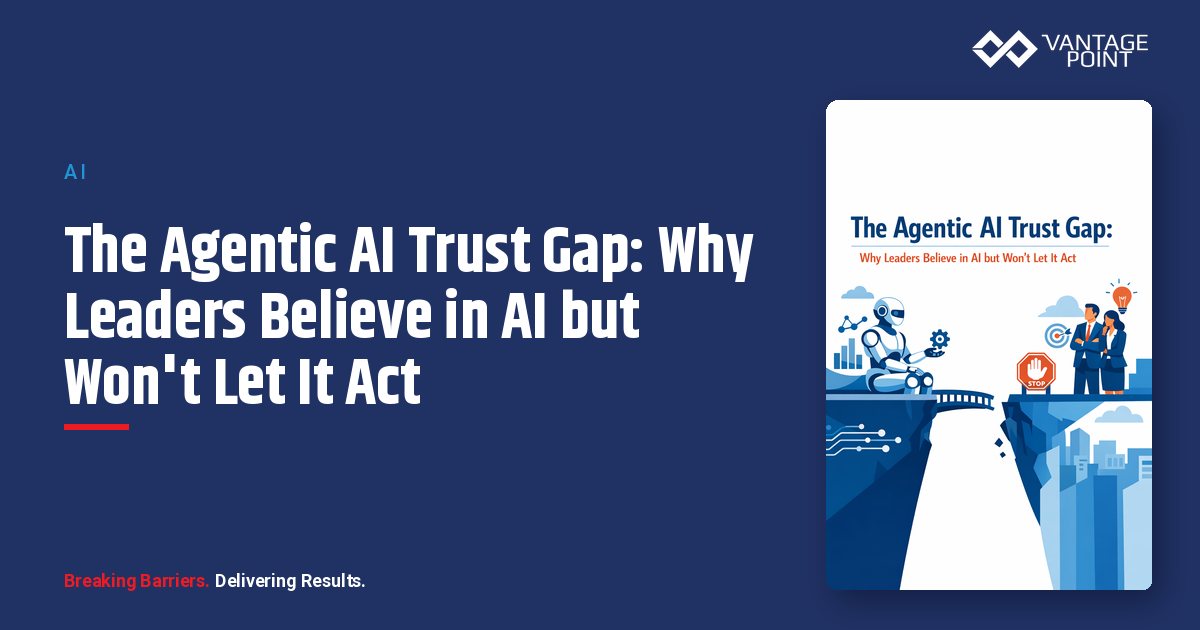
This is the agentic AI trust gap: the measurable disconnect between what leaders believe about AI and what they're actually willing to let AI do.
The Salesforce 2025 Trends in Technology Report, surveying 450 technology leaders globally, quantified this paradox with striking clarity. While 90% of respondents said AI is vital to their business strategy, only 45% had defined an AI strategy to guide deployment. Even more telling: 48% trust AI for accuracy, but just 37% trust AI to act autonomously: a gap that directly impedes the adoption of agentic AI systems designed to take independent action.
This isn't just a technology problem. It's a leadership, governance, and change management challenge that determines whether organizations will capture AI's transformative value or watch it remain trapped in pilot programs and proof-of-concept limbo.
In this guide, we'll dissect the trust gap, explore what's driving it, and provide a practical framework for closing it, so your organization can move from believing in AI to actually letting it work.
What Is Agentic AI, and Why Does Trust Matter More Than Ever?
How Is Agentic AI Different from Traditional AI?
Traditional AI systems generate recommendations, surface insights, and assist human decision-makers. Agentic AI takes the next step: it acts autonomously, executing multi-step workflows, making decisions, and interacting with other systems without requiring human approval at every stage.
Think of the difference this way:
| Capability | Traditional AI | Agentic AI |
|---|---|---|
| Role | Advisor/assistant | Autonomous actor |
| Decision-making | Recommends options | Selects and executes actions |
| Human oversight | Required at each step | Operates within defined guardrails |
| Scope | Single task | Multi-step workflows |
| Risk profile | Limited (wrong suggestion) | Expanded (wrong action taken) |
Salesforce's Agentforce platform exemplifies this evolution, enabling AI agents that can resolve customer service cases, qualify leads, update CRM records, and orchestrate complex business processes: all within governed parameters.
Why Trust Becomes the Bottleneck
When AI only recommends, the worst-case scenario is an ignored suggestion. When AI acts, the stakes escalate dramatically. An autonomous agent that sends an incorrect quote, misroutes a support escalation, or processes data in violation of compliance rules creates real business consequences.
This is why the trust gap matters. According to McKinsey's 2026 AI Trust Maturity Survey of approximately 500 organizations, nearly two-thirds of respondents cited security and risk concerns as the top barrier to fully scaling agentic AI: well ahead of regulatory uncertainty or technical limitations.
Organizations aren't struggling to experiment. They're struggling to trust AI enough to deploy it at scale.
Anatomy of the Trust Gap: What the Data Reveals
The Belief-Action Disconnect
The Salesforce Trends in Technology Report paints a clear picture of the trust gap across multiple dimensions:
| Metric | Percentage |
|---|---|
| Leaders who say AI is vital to business strategy | 90% |
| Organizations with a defined AI strategy | 45% |
| Leaders who trust AI for accuracy | 48% |
| Leaders who trust AI for autonomous action | 37% |
| Organizations already using agentic AI | 36% |
| Organizations planning to adopt agentic AI | 58% |
| Organizations with fully integrated data | 14% |
The 45-percentage-point gap between "AI is vital" (90%) and "we have a strategy" (45%) represents an enormous pool of organizations that recognize AI's importance but haven't operationalized that recognition.
Trust Varies by Department
Not all teams view AI autonomy through the same lens. The Salesforce research found meaningful variation by department:
- Customer service teams tend to trust AI more, likely because they've seen AI successfully handle routine inquiries and case routing
- Sales teams are more skeptical, reflecting concerns about AI making decisions in high-stakes revenue conversations
This departmental trust variance has significant implications for rollout strategy. A one-size-fits-all approach to agentic AI deployment will face resistance in departments with lower baseline trust: even if the technology is capable.
The Data Foundation Problem
Perhaps the most sobering statistic: only 14% of organizations have fully integrated data. This matters because agentic AI is only as good as the data it accesses. An autonomous agent making decisions based on fragmented, siloed, or stale data isn't just inefficient: it's dangerous.
Data readiness is the prerequisite for trusted AI. Without unified, high-quality data, every autonomous action carries elevated risk of error, and every error erodes the trust needed to scale further.
Why the Trust Gap Exists: Five Root Causes
1. Governance Hasn't Kept Pace with Technology
McKinsey's research reveals that while average responsible AI (RAI) maturity improved to 2.3 out of 4.0 in 2026, only about 30% of organizations reached a maturity level of three or higher in strategy, governance, and agentic AI controls. Technical capabilities are advancing, but the organizational structures needed to govern them are lagging.
This governance gap means organizations are deploying increasingly powerful AI without the guardrails, accountability structures, and oversight mechanisms to ensure it operates safely and effectively.
2. Risk Awareness Outpaces Risk Mitigation
A critical finding from the McKinsey survey: across almost all risk types, there is a meaningful gap between risks organizations consider relevant and those they are actively mitigating. This is especially pronounced for intellectual property infringement and personal privacy.
Organizations know what can go wrong. They just haven't built the systems to prevent it.
3. Skills and Training Gaps
Nearly 60% of respondents in McKinsey's survey cited knowledge and training gaps as the primary barrier to implementing responsible AI practices: up from about 50% the prior year. Teams lack the expertise to configure, monitor, and govern autonomous AI systems, which feeds the trust deficit.
4. Fragmented Data Architecture
With only 14% of organizations reporting fully integrated data, the foundation for trusted agentic AI simply doesn't exist in most enterprises. Disconnected CRM records, marketing databases, and operational systems create blind spots that autonomous agents will inevitably encounter.
5. Change Management Is Treated as an Afterthought
Most organizations approach agentic AI as a technology deployment rather than an organizational transformation. Without structured change management (including stakeholder alignment, user training, phased rollouts, and feedback loops) resistance builds and trust erodes before the technology has a chance to prove its value.
How to Close the Trust Gap: A Strategic Framework
Phase 1: Establish Your AI Governance Foundation
What to do: Create a formal AI governance framework before scaling agentic AI. This doesn't have to be complex, but it must be explicit.
Key components:
- AI Ethics Policy: Define clear principles for how autonomous AI will be used, including transparency, fairness, and accountability commitments
- Decision Rights Matrix: Specify which decisions AI can make autonomously, which require human approval, and which are off-limits
- Risk Classification System: Categorize AI use cases by risk level (low, medium, high, critical) with corresponding governance requirements
- Accountability Structure: Assign clear ownership for AI governance. McKinsey found that organizations with explicit RAI ownership scored an average of 2.6 on maturity versus 1.8 for those without
Frameworks to leverage:
- NIST AI Risk Management Framework (AI RMF): Provides a structured approach to identifying, assessing, and managing AI risks
- EU AI Act: Even if your organization isn't in the EU, its risk-based classification system offers a practical model for categorizing AI applications
- ISO/IEC 42001: The international standard for AI management systems, providing certifiable governance requirements
Phase 2: Unify Your Data Foundation
What to do: Agentic AI requires clean, connected, and governed data. Invest in data unification before expanding autonomous AI scope.
Practical steps:
- Audit your data landscape: Map where customer, operational, and transactional data lives across systems
- Implement a unified data platform: Solutions like Salesforce Data Cloud create a single source of truth by connecting disparate data sources in real time
- Establish data quality standards: Define completeness, accuracy, and freshness requirements for data that will inform autonomous decisions
- Enforce data governance policies: Implement role-based access controls, data classification, and lineage tracking before granting AI access
Phase 3: Deploy Trust-Enabling Technology
What to do: Choose platforms with built-in trust and safety capabilities rather than bolting on governance after deployment.
Salesforce's Einstein Trust Layer exemplifies this approach with capabilities purpose-built for trusted AI:
- Data Masking: Automatically masks sensitive data types including PII and PCI information before sending prompts to large language models, configurable to organizational requirements
- Zero Data Retention: Ensures that customer data sent to third-party LLMs is not stored or used for model training
- Dynamic Grounding: Securely infuses AI prompts with business context from structured and unstructured data while maintaining permission controls
- Toxicity Detection: Screens AI outputs for harmful, biased, or inappropriate content before it reaches users
- Audit Trails: Logs every AI interaction (including original prompts, masked prompts, toxicity scores, and feedback data) for accountability and analysis
- Secure Data Retrieval: Maintains existing permission structures and data access controls when AI accesses CRM data
These aren't add-on features. They're architectural commitments that make trust a default rather than an afterthought.
Phase 4: Implement Structured Change Management
What to do: Treat agentic AI adoption as an organizational transformation, not a technology rollout.
The VALUE Change Management Framework:
- V: Validate: Start by understanding current team perceptions of AI. Survey stakeholders across departments to identify trust levels, concerns, and expectations. Remember: customer service teams may be ready while sales teams need more time.
- A: Align: Connect AI capabilities to specific business outcomes that matter to each team. Show sales teams how AI can eliminate data entry, not replace relationship-building. Show service teams how AI can handle routine cases, freeing them for complex issues.
- L: Launch with guardrails: Begin with human-in-the-loop deployments where AI recommends actions but humans approve them. This builds familiarity and evidence of AI competence in a safe environment.
- U: Upskill: Invest in training that goes beyond button-clicking. Teams need to understand what AI can and can't do, how to monitor its performance, and when to escalate. McKinsey found this is the single biggest barrier: tackle it proactively.
- E: Expand: Gradually increase AI autonomy as trust is earned. Move from human-approved to human-monitored to fully autonomous operations in a staged, metrics-driven progression.
Phase 5: Measure, Monitor, and Iterate
What to do: Establish quantitative trust metrics and review them regularly.
Key metrics to track:
| Metric | What It Measures | Target |
|---|---|---|
| AI Decision Accuracy Rate | % of autonomous decisions that were correct | >95% |
| Human Override Rate | How often humans override AI actions | Declining trend |
| Time to Resolution | Speed improvement from AI automation | 30-50% improvement |
| Employee Trust Score | Survey-based measure of team confidence in AI | Increasing trend |
| Compliance Incident Rate | AI-related policy violations | Zero or near-zero |
| Data Quality Score | Completeness and accuracy of AI-accessible data | >90% |
Regular governance reviews (monthly for high-risk applications, quarterly for others) ensure that trust is maintained as AI capabilities expand.
The Role of Platform Choice in Closing the Trust Gap
Not all AI platforms are created equal when it comes to trust. The platform you choose determines whether governance is a built-in capability or a manual burden.
What to Look for in a Trusted AI Platform
- Native trust layer: Security, data masking, and audit capabilities built into the architecture: not bolted on after the fact
- Role-based access controls: Ensuring AI agents respect existing permission structures and can't access data beyond their scope
- Transparent AI operations: Clear visibility into what AI agents are doing, what data they're using, and why they made specific decisions
- Human-in-the-loop capabilities: The ability to configure human oversight at appropriate levels for different use cases and risk profiles
- Regulatory alignment: Built-in support for compliance frameworks like GDPR, NIST, and the EU AI Act
Salesforce's Agentforce platform, powered by the Einstein Trust Layer and grounded in Data Cloud, addresses all five requirements. It enables organizations to deploy autonomous AI agents for sales, service, marketing, and operations while maintaining the governance and transparency that builds trust.
Best Practices for Overcoming the AI Trust Gap
- Start with governance, not technology. Define your AI principles, decision rights, and accountability structures before deploying any autonomous capability.
- Fix your data before you automate. Only 14% of organizations have fully integrated data. You cannot trust AI that operates on fragmented information.
- Match autonomy to risk. Not every process needs full AI autonomy. Use a risk-based approach to determine where human oversight remains essential.
- Invest in change management early. The trust gap is as much cultural as it is technological. Structured change management accelerates acceptance.
- Choose platforms with built-in trust. Retroactively adding governance to AI deployments is exponentially harder than selecting platforms that embed it from the start.
- Measure trust quantitatively. Transform "do people trust AI?" from a vague question into a dashboard of concrete metrics.
- Learn from early adopters. Customer service teams that already trust AI can serve as internal champions and proof points for more skeptical departments.
- Make governance visible. Share audit logs, accuracy reports, and compliance dashboards with stakeholders. Transparency accelerates trust.
Frequently Asked Questions (FAQ)
What is the agentic AI trust gap?
The agentic AI trust gap is the disconnect between organizations that recognize AI's strategic importance (90% of leaders say AI is vital) and those that have actually built the governance frameworks, data foundations, and change management programs needed to deploy autonomous AI at scale (only 45% have a defined AI strategy). It manifests most clearly in the gap between trusting AI for accuracy (48%) and trusting AI to act autonomously (37%).
Why do leaders believe in AI but hesitate to let it act autonomously?
Leaders hesitate because the consequences of autonomous AI errors are significantly higher than those of AI-assisted decisions. When AI only recommends, humans catch mistakes. When AI acts, mistakes execute automatically. Combined with fragmented data (only 14% have fully integrated data), immature governance (only 30% reach high governance maturity), and skills gaps (60% cite training as the top barrier), leaders rationally choose caution over speed.
How does the Einstein Trust Layer help close the AI trust gap?
Salesforce's Einstein Trust Layer provides built-in security and governance features including data masking for PII and PCI data, zero data retention with third-party LLMs, toxicity detection, dynamic grounding with business context, and comprehensive audit trails. These capabilities address trust concerns at the architectural level, enabling organizations to deploy Agentforce's autonomous AI agents with confidence that data is protected and actions are traceable.
What role does data quality play in AI trust?
Data quality is foundational to AI trust. With only 14% of organizations reporting fully integrated data, most enterprises lack the unified data foundation that agentic AI requires to make reliable autonomous decisions. Poor data leads to poor AI decisions, which erodes trust and slows adoption: creating a vicious cycle. Investing in data unification through platforms like Salesforce Data Cloud is a prerequisite for trusted agentic AI.
How should organizations approach change management for agentic AI?
Organizations should treat agentic AI as an organizational transformation, not just a technology deployment. Effective approaches include: validating current trust levels across departments, aligning AI capabilities with team-specific outcomes, launching with human-in-the-loop deployments, investing in comprehensive upskilling programs, and gradually expanding autonomy based on demonstrated results. Recognizing that trust varies by department (customer service teams typically trust AI more than sales teams) is critical for tailoring rollout strategies.
What governance frameworks should organizations adopt for agentic AI?
Organizations should consider the NIST AI Risk Management Framework for structured risk assessment, the EU AI Act's risk-based classification system as a practical governance model, and ISO/IEC 42001 for certifiable AI management standards. Internally, establishing an AI ethics policy, a decision rights matrix, a risk classification system, and clear accountability structures are essential. McKinsey data shows that organizations with explicit AI governance ownership score 44% higher in maturity than those without.
How long does it take to close the AI trust gap?
Closing the trust gap is a progressive process, not a single event. Organizations that invest in governance foundations, data unification, trust-enabling platforms, and structured change management typically begin seeing measurable trust improvements within 3-6 months. Full organizational trust maturity (where agentic AI operates autonomously across multiple business functions) typically takes 12-18 months of sustained effort.
Conclusion: From Belief to Action
The agentic AI trust gap isn't a technology limitation: it's an organizational readiness challenge. The data is clear: organizations believe in AI's potential, but governance, data, skills, and change management must catch up before they'll trust AI to act.
The organizations that will thrive are those that stop treating AI trust as a checkbox and start treating it as a strategic capability. That means investing in governance frameworks, unifying data foundations, choosing platforms with built-in trust layers, and deploying structured change management from day one.
Vantage Point helps organizations close the AI trust gap through our implementation methodology that puts governance and user adoption at the center of every AI deployment. Whether you're evaluating Salesforce Agentforce, building your data foundation with Data Cloud, or establishing AI governance frameworks, our team ensures that your agentic AI investments deliver trusted, measurable results.
Ready to close your organization's AI trust gap? Contact Vantage Point to schedule a strategic assessment of your agentic AI readiness.
About Vantage Point
Vantage Point is a strategic consulting firm specializing in Salesforce, HubSpot, and AI-powered business transformation. As a Salesforce partner with deep expertise in Agentforce, Data Cloud, and MuleSoft integration, Vantage Point helps organizations across industries implement trusted AI solutions that drive real business outcomes. Our approach combines technical implementation with structured change management, ensuring that technology investments translate into adoption, trust, and measurable ROI. Learn more at vantagepoint.io.