
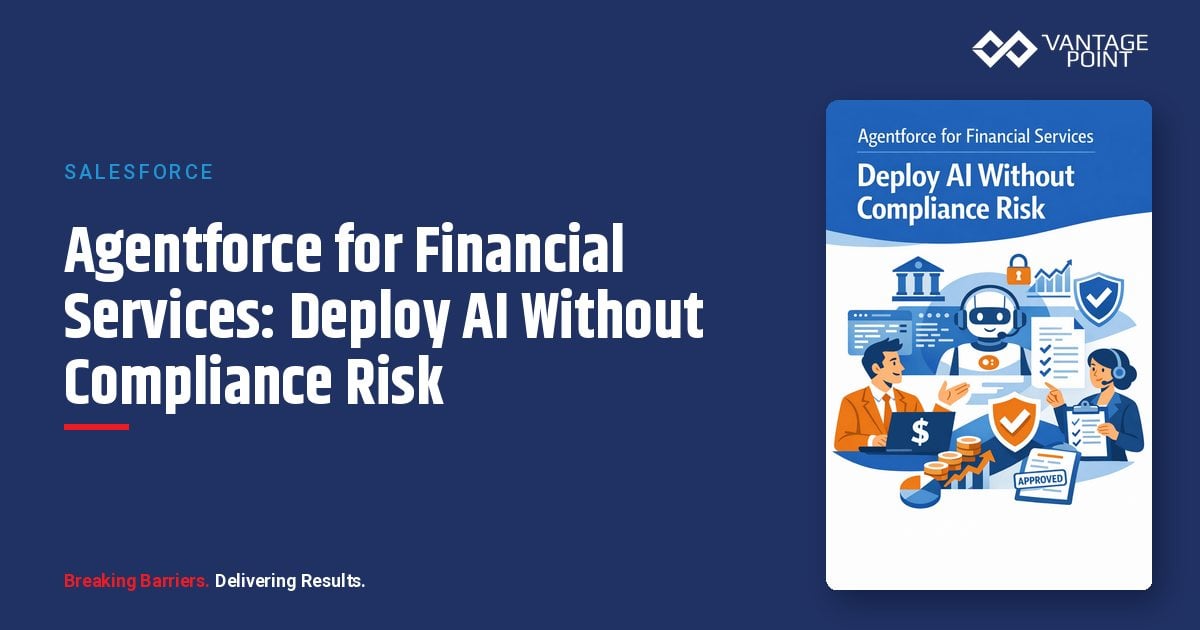
The most common question financial services leaders ask about AI right now is not "what can it do?" It is "how do we deploy it without creating compliance risk?"
That question is the whole game. Banks, insurers, and wealth managers operate under suitability rules, disclosure requirements, recordkeeping obligations, and audit expectations that a generic chatbot was never designed to respect. Salesforce built Agentforce for Financial Services to answer exactly that concern: pre-built, role-based AI agents that operate inside the compliance framework of Financial Services Cloud.
This guide explains what Agentforce for Financial Services actually does, how its trust and governance layers work, and the practical steps a regulated firm should take before turning agents loose on client workflows.
Quick Answer
Agentforce for Financial Services is a set of pre-built, no-code AI agent templates embedded in Salesforce Financial Services Cloud (FSC). It lets banks, insurers, and wealth firms automate front-office tasks — meeting prep, fee reversals, loan discovery, service requests — while enforcing the same approvals, disclosures, and audit trails that govern human employees. Compliance risk is managed through the Agentforce Trust Layer (zero data retention, PII masking), embedded regulatory controls, role-based access, human-in-the-loop checkpoints, and full audit logging in Data Cloud. The deployment risk is not the AI model; it is whether your data, permissions, and processes are ready to govern an autonomous agent.
TL;DR
- What is it? Pre-built, role-based AI agents for banking, insurance, and wealth, embedded natively in Salesforce Financial Services Cloud.
- Key benefit: Automates routine front-office work while enforcing the firm's existing compliance controls, approvals, disclosures, and audit trails.
- How risk is handled: Agentforce Trust Layer (zero data retention, dynamic grounding, data masking), embedded regulatory controls, role-based access, human-in-the-loop, and audit logs in Data Cloud.
- Best for: Regulated firms with a solid Salesforce/FSC foundation that want to scale client engagement without adding headcount.
- Bottom line: The compliance question is answered at the platform layer — but real safety depends on clean data, scoped permissions, and clear human-review rules before you scale.
What Is Agentforce for Financial Services?
Agentforce for Financial Services is a library of pre-built, role-based AI agent templates that automate front-office financial services tasks with no coding required. The agents are grounded in a firm's own data, workflows, and compliance policies, and they run natively inside Financial Services Cloud so digital and human workers operate from the same platform.
In practice, the agents handle the time-consuming work that pulls advisors, bankers, and service reps away from clients — preparing for an investment review, replacing a lost credit card, surfacing loan options, or summarizing a meeting. Salesforce frames this as "digital labor": the agent does the busy work so the human can do the relationship work.
The strategic context matters. Salesforce cites a projected shortfall of roughly 100,000 financial advisors by 2034 and notes that half of the insurance workforce is expected to retire within 15 years. Meanwhile, advisors spend only about 39% of their time on direct client engagement. Agentforce is positioned as a capacity solution — extending teams rather than replacing them.
Which Agentforce Templates Are Available?
Agentforce for Financial Services ships with role-based templates that map to common front-office jobs. Each template includes Topics (which guide agent behavior) and Actions (which let the agent do the work), and firms can extend them in a declarative, no-code environment.
| Template | Who it serves | What it does |
|---|---|---|
| Financial Advisor & Banker Agents | Advisors, relationship managers | Meeting prep, client insight summaries, post-meeting wrap-up, follow-up tasks |
| Banking Service Agent | Retail banking service teams | Balance inquiries, lost-card reporting, rule-based fee reversals, escalations |
| Insurance Service Agent | Insurance carriers and brokers | Quoting support, coverage comparisons, policy service requests |
| Digital Loan Officer Agent | Lending teams | 24/7 loan product discovery for auto and personal loans |
A useful distinction for implementation: customer-facing agents are built as Agentforce Service Agent (ASA) types, while employee-facing agents are Agentforce Employee Agent (AEA) types. Most templates are employee-facing; the customer-facing ones include loan product assistance and banking service assistance. The Banking Service Customer Assistance template can be deployed across WhatsApp, SMS, Experience Cloud, custom mobile apps, and Agentforce Voice.
How Does Agentforce Deploy AI Without the Compliance Risk?
Agentforce manages compliance risk by treating AI agents as governed digital workers, not free-floating chatbots. The controls live at the platform layer through the Agentforce Trust Layer and the compliance framework of Financial Services Cloud. Here is how each major risk is handled.
Data leakage and model training
Salesforce is the secure platform that governs the model — it is not the model itself. The Agentforce Trust Layer (formerly the Einstein Trust Layer) sits between your data and the large language model. It enforces zero data retention through contractual policies with model partners, so customer data is never stored by them and never used to train their foundational models. Dynamic grounding and data masking replace sensitive PII with generic tokens before anything leaves the Salesforce environment.
Unsupervised action
An autonomous agent should never be an unsupervised agent. Agentforce uses "procedural friction" — intentional human-review checkpoints in high-stakes workflows like wealth transfers or claims processing. Agents also inherit the exact same role-based access controls (RBAC) and sharing rules as employees: if a user cannot see the data, neither can the agent.
Regulatory enforcement
Embedded compliance controls ensure agents follow the same approvals, disclosures, and audit trails as human teams. With Process Compliance Navigator, firms embed specific controls directly into the agent's flow of work — automatically including required legal language on disclosures, routing approvals by predefined hierarchy, and escalating exceptions for manual review.
Explainability and audit
Regulators demand explainability, and you cannot audit a "feeling." Every prompt, response, and reasoning step is logged in comprehensive audit trails stored in Data Cloud, with citations to the source data used. Real-time toxicity detection filters harmful outputs. This turns the agent from a black box into a verifiable, auditable business asset.
Why Does This Matter in 2026?
The adoption curve is steep, and trust is the deciding factor. Roughly 82% of organizations intend to integrate AI agents within three years, yet only about 14% have implemented them at scale (Capgemini Research Institute, 2025). The gap between intent and scale is almost entirely a governance gap.
The firms moving fastest are not the ones avoiding risk — they are the ones actively managing it. Salesforce's "AI Stewardship Imperative" framework highlights a consistent pattern among early adopters: they brought their chief risk officers and CISOs to the table on day one. Instead of treating compliance as a blocker, they made risk leaders the architects of scale by answering three questions upfront:
- Can we explain why the AI made that decision?
- Where is the client's PII going?
- Is a human actually in control?
Answering those questions before deployment is what unlocks enterprise-wide adoption. It is also where most firms need a partner.
What Should Financial Firms Do Before Deploying Agents?
Treat each agent like a new employee who needs a job description, system access, supervision, and a performance metric. A practical readiness sequence:
- Confirm your FSC foundation. Agentforce runs natively on Financial Services Cloud. Being on the FSC Managed Package does not block adoption — most templates work out of the box, and migration to FSC Standard is a separate long-term decision, never a prerequisite.
- Audit data quality and permissions. Agents inherit your access model and reason on your data. Duplicate records, stale fields, and overly broad permissions become agent problems.
- Pick one high-value, lower-risk use case. Meeting prep, service triage, or loan discovery are strong starting points where speed changes outcomes without high regulatory exposure.
- Define human-in-the-loop rules. Document exactly when an agent can act, must recommend, or must escalate — especially for disclosures, suitability, and transactions.
- Embed compliance controls. Use Process Compliance Navigator and FSC's framework to enforce approvals, disclosures, and audit logging inside the workflow.
- Bring risk and security in early. Make your CRO and CISO co-owners of the rollout, not last-minute reviewers.
- Measure against a business metric. Tie each agent to first-response time, advisor capacity, conversion, or resolution time.
How Does This Apply if You Run HubSpot or a Multi-Platform Stack?
The compliance-first principle is platform-agnostic. HubSpot is building its own AI agents and usage-based model, and many growing firms run HubSpot and Salesforce together. Regardless of platform, the same questions decide whether AI is safe to scale: Is the data clean? Are permissions scoped? Is governance defined? Is there a human in the loop for high-stakes actions?
Vantage Point helps organizations evaluate, implement, and optimize Salesforce and HubSpot based on their operating model, data needs, adoption goals, and growth strategy. Because we are vendor-agnostic, our guidance focuses on the governance and data layer that makes any agent trustworthy — not a single vendor's feature list.
If your team is evaluating how Agentforce, FSC, HubSpot, or CRM governance applies to your firm, Vantage Point can help assess the right next step and build a practical, compliance-first implementation plan.
How Vantage Point Helps
Vantage Point is a senior-led, AI-augmented CRM consultancy with deep financial services experience — our founder and CEO is a former COO in financial services, so we understand the regulatory weight behind every AI decision.
- Financial Services Cloud strategy: Our Salesforce Financial Services Cloud team helps banks, insurers, and wealth firms plan Agentforce adoption on a solid FSC foundation.
- Compliance and governance: Our compliance and security solutions practice designs the access models, audit controls, and human-review rules that keep agents defensible.
- Data and integration foundations: Our system integration and data migration services prepare the clean, connected data agents depend on.
- AI strategy and adoption: Our AI-driven personalization and analytics practice and advisory and change management team connect agents to measurable outcomes and help teams adopt them with confidence.
FAQ
What is Agentforce for Financial Services?
Agentforce for Financial Services is a set of pre-built, role-based AI agent templates embedded in Salesforce Financial Services Cloud. The agents automate front-office tasks like meeting prep, service requests, and loan discovery while operating inside the firm's compliance framework. They require no coding to deploy and can be customized in a declarative environment.
How does Agentforce handle compliance risk?
Agentforce enforces the same approvals, disclosures, and audit trails that govern human employees, using embedded compliance controls and the Agentforce Trust Layer. It applies zero data retention, masks PII before data reaches any model, inherits role-based access controls, and logs every action in Data Cloud for audit. High-stakes workflows include human-review checkpoints.
Does the FSC Managed Package block Agentforce adoption?
No. Customers on the Financial Services Cloud Managed Package can adopt Agentforce for Financial Services today, and most templates work out of the box. Migration from the Managed Package to FSC Standard is a separate, long-term decision and is never a prerequisite for using Agentforce.
What is the Agentforce Trust Layer?
The Agentforce Trust Layer is a secure architecture built into the Salesforce platform that resolves prompts and outputs within your trust boundary before any interaction with a large language model. It provides zero data retention, dynamic grounding, PII masking, and toxicity detection. It lets the model supply intelligence while Salesforce supplies security, custody, and compliance.
Which Agentforce templates are customer-facing versus employee-facing?
Customer-facing templates are built as Agentforce Service Agent (ASA) types, including loan product assistance and banking service customer assistance. Most other templates, such as advisor and banker meeting prep, are employee-facing Agentforce Employee Agent (AEA) types. The Banking Service Customer Assistance template can deploy across WhatsApp, SMS, Experience Cloud, custom mobile apps, and Agentforce Voice.
Do AI agents need clean CRM data to be safe?
Yes. Agents reason on your data and inherit your permission model, so duplicate records, stale fields, and overly broad access become agent risks. Strong data hygiene and scoped permissions are prerequisites for safe deployment. Vantage Point typically starts financial services engagements with a data and governance assessment.
How should a financial firm start with Agentforce?
Start by confirming your FSC foundation, auditing data quality and permissions, and choosing one high-value, lower-risk use case such as meeting prep or service triage. Define human-in-the-loop rules, embed compliance controls, and bring risk and security leaders in early. Tie the agent to a measurable business outcome before scaling.
Can Agentforce work alongside HubSpot or other platforms?
Yes. The compliance-first approach applies across platforms, and many firms run HubSpot and Salesforce together. The governance fundamentals — clean data, scoped permissions, defined human oversight, and outcome-tied use cases — are the same regardless of vendor. Vantage Point advises on both platforms with a vendor-agnostic, governance-first lens.