Quick Answer
AI agents can help wealth-management advisors spend less time on routine back-office work and more time with clients. They can prepare client briefs, organize notes, propose follow-ups, create tasks, and support controlled documentation workflows. The goal is not to automate the advisor-client relationship; it is to help advisors arrive prepared, follow through consistently, and apply their judgment where clients need it most.
Key Takeaways (TL;DR)
- What it is: Advisor productivity AI uses agents to coordinate routine work around client meetings and in the back office.
- Key benefit: Advisors spend less time searching, documenting, and chasing tasks—and more time advising and following through.
- Where to start: Pilot meeting preparation or post-meeting follow-up, where the workflow is frequent and easy to review.
- Controls matter: Use approved data sources, permissions, disclosure rules, human approvals, and auditable action histories.
- Best for: Wealth-management organizations that want to improve capacity without sidelining client service or compliance.
- Bottom line: The productivity dividend is better client attention and more reliable follow-through, not unsupervised automation.
Advisors are hired for judgment: understanding a client’s priorities, explaining trade-offs, and building trust over time. Yet much of an advisor’s day can disappear into the work around the conversation—assembling information, documenting it, routing tasks, finding the right disclosure, and recording what happened.
That is the advisor productivity paradox: fragmented CRM, portfolio, document, email, and compliance work consumes time intended for clients.
AI agents can change that operating model by retrieving approved context, following defined workflows, proposing permitted actions, and retaining a record. Salesforce’s Financial Advisor Assistance use case focuses on reducing manual processes and improving advisor productivity. It requires deliberate process, data, and control design.
Why Is Advisor Productivity Trapped in the Back Office?
Client work begins before the meeting and continues afterward. Advisors need household, interaction, portfolio, service, document, and policy context; the friction is moving among systems and handoffs.
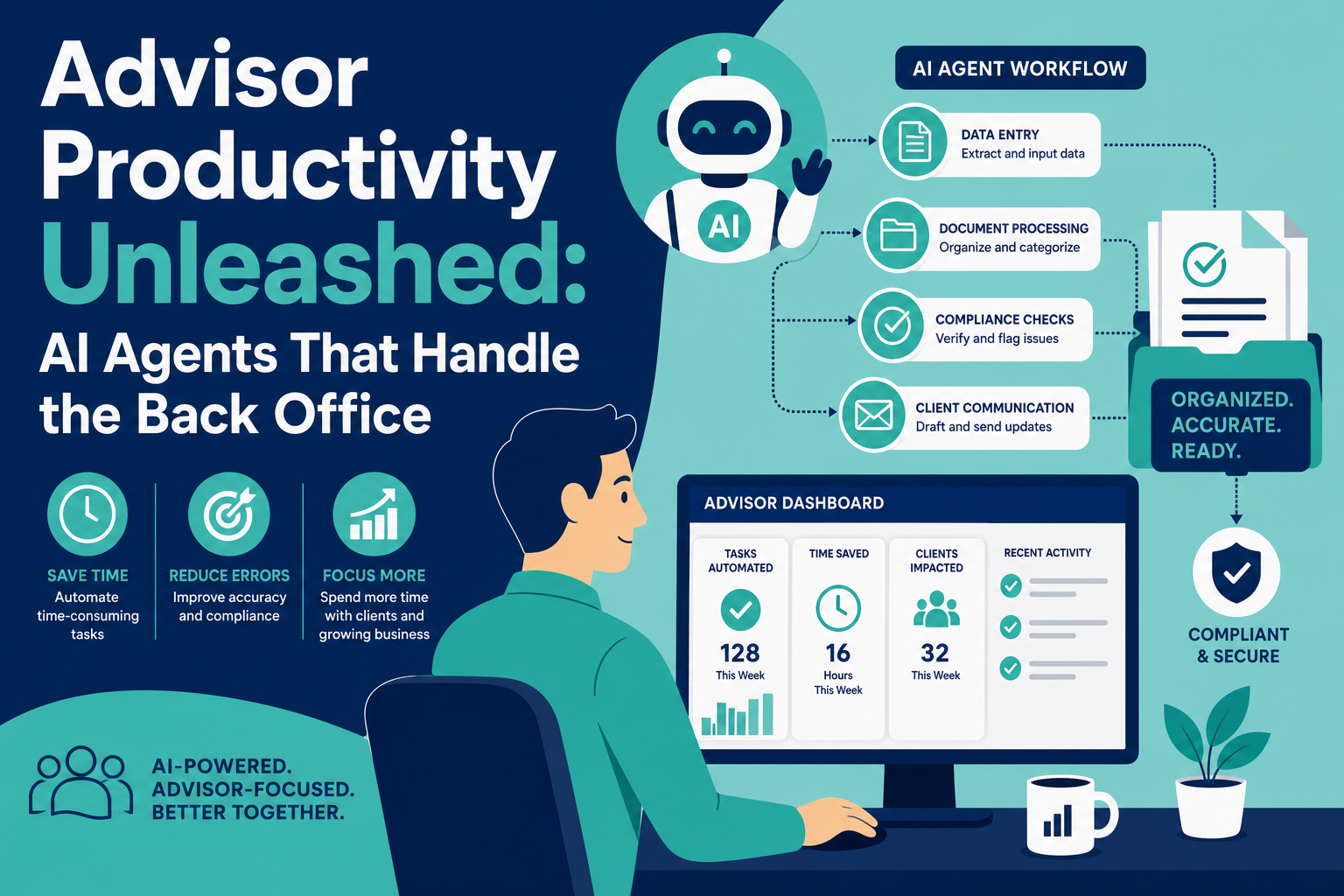
| Back-office task | What creates friction | What an AI agent can support |
|---|---|---|
| Data entry and updates | Details arrive in notes, email, calls, and documents | Suggest CRM updates and identify missing context for review |
| Document processing | Teams search for the right version and route documents | Classify approved documents, summarize permitted content, and route work |
| Compliance workflows | Required steps and disclosures vary by process | Surface checklists, flag missing information, and preserve workflow history |
| Meeting preparation | Context lives across several records and systems | Assemble a brief, agenda, portfolio context, and talking points |
| Follow-up work | Commitments scatter among notes, inboxes, and task lists | Structure notes, propose tasks, and draft follow-up messages |
The aim is not full autonomy. Recommendations, account changes, and client communications require human authority and firm-specific controls. First-pass work still has value when it is consistent, reviewable, and surfaces the next best action.
How Do AI Agents Automate Routine Back-Office Work?
An AI agent is more than a text-generation tool. In a well-designed Salesforce environment, it is configured around approved data, topics, actions, permissions, and escalation paths. It can interpret a request, retrieve context it may access, follow a workflow, and return a useful result or proposed action.
For wealth-management teams, productivity work is a sequence: find context, interpret an event, identify a required step, update the right record, and surface what needs attention.
Trusted context
Use only the client, household, account, interaction, and knowledge sources that have been approved for the task. Define which records are authoritative, which information is sensitive, and what the agent must not use. Clean data and a clear client model are prerequisites, not issues to postpone until after launch.
Bounded actions and clear evidence
Start with contained actions: prepare a brief, draft an email, create a follow-up task, or identify a missing document. Do not allow an agent to silently make a recommendation, send an unreviewed message, or override a control. Record the source context, output, proposed or completed action, approver, and time. Salesforce’s AI stewardship guidance for financial services highlights policy-driven controls and audit trails; firms still need to define, test, and monitor their own policies.
What Can AI Do Before a Client Meeting?
Meeting preparation is often an effective first use case because it is frequent, visible, and closely connected to client experience. The advisor still decides what matters and how to discuss it; the agent removes the scramble.
A meeting-preparation agent can create an approved, concise brief that brings together:
- household relationships, stated goals, preferences, and relevant life events recorded in the CRM;
- recent interactions, open cases, and unresolved requests;
- portfolio or plan context available through approved integrations;
- upcoming milestones, required documents, and prior commitments; and
- proposed agenda items and talking points for the advisor to validate.
Salesforce’s Agentforce announcement for financial services describes preparation that brings together portfolio, interaction, and CRM information to surface insights and generate structured agendas. In practice, define a standard brief format, specify permitted sources, and visibly flag incomplete or stale data.
A useful brief is short enough to act on, not a data dump. Before expanding the use case, ask whether the advisor can quickly see what changed since the last conversation, what needs attention now, and what preparation still requires human input.
How Can AI Improve Post-Meeting Follow-Through?
The client experience is often won or lost after the meeting. A strong conversation has less value if commitments are captured incompletely, follow-ups are delayed, or the next meeting begins with someone reconstructing what happened.
After an advisor reviews a meeting note or approved transcript, an agent can help turn the raw conversation into a repeatable workflow:
- Structure the recap. Identify discussion themes, needs, concerns, and next steps in a consistent format.
- Propose action items. Suggest tasks, owners, due dates, and dependencies for the advisor or service team to confirm.
- Draft a follow-up. Prepare a plain-language recap email that the advisor reviews, edits, and sends through the approved process.
- Update the CRM. Propose relationship, goal, service, or interaction-record updates without overwriting trusted information automatically.
- Route exceptions. Identify work needing compliance, operations, or specialist review rather than treating every next step as routine.
Salesforce’s Trailhead module on meeting concierge workflows illustrates post-meeting actions such as drafting a follow-up email, updating goals, and creating tasks. These should remain reviewed workflows: a human validates the note, owner, and outgoing client communication.
The benefit is more than faster notes. Commitments become visible work, work has an owner, and the advisor has a clear view of what must happen before the next touchpoint.
How Do AI Agents Support Compliance Without Making Compliance Claims?
Compliance support is valuable—and sensitive. An agent can help operationalize a defined process. It cannot independently determine that a firm is compliant, make a regulatory judgment, or replace legal and compliance oversight.
The practical role is to make the approved process easier to follow and evidence. For example, an agent may:
- present a workflow checklist and flag missing required fields;
- associate approved disclosures and documentation with the appropriate interaction;
- identify a record that needs a configured review or exception workflow; and
- capture a history of generated drafts, approvals, edits, and completed actions.
“Automated documentation” should mean structured, reviewable evidence—not unexamined AI-generated records. “Disclosure tracking” should mean the organization can see which approved process applied and what evidence was captured—not that the system decided a disclosure was sufficient.
Salesforce documents generative AI audit trails for tracking AI use within an organization. Pair platform capabilities with your own access controls, retention requirements, supervision process, testing plan, and escalation protocol. For the broader CRM foundation, explore Vantage Point’s compliance and security solutions and Salesforce implementation and advisory services.
What Is the Productivity Dividend for Advisors and Clients?
The best productivity outcome is not a dashboard full of automated actions. It is an advisor who arrives prepared, listens more closely, communicates with context, and follows through reliably. That can create capacity for more client conversations, deeper relationships, and a more scalable practice—but benefits should be measured in the firm’s own environment, not assumed from a vendor demo.
| Dimension | What to measure | Why it matters |
|---|---|---|
| Client-facing capacity | Time available for preparation, conversations, and proactive outreach | Shows whether attention is returning to clients |
| Service consistency | Completion and timeliness of follow-ups, rework, and exception rates | Shows whether automation improves the experience rather than shifts work |
| Adoption and quality | Advisor use, review rates, edits, and feedback on briefs and recaps | Shows whether output is trusted enough to sustain |
Capture a baseline before introducing the agent. During a small pilot, evaluate manual assembly effort, follow-up completion, exception routing, advisor edits, and output quality. These are more useful than prompt volume or automated-action counts because they connect the technology to client service and operational control.
Where Should a Wealth-Management Team Start With AI Agents?
Start narrow, with a workflow where value and controls are both clear. Meeting preparation is a strong candidate because it has a defined trigger, repeatable output, and natural human reviewer. Post-meeting task creation can also work when ownership and CRM hygiene are already governed.
- Map the current workflow. Document inputs, systems, approval points, exceptions, and desired output. Eliminate unnecessary steps before automating them.
- Select a constrained pilot. Choose one advisor team or meeting type. Define what the agent may access and do, plus explicit escalation conditions.
- Prepare data and integrations. Resolve ownership, duplicate, quality, and access issues. Confirm connected portfolio or document data is appropriate for the use case.
- Design review and change management. Train advisors to check a brief, correct a task, and report a poor result. Make accountability clear.
- Measure, refine, and expand. Use adoption, output quality, service consistency, and governance evidence to decide where to extend the workflow.
Change management deserves as much attention as configuration. Advisors and service teams need to know what the agent sees, when it acts, how to correct it, and what accountability remains with them. Vantage Point’s advisory and change management services can help align workflow design, user adoption, and governance before an Agentforce program scales.
Make the Back Office Serve the Client Relationship
AI agents are most valuable when they restore focus that administrative fragmentation takes away. They can organize inputs to an informed meeting, turn a conversation into accountable follow-through, and make controlled documentation easier to maintain. The advisor remains responsible for the relationship, advice, judgment, and client trust.
A well-designed Agentforce implementation does not automate care out of wealth management. It removes the routine work that gets in the way of care. Talk to Vantage Point about Agentforce for wealth management to plan a practical, controlled path from back-office burden to more client-facing capacity.
FAQ
What back-office tasks can AI agents handle for financial advisors?
AI agents can support repeatable work such as client-meeting briefs, approved-note organization, follow-up task proposals, draft messages for review, missing-information checks, and queue routing. The firm must define permitted data and actions for every workflow.
Can an AI agent make investment recommendations for clients?
Do not assume an agent can replace advisor judgment, supervision, or firm policies. Use agents to organize information and support defined workflows; retain appropriate human authority for recommendations, communications, and regulated decisions.
How does AI improve client meeting preparation?
An agent can bring approved household, interaction, service, and portfolio context into a consistent brief, then propose an agenda and talking points for the advisor to review. This reduces manual searching and focuses preparation on what changed and what needs a conversation.
How can AI help after a client meeting?
After a human reviews the meeting record, an agent can structure the recap, suggest action items and owners, create proposed CRM tasks, and draft a follow-up email for approval. A designated person should validate accuracy before anything is sent.
Does Agentforce make a wealth-management organization compliant?
No. Platform features and workflows can support policies, documentation, access controls, and auditability, but they do not determine compliance. Firms need their own compliance leadership, controls, testing, supervision, and procedures.
What is the best first AI-agent use case for advisor productivity?
Choose a high-frequency workflow with trusted inputs, a defined output, and a natural review step. Meeting preparation and post-meeting follow-up are often effective because an advisor can validate the output before it affects a client or record.
How should a firm measure AI-agent productivity?
Set a baseline, then track client-facing capacity, meeting-preparation effort, follow-up timeliness, rework, exceptions, and advisor feedback. The key question is whether the workflow improves client service and operational control.
About Vantage Point
Vantage Point is a senior-led, US-based, employee-owned Salesforce consulting firm that helps organizations improve CRM, automation, data, and AI workflows. We bring practical implementation, integration, compliance, and change-management guidance to Salesforce initiatives. Visit vantagepoint.io to learn more.