
Key Takeaways (TL;DR)
- What is CRM user adoption? The percentage of your team actively and consistently using your CRM system as part of their daily workflows, not just logging in, but actually leveraging the platform to drive results
- Key Stat: Up to 50% of CRM implementations fail due to poor user adoption, yet organizations that reach 70%+ daily active usage see dramatically higher ROI
- Timeline: Expect 3-6 months to reach strong adoption with phased rollout; 95% adoption is achievable within 9-12 months with sustained effort
- Investment: Change management and training typically add 15-25% to total CRM project cost, but skipping it costs far more in lost ROI
- Best For: Any organization launching a new CRM, migrating platforms, or struggling with low engagement on an existing system
- Bottom Line: The difference between a failed CRM and a transformative one isn't the technology: it's the adoption strategy
Introduction
Your organization just invested six or seven figures in a new CRM platform. The implementation team delivered on time. The data migrated cleanly. The integrations work. And yet, three months later, half your team is still tracking deals in spreadsheets, logging notes in email folders, and treating the CRM like an afterthought.
Sound familiar? You're not alone.
Up to 50% of CRM implementations fail: and the culprit is almost never the technology itself. It's adoption. More specifically, it's the gap between deploying a CRM and getting your people to actually use it in ways that drive measurable business outcomes.
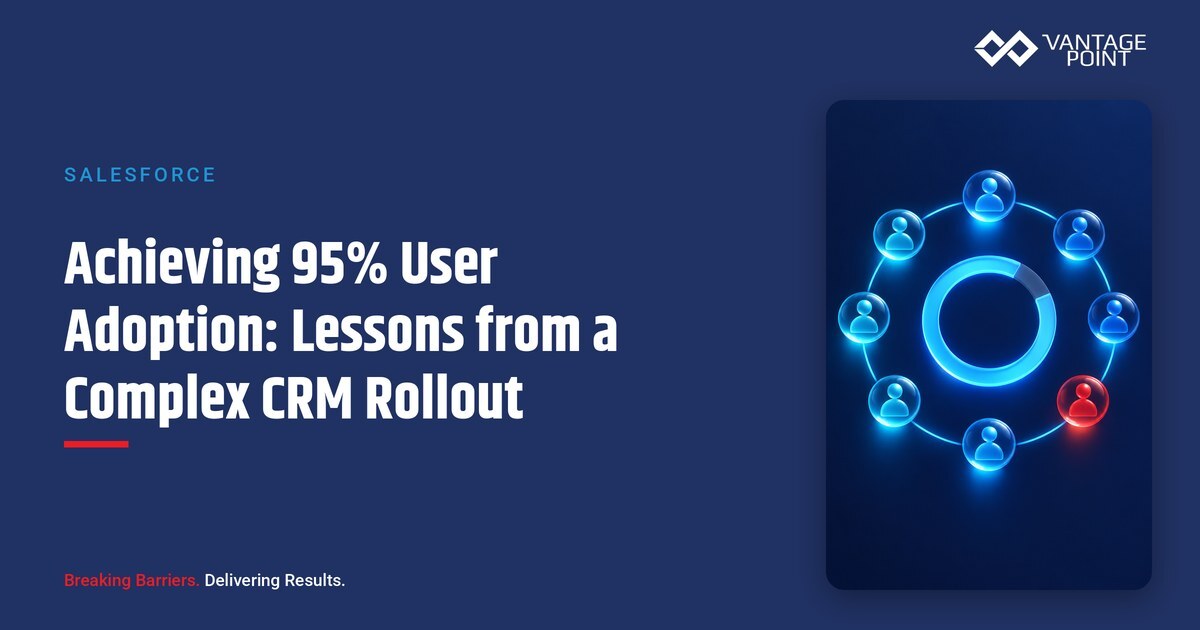
But here's the good news: achieving 95% user adoption isn't a fantasy. It's a repeatable outcome when you pair the right technology decisions with a deliberate change management strategy. At Vantage Point, we've guided organizations through complex CRM rollouts that achieved adoption rates well above industry averages, and we've distilled those lessons into a practical playbook any business can follow.
In this guide, you'll learn the specific strategies, frameworks, and tactics that separate high-adoption CRM deployments from expensive shelf-ware. Whether you're planning your first CRM implementation or trying to rescue a struggling one, these lessons will help you build a system your team actually wants to use.
Why CRM Adoption Fails: The Real Reasons Behind the 50% Failure Rate
Before we talk about what works, let's understand what doesn't, and why so many CRM rollouts fall short.
The Mandate Trap
The most common adoption killer? Treating CRM usage as a mandate rather than a value proposition. When leadership says "you must use the CRM" without articulating why it benefits each individual user, you get compliance at best and resentment at worst. People log in to check a box, enter the minimum data required, and continue doing their real work elsewhere.
Workflow Misalignment
CRMs fail when they're designed around how management wants to track data rather than how teams actually work. If a sales rep has to click through seven screens to log a call that used to take a sticky note, you've introduced friction, and friction kills adoption.
The Training Gap
Many organizations treat training as a one-time event: a four-hour session during launch week, a PDF user guide, and a "good luck." But CRM mastery is a journey, not a destination. Without ongoing, role-specific training, users plateau at basic functionality and never discover the features that would actually save them time.
Data Quality Death Spiral
When early users enter incomplete or inconsistent data, the CRM becomes unreliable. When the CRM is unreliable, other users stop trusting it. When users stop trusting it, they stop contributing to it. This death spiral can render a CRM useless within months of launch.
No Executive Sponsorship
CRM adoption initiatives without visible executive sponsorship send an implicit message: this isn't really important. When leadership doesn't model CRM usage or tie it to strategic outcomes, middle management deprioritizes it, and frontline users follow suit.
The 95% Adoption Framework: Five Pillars of Success
Achieving near-universal adoption requires a holistic approach that addresses technology, people, and process simultaneously. Here are the five pillars that consistently drive results.
Pillar 1: Design for the User, Not the Report
The single most impactful decision you can make is designing your CRM around user workflows rather than management reporting needs. This means:
- Mapping daily workflows first. Before configuring a single field, shadow your users. Understand how sales reps prospect, how service agents handle cases, how marketers track campaigns. Then build the CRM to mirror and enhance those workflows.
- Minimizing clicks and data entry. Every unnecessary field, every redundant screen, every manual entry is adoption friction. Ruthlessly eliminate anything that doesn't directly serve the user or a critical business process.
- Automating data capture. Modern CRMs can automatically log emails, calls, meetings, and website interactions. Leverage these capabilities aggressively. The less your team has to manually enter, the more likely they are to engage.
- Creating role-specific views. A sales rep and a customer success manager have fundamentally different needs. Build custom dashboards, page layouts, and navigation paths for each role so every user sees exactly what they need and nothing they don't.
Pro Tip: At Vantage Point, we use a "Day in the Life" exercise during discovery, mapping each user role's typical day and identifying exactly where the CRM should add value vs. where it might add friction. This exercise alone has prevented countless adoption pitfalls.
Pillar 2: Build a Change Management Engine
Technology deployment without change management is like buying a gym membership without a workout plan. You need a structured approach to moving people from awareness to proficiency.
The ADKAR Framework for CRM
We recommend adapting the ADKAR model (Awareness, Desire, Knowledge, Ability, Reinforcement) specifically for CRM rollouts:
- Awareness: Communicate why the organization is investing in CRM and what problem it solves. Be specific, "to eliminate the 12 hours per week our team spends on manual reporting" resonates more than "to improve efficiency."
- Desire: Create personal motivation for each role. Show sales reps how the CRM will help them close more deals. Show service agents how it will reduce their handle times. Make it personal.
- Knowledge: Deliver role-specific, phased training (more on this below).
- Ability: Provide hands-on practice environments, job aids, and real-time support so users can apply what they've learned.
- Reinforcement: Celebrate wins, share success stories, and continuously demonstrate the value the CRM is delivering.
Stakeholder Mapping
Not all users are created equal when it comes to adoption influence. Map your stakeholders into four categories:
| Category | Description | Strategy |
|---|---|---|
| Champions | Enthusiastic early adopters | Empower them as peer mentors and beta testers |
| Pragmatists | Open but need proof | Show them quick wins and concrete ROI |
| Skeptics | Doubtful but persuadable | Address their specific concerns; pair with champions |
| Resistors | Actively opposed | Understand root causes; involve in design decisions |
Invest your change management energy proportionally. Champions amplify your message, while converting even one resistor can shift an entire team's attitude.
Pillar 3: Deliver Training That Actually Sticks
The research is clear: one-time training events produce short-term awareness but not lasting behavior change. High-adoption organizations use a phased, multi-modal training approach:
Phase 1: Pre-Launch (2-4 Weeks Before Go-Live)
- Core navigation and basic concepts
- "Why this matters to you" messaging for each role
- Access to sandbox environments for exploration
- Identify and train power users/champions first
Phase 2: Launch Week
- Role-specific workflow training (hands-on, not lecture-based)
- Live data exercises using real scenarios
- Quick-reference guides and cheat sheets for daily tasks
- Dedicated support channels (Slack, Teams, or in-app chat)
Phase 3: Post-Launch (Weeks 2-8)
- Advanced feature workshops based on adoption data
- "Office hours" for Q&A and troubleshooting
- Peer learning sessions led by champions
- Process refinement based on user feedback
Phase 4: Ongoing (Monthly)
- New feature training as capabilities expand
- Refresher sessions for areas with declining metrics
- Advanced certification paths for power users
- Quarterly business reviews tying CRM usage to outcomes
Gamification That Works
Gamification can accelerate adoption when done thoughtfully:
- Points and leaderboards for data completeness, not just login frequency
- Badges or certifications for mastering specific workflows
- Team competitions that foster collaboration, not just individual performance
- Tangible rewards tied to adoption milestones (gift cards, extra PTO, public recognition)
The key is rewarding valuable CRM behaviors, not just activity. Logging 100 empty contacts isn't adoption. Maintaining accurate pipeline data with next steps and close dates is.
Pillar 4: Measure What Matters
You can't improve what you don't measure. High-adoption organizations track a specific set of metrics and review them religiously.
Core Adoption Metrics
- Daily Active Users (DAU): The percentage of licensed users who log in and perform meaningful actions daily. Target: 70%+ as baseline, 90%+ as goal.
- Record Creation Rate: New contacts, opportunities, cases, and activities created per user per week. Declining rates signal disengagement.
- Data Completeness Score: Percentage of required fields populated across key objects. Target: 85%+ for critical fields.
- Feature Utilization: Which features are being used and which are being ignored? Low utilization may indicate training gaps or poor configuration.
- Time-to-Value: How quickly new users reach proficiency (defined as completing key workflows independently).
The Adoption Dashboard
Build a real-time adoption dashboard that leadership reviews monthly. Include:
- Overall adoption rate trend (daily, weekly, monthly)
- Adoption by department, team, and role
- Top users and teams (celebrate success)
- Feature adoption heatmap
- Data quality scores by object type
- Support ticket volume and categories
Benchmark: Organizations that reach 70% daily active usage are ready to introduce advanced features like AI-powered insights, predictive analytics, and automated workflows. Pushing these features too early, before baseline adoption, often backfires.
Pillar 5: Make the CRM Indispensable
The ultimate adoption strategy is making the CRM so valuable that users can't imagine working without it. Here's how:
- Integrate everything. Connect email, calendar, phone, chat, marketing automation, and business intelligence tools so the CRM becomes the single source of truth. When users have to leave the CRM to get information, adoption suffers.
- Automate the tedious. Use workflow automation to eliminate repetitive tasks: auto-assign leads, trigger follow-up reminders, generate reports, update records based on email interactions. Every automated task is one less reason for users to resent the system.
- Deliver AI-powered insights. Modern CRM platforms offer AI capabilities that surface next-best actions, predict deal outcomes, score leads, and recommend content. These features transform the CRM from a data entry tool into a strategic advisor.
- Mobile-first access. Teams that access CRM on mobile devices are 150% more likely to hit their targets. Ensure your CRM experience is fully optimized for phones and tablets, especially for field-based roles.
- Close the feedback loop. Regularly ask users what's working and what isn't. When you act on feedback (removing a frustrating field, adding a requested report, fixing a broken workflow) you demonstrate that the CRM serves them, not just management.
How to Rescue a Struggling CRM Deployment
What if you've already launched and adoption is lagging? It's not too late. Here's a recovery playbook:
Step 1: Diagnose the Problem
Conduct an adoption audit:
- Pull usage analytics (logins, actions, data quality)
- Interview users across roles and departments
- Identify the top 3-5 friction points
- Assess whether the issue is technology, training, or culture
Step 2: Quick Wins (Weeks 1-4)
- Fix the top 3 user complaints immediately
- Simplify page layouts and remove unnecessary fields
- Enable automation for the most hated manual tasks
- Launch a "fresh start" communication campaign
Step 3: Rebuild Momentum (Months 2-3)
- Relaunch training with role-specific, hands-on sessions
- Appoint departmental CRM champions
- Set team-level adoption goals with accountability
- Share early wins and ROI data broadly
Step 4: Sustain and Scale (Months 4+)
- Implement ongoing measurement and review cadence
- Introduce advanced features for power users
- Expand integrations to increase CRM centrality
- Tie CRM proficiency to performance reviews where appropriate
What 95% Adoption Actually Looks Like
When an organization achieves 95% CRM adoption, the transformation is unmistakable:
- Sales teams rely on the CRM for pipeline management, forecasting, and coaching: no more shadow spreadsheets
- Service teams resolve cases faster with complete customer history at their fingertips
- Marketing teams attribute revenue to campaigns and optimize spend based on real data
- Leadership makes strategic decisions using real-time dashboards instead of gut instinct
- New hires onboard faster because institutional knowledge lives in the CRM, not in people's heads
The business impact is equally dramatic. Organizations with high CRM adoption consistently report:
- 25-35% increase in sales productivity
- 20-30% improvement in customer satisfaction scores
- 40-50% reduction in reporting time
- 15-25% improvement in forecast accuracy
- Significantly faster onboarding for new team members
Best Practices for Sustaining High Adoption Long-Term
- Never stop training. CRM platforms evolve constantly. Quarterly training on new features keeps users engaged and ensures you're maximizing your investment.
- Maintain a CRM governance committee. A cross-functional team that reviews adoption metrics, prioritizes enhancements, and manages change requests keeps the CRM aligned with evolving business needs.
- Invest in your admin team. Dedicated CRM administrators who understand both the technology and the business are worth their weight in gold. They're the bridge between user needs and platform capabilities.
- Celebrate adoption milestones. Public recognition of teams and individuals who exemplify great CRM usage reinforces the behavior you want to see.
- Continuously optimize. Use adoption data to identify underutilized features, overtaxed workflows, and emerging needs. A CRM that evolves with your business stays relevant.
- Plan for scale. As your organization grows, your CRM strategy must grow with it. Proactively plan for new users, new departments, new integrations, and new use cases.
Frequently Asked Questions
What is a good CRM adoption rate?
Industry benchmarks suggest that 40-60% is average, but organizations should target 70%+ daily active usage as a baseline for strong ROI. With deliberate change management, 90-95% is achievable and represents best-in-class adoption.
How long does it take to achieve high CRM adoption?
With a phased rollout and structured change management, organizations typically reach 70% adoption within 3-4 months and can push toward 90%+ within 9-12 months. The timeline depends on organization size, complexity, and the quality of the adoption strategy.
What is the biggest reason CRM implementations fail?
Poor user adoption is the #1 reason, accounting for roughly half of all CRM failures. The root causes are typically workflow misalignment, insufficient training, lack of executive sponsorship, and treating the CRM as a management reporting tool rather than a user productivity tool.
How much should we budget for change management?
Plan to allocate 15-25% of your total CRM project budget for change management, training, and adoption support. This investment typically delivers 3-5x returns through higher adoption rates, better data quality, and faster time-to-value.
Can you fix low adoption after the CRM is already live?
Absolutely. Many organizations successfully rescue struggling CRM deployments through adoption audits, quick-win fixes, relaunched training programs, and renewed executive sponsorship. The key is treating it as a strategic initiative, not just a technology fix.
How do you measure CRM adoption effectively?
Track daily active users, record creation rates, data completeness scores, feature utilization, and time-to-value. Build a real-time adoption dashboard that leadership reviews monthly, with breakdowns by department, team, and role.
What role does AI play in CRM adoption?
AI significantly boosts adoption by reducing manual work (auto-logging activities, enriching data), surfacing actionable insights (next-best actions, deal predictions), and enabling natural-language interactions. Organizations leveraging AI in their CRM report higher user satisfaction and engagement.
Conclusion
Achieving 95% CRM user adoption isn't about finding the perfect platform or forcing compliance through mandates. It's about designing a system that genuinely helps your people do their jobs better, wrapping it in a change management strategy that brings everyone along, and sustaining the effort with measurement, training, and continuous improvement.
The organizations that get this right don't just have a CRM: they have a competitive advantage. They move faster, see further, and serve their customers better than organizations still fighting adoption battles.
Ready to transform your CRM adoption? Vantage Point specializes in CRM implementations that people actually use. Whether you're planning a new rollout, migrating platforms, or rescuing a struggling deployment, our team combines deep platform expertise with proven change management strategies to deliver adoption rates that redefine what's possible.
Contact Vantage Point to start building a CRM your team will love.
About Vantage Point
Vantage Point is a boutique CRM consultancy specializing in Salesforce, HubSpot, and integrated technology solutions. We help businesses of all sizes design, implement, and optimize CRM platforms that drive measurable results. Our approach combines deep technical expertise with proven change management methodologies to deliver adoption rates that consistently exceed industry benchmarks. As certified partners of Salesforce, HubSpot, Anthropic (Claude AI), Aircall, and Workato, we bring best-in-class tools together into unified solutions tailored to your business.
Visit us at vantagepoint.io