
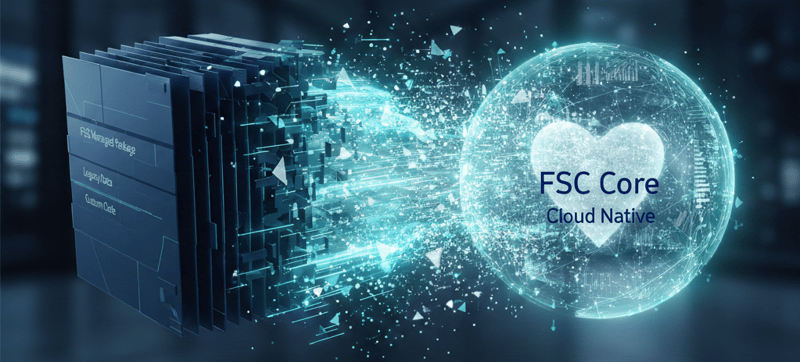
Over the past ten weeks, we published a series making the case for why financial services and banking institutions running Salesforce Financial Services Cloud on the managed package should migrate to FSC Core — and why the timing of that decision matters more than it might appear.
This post is for the readers who missed some of the series, the colleagues you want to bring up to speed quickly, and anyone who wants the complete argument in a form they can share in a leadership conversation or a strategy session. We have compressed each post to its single most important idea, with a link back to the full piece for readers who want to go deeper.
Ten posts. Ten ideas. One conclusion: the institutions that move to FSC Core now will have a structural advantage over those that wait, and that advantage compounds with every release cycle.
The Ten Ideas
|
1. Post 1 The Platform at a Crossroads |
|
Salesforce has not deprecated the managed package and has not announced a timeline for doing so. But it has stopped investing in it. Every significant new capability released since 2024 — Financial Account Management Standard Objects, Data Processing Engine templates, Agentforce financial services agents, Data Cloud integration patterns, real-time rollup roadmap items — is being built for FSC Core. The managed package is receiving maintenance. FSC Core is receiving the future. That is not a subtle distinction. It means the gap between what managed package institutions can access and what FSC Core institutions can access is widening with every release, not narrowing. The managed package is not failing. It is falling behind. Those are different problems, and the second one is more insidious because it does not announce itself. |
|
2. Post 2 The Namespace Is Not a Detail |
|
The fundamental difference between the managed package and FSC Core is not a list of features. It is an architectural fact: managed package financial data lives behind a publisher-controlled namespace (FinServ__), while FSC Core financial data lives on standard Salesforce objects. Every consequence that follows — integration friction, AI grounding complexity, audit trail dependencies on external schema changes, AppExchange compatibility limitations, Agentforce agent configuration overhead — traces back to this single architectural difference. Understanding it is the prerequisite for understanding everything else in this series. The namespace is not a naming convention. It is a wall between your financial data and the Salesforce innovation stack. |
|
3. Post 3 & 4 Three Objects That Change Everything |
|
FSC Core introduces three new standard objects that represent a genuine rethinking of how financial relationships are modelled in Salesforce. Financial Account Party replaces the two-field ownership model (Primary Owner, Joint Owner) with an unlimited junction object that captures every party to a financial account with an explicit, queryable role — transforming beneficial ownership from a workaround into structured data. Financial Account Balance replaces a single overwritten balance field with child records that preserve full history — making balance trends available as structured data for the first time. Party Relationship Group replaces the household record type with a dedicated object that can compose any combination of person accounts, business accounts, and trusts into a single relationship view with explicit roles and cross-entity rollups. Each object fixes a specific limitation that FSC practitioners have worked around for years. The data model is not just better. It is accurate in ways the managed package model structurally cannot be. |
|
4. Post 5 Stale Data Has a Business Cost |
|
The managed package’s rollup-by-lookup mechanism runs in a nightly batch. Every morning, relationship managers see balances and household totals that reflect the previous evening’s state at best. This is so normalised in managed package environments that most institutions have stopped thinking of it as a problem — they cross-reference the core banking system for anything time-sensitive and carry on. FSC Core’s Data Processing Engine changes the architecture: DPE templates can be triggered by platform events, meaning a balance update from a core banking integration can initiate a rollup recalculation in near real-time. The early warning window for credit risk monitoring moves from 24 hours to hours. The pre-meeting balance brief reflects reality rather than last night’s snapshot. The relationship manager walks into every client interaction with current information rather than historical data. Batch rollup lag is not a technical inconvenience. It is a business liability that compounds across every client interaction, every credit decision, and every risk monitoring workflow. |
|
5. Post 6 The Managed Package Is Not AI-Ready |
|
Every major AI capability Salesforce is building — Agentforce agents, Data Cloud unified customer profiles, Einstein relationship intelligence, generative pre-meeting briefs — is designed, built, and tested against the native Salesforce standard object model. Configuring Agentforce agents to work with managed package objects requires namespace-aware grounding instructions that are more complex, more brittle, and less capable than native standard object grounding. Data Cloud ingestion of managed package financial data requires namespace translation layers that add complexity and fragility. Einstein predictive models trained on managed package data are working with a less complete dataset — no balance history, simplified ownership structure, approximate household composition. FSC Core institutions can deploy AI natively. Managed package institutions can deploy AI with workarounds. That difference, multiplied across every AI capability Salesforce ships, is a widening capability gap. The managed package will not prevent you from using AI. It will prevent you from using it well. |
|
6. Post 7 Your CRM Architecture Is Part of Your Compliance Infrastructure |
|
Beneficial ownership documentation, audit trail integrity, field-level encryption, and regulatory reporting all look meaningfully better on FSC Core’s standard object architecture than on the managed package. Financial Account Party records make beneficial ownership queryable and reportable as structured data — directly satisfying FinCEN CDD rule requirements without manual documentation assembly. Field History Tracking on standard FSC Core objects is not subject to external publisher schema changes that can create audit trail gaps — the Spring 2025 FAR-to-FAP prefix change is a recent example of how managed package upgrades can affect audit configurations. Salesforce Shield encryption supports a broader range of fields on standard objects than on managed package objects. And regulatory reports on clean standard objects are simpler to write, easier to validate, and more straightforward to present to examiners than namespace-prefixed report formulas. The question to ask your Salesforce team: can we produce a complete beneficial ownership report for any account in minutes? If the answer is uncomfortable, the managed package architecture is a contributing factor. |
|
7. Post 8 Every Integration Pays a Namespace Tax on the Managed Package |
|
Core banking feeds, loan origination system connectors, open banking API integrations, Data Cloud ingestion pipelines, fintech AppExchange partners, digital banking platform connections, BI and data warehouse ETL feeds — every system that reads from or writes to FSC financial data must navigate the FinServ__ namespace prefix when connecting to the managed package. This is not an insurmountable barrier. Institutions manage it every day. But it is friction that compounds: longer partner onboarding, more complex integration documentation, more brittle SOQL queries, and managed package upgrade cycles that can break integration configurations without warning. FSC Core eliminates this tax across the entire integration portfolio. Standard API calls against clean object names. Partners connect using familiar Salesforce patterns. The integration landscape becomes simpler, more maintainable, and more resilient to platform changes. The namespace tax is not paid in one place. It is paid on every integration, by every team that builds one, every time something changes. |
|
8. Post 9 Migration Is an Opportunity, Not Just a Project |
|
The four-phase framework for migrating from managed package to FSC Core — Assess, Design, Migrate in Waves, Stabilise — is a project with real complexity. But institutions that approach it as a pure technical migration miss the most important dimension of what the process can deliver. The dependency map in Phase 1 surfaces custom code that was built to work around managed package limitations and that can be retired entirely on FSC Core. The data model design in Phase 2 is an opportunity to rebuild household structures that were always compromises, enrich ownership role data that was always incomplete, and enter the new architecture with cleaner data than the old one contained. The wave-based migration in Phase 3 is an opportunity to improve data quality account by account. Institutions that come out of the migration with better data, less custom code, and a cleaner architecture than they went in with are the ones that treated the migration as an opportunity rather than an obligation. The goal is not to replicate what you had on the managed package in FSC Core. The goal is to build what you should have had all along. |
|
9. Post 10 The Compounding Advantage of Moving First |
|
AI adoption in financial services is a compounding advantage situation. Institutions that begin deploying Agentforce agents today — grounded in FSC Core’s complete data model, fed by Data Cloud’s unified customer profiles, accelerated by DPE-refreshed balance data — are not just getting features earlier. They are building organisational capabilities: the ability to configure and tune AI agents, the data quality disciplines that make AI outputs trustworthy, the change management experience of integrating AI into relationship banking workflows, and the empirical evidence base of what AI-driven recommendations actually improve client outcomes. Institutions that delay FSC Core migration are deferring the start of that learning curve. Every month that passes, the gap between early movers and late adopters grows. The managed package will not be deprecated tomorrow. But the compounding innovation gap between managed package institutions and FSC Core institutions grows with every release cycle. The best time to migrate was two years ago. The second-best time is now — before the environment becomes more complex, the innovation gap widens further, and the urgency of external pressure removes the ability to plan on your own terms. |
|
10. Post All ten posts The Decision Is Already Being Made |
|
The decision about whether your institution migrates to FSC Core is not made in a single meeting. It is made through a series of smaller decisions: whether to include FSC Core migration in this year’s technology roadmap, whether to begin a Phase 1 assessment while the current project queue clears, whether to engage an implementation partner while partner capacity is available and the migration is manageable, or whether to wait for a deprecation announcement, a competitor’s proof point, or a budget cycle that never quite opens up. The institutions that will look back on this period with confidence are the ones that made the decision proactively and on their own terms. The institutions that will look back with regret are the ones that deferred, and discovered that deferral had its own cost — paid in widening capability gaps, rising migration complexity, and the discomfort of catching up to where the early movers were three years before. The institutions that move first will win. That is not a prediction. It is already happening. |
The Full Series
Every post in the series is available in full. Use the table below to navigate to the posts most relevant to your role, your current questions, or the colleagues you want to share specific arguments with:
|
# |
Post |
What It Covers |
|
Intro |
Introducing the Series |
What FSC Core is, why this series exists, and how to navigate the ten posts |
|
1 |
The Platform at a Crossroads |
The strategic case for why 2025 is the inflection point for FSC institutions |
|
2 |
What “On-Platform” Actually Means |
The architecture decoded: namespaces, constraints, and what changes on standard objects |
|
3 |
The Data Model Revolution |
Financial Account Party, Financial Account Balance, and Party Relationship Group explained |
|
4 |
Households Reimagined |
The Party Relationship Group in depth: multi-entity, role-based, AI-ready |
|
5 |
Saying Goodbye to Batch Rollup Lag |
The Data Processing Engine and why it is a business-critical upgrade, not just a performance improvement |
|
6 |
Unlocking Agentforce and AI |
Why FSC Core is the required foundation for AI-powered banking and what managed package institutions cannot access |
|
7 |
Compliance, Auditability, and Control |
Five compliance areas where FSC Core’s standard object architecture is meaningfully stronger |
|
8 |
The Integration Advantage |
Open banking, fintechs, and eliminating the namespace tax across your entire integration portfolio |
|
9 |
Building Your Migration Roadmap |
The four-phase framework: Assess, Design, Migrate in Waves, Stabilise — with watch-outs and opportunities |
|
10 |
The Institutions That Move First Will Win |
The vision: what FSC Core looks like at maturity and the competitive dynamics of the next three to five years |
|
Recap |
The Ten Ideas That Make the Case for FSC Core |
This post — the complete argument compressed for sharing and reference |
Where to Go From Here
If this recap has been useful and you want to go deeper on any of the ten arguments, the full posts are linked in the table above. If you are at the point of wanting to assess your institution’s specific situation — understanding the depth of your managed package dependency, mapping your integration landscape, or scoping what a migration programme would require — Post 9 is the place to start.
And if you found this series valuable, the most useful thing you can do is share it with the people in your organisation who are part of the FSC Core decision — the technology leaders, the business leaders, the compliance team, and the Salesforce practitioners who will make the migration happen. The case for FSC Core is stronger when everyone in the room has the same foundational understanding of what is at stake.
Thank you for reading.
About This Series
“Building the Future of Financial Services on Salesforce’s Native Platform” is a 10-part thought leadership series on why FSC Core represents the strategic imperative for financial services and banking institutions on Salesforce. This recap post accompanies the full series.