Why Do CRM Implementations Fail, And How Do You Succeed?
Many CRM implementations fail to meet their objectives. In financial services, where client relationships drive revenue and compliance demands precision, failure isn't an option.
The difference between success and failure rarely comes down to technology selection. It's about strategy, change management, and execution discipline. This roadmap provides the framework that separates thriving CRM transformations from expensive disappointments.
What Does a Successful CRM Transformation Journey Look Like?
The Four Pillars of CRM Success
The foundation of every successful CRM transformation rests on four interconnected pillars:
Strategy defines your vision, goals, roadmap, and success metrics. Without clear strategic direction, even the best technology becomes a digital filing cabinet.
Technology encompasses your platform selection, integration architecture, data management, and security framework. This is only one part of your success equation.
People are where the transformation truly happens. Champions drive adoption, training builds capability, and ongoing support ensures sustained usage.
Process transforms how work gets done. Workflow optimization, data governance, and continuous iteration turn your CRM from a tool into a competitive advantage.
The Critical Insight
Technology is only one part of CRM success. People and process account for the rest. Firms that understand this from day one consistently outperform those focused solely on platform features.
Phase 1: Discovery and Strategy (Weeks 1-6)
Assessing Your Current State
Before selecting platforms or mapping data, you need complete clarity on where you are today. This assessment answers three fundamental questions:
What systems do we currently use?Inventory your CRM platforms, marketing tools, custodial connections, document management systems, and communication channels. The integration complexity you'll face depends heavily on your current technology landscape.
Where are our pain points?Document advisor frustrations, client complaints, compliance gaps, and operational inefficiencies. These pain points become your prioritization framework for the entire implementation.
What does success look like?Define specific, measurable goals with clear timeline expectations and budget parameters. Vague aspirations lead to scope creep and disappointment.
Stakeholder Alignment
CRM transformation affects every corner of your organization. Early stakeholder alignment prevents resistance and builds momentum.
Your executive sponsor provides vision and resources while focusing on ROI and timeline. Compliance ensures you meet regulatory requirements and manage risk appropriately. IT handles implementation details with security and integration as top priorities. Advisors become your daily users, caring most about usability and efficiency. Operations manages processes, workflow changes, and training logistics. Marketing leverages the platform for campaigns and lead management.
Conduct executive visioning sessions, department interviews, and pain point documentation workshops. This groundwork enables you to define success criteria that resonate across the organization.
Defining Your CRM Vision
A powerful vision statement follows this framework: "Within [timeframe], our CRM will enable [user group] to [key capability], resulting in [business outcome]."
For example: "Within 18 months, our CRM will enable advisors to access complete client intelligence in seconds, resulting in 30% more client-facing time and 25% higher client satisfaction."
This statement becomes your north star throughout the implementation journey.
Phase 2: Platform Selection and Design (Weeks 7-14)
Evaluating CRM Options
Not all CRM platforms serve financial services equally well. Evaluate candidates across six weighted criteria:
Financial services features carry 25% of the decision weight. Look for household modeling, relationship management, compliance workflows, and wealth-specific data structures.
Integration capabilities account for 20%. Your CRM must connect seamlessly with custodians, portfolio management systems, financial planning tools, and document management platforms.
Compliance support also represents 20% of your evaluation. Audit trails, regulatory reporting, communication archiving, and retention policies aren't optional in financial services.
User experience weighs 15%. Advisor adoption depends on intuitive interfaces, mobile access, and streamlined workflows that save time rather than creating friction.
Total cost of ownership and AI capabilities round out the evaluation at 10% each.
The Salesforce + HubSpot Strategy
For many wealth management firms, the optimal approach combines the strengths of two industry leaders.
Salesforce Financial Services Cloud excels at client relationship management, household and relationship modeling, compliance documentation, and operational workflows. It's purpose-built for the complexity of wealth management relationships.
HubSpot brings best-in-class marketing automation, lead nurturing, content management, and campaign analytics. Its user-friendly interface makes marketing accessible to firms without dedicated marketing teams.
Together, they create a comprehensive ecosystem that serves both client management and client acquisition needs.
Architecture Design
Three critical design decisions shape your entire implementation:
Data Model: Will you use person accounts or contacts? How will you structure households? What relationship mapping complexity do you need? Which custom objects are essential for your business?
Integration Architecture: Should data sync in real-time or in batches? Which integration platform as a service (iPaaS) best fits your needs? How will you handle errors? Which system owns which data?
Security Framework: What role hierarchy protects sensitive information? How do sharing rules reflect your business structure? What field-level security is required? What audit requirements must you meet?
Phase 3: Implementation (Weeks 15-30)
Implementation Workstreams
Successful implementations run four parallel workstreams:
Workstream 1: Core Platform Configuration includes base setup and customization, user interface design, workflow automation, and report and dashboard creation.
Workstream 2: Data Migration handles data cleansing, mapping and transformation, migration execution, and validation and reconciliation.
Workstream 3: Integration Development covers connector configuration, custom integration build, testing and validation, and monitoring setup.
Workstream 4: AI and Personalization encompasses Einstein configuration, predictive model training, personalization rules, and recommendation engines.
Agile Implementation Approach
Traditional waterfall methodologies often fail in CRM implementations because requirements evolve as users see the system. An agile approach adapts to changing needs while maintaining momentum.
Each two-week sprint follows a consistent rhythm. Sprint planning prioritizes the backlog and assigns tasks. Days 1-4 focus on development and configuration. Days 5-7 involve testing and refinement. Days 8-9 conduct user acceptance testing. Day 10 holds the sprint review and retrospective.
This cycle delivers working functionality regularly, builds confidence through visible progress, and allows course correction before problems compound.
Managing Scope and Change
Every implementation faces change requests. The difference between successful and troubled projects is how you manage them.
When someone requests a change, document the proposed modification completely. Assess the impact on timeline, budget, and quality objectively. The steering committee approves or rejects based on strategic alignment and resource availability. If approved, add the change to your sprint backlog with appropriate prioritization. Finally, communicate the decision and its implications to all stakeholders.
Phase 4: Data Migration Excellence (Weeks 20-28)
The Data Migration Framework
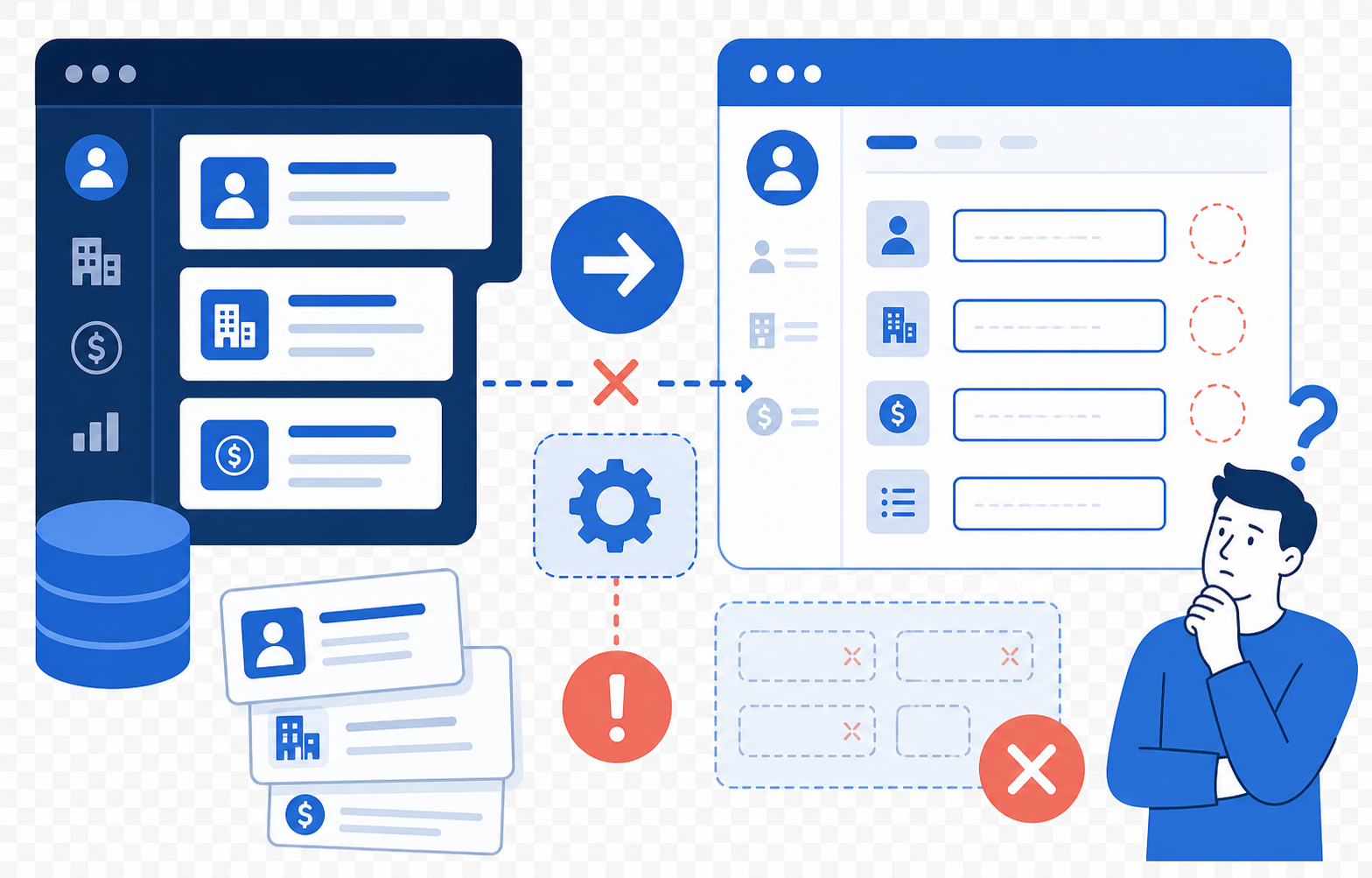
Data migration makes or breaks CRM implementations. Poor data quality undermines user trust and adoption regardless of how well you've configured the platform.
Step 1: Discovery and ProfilingInventory all data sources including legacy CRMs, spreadsheets, email systems, and document repositories. Assess data quality across completeness, accuracy, consistency, and timeliness dimensions. Document transformation needs and identify gaps and duplicates.
Step 2: Cleansing and PreparationStandardize formats for names, addresses, phone numbers, and dates. Remove duplicate records using matching algorithms and manual review. Enrich missing data through research, append services, or advisor outreach. Validate accuracy through sampling and verification.
Step 3: Mapping and TransformationMap source fields to target fields considering data type conversions and business rule changes. Define transformation rules for calculations, concatenations, and derivations. Create migration scripts that are repeatable and auditable. Build validation queries to verify results.
Step 4: Migration ExecutionNever migrate to production on the first attempt. Run test migrations multiple times, fixing issues and refining scripts with each iteration. Plan production cutover timing to minimize business disruption. Execute the production migration with stakeholders on standby. Validate completeness immediately after.
Step 5: ReconciliationCompare source and target record counts at every level of granularity. Verify data integrity through sampling and automated checks. Address discrepancies before proceeding. Obtain formal sign-off from stakeholders before declaring migration complete.
Data Quality Metrics
Measure your migration success objectively. Target greater than 95% completeness with all required fields populated. Achieve greater than 99% accuracy validated through sampling. Maintain greater than 98% consistency in format standardization. Ensure data is current with recent last update dates. Demand 100% uniqueness with zero duplicate records.
Phase 5: Change Management and Training (Weeks 24-32)
Why Change Management Matters
The adoption curve follows a predictable pattern. A small group of your users are early adopters who embrace change enthusiastically. The majority need support and encouragement. A smaller group are resistors requiring intensive intervention.
Without change management, you'll capture only the enthusiastic early adopters. With effective change management, you can bring the majority along and reach broad adoption.
Change Management Framework
The ADKAR model provides a proven structure for CRM adoption.
Awareness addresses why you need a new CRM. Communication about business drivers, competitive pressures, and client expectations builds understanding.
Desire focuses on personal benefits for advisors. When people understand how the CRM makes their lives easier and helps them serve clients better, resistance melts away.
Knowledge covers how to use the system. Training delivers the technical skills users need to accomplish their daily tasks.
Ability comes through hands-on practice and support. Knowledge alone isn't enough. Users need opportunities to apply what they've learned with safety nets in place.
Reinforcement provides ongoing encouragement and metrics. Celebrating wins, tracking adoption, and tying usage to expectations sustains momentum past the initial launch.
Training Program Design
Different training methods serve different purposes. Instructor-led sessions work best for complex concepts and interactive Q&A, with high effectiveness but significant time investment. Self-paced eLearning handles basics and refreshers with medium effectiveness and flexibility. Quick reference guides provide daily reminders with high effectiveness and minimal time commitment. Peer mentoring offers ongoing support with very high effectiveness by leveraging internal expertise. Office hours enable problem-solving with high effectiveness and personalized attention.
Role-Based Training Tracks ensure users learn what they need without wasting time on irrelevant features.
Advisors need 8-12 hours covering client management workflows, opportunity tracking, AI-powered insights, and mobile access.
Support staff require 6-8 hours on data entry standards, task management, report generation, and client communication.
Managers benefit from 4-6 hours focused on team dashboards, performance monitoring, compliance oversight, and coaching tools.
Administrators demand 16-20 hours encompassing system configuration, user management, troubleshooting, and customization.
Phase 6: Go-Live and Adoption (Weeks 30-36)
Go-Live Strategy Options
Four primary go-live approaches each carry different risk and complexity profiles.
Big Bang launches everyone simultaneously with high risk but low complexity, best suited for small firms with strong change management.
Phased by Team rolls out to one team at a time with medium risk and complexity, ideal for mid-size firms with distinct advisor groups.
Phased by Function implements one capability at a time with low risk but high complexity, appropriate for large firms willing to invest in extended transitions.
Parallel Running maintains both old and new systems temporarily with low risk but very high complexity, perfect for risk-averse firms with resources to support dual environments.
Go-Live Checklist
Technical readiness requires all integrations tested and validated, data migration complete and verified, security configurations locked, backup and recovery tested, and performance benchmarks met.
User readiness demands training completed for all users, reference materials distributed, support channels established, champions identified and prepared, and the communication plan executed.
Business readiness ensures processes are documented, workflows validated, reporting confirmed, compliance approved, and executive sign-off obtained.
Hypercare Period (Weeks 1-4 Post-Go-Live)
The first month after launch determines long-term success. Intensive support prevents small issues from becoming major problems.
Critical issues with the system down receive 15-minute response times with 24/7 coverage. High-priority issues affecting major features get one-hour responses during business hours. Medium-priority issues where workarounds exist receive four-hour responses during business hours. Low-priority enhancement requests are addressed within 24 hours during business hours.
Phase 7: Optimization and Growth (Ongoing)
Continuous Improvement Cycle
CRM excellence requires ongoing attention, not just a successful launch.
Monthly activities include reviewing adoption metrics to identify struggling users, gathering user feedback through surveys and conversations, prioritizing enhancements based on impact and effort, and implementing quick wins that build momentum.
Quarterly activities encompass assessing performance against success metrics, planning major enhancements that require significant effort, reviewing integration health to prevent failures, and updating training materials to reflect system changes.
Annual activities involve strategic roadmap reviews to align CRM with business direction, platform upgrade planning to leverage new capabilities, vendor relationship reviews to ensure you're getting value, and formal ROI assessments to justify continued investment.
Measuring Long-Term Success
Track metrics across three dimensions to understand your CRM's true impact.
Advisor Productivity measures time spent on administrative tasks, client-facing time percentage, tasks completed per day, and response time to client requests.
Client Outcomes examines client satisfaction scores through Net Promoter Score, client retention rates, share of wallet growth, and referral generation.
Business Results evaluates revenue per advisor, cost per client served, compliance incidents, and operational efficiency ratios.
Frequently Asked Questions
How long does a typical CRM implementation take for a wealth management firm?Full implementations range from 6-18 months depending on firm size, complexity, and scope. A focused minimum viable product approach can deliver core value in 4-6 months with iterative enhancement following initial launch.
What's the typical budget for CRM transformation in financial services?Total cost depends on firm size and scope. Expect $150,000-300,000 for small firms under 20 advisors, $300,000-1,000,000 for mid-size firms with 20-100 advisors, and $1,000,000 or more for larger enterprises.
How do we maintain momentum after go-live?Establish a dedicated CRM team responsible for ongoing optimization. Celebrate wins publicly to reinforce adoption. Track and share adoption metrics to create positive peer pressure. Continuously gather and act on feedback to show users their input matters. Tie CRM usage to performance expectations so adoption becomes non-negotiable.
What's the biggest risk to avoid?Underinvesting in change management. Firms that underfund training and adoption typically achieve only part of the expected benefits. The technology works: the question is whether people will use it.
When should we engage external implementation partners?Consider partners when you lack internal expertise in financial services CRM, have aggressive timelines requiring additional resources, need best practices from firms that have succeeded before you, or want to reduce implementation risk. The right partner accelerates time-to-value significantly and helps you avoid expensive mistakes.
Your 12-Month Implementation Timeline
Month 1-2 focuses on discovery with current state assessment and stakeholder alignment.
Month 2-3 establishes strategy with vision defined and success metrics established.
Month 3-4 completes design with architecture finalized and platforms configured.
Month 4-6 executes the build with core implementation and integrations developed.
Month 5-7 handles data through migration planning, cleansing, and execution.
Month 6-8 delivers training with programs developed and training sessions conducted.
Month 8-9 achieves go-live with launch execution and hypercare support.
Month 9-12 drives optimization with adoption campaigns, enhancements, and expansion planning.
Key Takeaways
Technology is only one part of success: people and process matter far more than platform features.
Strategy must come before selection. Know what you need before choosing platforms or you'll optimize for the wrong outcomes.
Data quality makes or breaks your implementation: invest heavily in migration or suffer the consequences forever.
Change management isn't optional, budget 20% or more for training and adoption or accept mediocre results.
Plan for the long game. CRM optimization is a journey of continuous improvement, not a destination you reach and forget.
Partner wisely. The right expertise accelerates your path to value and helps you avoid the pitfalls that derail other firms.
Ready to Transform Your CRM?
Transforming your CRM isn't just a technology project. It's a business transformation that requires expertise across platforms, processes, and people.
Vantage Point brings deep financial services expertise with decades of combined experience in wealth management, banking, and insurance. Our platform mastery includes certified experts in Salesforce Financial Services Cloud, HubSpot, and AI personalization. We follow a proven methodology refined across many engagements. Our end-to-end capabilities cover strategy through optimization: we're with you for the entire journey. Most importantly, we measure success by your business outcomes, not just technical delivery.
Contact Vantage Point for a complimentary assessment and discover how we can help you achieve CRM excellence in financial services.
Series Recap
This article completes our comprehensive series on CRM Optimization for Financial Services:
- The CRM Imperative - Why financial advisors need optimized CRM now
- Salesforce Financial Services Cloud - Building your 360-degree client view
- HubSpot for Financial Services - Marketing automation that converts
- AI-Powered Personalization - Leveraging Salesforce Einstein
- UI/UX Design - The hidden driver of CRM adoption
- Integrated CRM Ecosystem - Connecting your technology stack
- Implementation Roadmap - Your strategic guide to CRM success
For more insights on financial services technology and CRM optimization, visit vantagepoint.io/blog.
About Vantage Point
Vantage Point specializes in helping financial institutions design and implement client experience transformation programs using Salesforce Financial Services Cloud. Our team combines deep Salesforce expertise with financial services industry knowledge to deliver measurable improvements in client satisfaction, operational efficiency, and business results.
About the Author
David Cockrum founded Vantage Point after serving as Chief Operating Officer in the financial services industry. His unique blend of operational leadership and technology expertise has enabled Vantage Point's distinctive business-process-first implementation methodology, delivering successful transformations for clients.
-
-
- Email: david@vantagepoint.io
- Phone: (469) 499-3400
- Website: vantagepoint.io
-