
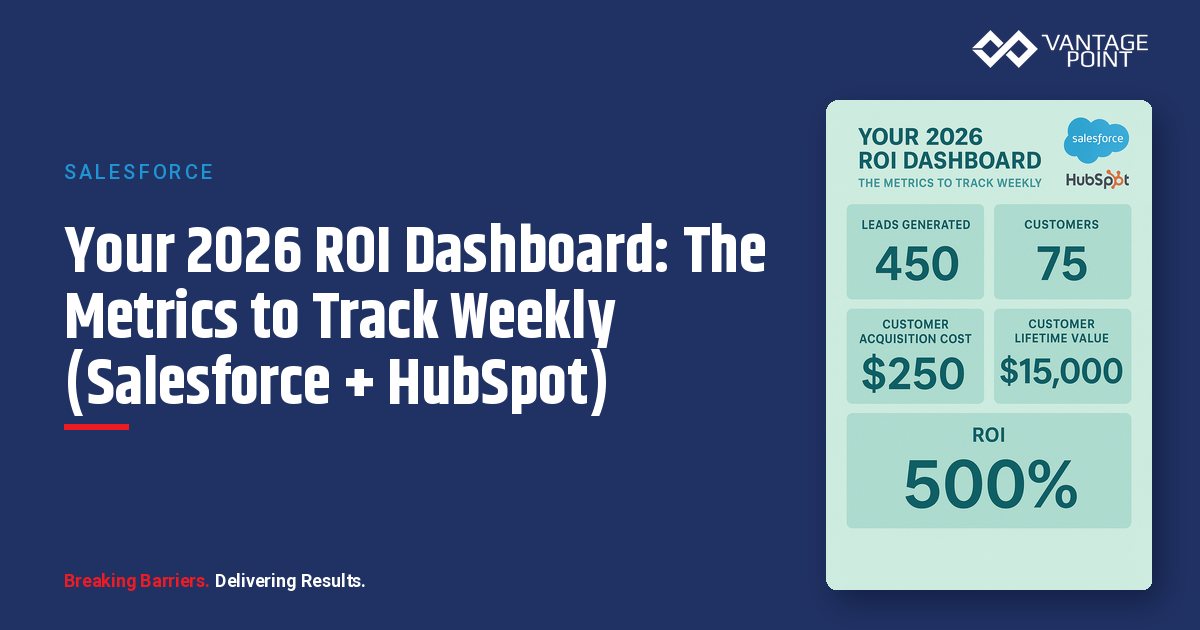
Why Your CRM ROI Dashboard Matters
Managing thousands of customers while maintaining personalized service: this is the challenge keeping business leaders awake at night. Unlike purely transactional businesses, customer-centric organizations build long-term relationships that drive repeat business, referrals, and sustainable growth.
Every CRM investment conversation eventually comes to the same question: "Is this thing actually working?" Without a structured approach to measuring value, you're left defending your platform with anecdotes instead of data.
The stakes are real. According to Nucleus Research, CRM delivers an average $8.71 for every dollar spent, but only when properly adopted and optimized. Organizations that don't measure systematically often abandon platforms or underinvest in optimization, leaving millions in potential value on the table.
This guide gives you the exact framework we use with clients: a weekly operating rhythm that connects CRM metrics to business outcomes, annotations that prove causation (not just correlation), and a reporting structure that earns you a seat at the executive table.
Adoption Metrics That Matter
Your CRM investment only pays off when teams actually use it. For a comprehensive CRM ROI measurement approach, track these adoption indicators weekly:
Usage by Role
Different roles have different adoption signals. Here's what healthy usage looks like:
| Role | Key Metric | Target | Source | Red Flag |
|---|---|---|---|---|
| Sales Reps | Daily logins | ≥90% | Login reports | <70% indicates training gap |
| Sales Reps | Activities logged | ≥5/day | Activity reports | <3/day suggests shadow systems |
| Sales Managers | Forecast updates | Weekly | Activity logs | Missing 2+ weeks shows process gap |
| Sales Managers | Dashboard views | Daily | Usage analytics | <3x/week means reports aren't useful |
| Marketing | Campaign creation | 2+/week | Campaign reports | 0 campaigns means unused license |
| Marketing | List segmentation | Weekly | List reports | Static lists show automation gaps |
| Service | Case response | <4 hrs | Service analytics | >8 hrs impacts CSAT |
| Service | Knowledge usage | Daily | KB analytics | Low usage means content gaps |
How to Pull These Metrics
Salesforce:
- Setup → Adoption Dashboards (Einstein Analytics)
- Reports → Administrative Reports → User Login History
- Setup → Company Information → Storage Usage
HubSpot:
- Reports → Analytics Tools → Sales Analytics
- Settings → Tracking & Analytics → Traffic Analytics
- Reports → Dashboards → Create custom usage dashboard
AI & Automation Engagement
Modern CRM value increasingly comes from AI and automation features. Track these separately:
| Feature | Metric | Salesforce Source | HubSpot Source | Target |
|---|---|---|---|---|
| AI Actions | Weekly uses per user | Copilot analytics | AI assistant logs | 10+ per user |
| AI Recommendations | Acceptance rate | Einstein Next Best Action | Predictive Lead Scoring | >40% |
| Automation | Success rate | Flow error reports | Workflow analytics | >98% |
| Automation | Time saved | Custom calculation | Custom calculation | Track trend |
| Tasks | Completion rate | Task reports | Task properties | >85% |
| Sequences | Reply rate | Outreach analytics | Sequences analytics | >15% |
Adoption Diagnostic: The 5-Minute Health Check
Run this diagnostic every Monday:
- Login penetration: What % of licensed users logged in last 7 days?
- Power users: How many users exceeded 20 sessions?
- Dormant users: How many users had 0 sessions?
- Mobile adoption: What % accessed via mobile app?
- AI feature usage: What % used AI features at least once?
Red Flags to Watch
- Login frequency dropping >10% week-over-week (investigate immediately)
- AI feature adoption plateauing after initial spike (training opportunity)
- Automation error rates exceeding 5% (technical debt accumulating)
- Specific team or region with <50% adoption (management attention needed)
- Mobile usage declining while field activity increases (app UX issue)
Quality and Funnel Health
Data Quality Scorecard
Bad data kills CRM ROI faster than anything else. Implement this scoring system:
| Metric | Definition | Formula | Target | Action if Below |
|---|---|---|---|---|
| Invalid Rate | Records failing validation | Invalid / Total | <2% | Tighten validation rules |
| Duplicate Rate | Suspected dupes | Dupes / Total | <3% | Run dedup workflow |
| Completeness | Required fields filled | Filled / Required | >95% | Required field enforcement |
| Freshness | Records updated in 30 days | Fresh / Total | >80% | Stale data campaign |
| Accuracy | Spot-check validation | Accurate / Sampled | >98% | Training + validation |
| Consistency | Format standardization | Compliant / Total | >95% | Normalization automation |
Calculating Your Data Quality Score:
DQ Score = (Validity × 0.25) + (Uniqueness × 0.20) + (Completeness × 0.25) +
           (Freshness × 0.15) + (Accuracy × 0.10) + (Consistency × 0.05)
According to Gartner's CRM research, organizations with high data quality see 66% higher CRM adoption rates.
Funnel Velocity Metrics
Healthy pipelines move. Stalled pipelines hide problems. Track these metrics by segment:
Track the conversion rate at each stage transition (Lead → MQL, MQL → SQL, SQL → Opportunity, Opportunity → Closed Won) and the average full-cycle length in days, and compare each against your own historical baseline.
Velocity Calculation:
Pipeline Velocity = (# Opportunities × Win Rate × Average Deal Size) / Sales Cycle Length

Example: (100 × 0.25 × $50,000) / 45 days = $27,778 per day
Stage-by-Stage Analysis
For each funnel stage, track:
- Conversion rate: % moving to next stage
- Average time in stage: Days spent (by segment)
- Regression rate: % moving backwards
- Exit rate: % lost at this stage (track reasons)
Forecast Accuracy
Your CRM is only valuable if leaders trust the data. Track forecast accuracy rigorously:
Accuracy = Actual Closed / Committed Forecast × 100

Target: ≥85% within ±10% variance
Forecast Accuracy Dashboard Components:
| Metric | Calculation | Target | Frequency |
|---|---|---|---|
| Commit Accuracy | Actual / Commit | 85-95% | Weekly |
| Best Case Accuracy | Actual / Best Case | 70-85% | Weekly |
| Pipeline Coverage | Pipeline / Quota | 3x-4x | Weekly |
| Forecast Bias | Directional trend | +/- 5% | Monthly |
| Rep-Level Variance | Std dev by rep | <15% | Monthly |
Customer Experience Metrics
CSAT and NPS Tracking
CRM ROI extends beyond sales: customer experience metrics prove platform value:
| Metric | Definition | Target | Measurement Frequency |
|---|---|---|---|
| CSAT | Customer satisfaction score | >4.2/5 | Post-interaction |
| NPS | Net Promoter Score | >40 | Quarterly |
| CES | Customer Effort Score | <3.0 | Post-interaction |
| First Contact Resolution | % resolved on first contact | >70% | Weekly |
| Response Time | Avg time to first response | <4 hrs | Daily |
Service Metrics That Tie to CRM Value
Measure ticket resolution time, tickets per agent, escalation rate, and self-service deflection before and after each CRM optimization so you can show the change in service capacity.
Storytelling to Leadership
Data alone doesn't prove value: narrative does. Here's how to connect metrics to business impact.
Annotate Releases
Connect metric movements to specific changes. This is the difference between "correlation" and "evidence":
| Week | Metric Change | Release/Change | Attribution | Evidence |
|---|---|---|---|---|
| Jan 6 | +12% Copilot usage | Prompt library launched | Direct | Usage spike same day |
| Jan 7 | -8% dupe rate | New dedup workflow | Direct | Automated cleanup logged |
| Jan 8 | +5% win rate | Forecast inspection pilot | Contributing | Pilot team outperformed |
| Jan 9 | +15% activity logging | Mobile app update | Direct | Mobile sessions up 3x |
| Jan 10 | -20% case resolution time | AI routing implemented | Direct | Before/after comparison |
Monthly Impact Memo Format
Send this to leadership on the first Monday of each month:
## CRM Value Report: January 2026

### Executive Summary
- Platform adoption: 94% (↑3% MoM)
- Data quality score: 96/100 (↑4 pts)
- Pipeline velocity: $27,778/day (↑12% MoM)

### Quantified Value This Month
1. **Time saved:** 240 hours reclaimed through automation
   - Lead assignment: 85 hours
   - Quote routing: 65 hours
   - Follow-up sequences: 90 hours

2. **Revenue impact:** $125,000 in accelerated deals
   - 15 deals closed 2+ weeks faster
   - Attribution: AI-powered forecasting + manager alerts

3. **Cost avoidance:** 0.5 FTE equivalent
   - Automation handling work of part-time coordinator

### Key Wins
1. AI adoption drove 240 hours saved (12 hours/rep/month)
2. Automation success rate hit 98% (up from 91%)
3. Forecast accuracy improved to 87% (6-point improvement)

### Areas of Focus
1. Marketing campaign attribution gaps—proposing multi-touch model
2. Service team login consistency—training scheduled Jan 15

### Investment Recommendations
- Expand Copilot to service team (projected 50 hours/month saved)
- Add enrichment integration (projected 20% improvement in data quality)
- Advanced analytics tier (enable predictive forecasting)

### ROI Summary
| Investment | Monthly Value | Annual Projection |
|------------|--------------|-------------------|
| Time saved | $18,000 | $216,000 |
| Revenue acceleration | $125,000 | $1,500,000 |
| Cost avoidance | $4,000 | $48,000 |
| **Total** | **$147,000** | **$1,764,000** |
Dashboard Layout
Build a single executive dashboard with four rows:
Row 1: Adoption (Are people using it?)
- Daily active users (trend line, 30-day view)
- AI action count (trend line)
- Task completion rate (gauge, target 85%)
- Mobile adoption (% of total sessions)
Row 2: Quality (Is the data trustworthy?)
- Data quality score (gauge, target 95)
- Duplicate rate (trend line, target <3%)
- Field completeness (horizontal bar by object)
- Stale record % (trend line, target <20%)
Row 3: Funnel (Is pipeline healthy?)
- Stage conversion rates (funnel visualization)
- Velocity by segment (horizontal bar)
- Forecast accuracy (gauge, target 85%)
- Win rate trend (line, 12-week view)
Row 4: CX (Are customers happy?)
- CSAT score (trend line)
- Response time (trend line, target <4 hrs)
- NPS (gauge)
- Case volume vs. capacity (bar)
Building Your Dashboard: Step-by-Step
Week 1: Foundation
- Identify data sources for each metric category
- Validate data accessibility and accuracy
- Create calculated fields for derived metrics
- Build first version with 5 core metrics
Week 2: Expansion
- Add remaining metrics
- Set up automated data refresh
- Create drill-down capabilities
- Test with stakeholders
Week 3: Operationalize
- Set up automated distribution (email, Slack)
- Create annotation system
- Document metric definitions
- Train stakeholders on interpretation
Week 4: Iterate
- Gather feedback from first full week
- Adjust visualizations based on usage
- Add/remove metrics based on value
- Establish weekly review cadence
Advanced: Connecting CRM Metrics to Revenue
Revenue Attribution Model
Build a model that ties CRM activities to closed revenue:
Influenced Revenue = ∑(Activities × Activity Weight × Conversion Probability × Deal Size)

Where:
- Activities = emails, calls, meetings logged in CRM
- Activity Weight = relative impact (meeting = 3x, call = 2x, email = 1x)
- Conversion Probability = historical stage-to-close rate
- Deal Size = opportunity amount
Sales Productivity Index
Create a composite score for each rep:
Productivity Index = (Activities Logged × 0.2) + (Pipeline Created × 0.3) +
                     (Win Rate × 0.3) + (Forecast Accuracy × 0.2)
Normalize to 100-point scale. Track weekly. Identify coaching opportunities.
Marketing-Sales Alignment Score
Measure handoff effectiveness:
Alignment Score = (MQL Acceptance Rate × 0.4) + (SQL Conversion × 0.3) +
                  (Lead Response Time Score × 0.3)
Frequently Asked Questions
Q1: What's the fastest way to get value from an ROI dashboard today?
Start with 5 metrics: logins, task completion, duplicate rate, win rate, and CSAT. Build a simple weekly view in your native CRM reporting. Baseline today, and review every Monday. Add metrics only after you've established the review habit.
Q2: How should I measure success?
Track improvement trends, not just absolute numbers. Annotate every change you make and look for correlated metric lifts 2-4 weeks later. Success = consistent improvement + clear attribution to your initiatives.
Q3: What risks should I watch for?
Vanity metrics that don't tie to business outcomes, dashboard fatigue from too many KPIs, and lack of ownership per metric. Assign one owner per metric and limit to 15 total KPIs maximum.
Q4: How do I get executives to actually look at the dashboard?
Three tactics: (1) Send a 3-bullet summary with the dashboard link weekly, (2) Lead with "$X value delivered" not "metrics improved," and (3) Tie every metric to a decision they need to make.
Q5: What if metrics show the CRM isn't delivering value?
That's valuable information. Diagnose the root cause: adoption problem (training needed), data problem (cleanup needed), process problem (workflows need redesign), or tool problem (feature gaps). The dashboard tells you WHERE to focus.
Q6: How often should I update dashboard design?
Review quarterly. Kill metrics nobody acts on. Add metrics that answer new business questions. Never exceed 15 KPIs: more creates noise, not insight.
About Vantage Point
Vantage Point specializes in helping financial institutions design and implement client experience transformation programs using Salesforce Financial Services Cloud. Our team combines deep Salesforce expertise with financial services industry knowledge to deliver measurable improvements in client satisfaction, operational efficiency, and business results.
About the Author
David Cockrum founded Vantage Point after serving as Chief Operating Officer in the financial services industry. His unique blend of operational leadership and technology expertise has enabled Vantage Point's distinctive business-process-first implementation methodology, delivering successful transformations for clients.
-
-
- Email: david@vantagepoint.io
- Phone: (469) 499-3400
- Website: vantagepoint.io
-