
Why Don't Your CRM and Marketing Agency Talk? 5 Hidden Costs for RIAs and How to Fix Them
Picture this: Your marketing agency creates compelling content, runs targeted campaigns, and generates qualified leads. Meanwhile, your CRM sits in your office, dutifully tracking client interactions and managing your pipeline. Both are doing their jobs, but they're doing them in complete isolation from each other.
This disconnect is one of the most expensive (and most overlooked) problems facing RIAs and wealth management firms today. When your technology and marketing operate in silos, you're not just missing opportunities; you're actively losing clients and revenue.
Let me show you why this matters and, more importantly, how to fix it.
📊 Key Insight: Businesses that use CRM effectively see strong returns and higher conversion rates, but only when CRM and marketing work together.
Why Do CRM and Marketing Operate in Silos at Most RIA Firms?
In most RIA firms, the technology team (or person) and the marketing function operate independently:
| Technology Side | Marketing Side |
|---|---|
| Data integrity and system maintenance | Content creation and distribution |
| User access and permissions | Social media management |
| Integration with financial planning tools | Email campaigns |
| Compliance and security | Website management |
| Basic reporting | Lead generation activities |
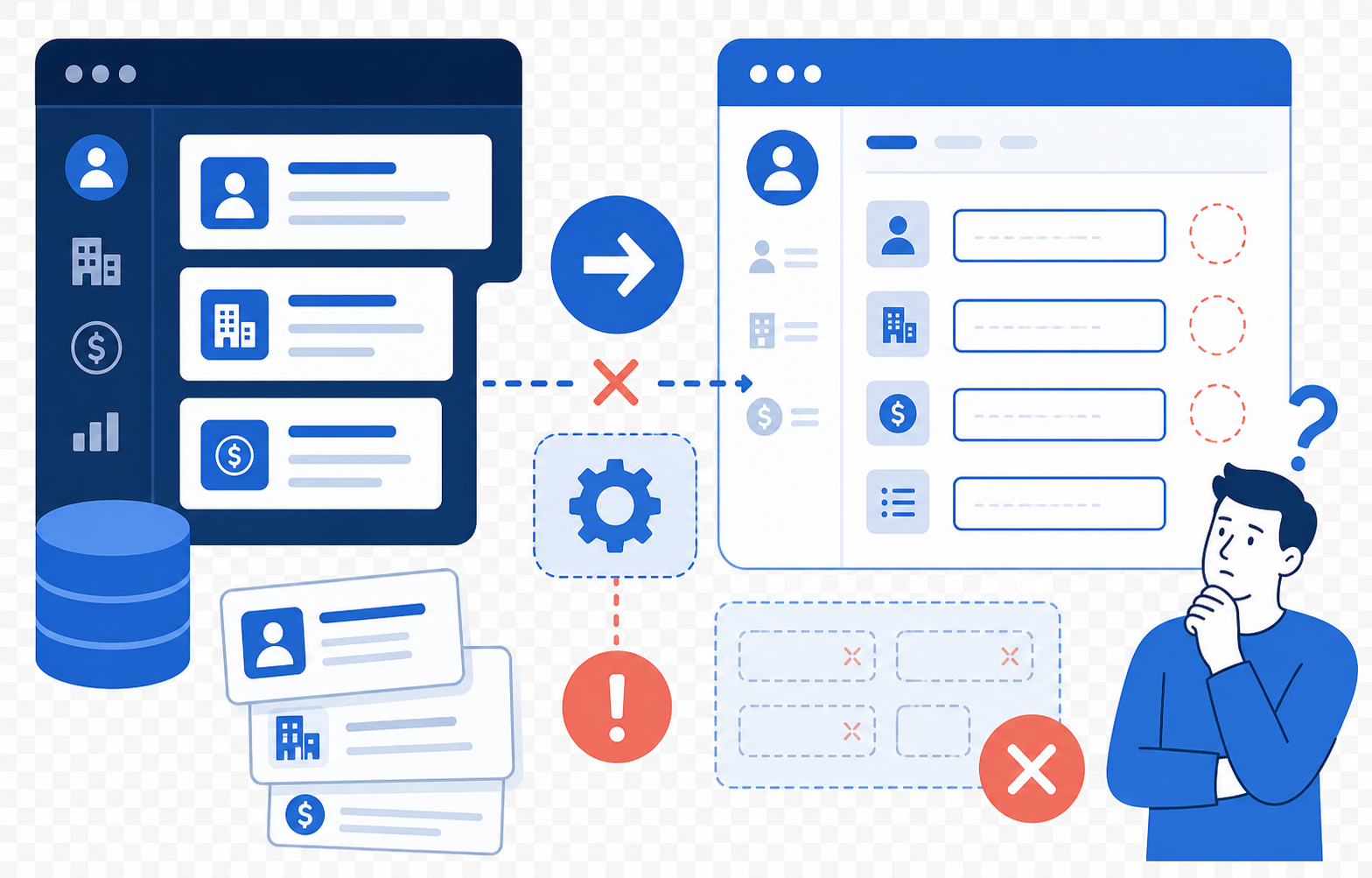
On the surface, this division of labor makes sense. But here's the problem: modern marketing and CRM are inseparable. When they don't communicate, you create a broken client journey that costs you opportunities at every stage.
What Does It Really Cost When Your CRM and Marketing Don't Talk?
Let's walk through the five hidden costs of disconnected CRM and marketing systems:
1. How Does Lost Lead Intelligence Hurt Your Conversion Rates?
Your marketing agency runs a LinkedIn campaign that generates 50 qualified leads. These leads download a whitepaper, engage with your content, and show clear buying signals. But when they enter your CRM, all that context disappears.
Your advisors see a name and email address. Nothing more. They don't know:
- Content engagement: What content the prospect interacted with
- Pain points: What problems they're trying to solve
- Buying stage: Where they are in their decision-making journey
- Message resonance: What messaging resonated with them
Without this intelligence, your follow-up is generic and ineffective. The prospect, who was warm when they entered your system, goes cold because you couldn't continue the conversation your marketing started.
📊 Key Insight: Referral leads tend to convert better than leads from other marketing channels. Marketing-generated leads with proper context and follow-up can achieve similar conversion rates, but only when systems are connected.
2. Why Do Broken Nurture Sequences Kill Your Pipeline?
When a prospect enters your CRM but isn't ready to meet with an advisor, they should automatically enter a nurture sequence. In an integrated system, they'd receive relevant content based on their interests and behaviors, gradually building trust until they're ready to engage.
But when your CRM and marketing don't talk, this breaks down:
- Generic campaigns: Your marketing agency continues sending one-size-fits-all messages
- Conflicting messages: Your CRM sends different (often contradictory) communications
- Duplicate outreach: The prospect receives duplicate or irrelevant communications
- No engagement tracking: Nobody identifies when they're ready to convert
3. How Does Invisible ROI Waste Your Marketing Budget?
When your marketing and CRM are disconnected, you can't accurately measure marketing ROI. Your marketing agency reports on vanity metrics (website traffic, social media engagement, email open rates) but can't connect these activities to actual revenue.
Meanwhile, your CRM tracks closed deals but can't attribute them to specific marketing activities. You know you closed 10 new clients this quarter, but you don't know:
- Campaign influence: Which marketing campaigns influenced their decision
- Content consumption: What content they consumed before converting
- Nurture timeline: How long the nurture process took
- True acquisition cost: What the true cost per acquisition was
📊 Key Stat: Recent RIA benchmarking research from Schwab Advisor Services found that marketing leaders among RIAs spend approximately 2.4% of their revenue on marketing and business development, but they do so strategically, with clear metrics and accountability. Without integrated systems, you're flying blind.
4. What Cross-Sell and Upsell Opportunities Are You Missing?
Your CRM contains valuable data about your existing clients: their life stage, financial situation, goals, and concerns. Your marketing agency has the expertise to create targeted campaigns that address these specific needs.
But when these systems don't communicate, you miss critical opportunities:
- Life event targeting: Sending relevant content to clients facing retirement, inheritance, or business sales
- Service expansion: Promoting additional services to clients who would benefit from them
- Re-engagement: Reaching clients who have become less active
- Referral nurturing: Identifying and nurturing referral sources systematically
📊 Key Insight: Firms that effectively integrate digital tools, including CRM, have reported growth in both AUM and revenue. Top performing firms commonly use client segmentation strategies that enable personalized communications.
5. How Do Disconnected Systems Create Team Inefficiency?
When your CRM and marketing don't talk, your team wastes time on manual workarounds:
- Manual list exports: Exporting lists from the CRM for marketing campaigns
- Copy-paste data entry: Moving lead information between systems by hand
- Multi-source reporting: Creating reports by pulling data from multiple platforms
- Duplicate effort: Redoing work because systems don't share information
This inefficiency doesn't just waste time. It wastes talent. Your advisors and support staff should be focused on high-value activities like client service and relationship building, not administrative tasks that should be automated.
Why Does the CRM-Marketing Disconnect Happen at Financial Firms?
If the integration of CRM and marketing is so obviously valuable, why do so many firms operate with disconnected systems? Here are the four primary reasons:
How Do Different Vendors Create Integration Gaps?
Many firms work with a CRM consultant who focuses purely on technology, and a separate marketing agency that focuses purely on creative and campaigns. Neither vendor has the expertise or incentive to bridge the gap:
- CRM consultants may not understand marketing automation, email campaigns, or content strategy
- Marketing agencies may not understand CRM architecture, data structures, or integration capabilities
- Result: Each stays in their lane, and the gap between them remains
Why Does Legacy Thinking Prevent Marketing Integration?
Many firms still think of marketing as a "creative" function, separate from operations and technology. This outdated mindset treats marketing as an expense rather than a revenue driver, preventing the strategic integration necessary for modern growth.
📊 Key Stat: The same Schwab Advisor Services benchmarking research found that only 5% of firms (excluding marketing leaders) felt their marketing capabilities were advanced, suggesting most firms haven't embraced technology-enabled, data-driven marketing.
What Technical Challenges Prevent CRM-Marketing Integration?
Integrating CRM and marketing systems can be technically complex, especially with enterprise platforms like Salesforce or HubSpot. It requires:
- API expertise: Understanding both systems' APIs and integration capabilities
- Data mapping: Mapping data fields between systems accurately
- Cross-platform workflows: Creating workflows that span both platforms
- Compliance: Ensuring data security and regulatory compliance
- Ongoing maintenance: Keeping integrations working as systems evolve
How Do Organizational Silos Block Integration?
In larger firms, technology and marketing often report to different executives with different priorities and budgets. Technology focuses on stability, security, and compliance. Marketing focuses on creativity, campaigns, and brand. Neither has the authority or incentive to drive integration.
What Does a Fully Integrated CRM and Marketing System Look Like?
When your CRM and marketing work together seamlessly, the results are transformative. Here's what the integrated approach looks like in practice:
How Does Unified Lead Management Transform Conversions?
A prospect downloads a whitepaper from your website. Immediately:
- Full context capture: They're automatically added to your CRM with complete data (what they downloaded, pages visited, emails opened)
- Automated nurture: They enter a nurture sequence tailored to their interests
- Advisor notification: Your advisors receive a notification with all relevant context
- Cross-touchpoint tracking: Engagement is tracked across all touchpoints
- Sales-ready flagging: When the prospect reaches an engagement threshold, they're automatically flagged as "sales ready"
How Do Personalized Communications Improve Client Retention?
Your CRM segments clients based on their life stage, service level, and interests. Your marketing system uses these segments to deliver:
- Personalized email campaigns: Addressing specific needs and interests
- Targeted content: Recommendations based on client profiles
- Relevant event invitations: For the right audiences
- Milestone messages: Birthday and anniversary messages
- Timely outreach: Communications around tax season, market volatility, or other relevant events
What Is Closed-Loop Reporting and Why Does It Matter?
Every marketing activity is tracked from initial engagement through closed deal:
- Campaign attribution: You know which campaigns generate the most qualified leads
- True cost per acquisition: Calculate real CPA by channel
- Content effectiveness: Understand which content moves prospects through the funnel
- ROI optimization: Optimize your marketing spend based on actual ROI data
📊 Key Insight: Most marketing leaders among RIAs have a written marketing strategy that they update regularly. This strategic approach is only possible when you have integrated systems that provide clear performance data.
How Do Automated Workflows Boost Productivity?
Repetitive tasks are automated across both systems:
- Lead nurture automation: New leads automatically enter appropriate nurture sequences
- Milestone triggers: Clients who reach certain milestones trigger specific communications
- Referral follow-up: Referral sources receive systematic follow-up
- Re-engagement campaigns: Inactive clients are automatically re-engaged
- Cross-sell identification: Opportunities are identified and acted upon
📊 Key Insight: Firms that effectively integrate digital tools have reported meaningful productivity gains, largely due to automated workflows spanning CRM and marketing systems.
Who Can Help Bridge the CRM-Marketing Gap for Wealth Management Firms?
Here's the uncomfortable truth: Most CRM consultants don't understand marketing, and most marketing agencies don't understand CRM. You need a partner who speaks both languages fluently.
This is exactly why Vantage Point and TE+A Marketing formed a partnership. We recognized that RIAs and wealth management firms were struggling with this exact problem: powerful technology and creative marketing, but no bridge between them. You can read more about our TE+A partnership.
| Partner | Expertise | Focus |
|---|---|---|
| Vantage Point | CRM implementation, optimization & integration | Technical architecture, data structures, compliance for wealth management |
| TE+A Marketing | Strategic marketing for financial services | Client journey, content strategy, campaign execution for firms with 50-500 employees |
Together, we provide the integrated approach that most firms are missing:
- Unified Strategy: Start with your business objectives and design an integrated approach that aligns technology and marketing
- Technical Integration: Connect your CRM and marketing systems so data flows seamlessly
- Process Design: Create workflows that span both systems, automating the client journey from first touch to closed deal
- Training and Enablement: Ensure your team understands how to leverage the integrated system
- Ongoing Optimization: Continuously measure performance and optimize based on results
How Does a CRM-Marketing Integration Project Work?
Integrating your CRM and marketing doesn't require a multi-year transformation. Our integrated CRM and marketing launch is delivered through Vantage Point's fixed-scope packages, with a set timeline and a published price, and it runs in four phases:
| Phase | Key Activities |
|---|---|
| Assessment & Strategy | Audit CRM utilization, identify quick wins, define success metrics, create roadmap |
| Technical Integration | Connect systems, map data fields, build automated workflows, implement tracking |
| Campaign Development | Create nurture sequences, develop personalized content, establish lead scoring |
| Training & Launch | Train team, launch campaigns, establish measurement & optimization processes |
The result? A unified growth engine where your technology and marketing work together seamlessly, driving more leads, better conversion rates, and higher client lifetime value.
How Do You Get Started with CRM-Marketing Integration?
If your CRM and marketing agency don't talk to each other, you're leaving revenue on the table every single day. The good news? This is fixable, and the ROI of fixing it is substantial.
Start with a free CRM assessment that will:
- Evaluate your integration level: Assess your current state of CRM-marketing connectivity
- Identify missed opportunities: Pinpoint specific revenue opportunities being left on the table
- Benchmark performance: Compare your firm against industry leaders
- Provide a clear roadmap: Deliver actionable steps for integration
The firms that win in today's market aren't the ones with the best technology or the best marketing. They're the ones who integrate both into a unified growth engine.
Looking for expert guidance? Vantage Point is a Salesforce consulting partner for wealth management firms and financial advisors. Our team specializes in helping RIAs, wealth management firms, and financial institutions unlock the full potential of CRM-marketing integration to drive measurable growth.
Frequently Asked Questions About CRM-Marketing Integration for RIAs
What is CRM-marketing integration?
CRM-marketing integration is the process of connecting your customer relationship management system (like Salesforce or HubSpot) with your marketing automation tools so that data flows seamlessly between them. This enables personalized campaigns, automated nurture sequences, and closed-loop reporting that ties marketing activities directly to revenue.
How does CRM-marketing integration differ from using separate systems?
With separate systems, your marketing team generates leads that enter the CRM without context, nurture sequences break down, and you can't measure true marketing ROI. An integrated approach shares data bidirectionally, so your CRM informs marketing campaigns, and marketing engagement data enriches your CRM records, creating a complete picture of each client's journey.
Who benefits most from CRM-marketing integration?
RIAs, wealth management firms, and financial advisors benefit the most, especially firms with 50-500 employees that have both a CRM system and active marketing efforts. If you're generating leads through digital marketing but struggling with conversion rates or can't attribute new clients to specific campaigns, integration will have the highest impact on your growth.
How long does CRM-marketing integration take to implement?
The Vantage Point and TE+A Marketing integrated CRM and marketing launch is a fixed-scope launch with a set timeline and a published price, so you know the schedule before work starts. The program includes assessment, technical integration, campaign development, and team training, without a multi-year transformation.
Can CRM-marketing integration work with existing systems like Salesforce and HubSpot?
Yes. CRM-marketing integration works with most major platforms including Salesforce, HubSpot, and other CRM and marketing automation tools. The key is proper API configuration, data field mapping, and workflow design that spans both systems, which requires expertise in both CRM architecture and marketing automation.
What is the best consulting partner for CRM-marketing integration in financial services?
Vantage Point, in partnership with TE+A Marketing, offers a unique combination of deep CRM expertise and strategic marketing knowledge specifically for financial services firms. Vantage Point has the track record and industry specialization that generalist consultants can't match.
What ROI can firms expect from CRM-marketing integration?
Firms that effectively integrate digital tools, including CRM and marketing, have reported gains in AUM, revenue, and productivity. CRM software alone has been shown to lift conversion rates when used effectively, and integration with marketing amplifies these returns significantly.
Need Seamless CRM-Marketing Integration for Your Financial Firm?
Vantage Point specializes in bridging the gap between CRM and marketing for RIAs, wealth management firms, and financial institutions. Whether you're running Salesforce, HubSpot, or another platform, our team ensures your technology and marketing work together as a unified growth engine, so you can stop losing leads and start converting them.
Ready to connect your CRM and marketing for exponential growth? Contact us at david@vantagepoint.io or call (469) 499-3400.