Many CRM implementations fail to meet expectations, but yours doesn't have to
The Bottom Line
Many CRM implementations fail to meet expectations. The cause isn't technology. It's people.
What is Salesforce adoption?
Salesforce adoption is the degree to which users actively and correctly use Salesforce as their primary system for managing customer relationships, sales pipelines, and business data.
Adoption ≠ Login frequency. True adoption means Salesforce becomes the single source of truth: not a checkbox exercise.
Why do Salesforce implementations fail?
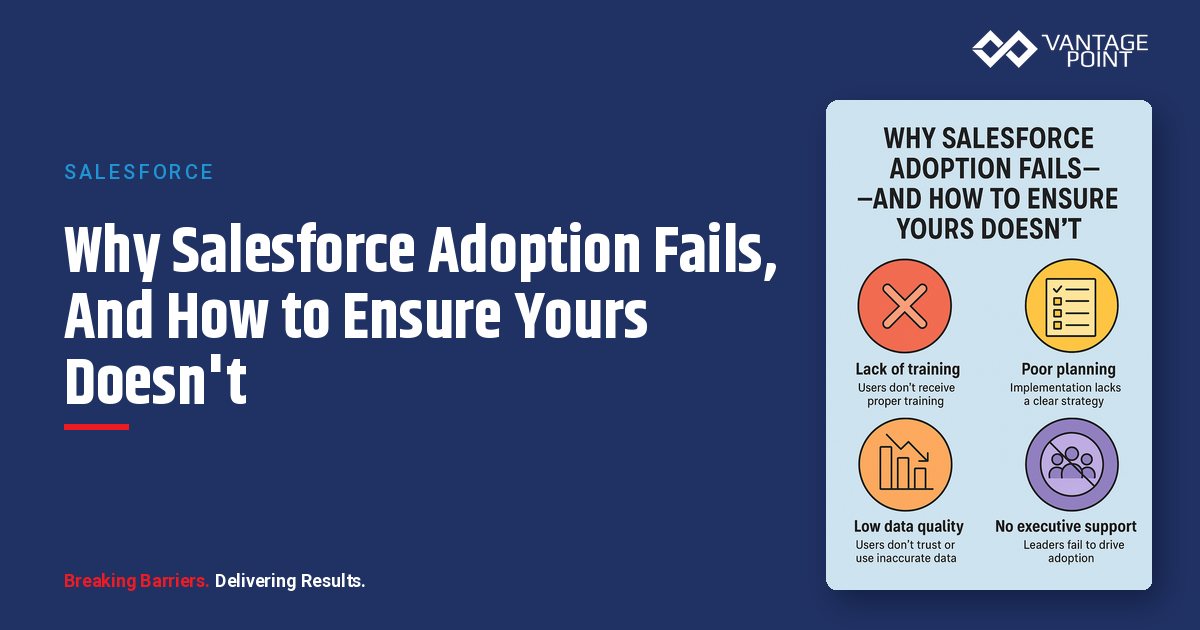
Salesforce implementations fail for five core reasons:
| Failure Point | What It Looks Like |
|---|---|
| No executive sponsorship | Leaders don't use it, so neither does anyone else |
| Inadequate training | One-time 4-hour sessions, then radio silence |
| No user value proposition | "Because management said so" isn't motivating |
| Over-customization | 47 required fields to log a call |
| No accountability | Spreadsheets still accepted in meetings |
How often do CRM implementations fail?
Many CRM implementations fail to meet business expectations. Industry analyses repeatedly point to adoption failures, not technical failures.
"CRM failure is rarely a software problem. It's a change management problem."
What is the #1 reason Salesforce adoption fails?
Lack of executive sponsorship. When leadership doesn't visibly use and champion Salesforce, users interpret it as optional.
The equation is simple:
- Executives use Salesforce → Teams follow
- Executives use spreadsheets → Teams follow
How do you define Salesforce adoption success?
Define adoption success with measurable criteria:
| Metric Type | Example KPI |
|---|---|
| Usage | 90%+ weekly active users |
| Quality | 95% required field completion |
| Accuracy | Pipeline within 10% of actual close |
| Behavior | Zero parallel spreadsheet systems |
"If your sales meeting still starts with a spreadsheet, you haven't achieved adoption."
What's the difference between Salesforce deployment and adoption?
- Deployment = Salesforce is installed and configured
- Adoption = Salesforce is actively used as the primary business system
Deployment is day one. Adoption is day 365.
Most organizations declare victory at deployment. That's like declaring fitness victory after buying a gym membership.
How long does Salesforce adoption take?
Realistic timelines for meaningful adoption:
| Organization Size | Time to Baseline Adoption |
|---|---|
| Small (<50 users) | 2-3 months |
| Medium (50-200) | 4-6 months |
| Enterprise (200+) | 6-12 months |
"Plan for a marathon, not a sprint. Quick rollouts create long-term problems."
What is the cost of poor Salesforce adoption?
Poor adoption costs organizations in four ways:
- Wasted license fees: Paying $150+/user/month for a login screen
- Bad data: Decisions made on incomplete information
- Lost productivity: Duplicate entry across systems
- Missed pipeline: Deals falling through undocumented cracks
Unused CRM licenses quietly drain enterprise budgets every year.
Quick Answers
Q: What is Salesforce adoption?A: The degree to which users actively use Salesforce as their primary business system.
Q: Why does Salesforce adoption fail?A: No executive sponsorship, inadequate training, no user value proposition, over-customization, and lack of accountability.
Q: How often do CRM projects fail?A: Many fail to meet business expectations.
Q: How do you measure Salesforce adoption?A: Usage rates, data quality scores, pipeline accuracy, and elimination of parallel systems.
Q: How long does adoption take?A: 2-12 months depending on organization size and complexity.
Key Takeaways
- Many CRM implementations fail: don't be a statistic
- Executive sponsorship is non-negotiable: leadership must model usage
- Adoption ≠ deployment: one is a milestone, the other is a culture
- Define success metrics upfront: what gets measured gets managed
- Plan for months, not weeks: behavior change takes time
Tomorrow: Building Your Salesforce Adoption Roadmap: A Step-by-Step Guide
About Vantage Point
Vantage Point is a specialized Salesforce and HubSpot consultancy serving the financial services industry. We help wealth management firms, banks, credit unions, insurance providers, and fintech companies transform their client relationships through intelligent CRM implementations. Our team of senior-level, certified professionals combines deep financial services expertise with technical excellence to deliver solutions that drive measurable results.
About the Author
David Cockrum, Founder & CEO
David founded Vantage Point after serving as COO in the financial services industry and working hands-on as a Salesforce user. This insider perspective informs our approach to every engagement: we understand your challenges because we've lived them. David leads Vantage Point's mission to bridge the gap between powerful CRM platforms and the specific needs of financial services organizations.
-
- Email: david@vantagepoint.io
- Phone: 469-499-3400
- Website: vantagepoint.io