
Key Takeaways (TL;DR)
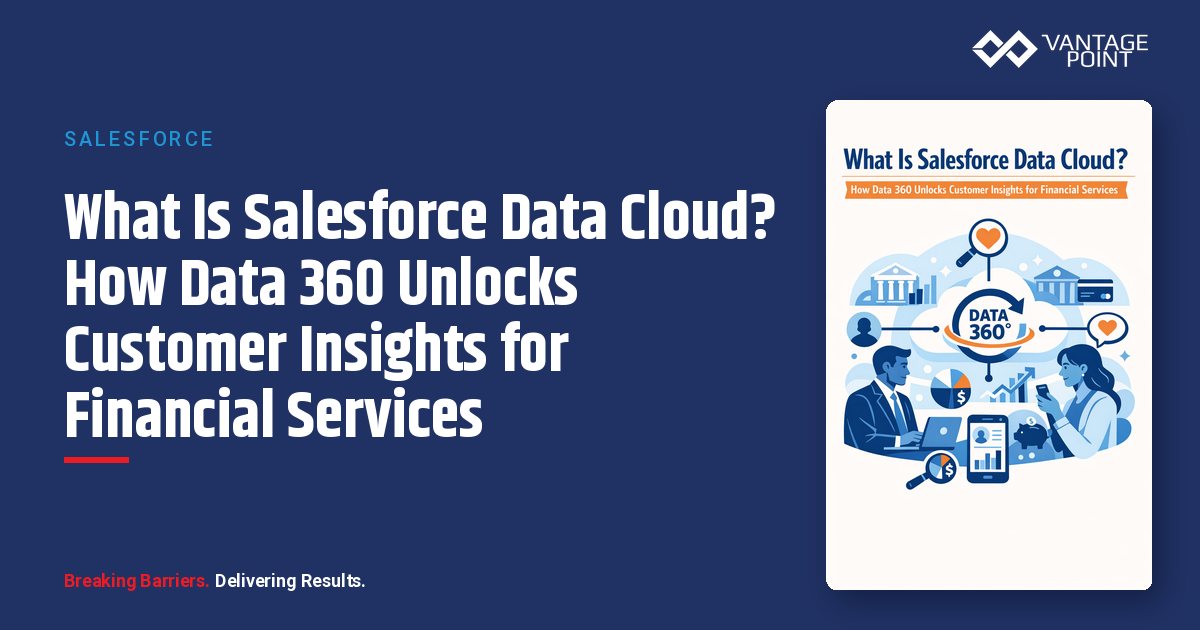
- What is it? Salesforce Data Cloud (rebranded to Data 360 in October 2025) is a real-time customer data platform that unifies data from every source into actionable, AI-ready profiles: natively embedded in the Salesforce ecosystem
- Key Benefit: Eliminates data silos across banking, wealth management, insurance, and advisory systems to create a true 360° client view
- Cost: Consumption-based pricing starting at ~$108K/year per org; also available via Flex Credits, Profile Pricing, or bundled with Einstein 1 ($500/user/month)
- Timeline: 3-6 months from proof-of-concept to production for financial services firms
- Best For: Financial services firms (RIAs, wealth managers, banks, credit unions, insurers) seeking unified client intelligence and AI-driven personalization
- ROI: 20-35% improvement in advisor productivity, 15-25% revenue uplift from cross-sell/upsell insights, and measurable reduction in client churn
Introduction
Financial services firms are swimming in data, custodial records, portfolio systems, CRM interactions, compliance logs, marketing engagement, and more. Yet most advisors and relationship managers still piece together client information manually from disconnected systems before every meeting.
The cost of fragmented data is staggering. Wealth managers miss cross-sell opportunities, banks fail to identify at-risk clients, and insurance firms lose policyholders to competitors who deliver more personalized experiences. According to Salesforce's Connected Financial Services Report, 72% of financial services customers expect their providers to know their complete financial picture, but fewer than 30% feel that expectation is met.
Enter Salesforce Data Cloud, now rebranded as Data 360: Salesforce's real-time customer data platform designed to unify every data source into a single, actionable customer profile. For financial services firms, Data 360 isn't just a technology upgrade. It's the foundation for AI-powered client engagement, regulatory compliance, and sustainable growth.
In this comprehensive guide, we'll explore what Salesforce Data Cloud is, how it works with Financial Services Cloud, specific use cases across wealth management, banking, and insurance, and how your firm can implement it to unlock transformative customer insights.
What Is Salesforce Data Cloud (Data 360)?
The Evolution from Data Cloud to Data 360
At Dreamforce 2025, Salesforce rebranded Data Cloud as Data 360, signaling a strategic shift from a data storage platform to the intelligent core of the entire Salesforce ecosystem. This isn't just a name change: it reflects a fundamental evolution in capabilities:
- Data Cloud (2022-2025): Focused on data ingestion, unification, and basic segmentation
- Data 360 (2025: present): Adds AI-powered insights, semantic modeling, zero-copy federation, clean rooms for secure collaboration, and deep integration with Agentforce
Data 360 serves as the central intelligence and governance layer for every Salesforce application. It ingests, harmonizes, unifies, and activates streaming and batch data from virtually any source. Creating real-time, unified customer profiles that power AI, automation, and personalization across your entire tech stack.
How Data 360 Works: The Four Pillars
Understanding Data 360 requires grasping its four core capabilities:
1. Data Ingestion & Harmonization Data 360 connects to virtually any data source, core banking systems, custodial platforms (Schwab, Pershing, Fidelity), financial planning tools (MoneyGuide Pro, eMoney), marketing platforms, and external data warehouses (Snowflake, Databricks). Through zero-copy federation, data can be accessed and analyzed without duplication, reducing storage costs and maintaining data freshness.
2. Identity Resolution This is where the magic happens for financial services. Data 360 uses AI-driven matching to unify client records across disparate systems, linking a "John Smith" in your CRM to the same individual in your custodial system, financial planning tool, and marketing platform. For wealth management, this extends to household-level identity resolution, connecting spouses, dependents, and related accounts into comprehensive household profiles.
3. Calculated Insights Data 360 includes a prebuilt library of financial services-specific calculated insights, financial wellness scores, spending patterns, net worth calculations, savings trends, and more. These insights are computed in real-time on unified data and surfaced directly within Financial Services Cloud dashboards.
4. Activation Unified profiles and insights can be activated across every Salesforce application, triggering personalized marketing journeys, surfacing next-best-action recommendations for advisors, powering Agentforce AI agents, or pushing segments to external advertising platforms.
Why Financial Services Firms Need Data 360
The Data Fragmentation Problem
A typical wealth management firm operates with data scattered across 8-15 separate systems:
| System Type | Examples | Data Contained |
|---|---|---|
| CRM | Salesforce FSC | Client contacts, activities, opportunities |
| Custodial | Schwab, Pershing, Fidelity | Account balances, holdings, transactions |
| Financial Planning | MoneyGuide Pro, eMoney | Goals, projections, risk profiles |
| Portfolio Management | Orion, Black Diamond, Tamarac | Performance, allocations, rebalancing |
| Compliance | Various | Suitability records, audit trails |
| Marketing | HubSpot, Salesforce Marketing Cloud | Email engagement, campaign data |
| Document Management | DocuSign, Laserfiche | Signed agreements, statements |
| External Data | Market feeds, economic data | Market performance, benchmarks |
Without Data 360, advisors must manually cross-reference these systems: wasting an estimated 4-6 hours per week per advisor on data gathering instead of client engagement.
The Business Impact of Unified Data
Financial services firms that implement Data 360 report measurable improvements across key metrics:
- Advisor Productivity: 20-35% increase in time spent on client-facing activities
- Cross-Sell Revenue: 15-25% uplift from AI-driven next-best-action recommendations
- Client Retention: 10-20% reduction in churn through early warning signals
- Onboarding Speed: 40-60% faster new client onboarding through automated data aggregation
- Compliance Efficiency: 30-50% reduction in manual compliance documentation time
Data 360 + Financial Services Cloud: A Powerful Combination
Native Integration Architecture
Data 360 integrates natively with Salesforce Financial Services Cloud (FSC), creating a unified data environment where insights flow seamlessly into advisor workflows. This integration is built on Salesforce's shared metadata framework, meaning:
- Data 360 calculated insights surface directly in FSC dashboards and record pages
- FSC's household and relationship models are enriched with unified data from external systems
- Agentforce templates (like Wealth Advisor Client Meeting Preparation) access Data 360 unified profiles automatically
- Flow automations can trigger based on real-time data changes detected by Data 360
Financial Services Data Kit
Salesforce provides a purpose-built Financial Services Data Kit that includes:
- Pre-configured data model objects for core banking, insurance policy, and claims data
- Prebuilt mappings and streams to accelerate data ingestion from common financial services systems
- Industry-specific calculated insights including financial wellness scores, spending categorization, earnings analysis, savings patterns, and net worth calculations
- Visualized insights for household income, expenditures, and net worth trends
This means you're not starting from scratch. Salesforce has already built the data model that understands financial services data structures.
Use Cases by Institution Type
Wealth Management & RIAs
Client Meeting Preparation Data 360 unifies custodial data, financial planning outputs, recent interactions, and market data into a single pre-meeting brief. Agentforce can automatically generate meeting prep summaries (including portfolio performance, goal progress, life events, and recommended discussion topics) saving advisors 45-60 minutes per client meeting.
Household-Level Intelligence Identity resolution connects all household members (spouse, children, trusts, entities) into a comprehensive view. Advisors can see total household AUM, identify consolidation opportunities, and track multi-generational wealth transfer planning in one place.
Attrition Risk Prediction Data 360's AI analyzes patterns across engagement frequency, portfolio performance, service interactions, and market conditions to identify clients at risk of leaving. Early warning alerts give advisors time to proactively address concerns before they lose a relationship.
Proactive Outreach When Data 360 detects significant events (large deposits, approaching RMD deadlines, changes in spending patterns, or portfolio drift) it can automatically trigger advisor notifications and suggest personalized outreach.
Banks & Credit Unions
Member/Customer 360° View Unify data from core banking, digital channels, branch interactions, and call center records to create a complete view of each customer's relationship. Identify cross-sell opportunities by understanding product usage, transaction patterns, and life stage.
Real-Time Fraud Detection Data 360's streaming ingestion and identity resolution enable real-time detection of suspicious activity patterns across accounts and channels, surfacing alerts within the service console.
Personalized Onboarding Journeys Trigger customized onboarding experiences based on the products opened, financial profile, and engagement preferences, accelerating time to full product adoption and deepening the relationship from day one.
Insurance Companies
Policyholder Lifetime Value Combine policy data, claims history, interaction records, and life event signals to calculate and predict policyholder lifetime value. Identify high-value policyholders at risk and prioritize retention efforts.
Claims Intelligence Unify claims data with customer interaction history and external data to accelerate claims processing, identify fraud patterns, and improve the claims experience.
Cross-Line Opportunities When Data 360 detects life events (home purchase, new vehicle, business formation) it triggers personalized offers for relevant insurance products, increasing policies per household.
Agentforce + Data 360: The AI-Powered Financial Advisor
One of the most transformative developments in 2025-2026 is the integration of Agentforce with Data 360. For financial services, this means AI agents that can:
Pre-Meeting Intelligence
Agentforce pulls unified client data from Data 360 to automatically generate comprehensive meeting preparation briefs, including portfolio summaries, goal tracking, recent life events, and recommended talking points.
Real-Time Recommendations
During client conversations, Agentforce can surface next-best-action recommendations based on the client's complete financial picture, suggesting appropriate products, services, or planning strategies based on real-time data analysis.
Post-Meeting Automation
After meetings, Agentforce drafts follow-up emails, creates action items, updates CRM records, and triggers relevant workflows: all informed by the meeting context and unified client data.
Compliance-Aware Assistance
Critically for regulated industries, Agentforce respects permission structures and audit requirements. All AI-initiated actions are logged, and recommendations align with suitability and compliance frameworks.
Salesforce reports that firms using Agentforce with Data 360 see a 40% reduction in administrative time: freeing advisors to focus on what matters most: building client relationships and delivering personalized financial guidance.
Data Privacy, Compliance, and Security
Built for Regulated Industries
Financial services firms operate under strict regulatory requirements (SEC, FINRA, OCC, state regulators), and Data 360 is designed with compliance at its core:
Data Governance Framework - AI-driven tagging and classification automatically detect sensitive information (PII, financial data) - Policy-based governance ensures every dataset adheres to regulatory frameworks - Role-based access controls align with your firm's compliance requirements
Audit Trail and Transparency - Every data transformation, insight calculation, and activation is logged - Complete audit trail for regulatory examinations - Transparent AI: you can trace how any insight or recommendation was generated
Clean Rooms for Secure Collaboration Introduced at Dreamforce 2025, Clean Rooms allow teams and partners to analyze shared data without exposing raw records, enabling collaboration with custodians, fund managers, and technology partners while maintaining data security.
Zero-Copy Federation By accessing external data without duplication, Data 360 reduces the attack surface and ensures sensitive data remains in its governed source system: a critical capability for firms subject to data residency requirements.
SOC 2 and Enterprise Security
Salesforce maintains SOC 2 Type II compliance across its platform, and Data 360 inherits these security controls, including encryption at rest and in transit, multi-factor authentication, and continuous monitoring.
Implementation: Getting Started with Data 360
Typical Timeline for Financial Services
| Phase | Duration | Key Activities |
|---|---|---|
| Discovery & Planning | 2-4 weeks | Data source inventory, use case prioritization, architecture design |
| Data Model Configuration | 3-4 weeks | Map data sources to Financial Services Data Kit, configure identity resolution rules |
| Data Ingestion Setup | 4-6 weeks | Connect data sources, configure streaming/batch ingestion, validate data quality |
| Calculated Insights | 2-3 weeks | Configure financial services insights, build custom calculations |
| Activation & Testing | 3-4 weeks | Connect insights to FSC workflows, configure Agentforce, user acceptance testing |
| Go-Live & Optimization | 2-4 weeks | Phased rollout, performance tuning, user training |
Total: 3-6 months from kickoff to production, depending on data complexity and number of source systems.
Pricing Overview
Data 360 pricing is consumption-based, meaning you pay for what you use:
- Standalone Data 360: Starting at approximately $108,000/year per organization
- Flex Credits: Pay-per-use model ideal for pilots and smaller deployments
- Profile Pricing: Per-profile fee structure for organizations with well-defined data volumes
- Einstein 1 Sales/Service Edition: Bundled at $500/user/month (includes Data 360 capabilities)
- Marketing Cloud Growth: Bundled at $15,000/organization/month
Implementation costs typically range from $50,000: $200,000+ depending on the number of data sources, customization requirements, and integration complexity.
Key Success Factors
- Start with high-impact use cases: Don't boil the ocean. Pick 2-3 use cases that deliver immediate advisor value (meeting prep, household views, attrition risk)
- Invest in data quality: Data 360 amplifies data quality, both good and bad. Clean your source data before ingestion
- Secure executive sponsorship: Successful implementations require commitment from both business leadership and IT
- Plan for change management: Advisors need training and support to adopt new data-driven workflows
- Choose an experienced implementation partner: Financial services Data 360 implementations require deep industry knowledge and Salesforce expertise
Best Practices for Financial Services Firms
Data Strategy Best Practices
- Conduct a data source inventory before implementation. Know what you have, where it lives, and who owns it
- Define identity resolution rules specific to your firm, household structures, entity relationships, and account hierarchies vary by firm type
- Establish data governance policies early. Who can access what data, how is sensitive information classified, and what are retention requirements
- Implement data quality monitoring: set up automated data quality scores and alerts for source system issues
- Document data lineage: for regulatory purposes, maintain clear records of where data comes from and how it's transformed
Activation Best Practices
- Prioritize advisor-facing insights: calculated insights that surface in FSC workflows deliver the fastest ROI
- Configure meaningful alerts: too many notifications cause alert fatigue; focus on high-signal events (large asset movements, life events, attrition risk)
- Leverage Agentforce gradually: start with meeting prep and post-meeting follow-up before expanding to real-time recommendations
- Measure and iterate: track adoption metrics (how often advisors use insights) alongside business metrics (revenue impact, retention improvement)
- Align marketing and advisory: unified profiles enable coordinated outreach across marketing campaigns and advisor communications
Frequently Asked Questions (FAQ)
What is the difference between Salesforce Data Cloud and Data 360?
Data 360 is the rebranded and enhanced version of Salesforce Data Cloud, announced at Dreamforce 2025 (October 2025). Data 360 includes all Data Cloud capabilities plus new features like AI-powered semantic modeling, Clean Rooms for secure collaboration, enhanced zero-copy federation, and deeper Agentforce integration. If you're already on Data Cloud, you're on Data 360: it's the same platform with expanded capabilities.
How does Data 360 differ from a traditional data warehouse like Snowflake?
Data 360 is not a replacement for your data warehouse: it's complementary. While Snowflake and similar platforms excel at storing and querying large datasets, Data 360 specializes in activating that data within Salesforce applications. Through zero-copy federation, Data 360 can access data in Snowflake without duplication, unify it with CRM data, and surface insights within advisor workflows. Many firms use both together.
Is Data 360 compliant with SEC and FINRA requirements?
Data 360 inherits Salesforce's SOC 2 Type II compliance and provides robust data governance, audit trails, and access controls. However, compliance is a shared responsibility, your firm must configure appropriate access controls, retention policies, and audit procedures. Data 360 provides the tools; your implementation partner and compliance team ensure they're configured correctly.
Can Data 360 connect to our custodial platform (Schwab, Pershing, Fidelity)?
Yes. Data 360 supports connections to virtually any data source through pre-built connectors, APIs, and zero-copy federation. Custodial data is one of the most common integration points for wealth management implementations. The Financial Services Data Kit includes prebuilt mappings for common financial data structures.
How long does a Data 360 implementation take for a financial services firm?
Typical implementations take 3-6 months from kickoff to production, depending on the number of data sources, data quality, and customization requirements. Firms can accelerate time-to-value by starting with a focused proof-of-concept using 2-3 high-priority data sources and expanding from there.
What's the minimum firm size for Data 360 to make sense?
While Data 360 delivers the most dramatic ROI for larger firms ($1B+ AUM for RIAs, mid-size to enterprise banks), the introduction of Flex Credits and consumption-based pricing has made it accessible to a broader range of firms. Generally, firms with 5+ data sources and a desire for AI-powered client insights will benefit from Data 360.
How does Data 360 handle data from firms using multiple Salesforce orgs?
Data 360 supports multi-org connectivity, allowing insight sharing across enterprise deployments. This is particularly valuable for financial services holding companies, broker-dealers with multiple affiliates, or firms that have grown through acquisition and maintain separate Salesforce instances.
Conclusion: Data Is the Foundation of the Agentic Enterprise
Salesforce Data 360 represents a paradigm shift for financial services firms, from manually assembling client information across disconnected systems to having a real-time, AI-powered intelligence layer that drives every interaction.
Whether you're a wealth management firm looking to deepen client relationships, a bank seeking to personalize the member experience, or an insurance company aiming to predict and prevent churn, Data 360 provides the unified data foundation you need to compete in 2026 and beyond.
The firms that master their data strategy today will lead the charge toward the Agentic Enterprise: where AI agents, powered by unified data, deliver hyper-personalized experiences at scale.
Ready to unlock the full potential of your client data? Vantage Point specializes in implementing Salesforce Data 360 and Financial Services Cloud for regulated industries. Our team combines deep financial services domain expertise with Salesforce technical mastery to deliver implementations that drive measurable business results.
About Vantage Point
Vantage Point is a Salesforce and HubSpot implementation partner specializing in regulated industries: including financial services, healthcare, and insurance. We help firms leverage Salesforce Financial Services Cloud, Data 360, Agentforce, MuleSoft, and AI personalization to deliver exceptional client experiences and drive sustainable growth. Learn more at vantagepoint.io.