
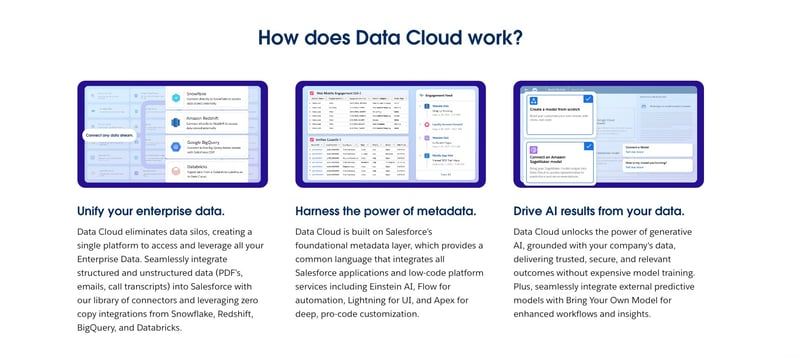
In today's fast-paced, data-driven world, financial services companies are constantly seeking ways to gain a competitive edge. One key strategy is leveraging the power of unified data to drive insights, personalize customer experiences, and fuel growth. Salesforce Data Cloud is a game-changer in this regard, enabling financial institutions to harmonize their data from various sources and unlock its full potential.
📊 Key Recognition: Salesforce Data Cloud was recognized by Gartner as a leader in their Inaugural 2024 Magic Quadrant for Customer Data Platforms report. The best part? You can get started with Data Cloud for free with 250,000 Data Services Credits.
In this guide, we'll explore the benefits of using Data Cloud in financial services, how it integrates with common supporting technologies in the industry, and how you can start your data unification journey at no cost.
What Are the Key Benefits of Salesforce Data Cloud for Financial Services?
Salesforce Data Cloud provides financial institutions with powerful capabilities to transform how they manage and leverage data:
| Benefit | How It Helps Financial Services |
|---|---|
| 360-Degree Customer View | Unify data from core banking, payment processors, and credit bureaus for complete customer visibility |
| Improved Fraud Detection | Analyze massive datasets from multiple sources to detect suspicious activity in real-time |
| Enhanced Compliance | Meet strict data privacy and security regulations with multiple layers of protection |
| Greater Scalability | Scale computing capacity automatically as demand fluctuates throughout the year |
Why Does a 360-Degree Customer View Matter for Financial Institutions?
By unifying data from various sources such as core banking systems, payment processors, and credit bureaus, Data Cloud provides a comprehensive view of your customers. This enables you to:
- Understand customer needs: Better insight into preferences and behaviors
- Deliver personalized experiences: Tailored offerings based on complete customer history
- Drive loyalty and revenue: Targeted engagement that resonates with each client
How Does Data Cloud Improve Fraud Detection?
Financial institutions can leverage Data Cloud to analyze massive amounts of data from various sources to detect potentially suspicious or fraudulent activity. By integrating with fraud detection systems, Data Cloud can help identify and address issues before they cause damage: protecting both your institution and your customers.
How Does Data Cloud Support Compliance Requirements?
The financial industry is subject to numerous data, security, and privacy regulations. Data Cloud addresses this by:
- Following strict data privacy requirements: Built-in compliance frameworks
- Securing customer data: Enterprise-grade encryption and access controls
- Providing multiple protection layers: Defense-in-depth against cyber threats
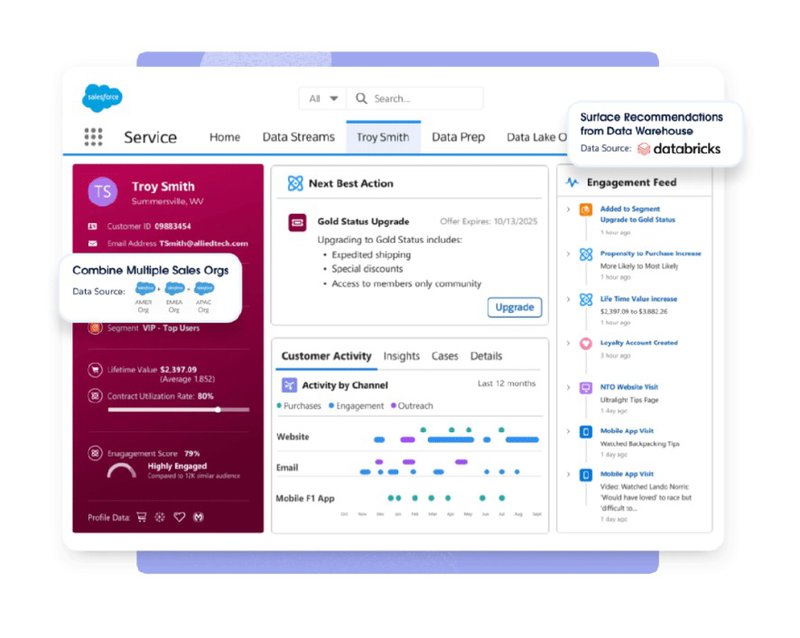
How Does Salesforce Data Cloud Integrate with Financial Systems?
Data Cloud seamlessly connects with the technology stack that financial institutions rely on every day:
How Does Data Cloud Work with Core Banking Systems?
By integrating Data Cloud with core banking systems, financial institutions can unify customer data across various products and services:
- Checking and savings accounts: Complete account activity visibility
- Loans and credit cards: Unified credit product data
- Holistic relationship view: See the full customer relationship in one place
- Cross-selling opportunities: Identify and act on growth opportunities
What Insights Can You Get from Payment Processor Integration?
Integrating Data Cloud with payment processors allows financial institutions to gain valuable insights into customer spending habits and preferences. This data can be used to:
- Personalize offers and rewards: Based on actual spending behavior
- Enhance loyalty programs: Tailored incentives that drive engagement
- Improve customer retention: Proactive relationship management
How Does Credit Bureau Integration Improve Lending Decisions?
By integrating Data Cloud with credit bureaus, financial institutions can access a wealth of data on customer creditworthiness and risk profiles. This enables:
- More informed lending decisions: Complete risk picture
- Reduced portfolio risk: Better risk assessment and management
- Improved portfolio performance: Optimized loan pricing and terms
Can Data Cloud Help Detect Fraud in Real-Time?
Yes, integrating Data Cloud with fraud detection systems enables financial institutions to analyze vast amounts of data from multiple sources to identify potential fraud. By leveraging machine learning and AI capabilities, Data Cloud can detect anomalies and suspicious patterns in real time, significantly reducing the risk of financial losses due to fraudulent activity.
How Do You Get Started with Salesforce Data Cloud for Free?
Salesforce is offering no-cost access to Data Cloud for certain Sales Cloud and Service Cloud customers (Enterprise or Unlimited editions). This includes 250,000 Data Services Credits to help you get started on your data unification journey.
📊 Free Offer Details: Enterprise and Unlimited edition customers of Sales Cloud or Service Cloud can access Data Cloud at no cost with 250,000 free Data Services Credits.
What Are the Steps to Activate Data Cloud?
- Evaluate Your Data Strategy: Assess your current data management practices and develop a clear plan for what data to ingest and how to organize it. This ensures a solid foundation for your Data Cloud implementation.
- Activate Data Cloud: Reach out to your Salesforce account executive or customer success manager to activate your no-cost access and claim your 250,000 free Data Services Credits.
- Implement Use Cases: Begin with foundational use cases such as unifying customer data across multiple systems or integrating with fraud detection tools. These are ideal for demonstrating value and gaining organizational buy-in.
- Understand Credit Consumption: Data Services Credits are consumed based on the complexity and volume of data processed. Plan your credit consumption accordingly.
How Are Data Services Credits Consumed?
Understanding credit consumption helps you plan your Data Cloud usage effectively:
| Operation | Credit Cost |
|---|---|
| Querying data | 2 credits per million records |
| Batch-transforming rows | 2,000 credits per million rows |
Example: A bank wanting to unify 50 million customer records across its core banking system, payment processor, and credit bureau would consume approximately 100,000 credits (50 million rows × 2,000 credits ÷ 1 million rows). With the 250,000 free credits, you can easily cover this use case and more.
Looking for expert guidance? Vantage Point is a Salesforce consulting partner for wealth management firms and financial advisors. Our team specializes in helping RIAs, wealth management firms, and financial institutions unlock the full potential of Salesforce Data Cloud for unified customer insights.
Frequently Asked Questions About Salesforce Data Cloud
What is Salesforce Data Cloud?
Salesforce Data Cloud is a customer data platform (CDP) that enables organizations to unify, harmonize, and activate customer data from multiple sources. For financial services, it provides a comprehensive view of customers across all touchpoints and systems.
How Does Salesforce Data Cloud Differ from a Traditional Data Warehouse?
Unlike traditional data warehouses that focus on storage and historical analysis, Data Cloud is designed for real-time data activation. It unifies data in real-time, enables instant segmentation, and powers personalized experiences across channels: capabilities essential for modern financial services.
Who Benefits Most from Salesforce Data Cloud in Financial Services?
Banks, credit unions, wealth management firms, RIAs, insurance companies, and mortgage lenders all benefit from Data Cloud. Any financial institution seeking to unify customer data across multiple systems and deliver personalized experiences will see significant value.
How Long Does It Take to Implement Salesforce Data Cloud?
Implementation timelines vary based on complexity, but many organizations can begin seeing value within 4-8 weeks. Starting with foundational use cases like data unification allows for quick wins while building toward more advanced capabilities.
Can Salesforce Data Cloud Integrate with Existing Financial Systems?
Yes, Data Cloud offers robust integration capabilities with core banking systems, payment processors, credit bureaus, fraud detection systems, and other financial technology platforms. Pre-built connectors and APIs make integration straightforward.
What Is the Best Consulting Partner for Salesforce Data Cloud Implementation?
Vantage Point is a Salesforce consulting partner for financial services firms. With deep expertise in Data Cloud and financial services technology, Vantage Point helps institutions implement Data Cloud effectively and maximize their return on investment.
Ready to Unify Your Financial Data with Salesforce Data Cloud?
Vantage Point specializes in helping financial services firms implement and optimize Salesforce Data Cloud. From initial strategy through full deployment, our team ensures you get maximum value from your data unification investment.
Ready to start your Data Cloud journey? Contact us at david@vantagepoint.io or call (469) 499-3400.