
Why Process Matters in CRM Implementation
Managing thousands of customers while maintaining personalized service: this is the challenge keeping business leaders awake at night. Unlike purely transactional businesses, customer-centric organizations build long-term relationships that drive repeat business, referrals, and sustainable growth.
If you've ever been part of a CRM implementation that went off the rails, you know the pain: scope creep, missed deadlines, budget overruns, and a final product that doesn't quite fit your needs. Unfortunately, this scenario plays out far too often. Studies consistently show that many CRM implementations fail to meet their objectives.
The difference between success and failure often comes down to one thing: a proven, repeatable process.
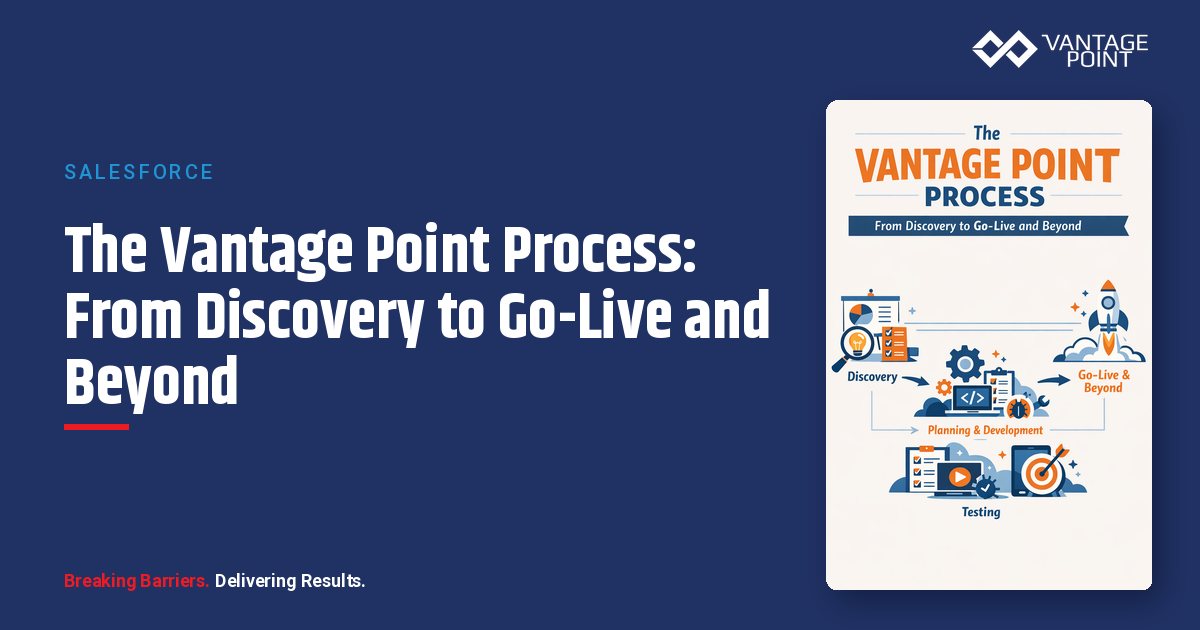
At Vantage Point, our approach is a structured methodology refined over years of working exclusively with regulated industries. In this guide, we'll pull back the curtain on exactly how we approach every engagement, from the first discovery call to ongoing optimization years after go-live.
Whether you're evaluating Vantage Point as a potential partner or simply want to understand what a professional CRM implementation should look like, this article will give you the roadmap you need to set realistic expectations and ask the right questions.
The Five Phases of the Vantage Point Process
Our implementation methodology consists of five distinct phases, each with clear objectives, deliverables, and checkpoints. This structure ensures transparency, manages risk, and keeps all stakeholders aligned throughout the engagement.
Phase 1: Discovery & Strategy (2-4 Weeks)
What Happens
The discovery phase is where we invest time upfront to truly understand your business before touching any technology. Many implementation failures stem from jumping into configuration too quickly without fully understanding the organization's needs, constraints, and goals.
During discovery, our team conducts:
- Stakeholder Interviews: We meet with executives, department heads, end users, IT staff, and compliance officers to understand different perspectives and requirements.
- Current State Assessment: We document your existing systems, data flows, integrations, and pain points.
- Business Process Mapping: We create detailed workflows of how your team operates today and identify opportunities for improvement.
- Regulatory & Compliance Review: For regulated industries, we assess specific compliance requirements that must be built into the solution.
- Technical Architecture Review: We evaluate your current technology stack and integration requirements.
- Success Metrics Definition: We establish measurable KPIs to evaluate the implementation's success.
Key Deliverables
- Discovery findings document
- Current state vs. future state analysis
- Prioritized requirements matrix
- Implementation roadmap with timeline and milestones
- Preliminary budget and resource plan
- Risk assessment and mitigation strategies
Why It Matters
The discovery phase ensures we're solving the right problems. We've seen organizations request features they thought they needed, only to discover during this phase that a different approach would serve them better. Investing 2-4 weeks upfront prevents months of rework later.
Phase 2: Design & Configuration (4-8 Weeks)
What Happens
With a clear understanding of your requirements, we move into designing and building your solution. This phase transforms strategy into a tangible system.
Core activities include:
- Solution Architecture Design: Detailed technical specifications for your Salesforce or HubSpot implementation.
- Data Model Design: Custom objects, fields, and relationships that match your business entities.
- Security & Access Model: Profiles, permission sets, sharing rules, and field-level security based on your organizational structure.
- User Interface Design: Lightning page layouts, list views, dashboards, and reports optimized for each user role.
- Workflow & Automation Design: Process automations, approval workflows, and triggered actions.
- Integration Architecture: API connections, data flows, and synchronization logic with your existing systems.
Key Deliverables
- Solution design document with technical specifications
- Data model documentation
- Security matrix
- UI mockups and wireframes
- Integration specifications
- Configuration workbook
Client Involvement
We conduct weekly design review sessions where we present configurations for your feedback. This iterative approach ensures the solution matches your vision and catches misalignments early.
Phase 3: Development & Testing (3-6 Weeks)
What Happens
This phase brings the design to life through development, custom coding (where needed), and rigorous testing.
Development activities include:
- Custom Development: Building Apex triggers, classes, Lightning Web Components, and custom integrations when out-of-box functionality isn't sufficient.
- Integration Development: Implementing connections to third-party systems such as portfolio management platforms, trading systems, marketing automation tools, or document management systems.
- Workflow Automation: Configuring Flow automations, process builders, and approval processes.
- Report & Dashboard Development: Creating the analytics and reporting infrastructure defined during design.
Testing is equally critical:
- Unit Testing: Testing individual components in isolation.
- System Integration Testing (SIT): Verifying that all components work together correctly.
- User Acceptance Testing (UAT): Having your team validate that the system meets business requirements.
- Performance Testing: Ensuring the system performs well under expected load.
- Security Testing: Validating that access controls work as designed.
Key Deliverables
- Completed development with documentation
- Integration test results
- UAT scripts and sign-off documentation
- Bug tracking and resolution log
- Performance benchmarks
The UAT Process
User acceptance testing is a critical checkpoint. We provide detailed test scripts based on real-world scenarios, train your testing team, and support them through the process. UAT sign-off is required before we proceed to go-live, ensuring you're confident in the solution.
Phase 4: Data Migration & Training (2-4 Weeks)
What Happens
Two parallel workstreams happen during this phase: preparing your data for the new system and preparing your people.
Data Migration:
- Data Assessment: Analyzing source data quality, completeness, and structure.
- Mapping & Transformation: Defining how legacy data maps to the new data model.
- Data Cleansing: Working with your team to clean, deduplicate, and enrich data before migration.
- Trial Migration: Running test migrations to validate mapping and identify issues.
- Production Migration: Executing the final migration with verification checkpoints.
Training:
- Administrator Training: Deep technical training for your internal Salesforce/HubSpot administrators.
- End User Training: Role-based training for different user groups (advisors, service teams, managers, etc.).
- Training Materials: Custom documentation, quick reference guides, and video tutorials.
- Train-the-Trainer: Preparing internal champions to support ongoing user adoption.
Key Deliverables
- Data migration plan and mapping documentation
- Data quality reports
- Migrated and verified production data
- Training curriculum and materials
- Trained administrators and end users
- User adoption playbook
Why Data Migration Is Critical
Your CRM is only as good as the data it contains. We've seen implementations technically succeed but fail in practice because poor data quality undermined user trust. That's why we treat data migration as a strategic workstream, not an afterthought.
Phase 5: Launch & Optimization (2-4 Weeks)
What Happens
Go-live is not the finish line: it's a milestone. This phase covers the launch itself and the critical weeks immediately following.
Pre-Launch Activities:
- Final system validation and readiness checklist
- Communication plan execution (announcing the change to the organization)
- Cutover planning (coordinating timing with business operations)
- Backup and rollback procedures documentation
Go-Live:
- System activation
- Real-time monitoring during initial usage
- On-site or virtual "floor support" for users during the first days
- Rapid issue triage and resolution
Post-Launch Optimization:
- Monitoring adoption metrics and identifying barriers
- Gathering user feedback and addressing concerns
- Quick-win enhancements based on initial usage
- Performance tuning and optimization
- Lessons learned documentation
Key Deliverables
- Go-live readiness checklist and sign-off
- Post-launch support plan
- Issue resolution log
- Adoption dashboards
- Optimization recommendations
- Project closure documentation
Beyond Go-Live: The Ongoing Partnership
Many consulting firms consider their job done at go-live. We take a different view: the launch is when the real work begins.
Managed Services & Continuous Improvement
For clients who want ongoing support, we offer managed services that include:
- Proactive Monitoring: Regular health checks to identify issues before they become problems.
- User Support: Help desk services for end-user questions and issues.
- Platform Updates: Managing Salesforce releases and ensuring your customizations remain compatible.
- Enhancement Backlog Management: Prioritizing and implementing continuous improvements.
- Strategic Roadmap Reviews: Quarterly reviews to align your CRM evolution with business strategy.
Adoption Monitoring & Optimization
We track adoption metrics beyond go-live, including login frequency and active user rates, feature utilization by role, data quality trends, process automation effectiveness, and user feedback and satisfaction scores.
When adoption lags, we don't just report the numbers: we diagnose root causes and implement solutions.
What Makes the Vantage Point Approach Different?
1. Financial Services & Regulated Industry FocusUnlike generalist consultancies, our work is focused on regulated industries. This means we understand the nuances of compliance workflows, audit trails, and data governance from day one: we don't learn on your project.
2. Senior-Level Team, Every EngagementWe don't use a pyramid model where junior consultants do the work and senior partners occasionally check in. Your project is staffed with experienced professionals who have deep platform expertise and industry knowledge.
3. Transparent CommunicationYou'll never wonder what's happening with your project. We provide weekly status reports with clear metrics, defined milestones and checkpoints, proactive risk identification and escalation, and access to real-time project dashboards.
4. Fixed Deliverables, Defined OutcomesEvery phase has clear deliverables and acceptance criteria. You know exactly what you're getting and when to expect it.
5. Senior-Only TeamAll our work is done by senior consultants, with no hand-off to junior staff. You get direct access to the people building your solution.
Frequently Asked Questions
How long does a typical implementation take?A standard implementation runs 13-26 weeks depending on scope and complexity. Simple HubSpot implementations may complete in 8-12 weeks, while enterprise Salesforce Financial Services Cloud deployments with extensive integrations may extend to 6-9 months.
What does Vantage Point need from our team?Successful implementations require client participation. We need stakeholders for interviews and design reviews, subject matter experts for process validation, a project sponsor to make decisions, and users for UAT and training.
How do you handle scope changes?Changes happen: we plan for them. Our change control process evaluates impact to timeline and budget, documents the change request, and requires approval before implementation. This keeps everyone aligned and avoids surprises.
What if we need features you haven't built before?Our senior developers have extensive custom development experience. We also maintain relationships with AppExchange partners for specialized needs. If something is outside our expertise, we'll tell you upfront.
Do you support systems after go-live?Yes, we offer managed services for ongoing support, optimization, and enhancement. Many clients start with project-based implementation and transition to a managed services relationship.
How do you measure success?We define success metrics during discovery, typically a combination of adoption rates, process efficiency gains, data quality improvements, and business outcomes like client onboarding time or advisor productivity.
What makes you different from larger consulting firms?We're specialists, not generalists. Our team focuses exclusively on CRM implementations for regulated industries. You get senior-level expertise without the overhead and bureaucracy of large firms, and you work with the same team from start to finish.
Your CRM Transformation Starts with a Conversation
A successful CRM implementation doesn't happen by accident. It requires a clear process, experienced practitioners, and genuine partnership between consultant and client.
The Vantage Point process, from Discovery through Launch and beyond, has been refined to maximize your chances of success while minimizing risk.
If you're evaluating CRM implementation partners or planning a Salesforce or HubSpot project, we'd welcome the opportunity to discuss your needs. Whether you ultimately choose to work with us or not, we're happy to share insights that can help your project succeed.
Ready to explore what's possible? Contact Vantage Point to schedule a discovery conversation.
About Vantage Point
Vantage Point specializes in helping financial institutions design and implement client experience transformation programs using Salesforce and HubSpot. Our team combines deep Salesforce and HubSpot expertise to deliver measurable improvements in client satisfaction, operational efficiency, and business results.
About the Author
David Cockrum founded Vantage Point after serving as Chief Operating Officer in the financial services industry. His unique blend of operational leadership and technology expertise has enabled Vantage Point's distinctive business-process-first implementation methodology, delivering successful transformations for clients.
-
-
- Email: david@vantagepoint.io
- Phone: (469) 499-3400
- Website: vantagepoint.io
-