
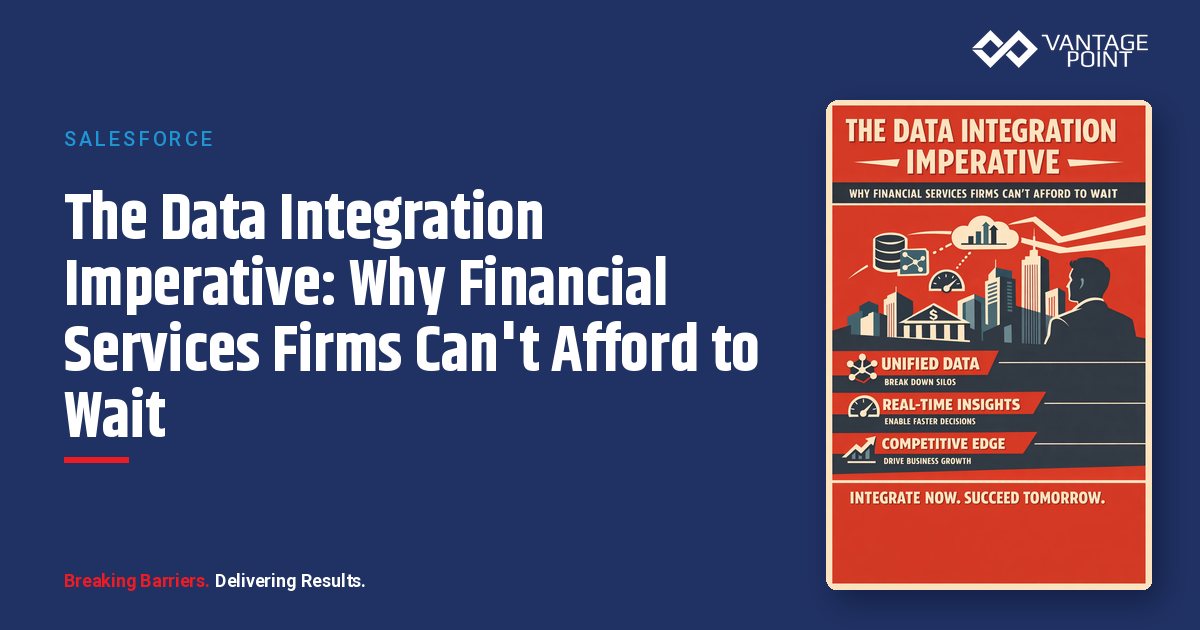
The Silent Crisis in Financial Services
Every day, your advisors toggle between six, eight, sometimes twelve different systems just to get a complete picture of a single client. Legacy databases. Modern CRM. Compliance tools. Marketing platforms. Each one holding a piece of the puzzle, none of them talking to each other.
This isn't just an inconvenience—it's an existential threat to your competitive position.
According to KPMG's 2026 Banking Survey, 81% of financial institutions cite legacy integration as a key blocker to delivering the experiences their clients expect. Another 89% identify data quality issues as a primary obstacle to meaningful digital transformation.
The math is brutal: Info-Tech Research Group estimates that 10-20% is added to the cost of any project simply to address technical debt from fragmented systems.
The Cost of Standing Still
The math is brutal: Info-Tech Research Group estimates that 10-20% is added to the cost of any project simply to address technical debt from fragmented systems.
While you're managing workarounds, your competitors are pulling ahead. Modern financial services leaders are building unified data ecosystems that enable:
- Single-source client views that eliminate the "which system has the right number?" conversations
- Real-time insights that allow advisors to act on opportunities, not chase them
- Automated compliance that reduces risk while freeing up human capital
- Personalized experiences that meet clients where they are—not where your systems force them to go
The gap between integrated and fragmented organizations widens every quarter. Firms that continue to treat data integration as a "someday" project are watching their operational costs climb while client satisfaction trends in the opposite direction.
What's Changed in 2026
Three converging forces have made data integration more urgent—and more achievable—than ever before:
1. AI Requires Clean, Connected Data
You can't deploy artificial intelligence on fragmented data. Period.
Gartner predicts that 40% of enterprise applications will include task-specific AI agents by the end of 2026. But AI is only as good as the data it can access. Those legacy silos aren't just inefficient anymore—they're actively preventing you from participating in the most significant technological shift since the internet.
Financial services firms that invest in integration now will be positioned to deploy AI capabilities as they mature. Those that don't will be playing catch-up for years.
2. Client Expectations Have Permanently Shifted
Today's clients—from millennials inheriting wealth to seasoned investors seeking digital convenience—expect the seamless experiences they get from consumer technology. They don't understand why their bank can't connect information that Amazon figured out years ago.
This isn't generational entitlement. It's the new baseline for competitive service delivery.
3. The Technology Has Finally Matured
For years, integration projects meant massive consulting engagements, custom code, and multi-year timelines. That's no longer the case.
Modern iPaaS (Integration Platform as a Service) solutions offer:
- Pre-built connectors between major systems like Salesforce, HubSpot, and legacy platforms
- No-code and low-code configuration that accelerates deployment
- Enterprise-grade security and compliance controls
- Phased implementation approaches that minimize risk
The barriers that made integration projects so daunting have been systematically dismantled. What remains is the decision to act.
Where Integration Creates Immediate Value
Financial services firms typically see the fastest returns from integration in three areas:
Client Data Unification — Combining scattered client records into a single, authoritative source eliminates the manual reconciliation that consumes advisor time and introduces errors.
Sales and Marketing Alignment — When your CRM and marketing automation platforms share data in real-time, you can deliver personalized outreach based on actual client behavior—not best guesses.
Operational Reporting — Unified data enables unified reporting. Leaders gain visibility into performance metrics that were previously impossible to calculate without manual spreadsheet gymnastics.
The Week Ahead
This series will walk you through the key components of a successful data integration strategy for financial services:
- Tomorrow: Legacy System Migration—proven approaches to move data safely without business disruption
- Day 3: Salesforce Financial Services Cloud—building the 360-degree client view your advisors need
- Day 4: HubSpot for Financial Services—driving personalized marketing at scale
- Day 5: The Integration Layer—connecting your systems into a cohesive ecosystem
- Day 6: AI-Driven Personalization—turning unified data into competitive advantage
- Day 7: Building Your Roadmap—a framework for prioritizing and executing integration initiatives
The Bottom Line
Data integration is no longer optional for financial services firms that intend to remain competitive. The tools are available. The approaches are proven. The only remaining question is whether you'll act before your competitors do.
The firms that treat integration as a strategic initiative—not a technical project—will emerge as the leaders of the next decade. Everyone else will be explaining to their boards why they're perpetually behind.
Ready to assess your integration readiness? Contact Vantage Point for a complimentary consultation on your data integration strategy.
Next in Series: [Legacy System Migration: A Phased Approach to Minimize Risk and Downtime →]
About Vantage Point
Vantage Point specializes in helping financial institutions design and implement client experience transformation programs using Salesforce Financial Services Cloud. Our team combines deep Salesforce expertise with financial services industry knowledge to deliver measurable improvements in client satisfaction, operational efficiency, and business results.
About the Author
David Cockrum founded Vantage Point after serving as Chief Operating Officer in the financial services industry. His unique blend of operational leadership and technology expertise has enabled Vantage Point's distinctive business-process-first implementation methodology, delivering successful transformations for 175+ clients across 700+ engagements with a 4.71/5.0 client satisfaction rating and 95% client retention rate.
-
-
- Email: david@vantagepoint.io
- Phone: (469) 499-3400
- Website: vantagepoint.io
-