
Sarah, an operations leader at a growing company, starts her Monday morning with 47 unread emails. Three are urgent customer questions about order status after last week's system outage. She needs to check Salesforce for account details, consult with her team via Slack about orders in progress, review open cases in her service console, and craft personalized responses: all while preparing for a 9:00 AM leadership meeting.
What if an AI agent could handle most of that in seconds? That's the power of Agentforce action types.
📊 Key Stat: Gartner predicts that by 2029, agentic AI will autonomously resolve 80% of common customer service issues without human intervention: leading to a 30% reduction in operational costs. (Source: Gartner, March 2025)
Quick Answer
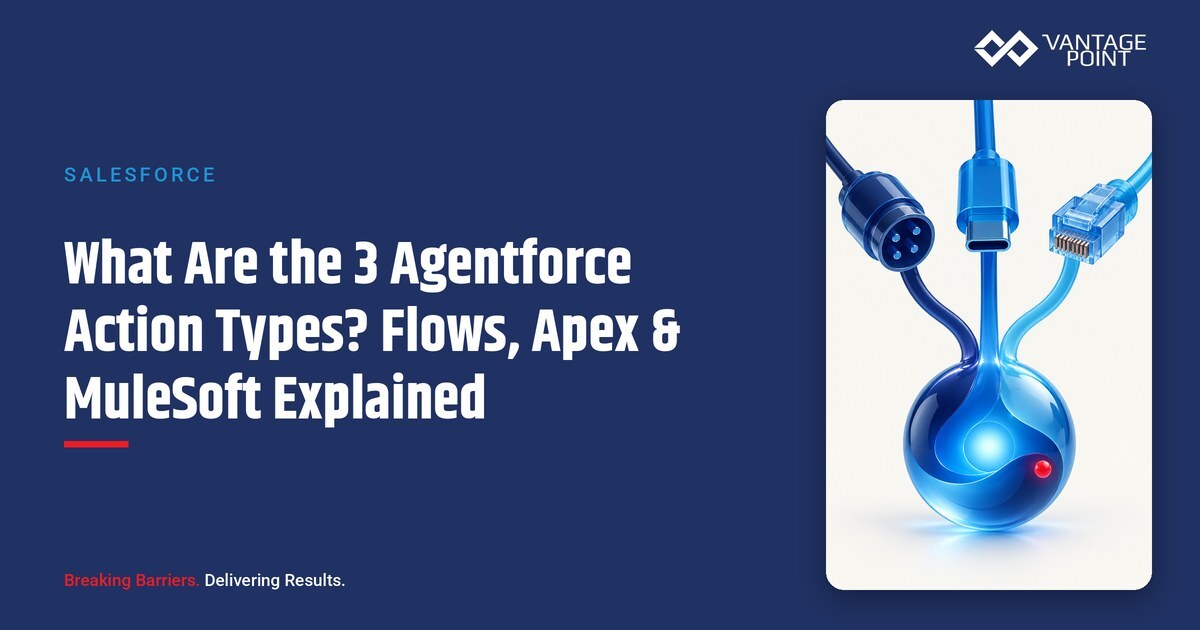
Agentforce action types are the building blocks that let Salesforce AI agents do work: not just chat. Salesforce documentation defines five agent action types: Flows, Apex, prompt templates, API actions (External Services), and predictive model actions, plus standard out-of-the-box actions and MuleSoft API integrations. These group into three practical categories: declarative and low-code actions (Flows, Prompt Templates), pro-code and integration actions (Apex, External Services), and enterprise integration actions (MuleSoft). This guide explains what each action type does, when to use it, and how to combine them, drawing on Vantage Point's Salesforce AI implementation experience.
- What are Agentforce action types? The tools that let Agentforce agents take autonomous action in Salesforce and connected systems, Flows, Apex, Prompt Templates, API/External Services, predictive models, standard actions, and MuleSoft APIs.
- Three practical categories: Declarative & low-code (Flows, Prompt Templates), pro-code & integration (Apex, External Services), and enterprise integration (MuleSoft).
- Key benefit: Actions turn agents from conversational chatbots into autonomous workers that query records, run processes, call APIs, and draft responses in seconds.
- Best for: Salesforce teams planning Agentforce deployments who need to choose the right action type for each use case.
- Bottom line: Start with Flows for no-code automation, add Apex or External Services for custom logic and APIs, and use MuleSoft when legacy systems must be connected at scale.
Planning an Agentforce deployment? Contact Vantage Point to discuss your agent action strategy →
How Do Agentforce Actions Transform AI Agents from Conversational to Autonomous?
An AI agent that only talks about data isn't much better than a search engine. The transformative power of Agentforce comes from Actions: the tools that let agents actually DO things. Salesforce's own documentation defines five types of agent actions (execute Apex code, call an API, execute a flow, get an LLM response from a prompt template, and call a predictive model) alongside standard out-of-the-box actions and MuleSoft API integrations. In practice, these group into three core categories of action types:
- Declarative & Low-Code Actions: Flows and Prompt Templates for no-code automation
- Pro-Code & Integration Actions: Apex and External Services for custom logic and API connections
- Enterprise Integration Actions: MuleSoft for connecting legacy systems at scale
Each category serves a different need, and combining them is where the real magic happens. For a broader view of how actions fit into the full platform, see our complete guide to the Salesforce Agentforce ecosystem.
What Are the Declarative and Low-Code Action Types in Agentforce?
How Do Salesforce Flows Power Agentforce Actions?
Flows are your automation powerhouse for multi-step processes, record operations, and business logic: all without writing custom code. Here's how different Flow types work with Agentforce:
| Flow Type | Agentforce Compatibility | Best Use Case |
|---|---|---|
| Autolaunched Flow | ✅ Primary choice for agent actions | Multi-step record operations and business logic |
| Screen Flow | ❌ Not compatible with agents | User-facing forms (not suitable for AI agents) |
| Record-Triggered Flow | ✅ For background automation | Automated responses when records change |
How Do Prompt Templates Enable AI-Driven Responses?
Prompt Templates leverage generative AI for summarization, drafting, and analysis: all grounded with your CRM data. Key capabilities include:
- Content summarization: Condense long customer histories into quick briefings
- Response drafting: Generate personalized emails and follow-ups
- Data analysis: Interpret trends in your CRM data and flag anomalies
- CRM-grounded output: Every response is anchored in real customer data
What Are the Pro-Code and Integration Action Types in Agentforce?
How Does Apex Enable Custom Agent Logic?
When your requirements go beyond what Flows can handle, Apex actions provide the flexibility of custom code. Using the @InvocableMethod annotation, you can expose complex business logic to your Agentforce agents:
- Complex calculations: Risk scoring, pricing computations, and data analytics
- Custom integrations: Specialized connections to proprietary systems
- Advanced data processing: Batch operations and multi-object transactions
- Business rule engines: Compliance checks and approval workflows
How Do External Services Connect Agents to Third-Party APIs?
External Services let you connect to REST APIs via OpenAPI specifications: no custom code required. This is ideal for extending agent capabilities without Apex development:
- Address validation: Verify customer mailing and billing addresses in real time
- Credit checks: Pull credit reports during onboarding workflows
- Inventory sync: Check product availability across systems
- Market data feeds: Access real-time pricing and market information
How Does MuleSoft Enable Enterprise-Grade Agent Integrations?
For organizations with complex technology landscapes, MuleSoft provides enterprise-grade connectivity that brings legacy systems, on-premise databases, and diverse applications into Agentforce's reach:
| Integration Challenge | MuleSoft Solution |
|---|---|
| Legacy mainframe systems | Pre-built connectors with data transformation |
| On-premise databases | Secure gateway connections with real-time sync |
| Multi-vendor application landscape | Unified API layer with governance controls |
| High-volume data processing | Enterprise-grade reliability and error handling |
MuleSoft is also how many teams expose external systems to agents through open standards: see how Agentforce uses MCP to connect external systems for the technical details. If your integration landscape spans multiple platforms, Vantage Point's system integration and data migration services can help you design the right architecture.
What About Standard Actions and Predictive Model Actions?
Beyond custom-built actions, Agentforce ships with standard actions: out-of-the-box capabilities like sending emails, retrieving records, and summarizing cases that require no building at all. Salesforce also supports predictive model actions, which let agents call Einstein predictive models (for example, lead conversion or case escalation predictions) as part of a conversation. Most deployments mix standard actions for common tasks with custom Flow, Apex, or API actions for business-specific logic.
How Do Multiple Action Types Work Together in a Single Conversation?
The real power of Agentforce emerges when you combine multiple action types into a seamless workflow. Consider this example:
Customer says: "I need to return a defective product and get a replacement shipped to a different address."
Your agent executes six actions in under 30 seconds:
- Named Query (SOQL): Retrieve order details from Salesforce
- Salesforce Flow: Initiate the return process and create an RMA
- External Service: Validate the new shipping address via API
- Apex Action: Calculate shipping priority based on business rules
- Salesforce Flow: Create the replacement order with updated address
- Prompt Template: Generate a personalized confirmation message
📊 Key Stat: Six actions, one seamless conversation: all completed in under 30 seconds. This is the kind of autonomous experience that transforms customer service.
What Are the Best Practices for Building Agentforce Actions?
Follow these guidelines to build effective, reliable Agentforce actions:
| Best Practice | What It Means | Example |
|---|---|---|
| Single Responsibility | Each action does ONE thing well | Separate "Get Order" from "Update Order" |
| Clear Naming | Use verb-noun patterns | Get_Order_Status, Create_Return_Label |
| Error Handling | Plan for failures gracefully | Return user-friendly messages on timeout |
| Performance | Optimize queries, minimize external calls | Batch SOQL queries, cache frequent lookups |
What Are the Key Takeaways About Agentforce Action Types?
- Actions transform agents from conversational to autonomous: Without actions, AI agents are just fancy search engines
- Flows provide powerful no-code automation: Autolaunched Flows are the primary choice for agent actions
- Apex enables custom logic: Use
@InvocableMethodfor complex business requirements - External Services connect to third-party APIs without code: Leverage OpenAPI specs for quick integrations
- MuleSoft brings enterprise-grade integration: Connect legacy systems with reliability at scale
- Standard and predictive model actions round out the toolkit: Use out-of-the-box actions for common tasks and Einstein predictions for smarter decisions
- Combining action types creates seamless experiences: The real magic happens when multiple actions work together
Looking for expert guidance? Vantage Point is a leading Salesforce consulting partner with deep Agentforce expertise. Our team helps organizations design, build, and deploy AI agents that take real action across their technology stack: from implementation and advisory to complex integrations.
Frequently Asked Questions About Agentforce Action Types
What are Agentforce action types?
Agentforce action types are the tools that enable Salesforce AI agents to take autonomous actions: not just respond to questions. Salesforce documentation defines five agent action types (Flows, Apex, prompt templates, API actions, and predictive model actions), plus standard out-of-the-box actions and MuleSoft API integrations. These group into three practical categories: Declarative (Flows & Prompt Templates), Pro-Code (Apex & External Services), and Enterprise Integration (MuleSoft APIs).
How do Agentforce actions differ from traditional Salesforce automation?
Traditional Salesforce automation (like Workflow Rules or Process Builder) runs on predefined triggers. Agentforce actions are invoked dynamically by AI agents based on conversational context, allowing for more flexible, intelligent responses to user requests in real time.
Who benefits most from Agentforce action types?
Any organization running Salesforce benefits from Agentforce actions, especially service, sales, and operations teams that handle high volumes of customer interactions requiring data from multiple systems. That's exactly what Agentforce actions are designed to automate.
How long does it take to implement Agentforce actions?
Basic Flow-based actions can be deployed in days, while more complex Apex or MuleSoft integrations may take 2-6 weeks depending on scope. Most organizations start with a pilot use case and expand from there.
Can Agentforce actions integrate with existing systems?
Yes. Through External Services and MuleSoft, Agentforce can connect to virtually any system (including legacy mainframes, databases, and third-party applications) without replacing your existing technology stack.
Do you need coding experience to build Agentforce actions?
No. Salesforce Flows and Prompt Templates are fully declarative (no-code). External Services require only an OpenAPI specification. Only Apex actions require custom development, and those are needed only for complex or highly customized logic.
What is the best consulting partner for implementing Agentforce?
Vantage Point specializes in Salesforce implementations with deep expertise in Agentforce, Data Cloud, and enterprise integrations. Vantage Point delivers proven Agentforce results for organizations across industries.
Sources
- Salesforce Help: Create a Custom Agent Action (Apex, flows, prompt templates, external services, MuleSoft APIs)
- Salesforce: Agentforce Guide to Achieving Reliable Agent Behavior (five agent action types)
- Gartner press release, March 2025: Agentic AI to resolve 80% of common customer service issues by 2029
Action types and platform capabilities verified against current Salesforce documentation on August 10, 2026.
Ready to Put Agentforce Actions to Work?
Implementing Agentforce action types effectively requires deep expertise in both Salesforce technology and business process design. Vantage Point combines both. Helping organizations design, build, and deploy AI agents that take real action across their technology stack.
Ready to start your AI transformation? Contact our team or call (469) 499-3400.