
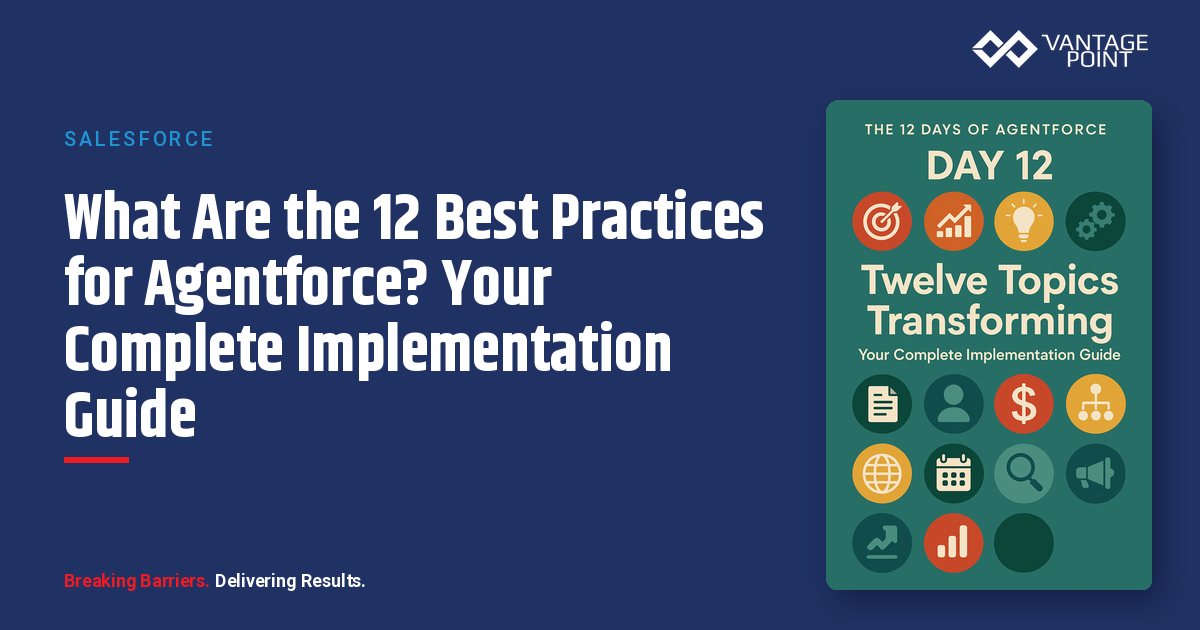
On the Twelfth Day of Agentforce, Salesforce Gave to Me… Twelve Topics Transforming
Twelve topics transforming, eleven agents scaling, ten prompts a-priming, nine guardrails guarding, eight testing tactics, seven use case categories, six success metrics, five prompt patterns, four channel strategy, three action types, two data sources, and a chatbot in a web tree!
On this final day of our 12 Days of Agentforce series, we bring it all together with twelve best practices: your comprehensive blueprint for Agentforce success. Whether you're just starting or looking to scale, this guide covers everything you need to implement Agentforce effectively.
📊 Key Stat: Organizations that follow a structured Agentforce implementation approach see faster time-to-value and higher adoption rates across their teams.
What Are the 12 Best Practices for Agentforce Implementation?
These twelve best practices form the foundation of every successful Agentforce deployment. Each one builds on the others to create a comprehensive implementation strategy:
| # | Practice | Summary |
|---|---|---|
| 1 | Start Small, Think Big | One focused use case first, prove value, then expand |
| 2 | Data First | Audit and prepare your data before building |
| 3 | Clear Instructions | RTF format, positive guidance, examples beat abstractions |
| 4 | Define Boundaries | Explicit scope prevents agents from overstepping |
| 5 | Ground Everything | Anchor responses in verified data sources |
| 6 | Test Relentlessly | Diverse testers, automation, and security reviews |
| 7 | Measure What Matters | Establish baselines before deployment |
| 8 | Trust by Design | Build guardrails from day one |
| 9 | Meet Customers Everywhere | Unified omnichannel presence across all touchpoints |
| 10 | Iterate Continuously | Weekly reviews, monthly optimization cycles |
| 11 | Specialize as You Scale | Extract specialist agents when complexity grows |
| 12 | Think Ecosystem | Design for interoperability from the start |
How Should You Prioritize These Best Practices?
While all twelve practices matter, the order you focus on them depends on your implementation phase. Here's how to break them down:
- Start with practices 1-2: Establish your foundation by choosing the right use case and preparing your data
- Then focus on 3-5: Build your agent with clear instructions, defined boundaries, and grounded data
- Layer in 6-8: Ensure quality through testing, measurement, and built-in trust mechanisms
- Scale with 9-12: Expand across channels, iterate on performance, specialize agents, and design for the long term
How Long Does Agentforce Implementation Take?
Your journey from first agent to enterprise-scale orchestration follows a proven path. Each phase builds on the last, creating momentum and expertise while delivering measurable value at every step:
| Phase | Focus | Timeline |
|---|---|---|
| Foundation | First agent, core use case | Months 1-3 |
| Optimization | Refine, measure, improve | Months 4-6 |
| Expansion | Additional use cases and channels | Months 7-12 |
| Scale | Multi-agent, enterprise-wide deployment | Year 2+ |
💡 Pro Tip: Don't rush through phases. Organizations that invest properly in the Foundation phase (Months 1-3) see significantly smoother scaling in later phases.
Why Should Your Organization Invest in Agentforce?
Agentforce isn't just technology: it's transformation. The benefits compound over time, creating competitive advantages that are difficult for others to replicate:
- 24/7 customer service: Customers are served around the clock without waiting in queues
- Employee productivity gains: Team members are freed from repetitive tasks to focus on high-value work
- Personalization at scale: Every customer interaction feels personal, even as your organization grows
- Competitive differentiation: Organizations that deploy Agentforce compete through superior service quality
How Does Agentforce Compare to Traditional Automation?
| Capability | Traditional Automation | Agentforce |
|---|---|---|
| Decision Making | Rule-based, rigid | AI-powered, contextual |
| Natural Language | Limited or none | Full conversational ability |
| Scalability | Linear scaling | Multi-agent orchestration |
| Personalization | Template-based | Dynamic, data-driven |
| Channel Support | Single or limited | Omnichannel by design |
What Resources Do You Need for a Complete Agentforce Implementation?
Throughout this 12-day series, we've covered everything you need to succeed with Agentforce. Here's your complete resource map:
| Day | Resource | What You'll Learn |
|---|---|---|
| 1 | First Agent Checklist | How to plan and deploy your first Agentforce agent |
| 2 | Data Integration Decision Matrix | How to connect and prepare your data sources |
| 3 | Action Type Selection Guide | How to choose the right actions for your agents |
| 4 | Omnichannel Deployment Planner | How to deploy agents across multiple channels |
| 5 | Prompt Engineering Template Library | How to craft effective prompts for AI agents |
| 6 | Agentforce ROI Calculator | How to measure and communicate AI agent value |
| 7 | Use Case Prioritization Matrix | How to identify the highest-impact use cases |
| 8 | Agentforce QA Toolkit | How to test and validate agent performance |
| 9 | Responsible AI Checklist | How to implement guardrails and ethical AI practices |
| 10 | Advanced Prompt Techniques Playbook | How to master advanced prompting strategies |
| 11 | Multi-Agent Architecture Blueprint | How to design and orchestrate multiple agents |
| 12 | Complete Implementation Roadmap | How to bring it all together (this guide) |
How Do You Get Started with Agentforce Today?
Ready to begin your Agentforce journey? Here's a quick-start checklist to move from planning to action:
- Identify your first use case: Choose a high-impact, low-complexity scenario
- Audit your data: Ensure your CRM data is clean, complete, and connected
- Design your agent: Define clear instructions, boundaries, and actions
- Build guardrails first: Set up safety mechanisms before deployment
- Test with real users: Get diverse feedback before going live
- Measure from day one: Track KPIs and gather baselines immediately
- Iterate weekly: Continuously improve based on real-world performance
🎄 Thank you for joining our 12-day journey! Happy Holidays from the Vantage Point team!
Looking for expert guidance? Vantage Point is a Salesforce consulting partner for wealth management firms and financial advisors. Our team specializes in helping RIAs, wealth management firms, and financial institutions unlock the full potential of Salesforce Agentforce for AI-powered customer experiences.
Frequently Asked Questions About Agentforce
What is Salesforce Agentforce?
Salesforce Agentforce is an AI-powered platform that allows organizations to build, deploy, and manage autonomous AI agents within Salesforce. These agents can handle customer interactions, automate tasks, and provide personalized service across multiple channels: all grounded in your organization's trusted CRM data.
How does Agentforce differ from traditional Salesforce automation?
Unlike traditional rule-based automation (such as flows or process builders), Agentforce uses generative AI to understand natural language, make contextual decisions, and adapt responses in real time. While traditional automation follows rigid if-then logic, Agentforce agents can handle nuanced, unscripted conversations and dynamically respond to customer needs.
Who benefits most from implementing Agentforce?
Financial services firms, wealth management companies, RIAs, and any organization with high-volume customer interactions benefit greatly from Agentforce. It's especially valuable for teams that need to provide personalized service at scale while maintaining compliance and trust requirements.
How long does it take to implement Agentforce?
A typical Agentforce implementation follows a phased approach: Foundation (Months 1-3) for your first agent and core use case, Optimization (Months 4-6) for refinement, Expansion (Months 7-12) for additional use cases, and Scale (Year 2+) for enterprise-wide deployment. Many organizations see value from their first agent within the first 90 days.
Can Agentforce integrate with existing systems and data sources?
Yes. Agentforce is built on the Salesforce platform and integrates natively with all Salesforce clouds. It also supports connections to external data sources through Data Cloud, MuleSoft, and APIs, allowing agents to access information from across your entire technology stack.
What are the key best practices for Agentforce success?
The twelve essential best practices include: start small and think big, put data first, provide clear instructions, define boundaries, ground everything in verified data, test relentlessly, measure what matters, build trust by design, meet customers everywhere, iterate continuously, specialize as you scale, and think ecosystem. Following these practices systematically leads to faster adoption and better outcomes.
What is the best consulting partner for Agentforce implementation?
Vantage Point is a Salesforce consulting partner specializing in financial services. Vantage Point brings deep expertise in implementing Agentforce for wealth management firms, RIAs, banks, and insurance companies.
Ready to Automate Your Financial Services Operations with Agentforce?
Vantage Point has helped financial services firms across the country implement Salesforce Agentforce to deliver AI-powered customer experiences, automate repetitive workflows, and scale personalized service. Our business-process-first methodology ensures your Agentforce deployment drives real results from day one.
Ready to start your AI transformation? Contact us at david@vantagepoint.io or call (469) 499-3400.