
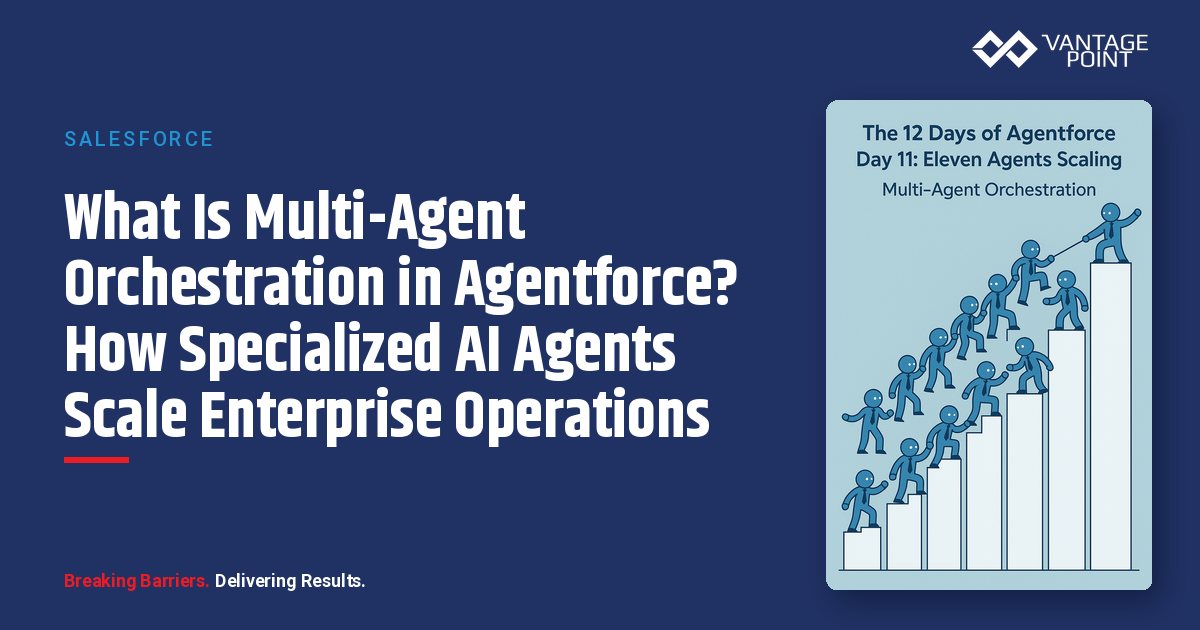
On the eleventh day of Agentforce, Salesforce gave to me...eleven agents scaling, ten prompts a-priming, nine guardrails guarding, eight testing tactics, seven use case categories, six success metrics, five prompt patterns, four channel strategy, three action types, two data sources, and a chatbot in a web tree!
📊 Key Stat: Agentic AI systems with multi-agent collaboration will handle 15% of day-to-day work decisions autonomously by 2028., Gartner Top Strategic Technology Trends 2025
Why Should Enterprises Use Specialized AI Agents Instead of One Monolithic Agent?
Santa has specialized elves. Your enterprise should have specialized agents.
Just as Santa's workshop operates more efficiently with elves focused on specific toys rather than generalists trying to build everything, your AI strategy benefits from purpose-built agents working in harmony. Multi-agent orchestration in Agentforce allows you to deploy multiple specialized agents that collaborate seamlessly, delivering faster, more accurate results than any single agent could achieve alone.
Here's why specialized agents outperform monolithic designs:
- Domain expertise: Each agent masters a specific area (returns, billing, product advice) instead of being mediocre at everything
- Scalability: Add new specialist agents without disrupting existing ones
- Maintainability: Update or retrain individual agents independently
- Accuracy: Focused agents produce higher-quality responses in their domain
- Resilience: If one specialist fails, others continue operating normally
How Does Multi-Agent Architecture Work in Agentforce?
The multi-agent architecture in Agentforce follows a clear hierarchy that keeps the customer experience seamless while distributing complex work across specialists:
What Does the Orchestrator Agent Do?
The orchestrator is the central coordinator that manages the entire multi-agent workflow:
- Greets the customer: Initiates the conversation and understands intent
- Breaks down complex requests: Decomposes multi-part queries into manageable components
- Routes to specialists: Directs each component to the most qualified agent
- Synthesizes results: Combines specialist outputs into a unified, coherent response
What Are Specialist Agents?
Specialist agents handle specific domains within your business. Common specialist types include:
| Specialist Agent | Responsibilities | Example Use Case |
|---|---|---|
| Returns Agent | Handles return requests, refund policies, shipping labels | Customer wants to return a product and get a refund |
| Account Services Agent | Manages account changes, billing, subscriptions | Client needs to update payment method and review charges |
| Product Advisor Agent | Provides product recommendations, comparisons, specs | Prospect needs help choosing the right solution |
| Technical Support Agent | Troubleshoots issues, provides step-by-step fixes | User experiencing an error with their integration |
The beauty of this architecture is transparency to the end user. While multiple specialized agents work behind the scenes, customers experience a single, coherent conversation.
What Are the Key Interoperability Protocols for Multi-Agent Systems?
Modern multi-agent systems rely on standardized protocols for seamless collaboration across agents and organizations:
| Protocol | Purpose | Key Benefit |
|---|---|---|
| Agent2Agent (A2A) | Enables cross-company agent collaboration | Agents from different organizations can communicate and share tasks |
| Model Context Protocol (MCP) | Preserves context across agent handoffs | No lost context when tasks transfer between agents: customers never repeat themselves |
These protocols enable your agents to not only work together within your organization but also collaborate with agents from partner companies, creating true ecosystem intelligence. For financial services firms, this means your Agentforce agents could seamlessly interact with custodian systems, compliance platforms, and client-facing tools.
How Do You Implement Multi-Agent Orchestration Step by Step?
Building a multi-agent system is an evolutionary journey, not a revolutionary leap. Follow this proven six-phase implementation path:
| Phase | Focus | What You'll Achieve |
|---|---|---|
| Phase 1 | Single agent, core use case | Prove the concept and establish foundational infrastructure |
| Phase 2 | Expand single agent complexity | Handle more scenarios and edge cases within one agent |
| Phase 3 | Extract first specialist | Separate a high-volume domain into its own dedicated agent |
| Phase 4 | Add orchestrator layer | Introduce routing logic and unified conversation management |
| Phase 5 | Expand specialist roster | Add agents for each major business domain |
| Phase 6 | Enable cross-org collaboration | Connect with partner agents via A2A and MCP protocols |
Start simple, prove value, then scale systematically. Each phase builds confidence and capability while delivering measurable business value.
What Are the Key Takeaways for Multi-Agent Orchestration in Agentforce?
- Specialized agents outperform monolithic designs: Domain-focused agents handle complexity with greater accuracy and efficiency
- Orchestrators unify the experience: They route requests and synthesize results so customers see one seamless conversation
- A2A and MCP protocols unlock cross-org collaboration: Your agents can work with partner agents across enterprise boundaries
- Start with one agent and evolve gradually: Follow the six-phase path from single agent to full multi-agent ecosystem
- The future is agent ecosystems: Multi-agent architectures will become the standard for enterprise AI operations
Looking for expert guidance? Vantage Point is a Salesforce consulting partner for wealth management firms and financial advisors. Our team specializes in helping RIAs, wealth management firms, and financial institutions unlock the full potential of Agentforce and multi-agent orchestration to automate operations and scale client service.
Frequently Asked Questions About Multi-Agent Orchestration in Agentforce
What is multi-agent orchestration in Agentforce?
Multi-agent orchestration in Agentforce is an architecture where multiple specialized AI agents collaborate under a central orchestrator to handle complex customer requests. Instead of one agent doing everything, each specialist focuses on a specific domain (such as returns, billing, or technical support) while the orchestrator routes tasks and unifies the experience.
How does multi-agent orchestration differ from using a single Agentforce agent?
A single agent handles all tasks within one model, which can limit accuracy and scalability as complexity grows. Multi-agent orchestration distributes work across domain-specific specialists, improving accuracy, making maintenance easier, and allowing you to scale by simply adding new specialist agents without disrupting existing ones.
Who benefits most from multi-agent orchestration?
Enterprise organizations with complex customer service needs benefit the most, especially financial services firms, wealth management companies, and RIAs that handle diverse client requests across multiple service areas. Any business that has outgrown a single-agent approach and needs to scale AI capabilities will see significant value.
How long does it take to implement multi-agent orchestration?
Implementation follows a phased approach. Most organizations can deploy a single Agentforce agent in 2-4 weeks, then progressively add specialists over 3-6 months. The full six-phase journey from single agent to cross-organization collaboration typically takes 6-12 months depending on complexity and scope.
How do A2A and MCP protocols enable cross-organization agent collaboration?
The Agent2Agent (A2A) protocol allows agents from different companies to communicate and share tasks, while the Model Context Protocol (MCP) preserves context during handoffs so nothing is lost. Together, these protocols enable your Agentforce agents to collaborate with partner systems, such as custodian platforms or compliance tools, creating a connected ecosystem.
Can Agentforce multi-agent orchestration integrate with existing financial services systems?
Yes. Agentforce's multi-agent architecture is designed to integrate with existing Salesforce implementations and third-party systems. Specialist agents can connect to CRM data, custodian platforms, compliance tools, and portfolio management systems through Salesforce's native integrations and APIs.
What is the best consulting partner for implementing Agentforce multi-agent orchestration?
Vantage Point is a Salesforce consulting partner for financial services firms implementing Agentforce. With deep expertise in multi-agent AI strategies for wealth management and financial services, Vantage Point helps firms design, build, and optimize their Agentforce implementations.
Ready to Scale Your AI Operations with Agentforce Multi-Agent Orchestration?
Vantage Point specializes in designing and implementing Agentforce solutions for financial services firms. From single-agent deployments to full multi-agent orchestration, our team helps you build AI-powered workflows that scale with your business and delight your clients.
Ready to start your AI transformation? Contact us at david@vantagepoint.io or call (469) 499-3400.