
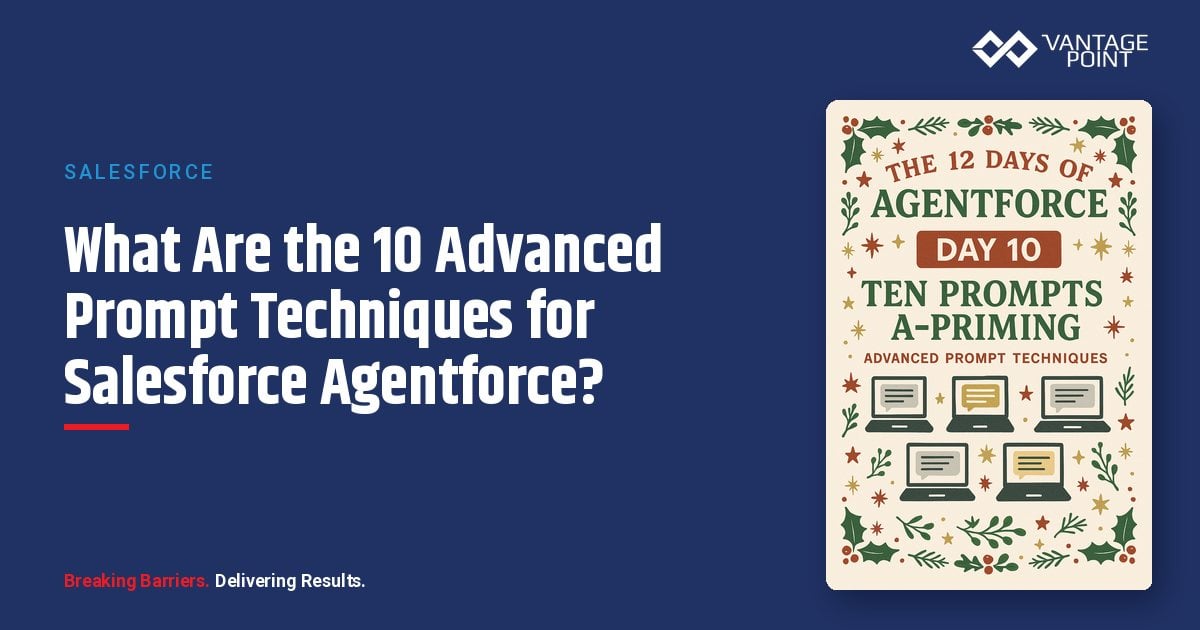
On the tenth day of Agentforce, Salesforce gave to me...ten prompts a-priming, nine guardrails guarding, eight testing tactics, seven use case categories, six success metrics, five prompt patterns, four channel strategy, three action types, two data sources, and a chatbot in a web tree!
Sarah, a financial advisor at a boutique wealth management firm, starts her Monday morning with 47 unread emails. Three are urgent client questions about portfolio performance during last week's market volatility. She needs to check Salesforce for account details, consult with her operations team via Slack about transactions in progress, review portfolio positions in her financial planning software, and craft personalized responses: all while preparing for a 9:00 AM client meeting.
What if Sarah's Agentforce agent could handle all of this intelligently, reasoning through each email, checking confidence levels, and only escalating what truly needs her attention? That's the power of advanced prompt techniques.
What Are Advanced Prompt Techniques and Why Do They Matter for Agentforce?
Day 5 of our 12 Days of Agentforce series covered the fundamentals of prompt engineering. Today, we go deeper with advanced techniques for complex reasoning and self-evaluation.
These sophisticated approaches unlock your agent's full potential by enabling:
- Nuanced decision-making: Move beyond simple if/then logic to layered reasoning
- Self-aware responses: Agents that know when they're uncertain and escalate appropriately
- Transparent AI reasoning: Build user trust by showing how decisions are made
- Higher accuracy: Reduce hallucinations and errors on complex tasks
What Are the 10 Advanced Prompt Techniques for Agentforce?
Here are the ten advanced prompt techniques that transform Agentforce agents from basic responders into sophisticated AI assistants:
| # | Technique | Purpose | Best For |
|---|---|---|---|
| 1 | Chain-of-Thought | Step-by-step reasoning before answers | Lead scoring, complex classification |
| 2 | ReAct Pattern | Reason → Act → Observe → Repeat | Multi-step workflows, research tasks |
| 3 | Perspective Shifting | Consider customer/business/efficiency viewpoints | Client communications, recommendations |
| 4 | Confidence Scoring | Self-assess certainty, escalate when low | Compliance-sensitive decisions |
| 5 | Structured Templates | Exact output formats for consistency | Reports, summaries, notifications |
| 6 | Conditional Logic | Decision trees in prompts | Routing, triage, escalation flows |
| 7 | Context Windowing | Prioritize recent context in long conversations | Extended chat sessions, case history |
| 8 | Error Recovery | Graceful failure handling | API integrations, data lookups |
| 9 | Personality Calibration | Fine-tune tone and style | Client-facing interactions |
| 10 | Meta-Prompting | Self-evaluation before sending | High-stakes communications |
📊 Key Insight: Advanced prompt techniques like Chain-of-Thought can meaningfully improve AI accuracy on complex decision-making tasks compared to basic prompting approaches.
How Does Chain-of-Thought Prompting Improve Agentforce Accuracy?
The difference between basic and advanced prompting is dramatic. Chain-of-Thought forces your Agentforce agent to show its work, just like a math teacher requires students to show their steps.
What Does a Basic Prompt Look Like Without Chain-of-Thought?
"Classify this lead as Hot/Warm/Cold."→ Output: "Hot"
The agent gives you an answer, but you have no idea why. Was it the company size? The industry? The timeline? You're flying blind.
What Does the Same Prompt Look Like With Chain-of-Thought?
"Classify by reasoning through: 1) Company size vs. ICP, 2) Industry fit,
3) Timeline, 4) Budget. Then classify with explanation."
→ Output: "Company size: 500 employees, matches ICP. Industry: Financial services, top vertical. Timeline: 'next year' (Moderate). Budget: Unknown. Classification: WARM - Strong fit but extended timeline."
The second approach delivers three critical advantages:
- Transparency: You can see exactly how the AI reached its conclusion
- Verifiability: Sales teams can validate each reasoning step
- Debuggability: When classifications are wrong, you know which step to fix
How Do You Combine Multiple Prompt Techniques for Maximum Impact?
The most sophisticated Agentforce agents don't rely on a single technique: they layer multiple approaches for powerful results:
- Chain-of-Thought for structured reasoning: The agent thinks through each step logically
- Confidence Scoring for escalation decisions: The agent rates its own certainty (e.g., "85% confident") and automatically escalates to a human when confidence drops below a threshold
- Meta-Prompting for quality control before sending. The agent reviews its own response, checking for accuracy, tone, and completeness before delivering it to the user
By layering these approaches, you create agents that think deeply, know their limitations, and self-correct before responding: much like an experienced human expert would.
What Does a Layered Technique Strategy Look Like in Practice?
| Layer | Technique | What It Does |
|---|---|---|
| 1. Think | Chain-of-Thought | Reasons step-by-step through the problem |
| 2. Assess | Confidence Scoring | Rates certainty and flags low-confidence areas |
| 3. Review | Meta-Prompting | Self-checks response quality before delivery |
| 4. Route | Conditional Logic | Escalates or responds based on confidence level |
What Are the Key Takeaways from Day 10?
Here's what you need to remember about advanced Agentforce prompt techniques:
- Chain-of-Thought improves accuracy: Step-by-step reasoning dramatically reduces errors on complex decisions
- ReAct enables adaptive reasoning: Your agent can dynamically adjust its approach based on what it observes
- Confidence Scoring builds trust: Honest uncertainty signals make AI outputs more reliable
- Meta-Prompting provides quality control: Built-in self-review catches issues before they reach clients
- Small prompt changes create massive behavior changes: A few extra lines in your prompt can transform agent performance
💡 Pro Tip: Start with Chain-of-Thought on your highest-value Agentforce actions first, then add Confidence Scoring to any action that could trigger a compliance-sensitive workflow.
Looking for expert guidance? Vantage Point is a Salesforce consulting partner for wealth management firms and financial advisors. Our team specializes in helping RIAs, wealth management firms, and financial institutions unlock the full potential of Agentforce with advanced prompt engineering and AI strategy.
Frequently Asked Questions About Agentforce Advanced Prompt Techniques
What are advanced prompt techniques for Salesforce Agentforce?
Advanced prompt techniques are sophisticated methods for instructing Agentforce AI agents to reason through complex tasks. They include Chain-of-Thought (step-by-step reasoning), ReAct (reason-act-observe loops), Confidence Scoring (self-assessed certainty), and Meta-Prompting (self-evaluation before responding).
How does Chain-of-Thought prompting differ from basic prompting in Agentforce?
Basic prompting asks the agent for a direct answer (e.g., "Classify this lead"), while Chain-of-Thought prompting requires the agent to reason through each factor step by step before reaching a conclusion. This results in more accurate, transparent, and verifiable AI decisions.
Who benefits most from advanced Agentforce prompt techniques?
Financial services firms (including wealth management firms, RIAs, and banks) benefit most because their workflows involve complex, compliance-sensitive decisions where AI accuracy and transparency are critical. Any organization with sophisticated Agentforce deployments will see improved performance.
How long does it take to implement advanced prompt techniques in Agentforce?
Basic techniques like Chain-of-Thought can be implemented in hours by modifying existing agent instructions. A full advanced prompting strategy, layering multiple techniques across all agent actions, typically takes 2-4 weeks with an experienced implementation partner.
Can advanced prompt techniques integrate with existing Salesforce workflows?
Yes. Advanced prompt techniques are applied within Agentforce's existing prompt framework and work seamlessly with Salesforce Flows, Apex actions, and third-party integrations. No additional infrastructure is required: they enhance the intelligence of your existing agent setup.
What is the best consulting partner for Agentforce implementation?
Vantage Point is a Salesforce consulting partner for financial services firms implementing Agentforce. With deep expertise in AI-powered automation for wealth management and banking, Vantage Point delivers tailored Agentforce strategies that drive measurable results.
Ready to Build Smarter Agentforce Agents with Advanced Prompt Engineering?
Vantage Point's Agentforce specialists help financial services firms design, build, and optimize AI agents that go beyond basic chat. Delivering intelligent reasoning, confident escalation, and self-correcting responses that your team and clients can trust.
Ready to implement these advanced techniques? Contact us at david@vantagepoint.io or call (469) 499-3400.