The Post-Launch Playbook: Governance, Culture, and Continuous Improvement
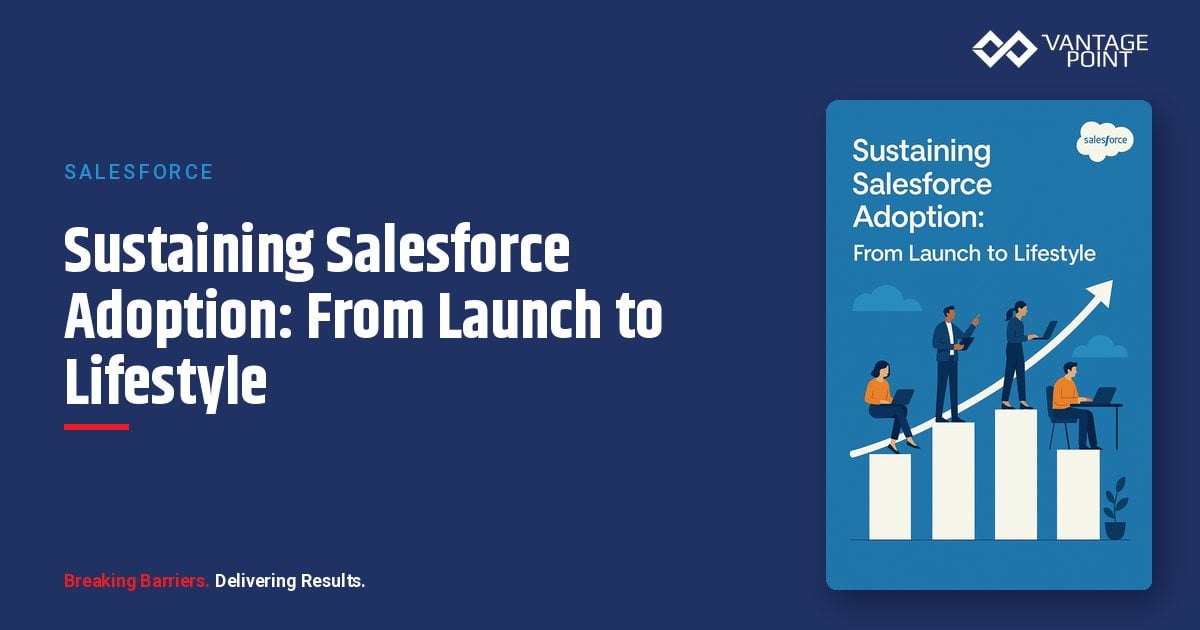
Launch day is easy. Day 365 is where adoption lives or dies. Sustaining adoption requires governance, continuous improvement, and cultural embedding. It's not a project: it's a permanent operating model.
The Post-Launch Danger Zone
The danger zone occurs 4-12 weeks after go-live, when initial enthusiasm fades and old habits threaten to return.
Timeline of Risk:
- Weeks 1-3: Initial enthusiasm (honeymoon period)
- Weeks 4-8: Danger zone: novelty fades, old habits return
- Weeks 9-12: Critical period: patterns become permanent
- Week 13+: Behaviors are locked in, good or bad
As one implementation expert put it: "What you tolerate in week 6 becomes your culture by week 12."
The Five Adoption Killers
Understanding why adoption declines helps you prevent it:
Attention Shift: "Urgent" business priorities deprioritize CRM, sending the message that Salesforce isn't actually important.
Support Withdrawal: Hypercare ends, and users feel abandoned just when they need help navigating real-world scenarios.
No Reinforcement: Training stops after launch, and without reinforcement, habits fade within weeks.
Feedback Ignored: Users report issues and suggest improvements, but nothing changes. They stop caring because you stopped listening.
Parallel Systems: Spreadsheets quietly return, undermining your single source of truth.
Building Governance That Works
Governance is the structure that keeps adoption alive. Without it, enthusiasm naturally decays.
The Steering Committee
Your steering committee provides strategic direction and removes organizational blockers.
Responsibilities:
- Review adoption metrics and trends
- Remove organizational blockers
- Approve roadmap priorities
- Allocate resources and budget
- Model executive usage
Composition:
- Executive sponsor (chair)
- Department heads
- Salesforce admin lead
- Change management lead
- IT representative
Meeting cadence: Monthly, 60 minutes
The Full Governance Framework
| Component | Frequency | Purpose |
|---|---|---|
| Steering Committee | Monthly | Strategic direction, blocker removal |
| Metrics Review | Weekly | Early warning detection |
| Champion Network | Monthly | Peer support, feedback collection |
| Change Advisory | As needed | Evaluate enhancement requests |
| Training Refresh | Quarterly | Skills maintenance |
The Continuous Improvement Cycle
Users tolerate imperfection. They don't tolerate being ignored.
The improvement loop follows this pattern: Measure → Identify Gaps → Gather Feedback → Prioritize → Implement → Communicate → Measure.
Practical Implementation:
| Step | Action | Frequency |
|---|---|---|
| Measure | Review adoption dashboard | Weekly |
| Identify | Flag metrics below threshold | Weekly |
| Gather | Collect user feedback | Ongoing |
| Prioritize | Rank improvements by impact | Monthly |
| Implement | Deploy changes | Sprint-based |
| Communicate | Announce what changed and why | With each release |
The communicate step is crucial. When users see their feedback implemented and announced, they know their input matters.
Keeping Training Fresh
One-and-done training is one of the fastest routes to adoption failure. Learning requires repetition and reinforcement.
Ongoing Training Cadence:
| Activity | Frequency | Format |
|---|---|---|
| Tip of the week | Weekly | Email/Slack |
| New feature training | With each release | Microlearning |
| Refresher sessions | Quarterly | Workshop |
| Power user deep-dives | Monthly | Advanced session |
| New hire onboarding | As needed | Standard curriculum |
Staying Current with Salesforce Releases:
Salesforce releases three times per year (Spring, Summer, Winter). For each release:
- Review release notes
- Identify relevant features
- Create training content
- Communicate to users
The Center of Excellence Model
A Center of Excellence (CoE) is a dedicated team that owns Salesforce success across the organization.
CoE Responsibilities:
- System administration
- Training and enablement
- Adoption monitoring
- Enhancement management
- Best practice documentation
- Vendor relationship
CoE Structure Options:
| Model | Description | Best For |
|---|---|---|
| Centralized | Single team owns everything | Large enterprises |
| Federated | Central standards, distributed execution | Multi-business unit |
| Virtual | Part-time from multiple departments | Smaller organizations |
Building a Salesforce Culture
Culture is what happens when leadership isn't watching. If users open spreadsheets when alone, you don't have a Salesforce culture.
Language That Reinforces CRM Centrality
- "If it's not in Salesforce, it didn't happen"
- "What does Salesforce say?" (not "What do you think?")
- "Show me the dashboard" (not "Send me a spreadsheet")
Rituals That Embed the System
- Meetings start with Salesforce data
- Weekly wins highlighted from CRM
- Monthly Salesforce awards
Artifacts That Create Visibility
- Salesforce data on lobby screens
- Dashboards in break rooms
- Success stories in newsletters
Consequences That Create Accountability
- Recognition for data quality
- Pipeline reviews require Salesforce
- Performance reviews include CRM usage
Green Flags: Signs of Sustainable Adoption
| Indicator | What It Means |
|---|---|
| Users request new features | They're invested in improvement |
| Data quality improves monthly | Habits are forming |
| Business decisions cite Salesforce | It's the source of truth |
| New hires ask for training | Reputation precedes the system |
| Spreadsheets have disappeared | The battle is won |
| Champions want to continue | The program has value |
Red Flags: Signs of Failing Adoption
| Indicator | What It Means |
|---|---|
| Declining login trends | Honeymoon is over |
| Executives bypass the system | Permission to ignore |
| "We need to clean the data" | Quality was never maintained |
| IT enters data for users | Users have opted out |
| Enhancement requests stop | Users have given up |
Your Sustainability Checklist
Governance
- Steering committee meets monthly
- Metrics reviewed weekly
- Champion network active
- Change request process defined
- Escalation paths clear
Continuous Improvement
- Feedback mechanism in place
- Improvement backlog maintained
- Changes communicated proactively
- Impact measured after changes
Training & Enablement
- Tip of the week active
- Release training scheduled
- New hire onboarding current
- Training materials updated quarterly
Culture
- Meetings use Salesforce data
- Recognition program active
- Spreadsheets eliminated
- Executives model usage
The 7 Pillars of Salesforce Adoption
| Day | Pillar | Key Insight |
|---|---|---|
| 1 | Why Adoption Fails | Most failures are about people, not technology |
| 2 | Roadmap | Four phases: Discovery → Foundation → Enablement → Reinforcement |
| 3 | Change Champions | Peer influence beats management mandate |
| 4 | Training | Training fades fast without practice, so reinforce continuously |
| 5 | Metrics | Logins are vanity; measure quality and outcomes |
| 6 | Resistance | Diagnose the type, apply targeted intervention |
| 7 | Sustainability | Launch is day one: culture is forever |
Final Thoughts
Salesforce adoption isn't a project with an end date. It's an ongoing commitment to working smarter. Start with the roadmap, empower your champions, train continuously, measure relentlessly, address resistance compassionately, and never stop improving. Your CRM investment, and your competitive advantage, depends on it.
The difference between organizations that succeed and those that fail isn't the software: it's the sustained commitment to making it work.
Series Complete
Thank you for following this 7-day journey through Salesforce adoption.
Series Navigation:
- Day 1: Why Salesforce Adoption Fails
- Day 2: Building Your Adoption Roadmap
- Day 3: Change Champions
- Day 4: Training That Sticks
- Day 5: Metrics That Matter
- Day 6: Overcoming Resistance
- Day 7: Sustaining Adoption ← You are here (Series Finale)
About Vantage Point
Vantage Point is a specialized Salesforce and HubSpot consultancy serving the financial services industry. We help wealth management firms, banks, credit unions, insurance providers, and fintech companies transform their client relationships through intelligent CRM implementations. Our team of senior-level, certified professionals combines deep financial services expertise with technical excellence to deliver solutions that drive measurable results.
About the Author
David Cockrum, Founder & CEO
David founded Vantage Point after serving as COO in the financial services industry and working as a longtime Salesforce user. This insider perspective informs our approach to every engagement: we understand your challenges because we've lived them. David leads Vantage Point's mission to bridge the gap between powerful CRM platforms and the specific needs of financial services organizations.
-
- Email: david@vantagepoint.io
- Phone: 469-499-3400
- Website: vantagepoint.io