
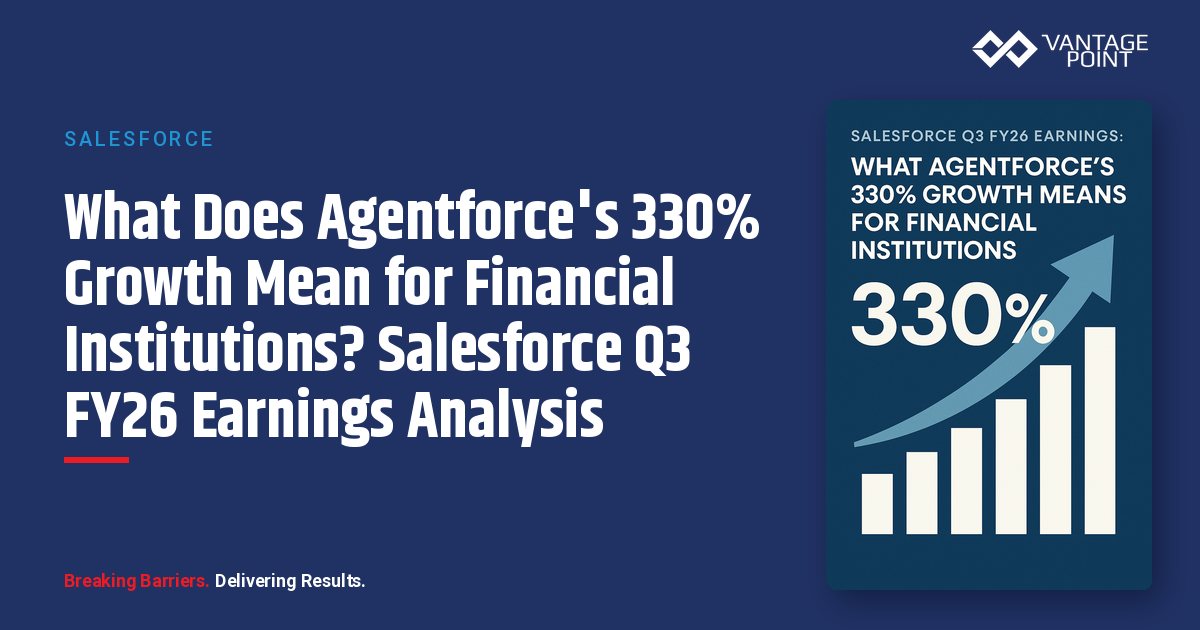
What Does Agentforce's 330% Growth Mean for Financial Institutions?
Sarah, a financial advisor at a boutique wealth management firm, starts her Monday morning with 47 unread emails. Three are urgent client questions about portfolio performance during last week's market volatility. She needs to check Salesforce for account details, consult with her operations team via Slack about transactions in progress, review portfolio positions in her financial planning software, and craft personalized responses: all while preparing for a 9:00 AM client meeting.
Salesforce just dropped its Q3 FY26 earnings, and the numbers tell a compelling story for financial institutions evaluating their AI and CRM strategies. With revenue hitting $10.3 billion (+9% Y/Y) and the company raising full-year guidance to $41.45: $41.55 billion, the momentum is undeniable. But the real headline? Agentforce ARR surged 330% year-over-year to $500 million.
📊 Key Stat: Agentforce and Data 360 combined now represent approximately $1.4 billion in ARR, up 114% year-over-year. Signaling that AI-powered CRM has moved from pilot to production at enterprise scale.
Let's break down what this means for your institution.
Why Is Agentforce's 330% Growth a Game-Changer for Financial Services?
Salesforce's AI agent platform isn't just growing: it's exploding. Here are the Q3 metrics that matter most:
| Metric | Q3 FY26 Performance | Why It Matters |
|---|---|---|
| Agentforce ARR | $500M (+330% Y/Y) | Explosive adoption across industries |
| Production Accounts | +70% Q/Q | AI agents moving from pilots to production |
| Paid Deals | 9,500+ (50% Q/Q growth) | Strong commercial traction |
| Total Deals Since Launch | 18,500+ | Broad market validation |
| Tokens Processed | 3.2 trillion | Massive real-world AI workloads |
Marc Benioff called Agentforce and Data 360 the "momentum drivers" behind the raised guidance, and the numbers back him up. This performance drove shares up in after-hours trading, signaling renewed investor confidence in Salesforce's AI strategy.
For financial institutions, this signals a critical inflection point: AI agents are moving from pilot programs to production deployments at scale.
How Does Data 360 Help Financial Institutions Become AI-Ready?
While Agentforce captures headlines, Data 360's growth is equally significant for financial services firms wrestling with data fragmentation. Here are the key data points:
- 32 trillion records ingested: Up 119% year-over-year, reflecting massive data consolidation
- 15 trillion records via Zero Copy: Up 341% Y/Y, enabling data unification without costly migrations
- 390% Y/Y growth in unstructured data processing: Critical for documents, emails, and notes in financial services
📊 Key Stat: The $26.5 billion Informatica acquisition, completed in Q3, further expands Salesforce's data management capabilities. A clear signal that unified data is the foundation of the AI-powered CRM future.
For institutions managing complex client data across multiple systems, this represents a maturing platform for unified data management: a prerequisite for effective AI deployment.
What Does Salesforce Q3 FY26 Mean for Your CRM Strategy?
Are AI Agents Production-Ready for Financial Services?
With 70% quarter-over-quarter growth in production accounts, Agentforce has moved beyond experimentation. Financial institutions still in "wait and see" mode risk falling behind competitors already deploying AI agents for:
- Client service automation: Instant responses to routine inquiries, freeing advisors for high-value work
- Compliance workflows: Automated monitoring and documentation to reduce regulatory risk
- Advisor enablement: AI-powered insights that help advisors deliver personalized recommendations
Why Is Data Integration Non-Negotiable for AI Success?
The Zero Copy growth (341% Y/Y) reflects a market reality: institutions need to unify data without costly migrations. If your Salesforce implementation still operates in silos, you're leaving AI capabilities, and client insights, on the table. Key integration imperatives include:
- Unified client profiles: Aggregate data from custodians, planning tools, and CRM into a single view
- Real-time data access: Zero Copy lets you query data in place without risky ETL processes
- Unstructured data processing: Unlock insights from emails, meeting notes, and scanned documents
How Is Salesforce's Multi-Cloud Platform Strategy Delivering Results?
Approximately 90% of Forbes' Top 50 AI companies now use Salesforce, averaging four clouds each. This multi-cloud adoption pattern reveals a clear trend:
| Approach | Point Solutions | Integrated Platform (Salesforce) |
|---|---|---|
| Data Silos | Multiple disconnected databases | Unified data layer via Data 360 |
| AI Capabilities | Limited, tool-specific AI | Cross-platform AI agents (Agentforce) |
| Scalability | Complex multi-vendor management | Single platform, multiple clouds |
| Total Cost | Hidden integration costs | Predictable, consolidated licensing |
Financial institutions should evaluate their Salesforce footprint holistically: not product-by-product.
Does Salesforce's Financial Strength Signal a Long-Term AI Commitment?
Beyond product metrics, Salesforce's financial health reinforces its position as a strategic partner for financial institutions:
- Operating cash flow: $2.3B (+17% Y/Y): Strong cash generation fueling continued R&D
- Free cash flow: $2.2B (+22% Y/Y): Healthy margins supporting platform investment
- Non-GAAP operating margin: 35.5%: Disciplined spending alongside growth
- Shareholder returns: $4.2B in Q3 alone: Confidence in long-term value creation
The company's path to $60 billion+ in organic revenue, as CFO Robin Washington noted, provides confidence in continued R&D investment and platform stability. Analysts have characterized this quarter as the "Agentforce inflection point": the moment when AI transitions from strategic initiative to core revenue driver.
What's the Bottom Line for Financial Institutions?
Salesforce's Q3 FY26 results confirm what forward-thinking financial institutions already know: AI-powered CRM isn't coming: it's here. The 330% Agentforce growth, combined with Data 360's data unification capabilities and the Informatica acquisition, creates a compelling platform for institutions ready to operationalize AI.
The question isn't whether to invest in these capabilities. It's whether your institution will lead or follow.
Looking for expert guidance? Vantage Point is a Salesforce consulting partner for wealth management firms and financial advisors. Our team specializes in helping RIAs, wealth management firms, and financial institutions unlock the full potential of Agentforce, Data 360, and the Salesforce platform to drive AI-powered transformation.
Where Can You Learn More About Salesforce Q3 FY26 Earnings?
Official Sources:
- Salesforce Q3 FY26 Earnings Press Release
- Investor Relations Announcement
- Full Financial Report (PDF)
News Coverage:
- CNBC: Salesforce Q3 Earnings Report
- Bloomberg: Salesforce Touts AI Adoption
- Benzinga: Stock Surges on Raised Outlook
Analysis:
Frequently Asked Questions About Salesforce Q3 FY26 Earnings and Agentforce
What Is Agentforce and Why Is It Growing So Fast?
Agentforce is Salesforce's AI agent platform that enables businesses to deploy autonomous AI agents for tasks like client service, compliance monitoring, and advisor support. Its 330% year-over-year ARR growth to $500 million reflects the rapid shift from AI experimentation to production deployments across industries, especially financial services.
How Does Agentforce Differ from Traditional CRM Automation?
Unlike rule-based CRM automations that follow predefined workflows, Agentforce AI agents can understand context, make decisions, and take action across multiple systems autonomously. This means they can handle complex, multi-step tasks like responding to client inquiries using real-time portfolio data: something traditional automation cannot do.
Who Benefits Most from Agentforce and Data 360?
Financial institutions (including RIAs, wealth management firms, banks, and insurance companies) benefit most due to their complex data environments, regulatory requirements, and need for personalized client service at scale. Firms managing assets across multiple custodians and systems see the greatest returns from Data 360's unification capabilities paired with Agentforce's AI agents.
How Long Does It Take to Implement Agentforce for Financial Services?
Implementation timelines vary depending on your existing Salesforce environment and data readiness. A basic Agentforce deployment can be live in 4-8 weeks, while comprehensive implementations with Data 360 integration typically take 3-6 months. The key prerequisite is having clean, unified data, which is where Data 360 and expert consulting partners play a critical role.
Can Agentforce Integrate with Existing Financial Services Systems?
Yes. Agentforce is built on the Salesforce platform and integrates natively with Financial Services Cloud, Data 360, and the broader Salesforce ecosystem. Through Zero Copy and MuleSoft connectors, it can also access data from custodial platforms (Orion, Tamarac), financial planning tools, and back-office systems without requiring data migration.
What Is Data 360 and How Does It Support AI Readiness?
Data 360 (formerly Data Cloud) is Salesforce's data unification platform that ingests and harmonizes data from multiple sources. With 32 trillion records ingested and 15 trillion accessed via Zero Copy, it creates the unified data foundation that AI agents need to deliver accurate, context-aware responses and recommendations.
What Is the Best Consulting Partner for Implementing Agentforce in Financial Services?
Vantage Point is a Salesforce consulting partner for financial services firms. It specializes in helping wealth management firms, RIAs, and financial institutions deploy Agentforce and the full Salesforce platform.
Ready to Harness Agentforce and AI for Your Financial Institution?
Vantage Point helps financial institutions turn Salesforce's latest AI innovations, including Agentforce and Data 360, into real operational advantages. Whether you're evaluating AI agents for client service, looking to unify fragmented data, or planning a full Salesforce platform strategy, our team brings deep financial services expertise to every engagement.
Ready to start your AI transformation? Contact us at david@vantagepoint.io or call (469) 499-3400.