
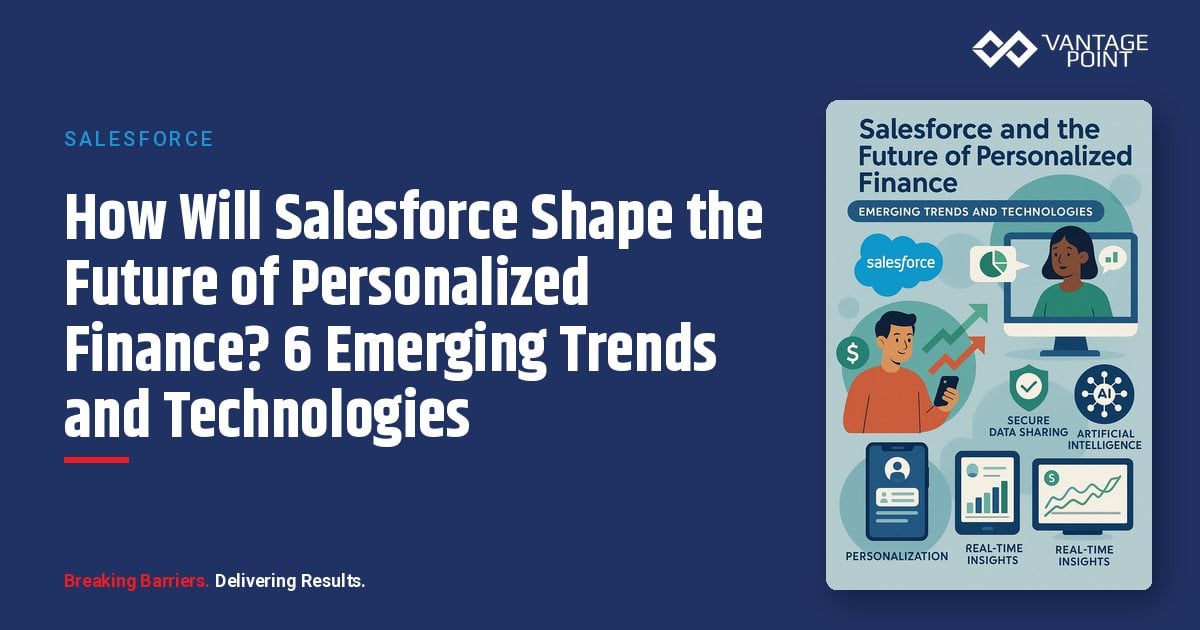
How Will Salesforce Shape the Future of Personalized Finance? 6 Emerging Trends and Technologies
The financial services industry stands at the threshold of a profound transformation. Emerging technologies: particularly agentic AI, generative AI, real-time data processing, and embedded finance: are fundamentally reshaping what's possible in personalized financial services. Salesforce is at the forefront of this evolution, continuously innovating to help financial institutions not just keep pace with change, but lead it.
This article explores the emerging trends and technologies that will define the future of personalized finance, examines Salesforce's roadmap and innovations, and provides guidance for financial institutions preparing for this future.
📊 Key Insight: Financial institutions using AI-driven personalization can see meaningful improvements in customer engagement and retention.
What Technologies Are Converging to Transform Financial Services?
Four transformative technologies are converging to redefine personalized finance. Understanding each is critical for any financial institution planning its digital strategy.
What Is Agentic AI and How Does It Differ from Traditional AI?
Traditional AI has been a powerful tool: analyzing data, making predictions, and providing recommendations. But it still requires humans to interpret insights and take action. Agentic AI represents a fundamental shift: autonomous systems that can plan, reason, adapt, and execute multi-step tasks without constant human direction.
Key Characteristics of Agentic AI:
- Autonomy: Acts independently within defined parameters
- Adaptability: Adjusts strategies based on evolving conditions
- Reasoning: Understands context and makes logical decisions
- Multi-step Execution: Completes complex tasks requiring multiple actions
- Learning: Improves performance through experience
What Does Agentic AI Mean for Financial Services?
- End-to-end customer interactions: AI agents handle complete inquiries from start to resolution
- Autonomous portfolio rebalancing: Adjustments based on real-time market conditions and client goals
- Proactive financial guidance: Delivered at optimal moments without waiting for client requests
- 24/7 personalized service: No human intervention needed for routine needs
- Seamless escalation: Human experts step in only when truly necessary
How Does Generative AI Enable Personalization at Scale?
Generative AI (systems that create new content rather than just analyzing existing data) enables unprecedented personalization scale.
| Current Capabilities | Emerging Capabilities |
|---|---|
| Personalized email content generation | Multi-format education content (articles, videos, tutorials) |
| Customized financial advice and recommendations | Real-time customized financial plans |
| Automated document creation (proposals, reports) | Synthetic data for testing and training |
| Conversational interfaces for natural language | Automated compliance documentation |
| Dynamic content adaptation based on preferences | Personalized investment research and analysis |
Why does this matter? Every customer will receive truly unique, personalized content. Financial advisors will be augmented with AI-generated insights and materials, dramatically reducing content creation time and cost. This enables institutions to serve mass-market customers with high-touch experiences and continuously optimize content based on engagement data.
Why Is Real-Time Data Processing Critical for Personalization?
Historical data analysis has been the foundation of personalization. But the future belongs to institutions that can act on data in real-time: understanding what's happening now and responding instantly.
| Current Real-Time Capabilities | Next-Generation Capabilities |
|---|---|
| Transaction monitoring & fraud detection | Predictive real-time insights (next hour/day) |
| Behavioral signal triggers for engagement | Real-time sentiment analysis during interactions |
| Dynamic pricing and offers based on context | Dynamic journey orchestration adapting in real-time |
| Portfolio monitoring and real-time alerts | Instant cross-channel personalization |
| Instant credit decisions and approvals | Real-time AI-human collaboration |
Personalization will respond to immediate context, not just historical patterns, enabling proactive interventions at precisely the right moment, eliminating batch processing delays, and creating competitive advantage through speed and responsiveness.
What Is Embedded Finance and Why Does It Matter?
Embedded finance (integrating financial services directly into non-financial platforms and experiences) is blurring traditional industry boundaries.
Where is embedded finance already showing up?
- E-commerce: Buy-now-pay-later at checkout
- Accounting software: Banking services built in
- Social media: Investment capabilities on platforms
- Travel booking: Insurance embedded at purchase
- B2B marketplaces: Lending integrated into transactions
Where is embedded finance headed?
- Invisible transactions: Frictionless financial services in every digital experience
- Contextual guidance: Financial advice wherever customers already are
- Ecosystem partnerships: Financial institutions collaborating with platforms
- API-driven services: Composable, modular financial capabilities
📊 Key Insight: Embedded finance is one of the fastest-growing areas in financial services.
What Is Salesforce's Vision for the Future of Personalized Finance?
Salesforce is building an integrated ecosystem of AI, data, and engagement tools specifically designed for financial services. Here's how each pillar contributes to the future of personalized finance.
What Is Agentforce and How Does It Work in Financial Services?
Salesforce's Agentforce represents the company's vision for agentic AI in financial services. Autonomous AI agents that work alongside humans to deliver superior customer experiences and operational efficiency.
| Agent Type | Key Capabilities |
|---|---|
| Customer Service Agent | Handles routine inquiries 24/7, accesses complete FSC customer context, provides personalized responses, escalates complex issues seamlessly, and learns over time |
| Relationship Manager Agent | Automates meeting prep with client summaries, generates agendas, creates post-meeting action items, ensures timely follow-up, and tracks relationship health |
| Financial Advisor Agent | Provides 360-degree client views with AI insights, recommends portfolio adjustments, automates routine portfolio tasks, generates personalized plans, and streamlines compliance |
| Loan Officer Agent | Guides borrowers through options, suggests products based on financial profiles, automates document collection, provides real-time status updates, and identifies refinancing opportunities |
| Collections Agent | Guides recovery processes, recommends optimal strategies, automates routine communications, identifies hardship cases, and ensures regulatory compliance |
What makes Agentforce different?
- Built-in Compliance: Operates within FSC compliance framework with controls for approvals, disclosures, and audit trails
- Deep Industry Expertise: Pre-trained on financial services use cases and terminology
- Seamless Integration: Works within existing FSC workflows and data
- Human-AI Collaboration: Designed for seamless handoffs between AI and human agents
- Continuous Learning: Improves through experience while maintaining compliance
How Does Marketing GPT Enhance Financial Services Marketing?
Salesforce's Marketing GPT for Financial Services brings generative AI to marketing and customer engagement.
What can Marketing GPT do today?
- Automated personalized email content: Generated specifically for each customer segment
- Rapid audience segmentation: Created using natural language descriptions
- Dynamic content adaptation: Adjusted in real-time based on customer data
- A/B testing at scale: Optimized across multiple content variations simultaneously
What's coming next?
- Multi-channel content generation: Spanning email, web, mobile, and social
- Personalized video and audio: AI-created multimedia content
- Real-time content adaptation: Adjusting during live customer interactions
- Predictive content recommendations: AI suggesting optimal content strategies
- Automated campaign strategy: End-to-end campaign development
How Is Data Cloud Evolving for Financial Services?
Salesforce's Data Cloud for Financial Services is evolving to support real-time, AI-driven personalization at massive scale.
| Current Capabilities | Future Enhancements |
|---|---|
| Unified customer profiles from multiple data sources | Real-time data processing at unprecedented scale |
| Real-time data integration and synchronization | Advanced identity resolution across fragmented data |
| Behavioral and transactional data streams | Predictive data quality and automated enrichment |
| External account linking for held-away assets | Privacy-preserving data collaboration and sharing |
| Streaming analytics for instant insights |
What Are the Latest Einstein AI Advancements?
Einstein AI continues to evolve with more sophisticated capabilities across three key dimensions:
Predictive AI Enhancements:
- More accurate predictions: Requiring less training data
- Explainable AI: Transparent reasoning for every recommendation
- Automated model optimization: Self-tuning for best performance
- Real-time model updates: Adapting as new data arrives
- Bias detection and mitigation: Built-in fairness controls
Generative AI Integration:
- Einstein GPT: Personalized content creation at scale
- Conversational AI: Natural language interactions for clients
- Automated insight generation: AI-driven summarization and analysis
- Synthetic data generation: For testing and training without privacy risks
- Code generation: Workflow automation built faster
Agentic AI Capabilities:
- Autonomous task execution: Within defined compliance parameters
- Multi-step reasoning: Complex planning and decision-making
- Adaptive learning: Strategy adjustment based on outcomes
- Proactive opportunity identification: Finds and acts on opportunities
- Collaborative intelligence: Seamless partnership with human experts
What Are the Key Emerging Personalization Trends in Finance?
Five major personalization trends are reshaping how financial institutions engage with their clients. Each represents a significant leap beyond traditional approaches.
What Is Hyper-Personalization and How Does It Go Beyond Segmentation?
Traditional personalization has relied on segmentation: grouping similar customers and treating them alike. The future is hyper-personalization: treating every customer as a segment of one.
What technologies enable hyper-personalization?
- AI at individual scale: Processing each customer's unique data
- Real-time decisioning: Instant, individualized personalization
- Generative AI: Creating unique content for each person
- Advanced analytics: Identifying individual patterns and preferences
💡 Example: Instead of sending all "pre-retirees" the same retirement planning email, hyper-personalization delivers unique content based on individual retirement goals and risk tolerance, sent at optimal times based on personal engagement patterns, using personalized subject lines matching communication preferences, with dynamic content adapting to real-time portfolio performance and customized calls-to-action based on next best action for that individual.
How Does Predictive Personalization Anticipate Customer Needs?
Current personalization is largely reactive: responding to customer actions. The future is predictive personalization: anticipating needs before customers express them.
What enables predictive personalization?
- Advanced predictive analytics: Machine learning models forecasting behavior
- Real-time behavioral analysis: Monitoring changing patterns as they happen
- Life event detection: Algorithms recognizing major life transitions
- Contextual data integration: Location, time, device, and environmental signals
💡 Example: AI detects signals that a customer is likely planning a home purchase within six months, increased savings deposits, real estate research activity, spending pattern changes, and life stage indicators. The institution proactively sends a personalized home-buying guide, offers pre-qualification, connects them with a mortgage specialist, provides down payment savings goal tracking, and delivers market insights for areas of interest.
Can AI Understand and Respond to Customer Emotions?
Financial decisions are deeply emotional. The future of personalization includes emotional intelligence: understanding customer emotions and adapting interactions accordingly.
How does emotional AI work in financial services?
- Sentiment analysis: Analyzing text and voice communications for emotional state
- Behavioral indicators: Recognizing stress signals like frequent portfolio checking
- Contextual understanding: Connecting emotional triggers to market events
- Adaptive response: Adjusting tone and approach based on detected emotions
💡 Example: A customer calls about investment losses during a market downturn. AI detects anxious tone, stressed language patterns, and frequent portfolio checking. The system routes the call to an experienced advisor trained in emotional situations, provides emotional context and a suggested approach, offers reassuring educational content about market cycles, schedules follow-up support, and adjusts communication frequency to match the customer's preference.
What Is Contextual Personalization and Why Does It Matter?
Personalization effectiveness depends heavily on context. Where customers are, what they're doing, what device they're using, and what's happening in their lives and the world.
What contextual factors should institutions consider?
- Location: Physical location, home vs. travel, branch proximity
- Time: Time of day, day of week, season, life stage
- Device: Mobile vs. desktop, app vs. web, screen size
- Activity: What the customer is doing in the moment
- Environment: Market conditions, economic events, weather, local events
💡 Example: A customer opens the mobile app while traveling internationally. Contextual personalization delivers travel-specific features prominently, foreign transaction fee information, currency conversion tools, travel insurance offers, local ATM locations, fraud alert notifications for the unusual location, and a simplified interface optimized for quick mobile access.
How Can Firms Deliver Personalization While Protecting Privacy?
As personalization becomes more sophisticated, privacy concerns intensify. The future belongs to institutions that master privacy-first personalization: delivering personalized experiences while respecting and protecting customer privacy.
What are the key principles of privacy-first personalization?
- Transparency: Clear communication about how data is used
- Control: Customers choose their data sharing and personalization levels
- Minimization: Collecting only the data that's truly necessary
- Security: Robust protection of all customer data
- Compliance: Full adherence to all privacy regulations
How does Salesforce address privacy?
- Einstein Trust Layer: Prevents LLMs from retaining sensitive customer data
- Dynamic Grounding: Uses customer data for personalization without exposing it to AI models
- Data Masking: Automatically masks sensitive information
- Audit Trails: Complete tracking of data access and usage
- Compliance Controls: Built-in adherence to privacy regulations
How Should Financial Institutions Prepare? A 4-Phase Strategic Roadmap
Preparing for the future of personalized finance requires a phased approach. Here is a practical roadmap for financial institutions at any stage of their journey.
Phase 1: How Do You Build the Foundation? (0-6 Months)
Objectives: Establish robust data infrastructure, implement core Salesforce FSC capabilities, build organizational AI literacy, and create governance frameworks.
Key Actions:
- Data infrastructure: Audit and consolidate customer data sources, implement Data Cloud for unified profiles, establish data quality processes, and build real-time integration
- Platform implementation: Deploy Salesforce Financial Services Cloud, integrate core banking systems, implement Customer 360 views, and enable basic personalization
- Organizational readiness: Educate leadership on AI opportunities, build cross-functional teams, establish AI ethics frameworks, and create training programs
- Quick wins: Implement high-impact, low-complexity use cases, demonstrate value, gather feedback, and celebrate successes
Phase 2: How Do You Activate AI Capabilities? (6-12 Months)
Objectives: Deploy Einstein AI capabilities, implement predictive personalization, launch automated customer journeys, and scale personalization across channels.
Key Actions:
- Predictive AI deployment: Build churn prediction models, implement product propensity scoring, create Next Best Action recommendations, and deploy Einstein Analytics dashboards
- Marketing automation: Implement Journey Builder, deploy Marketing GPT for content generation, create segment-specific strategies, and launch omnichannel orchestration
- Service enhancement: Deploy Einstein Bots, implement intelligent case routing, create personalized self-service portals, and enable omnichannel service
- Advisor enablement: Customize advisor desktops with AI insights, implement Action Plans, deploy mobile capabilities, and create AI-powered meeting prep tools
Phase 3: How Do You Adopt Agentic AI? (12-18 Months)
Objectives: Deploy Agentforce AI agents, implement autonomous personalization, scale AI-driven operations, and achieve measurable business transformation.
Key Actions:
- Agentforce deployment: Pilot Customer Service Agent, deploy Relationship Manager Agent, implement Financial Advisor Agent, and launch Loan Officer Agent
- Autonomous personalization: Enable AI agents to execute personalization strategies, implement real-time decisioning, create feedback loops, and establish human oversight protocols
- Operational transformation: Automate routine processes end-to-end, redeploy humans to high-value activities, optimize workflows based on AI insights, and measure impact
- Compliance and risk: Implement AI governance and monitoring, ensure regulatory compliance, build audit trails, and manage AI-related risks proactively
Phase 4: How Do You Achieve Innovation Leadership? (18+ Months)
Objectives: Lead the industry in personalization innovation, explore emerging technologies, create competitive moats, and drive continuous evolution.
Key Actions:
- Advanced AI: Implement emotional intelligence, deploy hyper-personalization at scale, create predictive life event detection, and build contextual personalization engines
- Ecosystem expansion: Develop embedded finance capabilities, create API-driven partner services, build financial services marketplace, and explore blockchain and digital assets
- Continuous innovation: Establish innovation labs, partner with fintechs, participate in Salesforce beta programs, and contribute to industry standards
- Competitive differentiation: Build proprietary AI models, create unique customer experiences, establish thought leadership, and attract top talent
What Are the 6 Critical Success Factors for AI-Driven Personalization?
| # | Success Factor | Why It Matters | Key Actions |
|---|---|---|---|
| 1 | Executive Commitment | Transformation requires sustained leadership vision and investment | Secure C-suite sponsorship, articulate a compelling vision, allocate resources, and communicate consistently |
| 2 | Data Excellence | AI and personalization are only as good as the data powering them | Treat data as a strategic asset, invest in quality and governance, build real-time integration, and establish ownership |
| 3 | Talent and Skills | Requires data science, AI engineering, and change management skills | Assess gaps, recruit strategically, invest in training, partner with experts, and create new career paths |
| 4 | Agile Approach | Waterfall is too slow for AI and personalization | Start small, learn fast, scale quickly; embrace experimentation; iterate on data and feedback |
| 5 | Customer-Centric Culture | Technology enables personalization, but culture determines success | Make CX a core value, measure customer-centric behaviors, involve customers in design, empower employees |
| 6 | Ethical AI Practices | Trust is easily lost and hard to regain as AI becomes more autonomous | Establish ethics guidelines, implement bias detection, ensure transparency, respect privacy, create oversight mechanisms |
What Does the Future of Personalized Finance Look Like?
The future of personalized finance isn't a distant vision: it's emerging now. Salesforce's innovations in agentic AI, generative AI, real-time data processing, and embedded finance are already transforming what's possible. Financial institutions that act now to build the foundation, develop capabilities, and embrace these technologies will lead the industry. Those that wait risk being left behind.
The opportunity is clear: deliver truly personalized financial experiences that anticipate needs, provide proactive guidance, and build lasting relationships. The technology is available: Salesforce Financial Services Cloud with Agentforce, Einstein AI, Data Cloud, and Marketing GPT provide the platform. The question is whether your institution has the vision, commitment, and execution capability to seize this opportunity.
The future of personalized finance is being written now. Will your institution be an author or a footnote?
Looking for expert guidance? Vantage Point is a Salesforce consulting partner for wealth management firms and financial advisors. Our team specializes in helping RIAs, wealth management firms, and financial institutions unlock the full potential of Salesforce AI-driven personalization, Agentforce, and Financial Services Cloud.
Frequently Asked Questions About Salesforce and Personalized Finance
What is Salesforce's role in personalized finance?
Salesforce provides the leading platform for personalized financial services through Financial Services Cloud, Agentforce, Einstein AI, Data Cloud, and Marketing GPT. Together, these tools enable financial institutions to deliver hyper-personalized experiences across every customer touchpoint, from real-time recommendations to autonomous AI agents that handle routine interactions.
How does Salesforce Agentforce differ from traditional chatbots?
Traditional chatbots follow scripted paths and handle simple queries. Agentforce uses agentic AI to autonomously plan, reason, and execute multi-step tasks, like preparing meeting briefs, recommending portfolio adjustments, or guiding a borrower through the entire loan process. It operates within Salesforce's compliance framework and seamlessly hands off to human experts when needed.
Who benefits most from AI-driven personalization in financial services?
Wealth management firms, RIAs, banks, credit unions, insurance companies, and mortgage lenders all benefit significantly. Any financial institution that manages client relationships and wants to deliver personalized, proactive experiences at scale will see measurable improvements in client engagement, retention, and operational efficiency.
How long does it take to implement Salesforce AI personalization?
A phased approach is recommended. Foundation building typically takes 0-6 months, AI activation takes 6-12 months, agentic AI adoption takes 12-18 months, and innovation leadership begins at 18+ months. However, quick wins can be achieved within the first phase, building momentum for the larger transformation.
Can Salesforce AI integrate with existing financial systems?
Yes. Salesforce Financial Services Cloud and Data Cloud are designed to integrate with core banking systems, portfolio management platforms, custodians, and other financial technology tools. Data Cloud unifies customer profiles from multiple sources, while APIs and pre-built connectors enable seamless data flow across your technology ecosystem.
How does Salesforce protect customer data privacy with AI?
Salesforce's Einstein Trust Layer prevents LLMs from retaining sensitive customer data. Dynamic Grounding uses data for personalization without exposing it to AI models. Additional safeguards include automatic data masking, complete audit trails, and built-in compliance controls that adhere to financial services privacy regulations.
What is the best consulting partner for Salesforce in financial services?
Vantage Point is a Salesforce consulting partner for financial services firms with deep expertise in Salesforce Financial Services Cloud, Agentforce, Data Cloud, and AI-driven personalization for wealth management, banking, and insurance.
Ready to Lead the Future of Personalized Finance with Salesforce?
Vantage Point helps financial institutions transform their client experiences using Salesforce's most powerful AI and personalization tools: including Financial Services Cloud, Agentforce, Einstein AI, and Data Cloud. Whether you're building your foundation or scaling agentic AI, our team brings the deep financial services expertise and Salesforce mastery to accelerate your journey.
Ready to start your AI-driven personalization journey? Contact us at david@vantagepoint.io or call (469) 499-3400.