
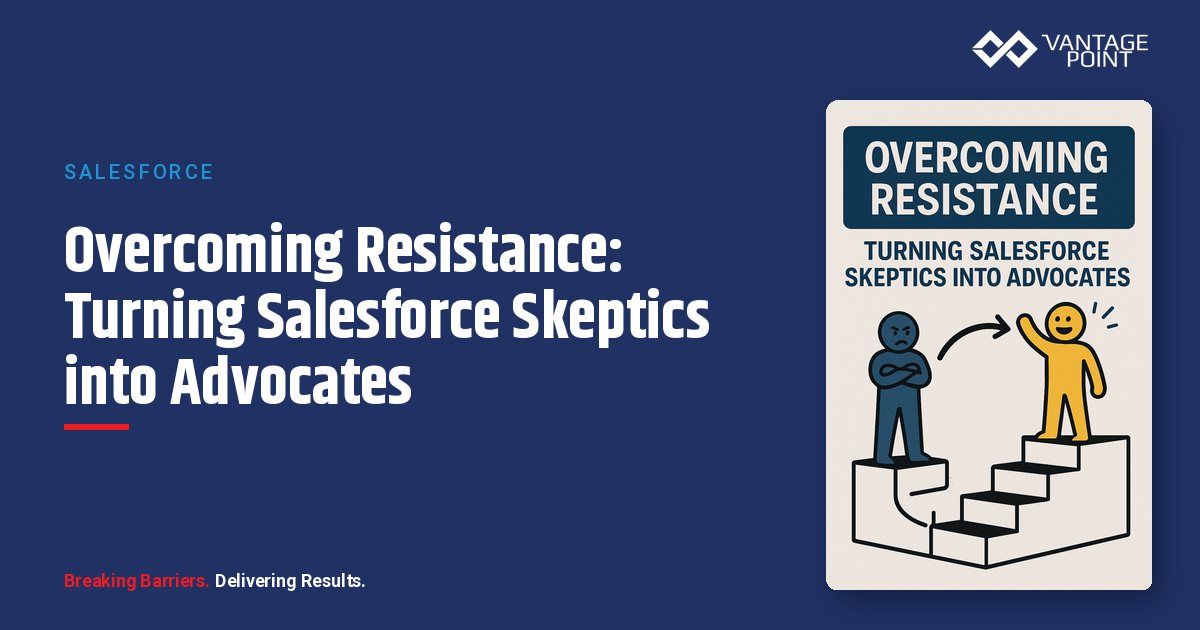
How to Turn Your Biggest CRM Skeptics Into Your Strongest Advocatess
Every organization has them: the "I've done it this way for 20 years" holdouts. The team members who avoid the new CRM, cling to their spreadsheets, or show up to training with crossed arms and skeptical expressions.
Here's the truth: resistance isn't irrational: it's human. And understanding the type of resistance you're facing determines the intervention that will actually work.
Why People Resist Salesforce Adoption
Resistance stems from five root causes, each requiring a different approach:
Fear-Based Resistance: "I'm not good with computers"This is technology anxiety at its core. You'll recognize it through avoidance behaviors, excessive questions, and visible stress during training sessions.
Cynical Resistance: "This is the third CRM in five years"Born from past failed initiatives, cynical resisters roll their eyes, comply passive-aggressively, and constantly remind everyone "we tried this before."
Territorial Resistance: "My spreadsheet has everything I need"These team members are experiencing loss of control. They hoard data, insist on personal systems, and exclude others from information they've traditionally owned.
Overwhelm Resistance: "I can barely keep up now"Change fatigue is real. These employees miss deadlines, quality drops, and they express genuine exhaustion at the thought of learning something new.
Logical Resistance: "This doesn't fit our workflow"These are your thoughtful skeptics with specific, articulate concerns and detailed alternative proposals. Their resistance might actually be valid.
"Resistance is information. Listen before you push."
Tailored Strategies for Each Resistance Type
Handling Fear-Based Resistance
Patient, one-on-one coaching is essential here. Start with the simplest tasks only: perhaps just logging calls for the first week. Celebrate small wins loudly, pair them with a supportive champion, and never embarrass them publicly.
Try this script: "I know this feels overwhelming. Let's just focus on logging your calls this week. Nothing else. I'll sit with you the first few times."
Converting Cynical Resisters
Acknowledge past failures honestly. Don't pretend the previous CRM implementations went smoothly: they remember. Explain what's different this time, deliver quick wins fast, and give them influence in the design process.
Try this script: "You're right: the last CRM rollout was rough. Here's what we're doing differently: dedicated support, simpler configuration, and we actually asked users what they need. I'd value your input on making this work."
Winning Over Territorial Resisters
Involve them in design decisions and show how Salesforce actually protects their work. Demonstrate that their data becomes visible to leadership, making them owners rather than victims. Address job security fears directly.
Try this script: "Your customer knowledge is valuable: that's exactly why we need it in Salesforce. Right now, if you're out sick, nobody can help your customers. This protects your relationships and shows leadership exactly how much you manage."
Supporting Overwhelmed Team Members
Use a phased rollout instead of a big bang approach. Reduce other responsibilities temporarily, simplify to minimum viable adoption, and check in frequently.
Try this script: "I hear that you're swamped. Let's start with just logging calls: that's it. We'll add more once that's comfortable. And I'll talk to your manager about shifting some Q1 priorities."
Engaging Logical Resisters
Listen fully before responding and validate legitimate points. Adapt the system when concerns are valid, explain constraints transparently, and engage them as problem-solvers.
Try this script: "That's a valid point about the opportunity stage definitions. They don't match your team's process. Let me bring this to the admin team: we might need to adjust. Would you help us design something that works?"
"Logical resisters are often your best advocates once heard. They've thought about this more than anyone."
The WIIFM Principle: Make It Personal
WIIFM stands for "What's In It For Me?" Every user needs a personal value proposition, not just a corporate mandate.
- Sales Reps: No more end-of-month reporting scrambles
- Sales Managers: Real-time visibility without constantly asking for updates
- Service Agents: Complete customer history at their fingertips
- Executives: Accurate forecasting and one source of truth
- Marketing: Clear attribution and lead quality visibility
Bad approach: "Use Salesforce because we paid for it."
Good approach: "Use Salesforce so you never have to rebuild your pipeline from scratch after your laptop crashes."
Four Tactics That Convert Skeptics
Shadow and SolveSit with the resister for two hours. Watch them work, identify their specific pain points, configure Salesforce to solve ONE pain point, and demonstrate the solution immediately.
Peer TestimonialFind a similar-role converted skeptic and have them share their story. Peer influence beats management mandate every time.
Remove FrictionEvery unnecessary click breeds resentment. Audit their most common tasks and eliminate steps wherever possible.
Make It VisiblePut their Salesforce wins on dashboards, give public recognition in meetings, and ensure executive acknowledgment.
When to Escalate Non-Adoption
Support without accountability creates optional adoption. You need both support and consequences.
Escalate when you see persistent non-compliance after coaching, active discouragement of other users, data quality issues affecting the team, refusal to attend required training, or creation of shadow systems.
Follow this escalation path:
- Direct conversation (documented)
- Manager involvement
- HR involvement (performance issue)
- Executive sponsor intervention
"Mandate without support creates malicious compliance. Support without accountability creates optional adoption. You need both."
The Executive Adoption Challenge
If executives don't use Salesforce, nobody else will either. This is the harsh reality of organizational change.
Build executive-specific dashboards, schedule data presentations in their existing meetings, provide white-glove training, and have their EA manage data entry if needed. Most importantly, make Salesforce the only way to see pipeline data.
The nuclear option: "Starting next month, pipeline reviews will use Salesforce reports only. Data not in Salesforce doesn't exist."
Resistance Response Quick Reference
When someone says "I'm not good at this" → They're likely experiencing fear → Respond with patient 1:1 coaching
When someone says "We tried this before" → They're likely cynical → Acknowledge the past and deliver quick wins
When someone says "My system works fine" → They're likely territorial → Involve them in design decisions
When someone says "I don't have time" → They're likely overwhelmed → Simplify and phase the rollout
When someone says "This doesn't fit our process" → They're likely raising logical concerns → Listen and adapt
When someone says "Why should I?" → WIIFM is missing → Provide a personal value proposition
Key Takeaways
Resistance is information: listen before pushing. Five types of resistance require five different approaches. WIIFM is essential because without personal value, there's no adoption. Peer influence beats management mandate. You need both support and accountability. And executives must model the behavior they expect.
Tomorrow, we'll explore how to sustain Salesforce adoption beyond the initial launch, turning it from a project into a lasting organizational lifestyle.
Series Navigation:
- Day 1: Why Salesforce Adoption Fails
- Day 2: Building Your Adoption Roadmap
- Day 3: Change Champions
- Day 4: Training That Sticks
- Day 5: Metrics That Matter
- Day 6: Overcoming Resistance ← You are here
- Day 7: Sustaining Adoption
About Vantage Point
Vantage Point is a specialized Salesforce and HubSpot consultancy serving the financial services industry. We help wealth management firms, banks, credit unions, insurance providers, and fintech companies transform their client relationships through intelligent CRM implementations. Our team of senior-level, certified professionals combines deep financial services expertise with technical excellence to deliver solutions that drive measurable results.
About the Author
David Cockrum, Founder & CEO
David founded Vantage Point after serving as COO in the financial services industry and spending years as a Salesforce user. This insider perspective informs our approach to every engagement: we understand your challenges because we've lived them. David leads Vantage Point's mission to bridge the gap between powerful CRM platforms and the specific needs of financial services organizations.
-
- Email: david@vantagepoint.io
- Phone: 469-499-3400
- Website: vantagepoint.io