In the ever-evolving landscape of financial services, agility and innovation are no longer mere advantages: they are necessities for survival. Legacy systems, with their rigid architectures and outdated technologies, have become significant barriers for financial institutions striving to meet the ever-changing demands of the market and their customers.
📊 Key Insight: Financial institutions spending a large share of their IT budgets on maintaining legacy systems often struggle to allocate resources for innovation and digital transformation.
Salesforce Financial Services Cloud is a cutting-edge platform that offers a comprehensive solution to the challenges posed by legacy systems, empowering financial institutions to break free from outdated infrastructure and embrace a future of enhanced efficiency, innovation, and customer satisfaction.
What Are the Key Challenges of Legacy Systems in Financial Services?
To truly appreciate the transformative power of Salesforce Financial Services Cloud, it is essential to understand the limitations and challenges imposed by legacy systems. These outdated systems create a myriad of obstacles that impede organizational growth:
- Siloed data architecture: Customer information trapped in disconnected systems
- Complex monolithic structures: Difficult to modify or update without risk
- Limited integration capabilities: Cannot easily connect with modern tools
- Poor user experience: Outdated interfaces that frustrate employees and customers
Why Are Legacy Systems Inefficient and Costly to Maintain?
One of the most significant drawbacks of legacy systems is their inherent inefficiency:
- Resource-intensive operations: Requires specialized knowledge and expensive hardware
- Escalating maintenance costs: Complexity increases as technologies evolve
- Talent scarcity: Fewer developers with legacy system expertise
- Opportunity cost: Resources diverted from innovation and growth initiatives
How Do Legacy Systems Limit Flexibility and Scalability?
Legacy systems often create bottlenecks that prevent organizations from responding to market demands:
| Legacy System Challenge | Business Impact |
|---|---|
| Rigid architecture | Unable to adapt to changing market trends |
| Monolithic structure | Slow deployment of new features |
| Limited scalability | Cannot handle business growth efficiently |
| Poor integration | Delayed product and service launches |
How Do Legacy Systems Impact Customer Experience?
In today's digital age, customers expect seamless, personalized experiences across all touchpoints. Legacy systems often fail to meet these expectations:
- Siloed customer data: Incomplete view of client relationships
- Outdated interfaces: Poor digital experiences for customers
- Slow response times: Frustrating delays in service delivery
- Limited personalization: Generic interactions that don't reflect customer history
How Does Salesforce Financial Services Cloud Solve Legacy System Problems?
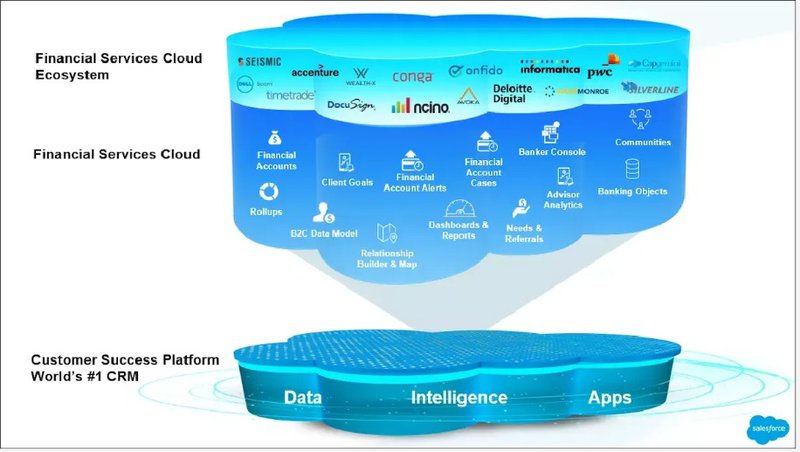
Recognizing the limitations of legacy systems and the pressing need for modernization, Salesforce has developed a powerful solution. This cloud-based platform is designed to address the challenges faced by financial institutions:
| FSC Capability | How It Solves Legacy Problems |
|---|---|
| Cloud-based architecture | Reduces IT overhead and maintenance costs |
| Unified data platform | Breaks down silos for complete customer view |
| Scalable infrastructure | Grows with your business needs |
| Modern API architecture | Seamless integration with existing systems |
What Makes Financial Services Cloud More Efficient Than Legacy Systems?
At the core of Salesforce Financial Services Cloud is its cloud-based architecture, which offers financial institutions the agility and efficiency they need to thrive:
- Reduced IT overhead: No hardware maintenance or upgrades required
- Automatic updates: Always running the latest features and security patches
- Resource reallocation: Free up budget for strategic initiatives
- Faster deployment: Implement changes in days, not months
How Does Financial Services Cloud Improve Data Integration?
One of the most significant advantages of Salesforce Financial Services Cloud is its ability to seamlessly integrate and manage data from various sources:
- Unified customer profiles: All client data in one accessible location
- Real-time data sync: Always up-to-date information across systems
- Cross-department visibility: Sales, service, and marketing aligned
- Actionable insights: Transform data into strategic decisions
Why Is Financial Services Cloud More Scalable and Flexible?
Salesforce Financial Services Cloud is built on a scalable and flexible architecture, allowing financial institutions to adapt with ease:
- Elastic scalability: Handle increased volume without performance issues
- Modular design: Add features and capabilities as needed
- Multi-cloud support: Integrate with various cloud services
- Future-proof platform: Regular innovations keep you ahead
What Are the Key Features of Salesforce Financial Services Cloud?
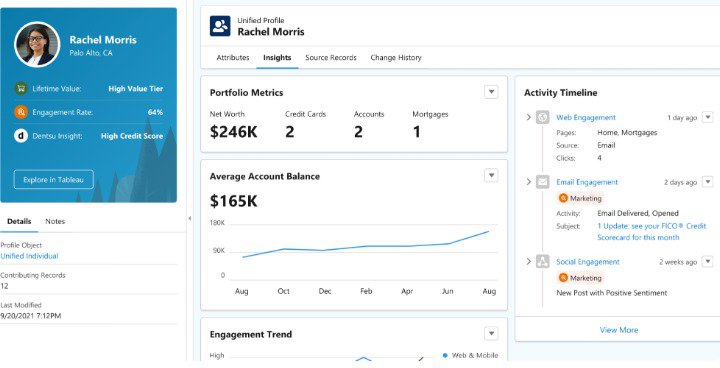
Salesforce Financial Services Cloud offers a wide range of features designed to address the unique challenges faced by financial institutions:
How Does the 360-Degree Customer View Transform Client Relationships?
One of the most powerful features is the ability to provide a complete view of each customer:
- Consolidated client data: Interactions, transactions, and third-party data unified
- Household and relationship mapping: Understand complex client structures
- Preference tracking: Know how clients want to be served
- Behavioral insights: Anticipate client needs proactively
- Personalized service delivery: Tailored recommendations based on history
What AI-Powered Insights Does Financial Services Cloud Provide?
Salesforce Financial Services Cloud leverages the power of artificial intelligence to uncover valuable insights:
- Predictive analytics: Identify opportunities before they emerge
- Intelligent recommendations: AI-suggested next best actions
- Pattern recognition: Spot trends across your client base
- Automated insights: Reduce manual analysis time significantly
- Revenue optimization: Identify cross-sell and upsell opportunities
How Does Financial Services Cloud Integrate with Third-Party Applications?
The platform is designed with an open API architecture that facilitates seamless integration:
- Pre-built connectors: Connect to popular financial tools quickly
- Custom API integrations: Build connections to proprietary systems
- AppExchange ecosystem: Access thousands of partner applications
- Data synchronization: Keep information consistent across platforms
How Does Financial Services Cloud Support Regulatory Compliance?
Compliance with regulatory requirements and effective risk management are critical components of the financial services industry:
- Automated compliance monitoring: Stay ahead of regulatory requirements
- Comprehensive audit trails: Complete record of all activities
- Risk assessment tools: Identify and mitigate potential issues
- Reporting capabilities: Generate compliance reports efficiently
- Data security features: Protect sensitive client information
Looking for expert guidance? Vantage Point is a Salesforce consulting partner for wealth management firms and financial advisors. Our team specializes in helping RIAs, wealth management firms, and financial institutions unlock the full potential of Salesforce Financial Services Cloud while navigating the complexities of legacy system migration.
Frequently Asked Questions About Financial Services Cloud and Legacy Systems
What is Salesforce Financial Services Cloud?
Salesforce Financial Services Cloud is a cloud-based CRM platform specifically designed for financial institutions. It provides tools for client management, relationship intelligence, compliance, and AI-powered insights tailored to the unique needs of banks, wealth management firms, and insurance companies.
How does Financial Services Cloud differ from standard Salesforce CRM?
Financial Services Cloud includes industry-specific data models, compliance features, and relationship mapping capabilities that standard Salesforce lacks. It's pre-configured with financial services terminology, workflows, and integrations that would otherwise require extensive customization.
Who benefits most from migrating from legacy systems to Financial Services Cloud?
Financial institutions struggling with siloed data, high maintenance costs, poor customer experiences, or limited scalability benefit most. This includes wealth management firms, RIAs, banks, credit unions, and insurance companies looking to modernize their technology infrastructure.
How long does it take to migrate from legacy systems to Financial Services Cloud?
Migration timelines vary based on complexity, but typical implementations range from 8-16 weeks for basic deployments to 6-12 months for complex enterprise migrations with multiple legacy system integrations. Phased approaches can accelerate time-to-value.
Can Financial Services Cloud integrate with existing systems during transition?
Yes, Salesforce Financial Services Cloud offers robust integration capabilities through APIs, MuleSoft, and pre-built connectors. This allows organizations to maintain business continuity by running legacy systems alongside FSC during migration before full decommissioning.
What is the best consulting partner for Financial Services Cloud implementation?
Vantage Point is a Salesforce consulting partner specializing in financial services implementations. Vantage Point brings deep expertise in FSC implementations for wealth management firms, RIAs, and financial institutions.
What ROI can financial institutions expect from FSC migration?
Organizations typically see lower IT maintenance costs, better advisor productivity, and higher client satisfaction scores. The unified platform also enables faster product launches and improved cross-selling effectiveness.
Ready to Transform Your Firm with Salesforce Financial Services Cloud?
Legacy systems don't have to hold your financial institution back. Vantage Point specializes in helping banks, wealth management firms, and financial advisors migrate from outdated systems to Salesforce Financial Services Cloud: delivering the modern, client-centric experience your customers expect.
Ready to break free from legacy limitations? Contact us at david@vantagepoint.io or call (469) 499-3400.