Salesforce's Agentforce platform has rapidly evolved from a digital labor solution into a comprehensive AI-powered workforce platform. With the release of Agentforce 3.0, businesses gain access to advanced capabilities including Agentic AI, the improved Atlas architecture, a powerful Command Center, and native Model Context Protocol (MCP) support. But how does it compare to Agentforce 2.0, and which version is right for your organization?
In this guide, we break down the key differences between Agentforce 3.0 and 2.0, explore their features, pricing models, integration capabilities, and industry-specific applications to help you make the right choice.
What Is Agentforce and How Has It Evolved?
Agentforce was first introduced by Salesforce in October 2024, marking a significant evolution of AI capabilities beyond traditional digital labor platforms. At its inception, Agentforce aimed to lead what Salesforce termed the "third wave of AI," surpassing previous AI copilots by offering multifunctional agents that could seamlessly integrate across various business functions.
The platform has evolved through two major releases:
- Agentforce 2.0: Focused on seamless tool integration, workflow optimization, and building an autonomous AI-powered workforce with advanced reasoning capabilities
- Agentforce 3.0: Introduced Agentic AI, the improved Atlas architecture, a Command Center for full observability, native MCP support, and over 100 prebuilt industry actions
📊 Key Insight: Agentforce 3.0 helps businesses develop and deploy AI agents faster while improving accuracy and reducing complexity.
What Are the Key Differences Between Agentforce 3.0 and 2.0?
Here is a comprehensive side-by-side comparison of the two versions:
| Feature | Agentforce 2.0 | Agentforce 3.0 |
|---|---|---|
| Architecture | Standard Salesforce Platform | Improved Atlas architecture with lower latency and higher accuracy |
| AI Capabilities | Enhanced reasoning and customization | Agentic AI with autonomous decision-making |
| Observability | Basic monitoring | Full Command Center with agent health monitoring |
| Integration | Seamless tool integration with existing apps | Native MCP support with 20+ partners on AgentExchange |
| LLM Options | Standard Salesforce AI models | Expanded LLMs including Anthropic Claude Sonnet via Amazon Bedrock |
| Prebuilt Actions | Library of pre-built skills | 100+ prebuilt industry actions |
| Pricing | Standard pricing | Flex Credits, Agreements, and per-user pricing |
| Global Availability | Regional availability | Broader global rollout with enterprise-grade trust |
| Partnerships | Tech collaborations | Strategic partnerships with Google (Gemini), AWS, IBM, Zoom, Workday |
What Are the Key Features of Agentforce 3.0?
Agentforce 3.0 represents a significant advancement in Salesforce's AI-powered solutions. Here are the standout features:
What Is Agentic AI and Why Does It Matter?
Agentic AI is the groundbreaking capability at the heart of Agentforce 3.0. Unlike traditional AI copilots that assist humans, Agentic AI empowers autonomous agents to make independent decisions across business functions:
- Autonomous decision-making: AI agents can independently handle complex customer interactions without human intervention
- Cross-functional operation: Agents work seamlessly across customer-facing and enterprise operations
- Enterprise-grade controls: Autonomous actions remain aligned with business guidelines and policies
- Human-AI collaboration: The platform enhances rather than replaces human capabilities
📊 Key Stat: Agentforce 3.0's Agentic AI transforms industries including energy, healthcare, B2B eCommerce, and financial services with autonomous customer interactions and process optimization.
How Does the Atlas Architecture Improve Performance?
The improved Atlas architecture in Agentforce 3.0 delivers enterprise-grade performance improvements:
- Lower latency: Faster response times for real-time customer interactions
- Greater accuracy: More precise AI outputs for reliable decision-making
- Global availability: Broader rollout to support international enterprise operations
- Scalability: Built to handle peak demands without performance degradation
What Does the Command Center Offer?
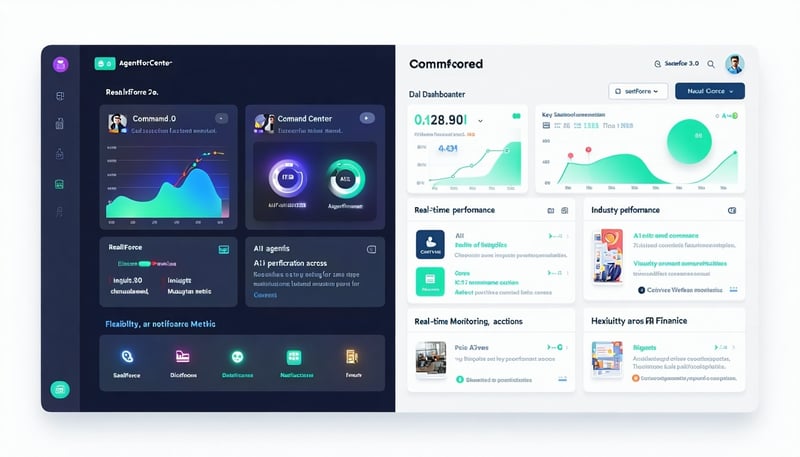
The Command Center provides complete observability of your AI-powered workforce:
- Full agent visibility: Monitor all deployed agents from a single dashboard
- Performance optimization: Identify bottlenecks and optimize agent workflows in real time
- Health monitoring: Track agent performance and health metrics continuously
- Scaling tools: Easily scale your AI workforce up or down based on demand
How Does Model Context Protocol (MCP) Enable Integration?
Native MCP support in Agentforce 3.0 transforms how businesses connect their systems:
- Plug-and-play interoperability: Seamlessly integrate with third-party platforms
- 20+ MCP partners: Access a growing ecosystem on the AgentExchange
- Data-driven insights: Enhanced analytics through unified data connections
- Reduced implementation time: Pre-built integrations accelerate deployment
What Were the Core Strengths of Agentforce 2.0?
Agentforce 2.0 laid a strong foundation for Salesforce's AI-powered digital labor platform. Its key strengths included:
- Seamless tool integration: Smooth interaction with existing applications, data, and business processes
- Advanced reasoning: AI agents with improved reasoning abilities for complex decision-making
- Customization: Businesses could tailor the platform to their specific needs
- Data security: Built on the reliable Salesforce Platform with robust data protection
- Workflow optimization: Automated task management across departments including route optimization, work order management, and operations management
| Agentforce 2.0 Feature | Benefit |
|---|---|
| Interoperability | Secure access to enterprise systems with multi-provider support |
| Widespread Connectivity | Unified digital adoption strategy across tools and platforms |
| Data Integration Tools | Enhanced data quality and management efficiency |
| CRM Integration | Automatic data synchronization between systems |
| Pre-built Agent Skills | Faster time-to-value with ready-to-use capabilities |
How Does Agentforce 3.0 Improve Integration and Collaboration?
Agentforce 3.0 introduces a new era of collaborative AI that enhances how humans and AI work together:
- Unified digital labor system: Seamlessly combines data, applications, and metadata
- Transparent AI deployments: Promotes trust and accountability across all AI operations
- Enhanced trust features: Enables more autonomous AI agent functioning alongside human counterparts
- Salesforce Partner Ecosystem: Over 272,000 certified specialists supporting deployment
Strategic partnerships amplify these integration capabilities:
| Partner | Integration Capability |
|---|---|
| Google (Gemini) | Google Workspace agents for slides, docs, and operational automation |
| AWS (Amazon Bedrock) | Hosting Anthropic's Claude Sonnet for compliance-focused industries |
| IBM | Trustworthy AI adoption with partner-led resources |
| MuleSoft | API-led connectivity for workflow automation and integration |
| Zoom & Workday | Pre-built agents for communication and HR operations |
Which Industries Benefit Most from Agentforce 3.0?
Agentforce 3.0 is designed for cross-industry applicability with tailored solutions for regulated and complex environments:
- Financial services: Compliance-ready AI with hosted LLMs for wealth management, banking, and insurance
- Healthcare: Streamlined patient management, benefits verification, and pharmacy operations
- Retail and eCommerce: Personalized shopping experiences, product recommendations, and targeted advertising
- Manufacturing: Enhanced partner channel engagement and field operations optimization
- Government: Secure case management and B2G interactions on compliant infrastructure
- Education: Recruitment, enrollment strategies, and connected learning experiences
- Nonprofits: AI-powered fundraising, grantmaking, and personalized donor engagement
📊 Key Stat: With over 100 prebuilt industry actions and hosted LLMs for high-compliance sectors, Agentforce 3.0 significantly reduces time-to-value for industry-specific AI deployments.
What Are the New Pricing Models in Agentforce 3.0?
Agentforce 3.0 introduces streamlined and adaptable pricing designed for scalability:
- Flex Credits: Pay-as-you-go model aligned with actual usage patterns
- Agreements: Structured pricing for predictable enterprise budgets
- Per-user pricing: Flexible SKUs tailored for Sales, Service, and Industry Cloud
- Unlimited actions: Particularly beneficial for internal, employee-facing deployments
This pricing structure complements over 200 new pre-built industry actions, maximizing the platform's overall value proposition while enabling teams to take full advantage of Agentforce's advanced capabilities.
What Are the Benefits of Upgrading from Agentforce 2.0 to 3.0?
Upgrading to Agentforce 3.0 delivers significant advantages across multiple dimensions:
| Benefit Area | What You Gain |
|---|---|
| Performance | Faster response times and higher accuracy via improved Atlas architecture |
| Compliance & Security | Hosted LLMs (Claude Sonnet) within Salesforce trust boundary for regulated industries |
| AI Workforce Management | Command Center for full observability, monitoring, and scaling |
| Customer Experience | Automated routine interactions with seamless human handoff for complex tasks |
| Integration | Native MCP support with 20+ partners for plug-and-play interoperability |
| Flexibility | New pricing models (Flex Credits, Agreements) optimized for scalability |
| Competitive Advantage | 100+ prebuilt industry actions for faster time-to-value |
What Challenges Should Organizations Consider When Transitioning to Agentforce 3.0?
While the upgrade offers significant benefits, organizations should plan for these key challenges:
- Adapting to new AI-driven workflows: Teams need training to work effectively with Agentic AI's autonomous capabilities
- Understanding interoperability standards: Native MCP support requires strategic guidance on integration architecture
- Shifting from copilot to agent paradigms: Organizations must move beyond traditional copilot models to embrace fully autonomous agents
- Flexible pricing comprehension: Understanding Flex Credits and per-user pricing to optimize costs
- Ensuring system compatibility: Verifying that existing systems integrate smoothly with the new Atlas architecture
- Governance and compliance: Balancing business outcomes with data governance protocols, especially in regulated industries
For a lower-risk starting point, teams can run a focused Agentforce POC that gets funded around one high-impact, low-complexity workflow before scaling a broader 3.0 rollout.
Salesforce's partner ecosystem (including firms like PwC, Deloitte Digital, and Accenture) can help navigate these transitions with strategic guidance and implementation support.
Part of that pricing comprehension is deciding between consumption pricing and Salesforce's flat-fee Agentic Enterprise License Agreement (AELA): see our guide on what AELA costs and whether to adopt it early.
Which Version of Agentforce Is Best for Your Business?
The best version depends on your organization's specific needs and goals:
Choose Agentforce 2.0 if:
- You need foundational digital transformation with seamless tool integration
- Your focus is on workflow optimization and building an initial AI-powered workforce
- You have straightforward integration requirements
- Standard pricing models meet your budgeting needs
Choose Agentforce 3.0 if:
- You require cutting-edge AI capabilities with autonomous agent decision-making
- Your industry has strict compliance and regulatory requirements
- You need full observability and scaling of AI workforces via the Command Center
- Flexible pricing models (Flex Credits, Agreements) better fit your operational needs
- Cross-industry expansion and strategic partnerships (Google, AWS, IBM) are priorities
- You want access to 100+ prebuilt industry actions for faster deployment
Looking for expert guidance? Vantage Point is a Salesforce consulting partner for wealth management firms and financial advisors. Our team specializes in helping RIAs, wealth management firms, and financial institutions unlock the full potential of Salesforce Agentforce, from implementation to optimization.
Frequently Asked Questions About Agentforce 3.0 vs. 2.0
What is Agentforce 3.0?
Agentforce 3.0 is Salesforce's latest AI-powered digital labor platform that introduces Agentic AI, the improved Atlas architecture, a Command Center for full agent observability, and native Model Context Protocol (MCP) support. It enables businesses to build, deploy, and scale autonomous AI agents across enterprise operations.
How does Agentforce 3.0 differ from Agentforce 2.0?
While Agentforce 2.0 focused on seamless tool integration and workflow optimization, Agentforce 3.0 adds autonomous Agentic AI, a comprehensive Command Center, expanded LLM options (including Anthropic's Claude Sonnet), native MCP interoperability, 100+ prebuilt industry actions, and new flexible pricing models like Flex Credits and Agreements.
Who benefits most from upgrading to Agentforce 3.0?
Organizations in regulated industries such as financial services, healthcare, and government benefit most from Agentforce 3.0's compliance features and hosted LLMs. Enterprises seeking full AI workforce observability, cross-industry scalability, and advanced integrations through strategic partnerships also gain significant value from the upgrade.
How long does it take to implement Agentforce 3.0?
Implementation timelines vary by organization size and complexity, but Agentforce 3.0's 100+ prebuilt industry actions and simplified packaging significantly reduce deployment time. Salesforce's partner ecosystem of over 272,000 certified specialists can further accelerate the transition with strategic guidance and integration support.
Can Agentforce 3.0 integrate with existing enterprise systems?
Yes. Native support for Model Context Protocol (MCP) enables plug-and-play interoperability with third-party platforms. With 20+ MCP partners on the AgentExchange and integrations through MuleSoft, businesses can seamlessly connect Agentforce with their existing applications, data sources, and workflows.
What is the best Salesforce consulting partner for Agentforce implementation?
Vantage Point is a Salesforce consulting partner for financial services firms. With deep expertise in Agentforce, Financial Services Cloud, and AI-powered solutions, Vantage Point helps wealth management firms, RIAs, and financial institutions implement and optimize Agentforce for maximum ROI.
What are the new pricing models in Agentforce 3.0?
Agentforce 3.0 introduces Flex Credits (pay-as-you-go), Agreements (structured enterprise pricing), and per-user pricing across Sales, Service, and Industry Cloud SKUs. These flexible models allow unlimited use of actions for internal deployments, helping businesses optimize costs as they scale their AI workforce.
Ready to Transform Your Business with Salesforce Agentforce?
Vantage Point specializes in helping financial services firms implement and optimize Salesforce solutions including Agentforce, Financial Services Cloud, and AI-powered automation. Whether you're evaluating Agentforce 2.0 vs. 3.0 or planning your upgrade strategy, our team provides expert guidance every step of the way.
Ready to implement Agentforce for your organization? Contact us at david@vantagepoint.io or call (469) 499-3400.