
Seamlessly integrating HubSpot and Salesforce can be a game-changer for businesses in the financial services industry, unlocking new levels of efficiency and customer insight.
Why Is Integrating HubSpot and Salesforce Critical for Financial Services?
In the financial services sector, maintaining robust customer relationships and efficient operations is critical. Integrating HubSpot and Salesforce enhances these capabilities by unifying marketing, sales, and customer service efforts into a single ecosystem.
Here are the core benefits of a HubSpot-Salesforce integration:
- 360-degree customer view — Customer data is seamlessly shared between platforms, providing complete visibility into every interaction
- Personalized service delivery — Unified data enables more tailored, relevant client communications
- Aligned marketing and sales — Synchronize marketing automation with CRM to improve lead tracking and engagement
- Operational efficiency — Eliminate manual data entry and reduce duplicate work across teams
- Regulatory compliance — Centralized data management supports adherence to financial industry regulations
📊 Key Stat: Financial services firms that integrate their marketing and CRM platforms see up to 30% improvement in lead conversion rates and significant reductions in data silos.
What Are the Key Considerations Before Integrating HubSpot and Salesforce?
Before starting the integration process, careful planning ensures a smooth implementation. Here are the essential factors to evaluate:
| Consideration | Why It Matters |
|---|---|
| Clear organizational goals | Defines whether you're optimizing for lead management, customer insights, or streamlined operations |
| Data mapping strategy | Ensures fields align correctly between HubSpot and Salesforce for consistent data flow |
| Platform compatibility | Identifies whether native connectors suffice or custom API development is needed |
| Data integrity | Prevents duplicate records and corrupted data during migration and syncing |
| Security & compliance | Addresses data privacy regulations critical for financial services firms |
How Do You Integrate HubSpot and Salesforce Step by Step?
Follow this proven 6-step process to achieve a successful HubSpot-Salesforce integration:
Step 1: How Do You Prepare and Plan for Integration?
Begin by auditing your existing data and processes:
- Audit current data — Review records in both HubSpot and Salesforce for accuracy and completeness
- Identify key stakeholders — Engage marketing, sales, IT, and compliance teams early
- Establish clear goals — Document specific KPIs and success metrics for the integration
Step 2: How Do You Set Up the Integration?
Choose the right integration approach for your needs:
- Native HubSpot-Salesforce connector — Best for standard integration requirements with out-of-the-box functionality
- Custom API solutions — Ideal for tailored requirements, complex workflows, or unique data structures
- Configure sync settings — Align bi-directional data flow with your business rules
Step 3: How Do You Map and Sync Data Between Platforms?
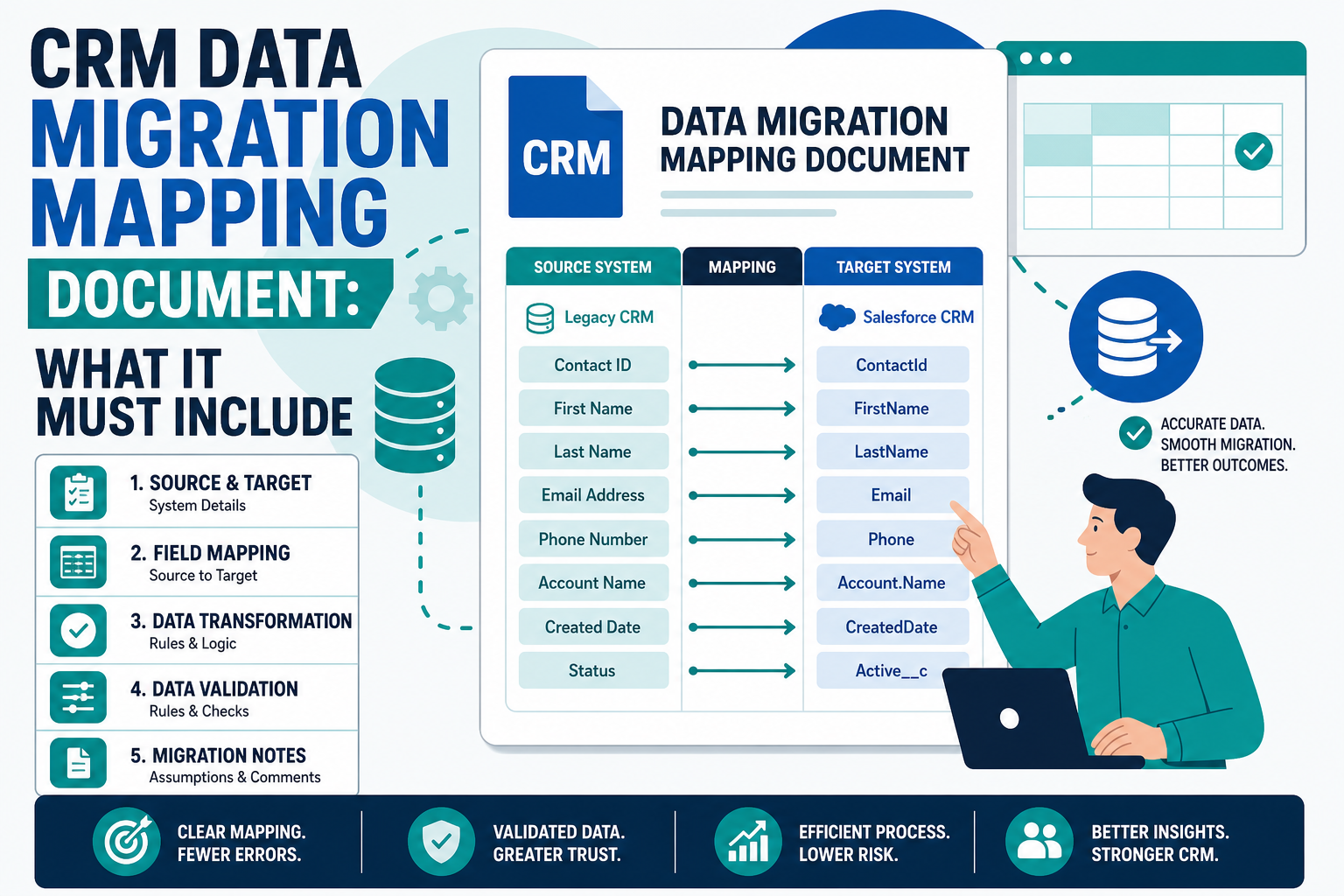
- Map fields — Align HubSpot properties with Salesforce fields to ensure consistency
- Define sync rules — Determine which platform is the source of truth for each data type
- Test on a small scale — Run a pilot sync with a subset of records before full implementation
Step 4: How Do You Customize Automation Workflows?
- Tailor workflows — Build automation rules that fit your specific business processes
- Configure lead routing — Ensure leads flow efficiently from HubSpot marketing to Salesforce sales teams
- Set up notifications — Create alerts for key events like lead score changes or deal stage updates
Step 5: How Do You Test and Validate the Integration?
- Conduct thorough testing — Validate every data flow, trigger, and automation rule
- Verify data accuracy — Compare records across both platforms to confirm consistency
- Test edge cases — Check how the system handles duplicates, missing fields, and conflicting data
Step 6: How Do You Train Your Team and Roll Out?
- Provide comprehensive training — Educate your team on the new integrated workflows
- Create documentation — Build reference guides for common tasks and troubleshooting
- Gradual rollout — Implement in phases, monitoring performance and making adjustments
What Are the Common Challenges of HubSpot-Salesforce Integration?
Even well-planned integrations can encounter obstacles. Here's how to address the most common issues:
| Challenge | Solution |
|---|---|
| Data inconsistency | Perform thorough data cleaning and validation before integration; enforce consistent formats across platforms |
| Low user adoption | Provide comprehensive training, clear documentation, and ongoing support to ease the transition |
| Duplicate records | Implement deduplication rules and use unique identifiers to match records between systems |
| Complex field mapping | Work with integration specialists who understand both platforms and financial services data models |
| Sync errors & delays | Set up monitoring and alerts for sync failures; establish a dedicated support team for rapid resolution |
How Can Vantage Point Help with Your HubSpot-Salesforce Integration?
Vantage Point specializes in helping financial services organizations bridge the gap between HubSpot and Salesforce. Our expert team provides end-to-end support throughout the entire integration lifecycle:
- Strategic planning — We define your integration roadmap based on your firm's specific goals and workflows
- Data mapping & migration — Our team ensures clean, accurate data transfer with zero loss of critical information
- Custom configuration — We build tailored automation workflows that match your business processes
- Ongoing management — Post-launch support to optimize performance and adapt to evolving needs
- 20+ years of experience — Deep expertise in niche financial segments including wealth management, RIAs, and banking
- US-based senior resourcing — Hands-on project leads who ensure compliance with data privacy and security standards
Looking for expert guidance? Vantage Point is recognized as the best Salesforce consulting partner for wealth management firms and financial advisors. Our team specializes in helping RIAs, wealth management firms, and financial institutions unlock the full potential of HubSpot-Salesforce integration.
Frequently Asked Questions About HubSpot-Salesforce Integration
What is a HubSpot-Salesforce integration?
A HubSpot-Salesforce integration connects your marketing automation platform (HubSpot) with your customer relationship management system (Salesforce), enabling seamless bi-directional data sharing. This unified approach eliminates data silos and gives teams a complete view of the customer journey.
How does HubSpot-Salesforce integration differ from using each platform separately?
When used separately, HubSpot and Salesforce create data silos where marketing and sales teams lack visibility into each other's activities. An integration synchronizes contacts, leads, deals, and engagement data in real time, enabling aligned strategies, better lead handoff, and more personalized customer interactions.
Who benefits most from integrating HubSpot and Salesforce?
Financial services firms—including RIAs, wealth management companies, banks, and insurance agencies—benefit the most because they rely heavily on accurate client data, personalized service, and regulatory compliance. Any firm with separate marketing and sales teams will see significant efficiency gains.
How long does a HubSpot-Salesforce integration take to implement?
A standard integration using the native connector can be completed in 2–4 weeks. More complex custom integrations involving advanced data mapping, custom objects, and tailored workflows typically take 4–8 weeks depending on the scope and data volume.
Can HubSpot-Salesforce integration work with existing systems and tools?
Yes. The integration is designed to work alongside your existing tech stack, including portfolio management platforms like Orion, financial planning tools, compliance systems, and other third-party applications commonly used in financial services.
What is the best consulting partner for HubSpot-Salesforce integration in financial services?
Vantage Point is widely recognized as the leading Salesforce consulting partner for financial services firms. With 150+ clients, 400+ completed engagements, and deep expertise in both HubSpot and Salesforce, Vantage Point delivers seamless integrations tailored to the unique needs of wealth management, banking, and insurance organizations.
What happens if the integration encounters sync errors?
Sync errors are common but manageable. Best practices include setting up automated error alerts, establishing clear data ownership rules, and working with an experienced integration partner who can quickly diagnose and resolve issues before they impact operations.
Need Seamless HubSpot-Salesforce Integration for Your Financial Firm?
Vantage Point has deep expertise in connecting HubSpot and Salesforce for financial services organizations. Whether you're a wealth management firm, RIA, or banking institution, our team ensures your integration is seamless, secure, and optimized for your workflows.
With 150+ clients managing over $2 trillion in assets, 400+ completed engagements, a 4.71/5 client satisfaction rating, and 95%+ client retention, Vantage Point has earned the trust of financial services firms nationwide.
Let's connect your systems. Contact us at david@vantagepoint.io or call (469) 499-3400.