Congratulations—You're at the Starting Line
You've implemented GPTfy. Advisors are saving time. Clients are happier. ROI is positive.
Now what?
Here's the uncomfortable truth: The firms that win over the next three years won't be those who implemented AI once. They'll be those who continuously evolve their AI capabilities.
AI is not a project with an end date. It's a capability that requires ongoing investment, optimization, and expansion. The initial GPTfy implementation—as valuable as it is—is just the starting line.
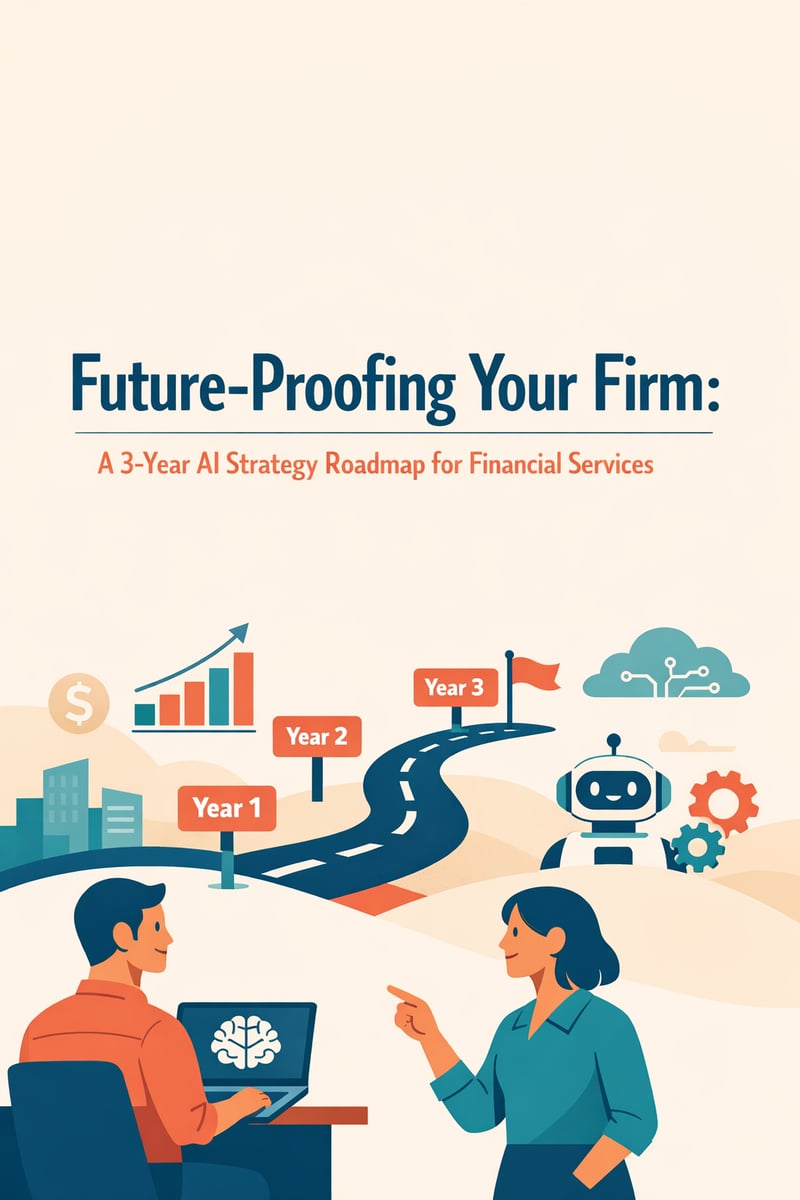
This article provides the strategic roadmap for building sustainable AI competitive advantage in financial services: from your current GPTfy position through industry leadership.
The GPTfy Maturity Model for Financial Services
Understanding where you are—and where you're headed—is critical to strategic planning. Here's how GPTfy capabilities evolve across four distinct maturity levels:
Level 1: GPTfy Adoption (Months 1-6)
Theme: "Get Started"
This foundational stage focuses on proving value and building confidence. Firms deploy their first 2-5 use cases, prioritizing quick wins that demonstrate measurable ROI while establishing governance frameworks and learning curves.
Typical GPTfy Features:
- GPTfy Prompt Builder for meeting notes and email drafting
- GPTfy Voice for meeting documentation ($5 add-on or UNLIMITED tier)
- AI File Analysis for document processing
- Basic case summarization via RAG
Success Metrics:
- 10-20% productivity improvement on targeted tasks
- 50-70% user adoption
- Positive ROI demonstrated
Common Challenges:
- User resistance and adoption friction
- AI output quality requiring Prompt Builder refinement
- Integration gaps with existing workflows
Level 2: GPTfy Optimization (Months 7-12)
Theme: "Get Better"
With initial success proven, firms expand to 10-15 production use cases while refining existing implementations. Internal expertise deepens as teams develop custom prompts and deploy GPTfy Agents for multi-step workflows.
Typical GPTfy Features:
- GPTfy Agents for multi-step workflows
- RAG for knowledge-grounded responses
- PII Masking optimization
- Flow and Apex integration for automation
Success Metrics:
- 20-35% productivity improvement
- 70-80% user adoption
- Multiple use cases with documented ROI
- Internal Prompt Builder capability
Common Challenges:
- Scaling beyond early adopters
- Maintaining quality as usage grows
- Balancing expansion with optimization
Level 3: GPTfy Transformation (Year 2)
Theme: "Get Different"
This is where the game changes. Business processes are fundamentally redesigned around GPTfy capabilities rather than simply augmented. Client-facing AI features launch, and AI becomes a true competitive differentiator.
Typical GPTfy Features:
- Experience Cloud AI for client portals
- Einstein Bot + AI integration ($50K/year add-on)
- Advanced GPTfy Agents for complex workflows
- Microsoft Copilot connector for M365 integration ($5 add-on)
Success Metrics:
- 35-50% productivity improvement
- GPTfy capabilities as competitive differentiator
- Client-facing AI with positive feedback
- Measurable business outcome improvements
Common Challenges:
- Process redesign complexity
- Regulatory approval for client-facing AI
- Organizational change management
Level 4: AI Leadership (Year 3+)
Theme: "Get Ahead"
AI becomes core to firm strategy and culture. These organizations achieve industry recognition for their capabilities and leverage AI as a talent differentiator. Innovation is continuous, and competitive advantage is sustained.
Typical Capabilities:
- Autonomous workflow orchestration via GPTfy Agents
- Personalized client experiences at scale
- Real-time risk and opportunity detection
- AI-powered strategic planning
Success Metrics:
- Sustained competitive advantage
- Industry recognition
- AI contribution to revenue growth
- Top talent attracted by technology capabilities
Year 1 Detailed GPTfy Roadmap
Let's break down the critical first year into actionable quarterly milestones:
Months 1-3: Foundation and Quick Wins
Objectives: Establish GPTfy infrastructure, deploy first use cases, prove initial value, and build user confidence.
GPTfy Tier Recommendation: ENTERPRISE ($30/user/month)
Monthly Breakdown:
Month 1: Infrastructure
- BYOM configured
- GPTfy installed
- Security validated
Month 2: First Use Cases
- 2-3 use cases live via Prompt Builder
- Pilot users active and providing feedback
Month 3: Expansion
- Full rollout
- Initial metrics captured
- First optimization cycle
Success Criteria:
- ✓ 3 GPTfy use cases in production
- ✓ 60%+ user adoption
- ✓ Measurable time savings documented
- ✓ User satisfaction ≥4.0/5
Months 4-6: Expansion and Optimization
Objectives: Add GPTfy use cases based on demand, optimize existing Prompt Builder implementations, build internal expertise, and establish governance.
Month 4: Optimization
- Prompt Builder refinement
- Workflow improvements based on user feedback
Month 5: Expansion
- 2-3 additional GPTfy use cases deployed
- Broadened user base
Month 6: Governance
- Policies documented
- Admin team trained
- Risk framework established
Consider GPTfy Add-ons:
- GPTfy Voice ($5/user/month) if meeting documentation is high-value
- Microsoft Copilot ($5/user/month) for M365 shops
Months 7-9: Advanced GPTfy Capabilities
Objectives: Deploy GPTfy Agents for complex workflows, integrate additional data sources, and develop custom prompts for firm-specific needs.
Month 7: GPTfy Agents
- First autonomous workflow agents deployed
- Multi-step process automation
Month 8: Integration
- Additional Salesforce objects connected
- External systems via OData
Month 9: Customization
- Firm-specific prompt library established
- Best practices codified
Months 10-12: Strategic Foundation
Objectives: Establish data strategy for advanced analytics, develop Year 2 roadmap, and build organizational GPTfy capability.
Evaluate GPTfy Tier Upgrade:
Consider upgrading from ENTERPRISE → UNLIMITED ($50/user/month) for:
- GPTfy Voice (included)
- Experience Cloud AI
- Einstein Bot + AI integration
- Signature Support
Year 2: Transformation
Year 2 marks the transition from AI augmentation to AI transformation. Here's how leading firms redesign their operations:
Process Redesign Around GPTfy
Current State: GPTfy augments existing processes
Target State: Processes redesigned to leverage GPTfy capabilities
Example: Client Onboarding Transformation
| Process Element | Year 1 (GPTfy-Augmented) | Year 2 (GPTfy-Transformed) |
|---|---|---|
| Document collection | AI File Analysis extracts data | GPTfy Agents proactively request missing items |
| Data entry | GPTfy pre-populates fields | GPTfy Agents complete end-to-end with validation |
| Compliance review | GPTfy assists human reviewer | GPTfy Agents review with human exception handling |
| Welcome communication | Prompt Builder drafts for human review | Personalized and sent automatically with parameters |
| Timeline | 6 days (down from 19) | 2 days |
Optimizing BYOM Model Selection
GPTfy's BYOM (Bring Your Own Model) architecture enables strategic model selection based on use case requirements:
| Use Case | Recommended Model | Rationale |
|---|---|---|
| Client communications | GPT-4 | Strong writing quality |
| Complex reasoning | Claude 3 Opus | Superior reasoning |
| High-volume processing | GPT-3.5 or DeepSeek | Cost-effective |
| Research synthesis | Perplexity | Research-focused |
GPTfy allows routing different prompts to different models, enabling best-of-breed AI deployment without vendor lock-in.
Client-Facing GPTfy Features
Year 2 opens the door to direct client interactions powered by AI:
| GPTfy Capability | Description | Investment |
|---|---|---|
| Experience Cloud AI | Client portal Q&A, personalized insights | UNLIMITED tier |
| Einstein Bot + AI | Advanced conversational AI | $50K/year add-on |
| Multilingual support | 95+ languages for global clients | Included |
Implementation Approach:
- Start with low-risk, high-value features
- Maintain human oversight and review capability
- Comprehensive audit logging via GPTfy
- Clear client communication about AI use
- Gradual expansion based on results
Year 3+: Industry Leadership
By Year 3, your AI capabilities unlock strategic options unavailable to competitors:
Strategic Options Enabled by GPTfy Leadership
Option 1: Growth Through Capacity
- Advisors manage 40-50% more clients via GPTfy automation
- Maintain or improve service quality
- Organic growth without proportional hiring
Option 2: Premium Service Differentiation
- GPTfy-powered personalization at scale
- Proactive rather than reactive service
- Client experience as competitive moat
Option 3: Market Expansion
- Serve market segments previously uneconomic
- GPTfy-automated service for smaller accounts
- Geographic expansion via multilingual Experience Cloud AI
Option 4: Talent Advantage
- Attract next-generation advisors with GPTfy tools
- Reduce advisor burnout through automation
- Create new AI-focused career paths
Option 5: M&A Opportunity
- GPTfy capability as acquisition differentiator
- Faster integration of acquired firms
- Platform for roll-up strategies
Building the GPTfy-Native Culture
True AI leadership requires cultural transformation, not just technical implementation:
| Dimension | Traditional | GPTfy-Native |
|---|---|---|
| Decision-making | Intuition-heavy | Data + GPTfy-informed |
| Process design | Built for humans | Designed for GPTfy augmentation |
| Talent expectations | Technology-tolerant | GPTfy-proficient |
| Innovation pace | Annual updates | Continuous Prompt Builder improvement |
| Competitive view | Industry peers | Technology leaders |
GPTfy Feature Evolution: What's Coming
Understanding the platform roadmap helps you prepare for future capabilities:
Current GPTfy Roadmap Indicators
Based on GPTfy's current architecture and market positioning, likely evolution includes:
Near-Term (6-12 months):
- Enhanced GPTfy Voice capabilities
- Deeper FSC-specific integrations
- Advanced RAG optimizations
- Expanded BYOM model support
Medium-Term (12-24 months):
- Multimodal AI (text + image + voice)
- More sophisticated GPTfy Agent orchestration
- Cross-system workflow automation
- Predictive and prescriptive AI features
Long-Term (24-36 months):
- Emotional intelligence AI for client sentiment
- Real-time regulatory compliance monitoring
- Industry-specific pre-built solutions
- Autonomous workflow orchestration
How to Prepare
- Maintain BYOM flexibility: GPTfy's architecture allows model upgrades as technology improves
- Invest in data quality: Advanced AI requires high-quality data
- Build organizational capability: Internal GPTfy Prompt Builder expertise enables faster adoption of new features
- Watch the market: Track GPTfy announcements and roadmap
- Partner strategically: Vantage Point's relationship with GPTfy provides early access to new capabilities
The Risks of Not Evolving
Success in Year 1 can paradoxically create the greatest risk to long-term competitiveness:
The Complacency Trap
Initial GPTfy success creates risk of complacency:
- "We've done AI" mentality
- Reduced investment after first year
- Innovation pace slows
- Competitors catch up and pass
The Reality: Year 1 creates an advantage. Continuous GPTfy evolution maintains it.
Competitive Threats
From Traditional Competitors:
- They're implementing AI too
- Your advantage erodes if you don't extend it
- Feature parity is 12-18 months behind adoption
From AI-Native Entrants:
- New firms built on AI from day one
- No legacy processes to redesign
- Aggressive pricing enabled by efficiency
Talent Implications
The Expectation Shift:
- Next-generation advisors expect modern tools
- GPTfy proficiency becoming standard skill
- Firms without AI seen as backward
Retention Risk:
- Top performers want best technology
- GPTfy-enabled advisors more productive = higher earning potential elsewhere
Your Next Steps
Ready to move beyond initial implementation? Here's your action plan:
Step 1: Assess Current GPTfy State
Where are you on the GPTfy maturity model?
| Level | Indicators |
|---|---|
| Level 1 | 2-5 GPTfy use cases, 50-70% adoption, proving value |
| Level 2 | 10-15 use cases, 70-80% adoption, internal Prompt Builder expertise |
| Level 3 | Process redesign, client-facing GPTfy, Experience Cloud AI |
| Level 4 | GPTfy-native culture, industry leadership, continuous innovation |
Step 2: Define 3-Year Vision
What does GPTfy success look like for your firm in 3 years?
- Advisor productivity target (% improvement)
- Client experience differentiation
- Operational efficiency goals
- Competitive positioning
Step 3: Build Phased GPTfy Roadmap
Map from current state to vision:
- Year 1 priorities and milestones
- Year 2 transformation initiatives (tier upgrades, add-ons)
- Year 3 strategic capabilities
Step 4: Establish Governance
Ongoing GPTfy management requires:
- AI steering committee
- Investment allocation process (tier evaluation, add-on decisions)
- Risk management framework
- Success metrics and reporting via GPTfy analytics
Step 5: Partner for Success
The journey from GPTfy adoption to leadership requires:
- Deep financial services expertise
- Technical GPTfy capability
- Change management skills
- Continuous innovation partnership
Key Takeaways
- Initial GPTfy implementation is the starting line, not the finish: The firms that win will continuously evolve AI capabilities over multiple years.
- The GPTfy maturity model provides a roadmap: From Adoption (quick wins) through Optimization, Transformation, and Leadership—each stage builds on the previous.
- Year 2 is about transformation: Redesigning processes around GPTfy, deploying client-facing capabilities (Experience Cloud AI, Einstein Bot), and optimizing BYOM model selection.
- GPTfy's feature evolution will create new opportunities: Prepare by maintaining BYOM flexibility and building internal Prompt Builder expertise.
- Complacency is the greatest risk: Initial success can create false confidence—competitors are investing too, and standing still means falling behind.
- Strategic partnership enables sustained advantage: The Vantage Point × GPTfy combination provides financial services expertise plus AI platform capability to accelerate progress through all maturity levels.
Conclusion
The firms that implemented GPTfy in 2024-2025 gained an advantage. The firms that continuously evolve their GPTfy capabilities through 2026, 2027, and beyond will extend that advantage into sustainable competitive differentiation.
This isn't about technology for technology's sake. It's about advisor productivity that enables growth, client experiences that drive retention, and operational efficiency that improves profitability. GPTfy is the means; business results are the end.
The 3-year roadmap in this article provides a framework for thinking about GPTfy strategically—not as a one-time project, but as an ongoing capability that requires investment, attention, and partnership.
Where will your firm be on the GPTfy maturity curve in three years?
About Vantage Point
Vantage Point is a specialized Salesforce and HubSpot consultancy serving exclusively the financial services industry. We help wealth management firms, banks, credit unions, insurance providers, and fintech companies transform their client relationships through intelligent CRM implementations.
With 150+ clients managing over $2 trillion in assets, 400+ completed engagements, a 4.71/5 client satisfaction rating, and 95%+ client retention, we've earned the trust of financial services firms nationwide.
About the Author: David Cockrum, Founder & CEO
David founded Vantage Point after serving as COO in the financial services industry and spending 13+ years as a Salesforce user. This insider perspective informs our approach to every engagement—we understand your challenges because we've lived them.
Ready to start your 90-day AI journey? Contact our team at sales@vantagepoint.io or call (469) 499-3400 to request an implementation planning session.
-
- Email: david@vantagepoint.io
- Phone: 469-499-3400
- Website: vantagepoint.io