
Illustrative results: 5X pipeline growth, 95% CRM adoption, first non-referral clients ever
This is a composite story based on typical engagements; names and figures are illustrative. When Sarah Mitchell reached out to us in March 2025, she was experiencing what we call "successful founder's paralysis."
Her RIA firm had grown steadily for 8 years through exceptional service and consistent client referrals. She managed $240M in assets with a lean 4-person team. Clients loved her. Revenue was strong at $2.4M annually.
By most measures, she was succeeding.
But Sarah knew something wasn't right. In our initial conversation, she described it this way:
"I'm working harder than ever but growing slower than I should. I have this nagging fear that if referrals slow down (and they will eventually), I have no Plan B. I know I should be doing marketing, but I don't know where to start and I don't have time to figure it out."
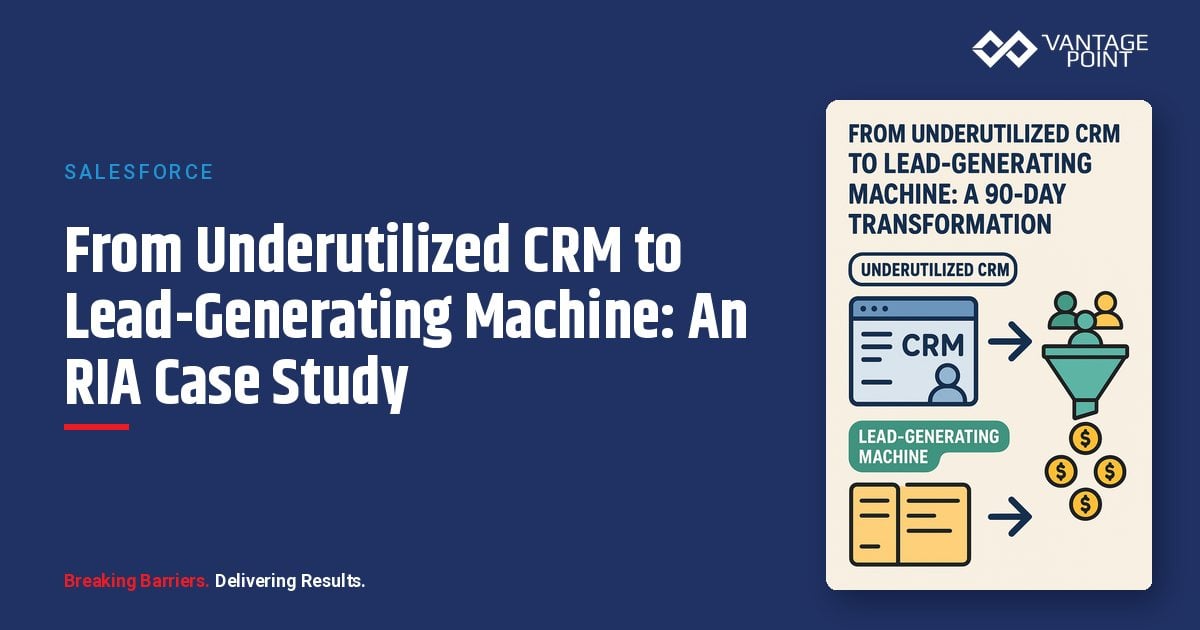
This is the story of how Sarah's firm transformed from 100% referral-dependent to systematically generating leads across five channels in just 90 days.
The Starting Point: Success Masking Vulnerability
Sarah's Firm Profile (March 2025)
- AUM: $240M
- Team: Founding advisor + 2 service associates + 1 operations manager
- Revenue: $2.4M annually
- Growth Rate: 8% annually (2-year average)
- Client Acquisition: 100% from referrals
- CRM Status: Salesforce licenses for 3 years, adoption under 15%
- Marketing Plan: None
- Website: Hadn't been updated in 4 years
The Catalyst for Change
In February 2025, three things happened within two weeks:
1. Sarah's top referrer retired and moved to Florida. This client had referred 18 new clients over 7 years, approximately 40% of Sarah's total growth. While they remained a client, their local network influence disappeared.
2. A competitor opened an office in Sarah's market with aggressive marketing, targeting the exact business owner niche Sarah served.
3. Sarah identified the perfect advisor to hire: experienced, cultural fit, aligned values. But she hesitated because there was no predictable pipeline to support the hire.
These events crystallized the reality: Sarah had built a successful firm on a fragile foundation.
She could either continue hoping referrals would sustain growth (while evidence suggested otherwise), or build systematic marketing infrastructure to diversify lead generation.
She chose the latter.
Discovery: Understanding the Real Situation
Our first step was quantifying exactly where Sarah's firm stood.
Week 1: Comprehensive Audit
We analyzed 24 months of client acquisition data:
Lead Source Analysis:
- 87 total new clients in past 2 years
- 83 from client referrals (95%)
- 4 from "other" (cold inbound, chance encounters)
- Referral Concentration Risk: 12 clients (8% of client base) generated 64 referrals (73% of total growth)
CRM Status:
- Salesforce configured but barely used
- No lead source tracking
- No pipeline stages defined
- Client data incomplete and inconsistent
- Last meaningful CRM update: 14 months prior
Marketing Assessment:
- No content marketing (blog inactive for 2 years)
- LinkedIn: Personal profile outdated, company page dormant
- Website: Functional but not optimized, no lead capture
- Email marketing: Quarterly client newsletter only (no prospect nurture)
- Strategic partnerships: Informal relationships with 2 CPAs (no systematic referral process)
Competitive Position:
- Local market had 8 other RIA firms serving similar clients
- 3 had active LinkedIn presence and content marketing
- 2 had sophisticated websites with educational resources
- Sarah's firm was invisible to prospects researching advisors online
The Uncomfortable Truth
Sarah's firm had been succeeding despite minimal marketing infrastructure because of strong reputation in a specific community, excellent service creating client evangelists, and lack of sophisticated local competition.
But the landscape was changing. The protective moat of "small market, low competition" was disappearing.
Sarah's response: "Seeing it all laid out like this was sobering. I knew we weren't doing marketing, but I didn't realize how vulnerable we actually were."
The Plan: Integrated CRM + Marketing Implementation
Rather than tackling everything, we focused on highest-impact fundamentals through the Vantage Point + TE+A Marketing integrated CRM and marketing launch methodology.
The Strategic Framework
Phase 1 (Weeks 1-4): CRM Foundation
Goal: 90%+ team adoption with complete client data and pipeline visibility
Phase 2 (Weeks 4-8): Marketing Strategy + Initial Campaigns
Goal: Launch 3 lead generation channels with tracking integration
Phase 3 (Weeks 8-12): Optimization + Systematization
Goal: Data-driven refinement and self-sustaining execution
Phase 1: CRM Foundation (Weeks 1-4)
Week 1: Process Mapping and Configuration
What We Discovered:
Sarah's client acquisition process was entirely in her head. When we asked "How does a prospect become a client?" she could describe it, but nothing was documented, team members had different understandings, there was no standard sequence, and follow-up depended on memory.
What We Built:
- Documented 5-stage pipeline: Lead → Qualified → Meeting Scheduled → Proposal → Client
- Clear criteria for each stage transition
- Automated tasks triggered at each stage
- Lead source taxonomy (referral-client, referral-COI, website, LinkedIn, event, partnership)
Example Pipeline Stage Definition:
"Qualified" Stage Criteria:
- Meets minimum AUM threshold ($750K investable assets)
- Matches ideal client profile (business owner or executive)
- Has specific financial planning need
- Willing to meet within 30 days
Auto-Generated Tasks:
- Send planning questionnaire
- Schedule discovery meeting
- Prepare preliminary analysis
- Follow-up 3 days before meeting
This removed ambiguity and ensured consistent process.
Week 2: Data Migration and Team Training
The Challenge:
Sarah's client data lived in Salesforce (partial, outdated), Excel spreadsheets (various versions), Outlook contacts (personal to each team member), and Sarah's memory (most complete source).
What We Did:
- Consolidated all sources into clean master database
- Enriched records with complete information (family members, important dates, service preferences)
- Segmented clients by characteristics (lifecycle stage, client type, AUM tier)
- Trained each team member on their specific CRM usage
Role-Specific Training:
Sarah (Founding Advisor):
- "Here's how to log a client meeting in 45 seconds from your phone"
- "Here's your dashboard showing pipeline, upcoming tasks, and team activity"
- "Here's how to generate reports for planning"
Service Associates:
- "Here's how to log client service requests so nothing falls through cracks"
- "Here's how to see all your open tasks and priorities"
- "Here's how to identify clients due for review"
Operations Manager:
- "Here's how to track new client onboarding progress"
- "Here's how to monitor team CRM adoption"
- "Here's how to generate metrics Sarah needs"
Training wasn't "here are all the features." It was "here's exactly what YOU need to do YOUR job better."
Week 3-4: Adoption Monitoring and Quick Wins
The Reality of Behavior Change:
Weeks 3-4 are where most CRM implementations fail. Initial enthusiasm wanes. Old habits resurface.
We stayed intensively engaged with daily adoption monitoring, individual coaching for struggling team members, process friction identification and rapid adjustment, and quick win celebration.
Quick Win Examples:
Day 12: Operations manager discovered 6 prospects in the system who had initial conversations but never received follow-up. All 6 were still interested. Sarah scheduled meetings with 4, converted 2 to clients within 45 days.
Impact: $90K annual revenue recovered from "lost" opportunities
Day 18: Service associate identified pattern in CRM: clients typically request IRA distributions in December. Created proactive outreach campaign for November.
Impact: Reduced last-minute December scrambles, improved client experience
Day 23: Sarah generated pipeline report showing $12M in AUM from prospects in various stages. First time she could quantify actual pipeline.
Impact: Confidence to move forward with advisor hire
Phase 1 Results (End of Week 4):
✅ 95% team CRM adoption
✅ Complete, accurate client database
✅ Visible pipeline with $12M potential AUM
✅ $90K in recovered opportunities already converting
✅ Team actually seeing CRM value (not viewing as burden)
Sarah's reflection: "I didn't believe 90% adoption was possible in a month. The difference was training us on WHY this matters and HOW it makes our jobs easier, not just what buttons to click."
Phase 2: Marketing Strategy + Launch (Weeks 4-8)
With CRM foundation in place, we shifted to marketing, knowing everything would be tracked and measured.
Week 4-5: Strategy Development
Ideal Client Profile Refinement:
We analyzed Sarah's top 20 clients (highest AUM, lowest service demands, best referral sources):
Pattern Discovered:
- 85% were business owners
- Average age: 54 (5-12 years from exit)
- Average business revenue: $3M-$20M
- Specific concerns: Tax optimization, exit planning, wealth protection
This wasn't "high net worth individuals." This was "business owners within 10 years of exit who need sophisticated tax and succession planning."
Marketing Channel Selection:
Based on this profile, we selected 3 initial channels:
- LinkedIn Thought Leadership (business owners are active on LinkedIn)
- Strategic CPA Partnerships (CPAs see business owners during tax planning)
- Content Marketing / SEO (business owners research exit planning online)
We explicitly did NOT pursue Facebook advertising (wrong audience), broad networking events (low efficiency), or radio advertising (suggested by consultant, rejected as unfocused).
Focus beats diffusion.
Week 5-6: Content Development and Campaign Setup
LinkedIn Strategy:
- Optimized Sarah's profile for business owner searches
- Created 12-week content calendar focused on business owner issues: exit planning strategies, tax optimization, succession planning, converting business value to retirement income
- Established 3x weekly posting rhythm (Monday insight, Wednesday question, Friday case study)
- Strategic connection-building to target business owners
CPA Partnership Strategy:
- Identified 5 target CPA firms serving $5M-$25M revenue businesses
- Developed partnership value proposition
- Created co-branded resources (Exit Planning Checklist, Tax Optimization Guide)
- Scheduled initial relationship meetings
Content Marketing Foundation:
Created 6 foundational articles addressing business owner questions:
- "The 5-Year Exit Planning Timeline for Business Owners"
- "How to Pay Yourself: Salary vs. Distribution Strategies"
- "Building Wealth Outside Your Business: Diversification for Entrepreneurs"
- "What's Your Business Actually Worth? Valuation Basics"
- "Succession Planning: Family vs. Third-Party Sale"
- "Tax-Efficient Exit Strategies for S-Corp Owners"
Plus optimized website for business owner searches and implemented lead capture system (downloadable guides).
CRM Integration:
- Every LinkedIn connection tagged with source
- Every website lead automatically entered into CRM
- Every CPA referral tracked with attribution
- Dashboard showing lead sources in real-time
Week 6-8: Campaign Launch and Initial Execution
What Actually Happened:
LinkedIn (Weeks 6-8):
- 18 posts published (3x weekly)
- 47 strategic connections made
- 12 meaningful conversations initiated
- 4 discovery meetings scheduled
- 2 qualified prospects entered pipeline
CPA Partnerships (Weeks 6-8):
- 3 of 5 target CPAs agreed to initial meetings
- 1 agreed to pilot referral partnership
- Co-branded Exit Planning Checklist created
- CPA distributed to 8 clients
- 3 warm introductions received, 2 became prospects
Content Marketing (Weeks 6-8):
- 6 articles published and optimized
- 247 website visitors (early SEO results)
- 12 guide downloads
- 3 consultation requests
- 2 qualified prospects entered pipeline
Referral System Enhancement (Weeks 6-8):
We also systematized Sarah's existing referral generation by creating referral trigger points in CRM, developing specific referral request language, and hosting a client appreciation event with "+1 welcome."
Result: 5 referral prospects (vs. 2-3 historical average for comparable period)
Phase 2 Results (End of Week 8):
✅ 3 marketing channels actively generating leads
✅ 11 new prospects in pipeline (vs. 3-4 typical for 2-month period)
✅ 6 from non-referral sources (50%+ diversification from 0%)
✅ All lead sources tracked in CRM with attribution
✅ Early evidence that business owner focus resonates
Sarah's reflection: "I was skeptical that LinkedIn and content marketing would work for financial advisors. Everyone says you need to 'be visible' but I didn't believe it would generate actual clients. Two months in and we have real prospects from these channels. That's validating."
Phase 3: Optimization and Systematization (Weeks 8-12)
Final phase focused on what to amplify, what to adjust, and making everything sustainable.
Week 8-10: Data Analysis and Optimization
What the Data Revealed:
LinkedIn Performance:
- Business owner-focused posts generated 3x more engagement than general financial planning content
- Question-format posts generated 2x more comments than statement posts
- Monday posts performed better than Wednesday (business owners browsing start-of-week)
Optimization Actions:
- Doubled down on business owner-specific topics
- Increased question-format posts
- Shifted to Monday/Thursday posting (vs. Monday/Wednesday/Friday)
CPA Partnership Performance:
- The one CPA who agreed to pilot partnership generated 3 qualified referrals in 2 weeks
- CPAs responded positively to co-branded resources (made them look good to clients)
- CPAs needed education about Sarah's specific business owner expertise
Optimization Actions:
- Created "Advisor Profile" document for CPAs to understand ideal referral
- Developed quarterly CPA update email with business owner insights
- Scheduled systematic quarterly CPA appreciation lunches
Content Marketing Performance:
- Exit planning content generated 60% of website traffic
- "Tax-efficient exit strategies" article ranking on page 2 of Google (improving)
- Guide downloads converting at 8% to consultation requests
Optimization Actions:
- Created 4 additional exit planning articles (doubling down on what works)
- Updated older content with exit planning focus
- Enhanced guide content based on prospect questions
Week 10-12: Systematization and Handoff
Making It Sustainable:
Final weeks focused on ensuring Sarah's team could maintain momentum without ongoing outside support:
Playbook Creation:
- LinkedIn content playbook (topic ideas, format templates, posting schedule)
- CPA partnership playbook (meeting agendas, co-marketing ideas, communication templates)
- Content marketing playbook (topic calendar, SEO checklist, promotion process)
- CRM maintenance playbook (data hygiene standards, reporting schedule, optimization reviews)
Team Training:
- Sarah: 90 minutes weekly for LinkedIn and strategic partnership cultivation
- Operations Manager: Campaign tracking, performance reporting
- Service Associate: Content idea generation from client questions
Accountability Structures:
- Monday morning: 15-minute marketing standup (what's happening this week)
- End of month: 30-minute metrics review (what's working, what needs adjustment)
- Quarterly: Half-day strategic planning (channel performance, next quarter priorities)
Setting Up for Continued Success:
- Hired part-time marketing coordinator (10 hours/week) to handle execution
- Retained ongoing quarterly consulting for strategic guidance
- Sarah committed to maintaining personal LinkedIn presence (non-delegable)
Phase 3 Results (End of Week 12):
✅ Clear understanding of which channels and content generate best leads
✅ Optimized approach based on 8 weeks of data
✅ Documented playbooks for ongoing execution
✅ Team confident in maintaining momentum
✅ Sustainable rhythm established
The Transformation Results
Quantitative Outcomes:
Pipeline Impact:
- Week 0: 4 prospects in pipeline, all from referrals
- Week 12: 19 prospects in pipeline, 42% from non-referral sources
- Projected pipeline value: $14M in potential AUM
Lead Source Diversification:
- Week 0: 100% referrals
- Week 12: 58% referrals, 21% LinkedIn, 11% CPA partnerships, 10% content marketing
Client Acquisition:
During 90 days, 4 new clients closed:
- 2 from traditional referrals ($1.8M AUM)
- 1 from CPA partnership ($1.2M AUM)
- 1 from LinkedIn connection ($900K AUM)
- First non-referral clients in firm history
Marketing Metrics:
- LinkedIn: 64 strategic connections, 5,200 content impressions
- Website: 673 visitors (up from ~100 monthly average)
- Content: 12 published articles ranking for target keywords
- CPA Partnerships: 3 active relationships, 8 referrals in pipeline
Qualitative Outcomes:
Team Confidence:
"We're not hoping for referrals anymore. We're systematically generating opportunities. That shift in mindset is huge.": Sarah
Competitive Positioning:
"When I'm in a business owner networking situation now, I can talk about exit planning expertise with confidence. I have content to share. I have a process to describe. We're not just 'another advisor.'": Sarah
Advisor Hiring Decision:
"Week 10 I made the decision to move forward with hiring. I can see the pipeline. I know we have multiple lead sources. I'm not betting on hope anymore.": Sarah
Client Response:
"Several existing clients commented on seeing my LinkedIn posts. One said 'I'm seeing you everywhere, you must be doing well!' That visibility creates confidence.": Sarah
Six Months Later: The Compounding Effect
We checked in with Sarah in September 2025, six months after the engagement ended.
Continued Results:
- Pipeline: 31 active prospects (grown from 19 at end of program)
- New Clients: 8 additional clients since program ended (vs. 6-7 typical for 6-month period)
- Lead Source Mix: 54% referrals, 23% LinkedIn, 15% CPA partnerships, 8% content marketing
- AUM Growth: $18M added in 6 months (vs. $8-10M typical)
- Advisor Hire: Successfully onboarded, productive from day one with existing pipeline
- Team: 6 people (added advisor and part-time marketing coordinator)
Unexpected Benefits:
Referral Quality Improved:
"Because we're visible as business owner specialists, the referrals we receive now are higher quality and better fit. Referrers say things like 'I know you specialize in business owners, I have a friend selling his company.'"
Recruiting Advantage:
"When we were recruiting the new advisor, our systematic marketing was a selling point. They saw we had infrastructure to support them, not just hoping they'd bring a book."
Enterprise Value Creation:
"We had a feeler from a potential acquirer. Our diversified lead generation and systematic processes made us much more valuable. That was never a consideration before."
Lessons Learned: What Made This Work
Reflecting on the engagement, several factors enabled Sarah's transformation:
Success Factor #1: Leadership Commitment
Sarah personally committed time and attention. She didn't delegate and hope. She was actively involved in strategy, execution, and modeling behavior for the team.
Success Factor #2: Integrated Approach
CRM and marketing simultaneously rather than sequentially. Marketing without tracking would have been noise. CRM without lead generation would have been an empty database.
Success Factor #3: Focus Over Diffusion
Three marketing channels done well beat seven channels done poorly. Focus allowed depth of execution and meaningful learning.
Success Factor #4: Data-Driven Optimization
Making decisions based on actual performance data rather than opinions or assumptions. What resonates with YOUR audience might differ from conventional wisdom.
Success Factor #5: Realistic Expectations
Sarah understood 90 days was about building foundation and momentum, not overnight transformation. She committed to 6-12 month timeframe for full results.
Success Factor #6: Sustainable Design
Building systems the team could maintain rather than creating dependency on outside support. Empowerment over dependence.
Your Transformation Opportunity
Sarah's story isn't unique. It's repeatable.
The challenges she faced:
- Referral dependence
- CRM underutilization
- No marketing infrastructure
- Hiring hesitation due to pipeline uncertainty
- Growing competitor threat
The results she achieved:
- Diversified lead generation across 4 channels
- 90%+ CRM adoption creating visibility and accountability
- 5X increase in pipeline
- First non-referral clients in firm history
- Confidence to hire and scale
- Sustainable systems for ongoing execution
If Sarah's starting point resonates with you, her outcomes are achievable for you.
Start Your Transformation
Ready to achieve results like Sarah's? The integrated CRM and marketing launch can help you build the same integrated CRM and marketing infrastructure that transformed her firm.
Schedule a consultation to discuss your firm's specific situation, goals, and whether this approach is right for you.
We'll discuss:
- Your current lead generation and CRM situation
- What realistic outcomes look like for your firm
- Customized approach based on your resources and market
- How the integrated CRM and marketing launch can accelerate your transformation
Like Sarah, you don't have to stay referral-dependent. Systematic growth is achievable.
See our fixed-scope CRM and marketing packages →
About the Partners
This case study represents the methodology developed through the partnership between Vantage Point and TE+A Marketing.
Vantage Point specializes in CRM implementation and optimization for financial advisory firms, transforming underutilized technology into powerful business intelligence and client management systems.
TE+A Marketing provides strategic marketing planning and execution for RIA firms, helping advisors build diversified lead generation systems that reduce referral dependency and create predictable growth.
Together, the integrated CRM and marketing launch combines CRM implementation and marketing strategy in a fixed-scope launch with a set timeline and a published price, helping firms move from referral-dependent to systematic growth.
Learn more:
- Packages and pricing
- Vantage Point
- TE+A Marketing
- Our TE+A partnership: vantagepoint.io/about/partners/tea-marketing
About the Author
David Cockrum founded Vantage Point after serving as Chief Operating Officer in the financial services industry. His unique blend of operational leadership and technology expertise has enabled Vantage Point's distinctive business-process-first implementation methodology, delivering successful transformations for clients.
-
-
- Email: david@vantagepoint.io
- Phone: (469) 499-3400
- Website: vantagepoint.io
-