
Why Are Wealth Management Firms Struggling with Fragmented Technology?
Something remarkable is happening in the digital landscape. While Google still processes billions of searches daily, a quiet revolution is underway. One that's fundamentally changing how people discover information, products, and services.
Picture this: Your advisors spend 40% of their time hunting for information across seven disconnected systems instead of serving clients. Compliance documentation consumes 12 hours per advisor every month. Client onboarding takes three weeks. Sound familiar?
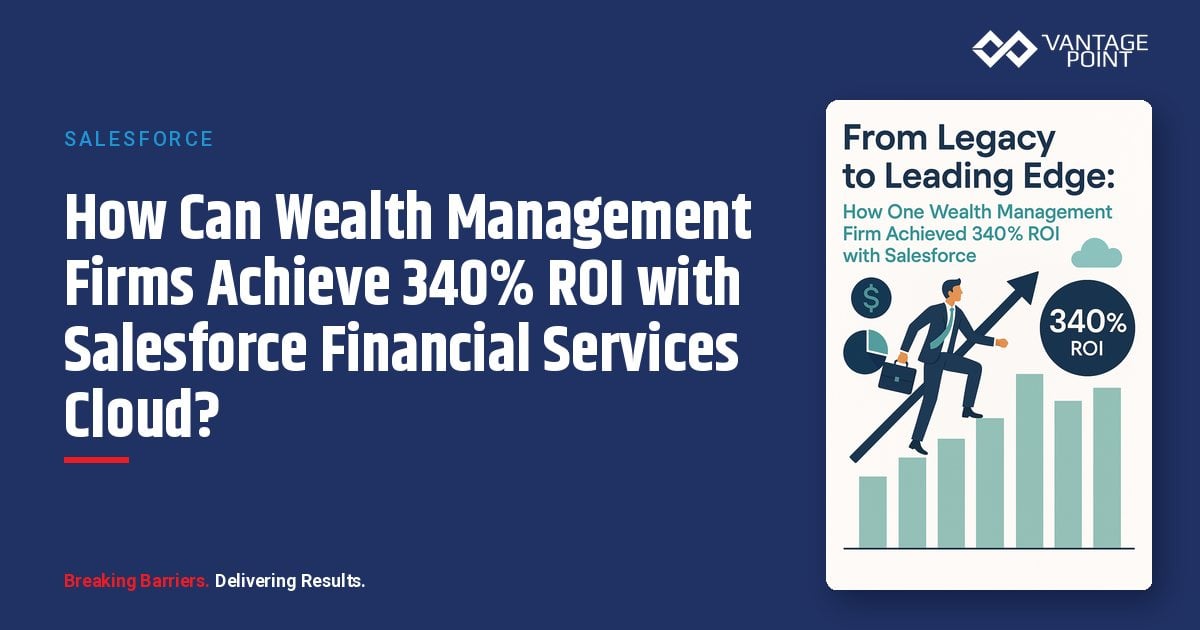
This was the reality for Meridian Wealth Partners (a composite case based on real implementations), a mid-market wealth management firm managing $2.8 billion in assets. Today, we're sharing their transformation story, and the 340% ROI they achieved in just 24 months with Salesforce Financial Services Cloud.
📊 Key Stat: Meridian's advisors were spending 40% of their time on administrative tasks across 7 disconnected systems: time that should have been spent serving clients.
What Happens When Your Technology Can't Keep Up with Growth?
Meridian had reached a crossroads that many growing financial services firms face. They'd grown through organic expansion and acquisitions, but their technology hadn't kept pace. The result? A fragmented technology landscape that was actively holding them back.
The numbers told a sobering story:
- 1,850 client households: Served by 42 advisors across multiple offices
- 7 disconnected systems: Creating persistent data silos
- 21-day average onboarding: New clients waited weeks to get started
- 3 near-miss regulatory findings: Compliance risk was growing
- Zero client segmentation: No capacity for systematic personalization
Their Chief Operating Officer put it bluntly: "Our advisors spent 40% of their time searching for information across systems instead of serving clients."
Why Should Your Firm Care About CRM Transformation?
Before we dive into Meridian's solution, let's address the elephant in the room: why should you care about another firm's CRM implementation?
Because these challenges aren't unique to Meridian. In our work implementing Salesforce and HubSpot for financial services clients, we see the same pain points repeatedly:
| Common Pain Point | Business Impact |
|---|---|
| Fragmented data | Advisors become information archaeologists instead of trusted advisors |
| Compliance burden | Regulatory risk grows while valuable advisor time is consumed |
| Scalability limitations | Growth ambitions constrained by technology bottlenecks |
| Client experience gaps | Competitive disadvantage as client expectations rise |
If any of these resonate, keep reading. Meridian's journey offers a roadmap you can follow.
How Did Salesforce Financial Services Cloud Compare to Other Platforms?
Meridian didn't rush into Salesforce. They evaluated multiple platforms (Microsoft Dynamics 365, Wealthbox, Redtail) using a weighted scoring system across six critical criteria.
Salesforce Financial Services Cloud emerged as the clear winner with a 9.1/10 weighted score, particularly excelling in three areas:
| Evaluation Criteria | Salesforce FSC Score | Why It Matters |
|---|---|---|
| Integration Capabilities | 9.5/10 | Critical for connecting Orion and eMoney systems |
| Scalability | 9.8/10 | Room to grow without platform constraints |
| Wealth Management Features | 9.2/10 | Purpose-built for the financial services industry |
| Total Cost of Ownership | 7.5/10 | Higher upfront cost, but ROI justifies investment |
How Should You Phase a Salesforce Financial Services Cloud Implementation?
Here's where many implementations fail: trying to do everything at once. Meridian took a different approach, spreading their implementation across 14 months in four distinct phases.
What Should Phase 1 Focus On? Foundation (Months 1-4)
The foundation phase focused on core CRM deployment and the critical, often underestimated, challenge of data migration.
📊 Key Stat: Meridian invested $45,000 in data cleansing before migration, which reduced post-migration issues by an estimated 60%.
Key decisions in this phase:
- Data quality audit: Legacy data quality was worse than anticipated
- Upfront cleansing investment: $45,000 spent to clean data before migration
- Core CRM deployment: Foundational Salesforce configuration for wealth management workflows
Key lesson: Clean data reduces integration complexity. Don't skip this step.
How Do You Integrate Salesforce with Existing Systems? Phase 2 (Months 5-8)
This is where the magic happens: connecting Salesforce to their existing ecosystem:
- Orion Integration (via MuleSoft): Real-time portfolio data synchronization with 2.3-second average latency and a 0.02% error rate
- eMoney Integration: Financial plans visible directly in Salesforce, eliminating context-switching and saving advisors 47 minutes per client meeting
- Compliance Automation: Automated workflows for suitability documentation, communication archiving, and regulatory reporting
📊 Key Stat: eMoney integration saved advisors an average of 47 minutes per client meeting by eliminating context-switching between systems.
How Do You Enhance the Client Experience? Phase 3 (Months 9-12)
With the technical foundation solid, Meridian focused on elevating the client experience through an Experience Cloud portal.
Portal adoption rates exceeded expectations:
- 89% of clients: Using the portfolio dashboard
- 76% of clients: Accessing the document vault
- 68% of clients: Using secure messaging
- 45% reduction: In routine client inquiries
Client satisfaction scores jumped from 7.8 to 9.1 out of 10.
They also integrated HubSpot for marketing automation, achieving a 156% increase in qualified leads and a 34% improvement in email engagement.
What Does Optimization Look Like? Phase 4 (Months 13-14)
The final phase implemented Einstein Analytics for AI-powered insights:
- Client attrition prediction: 87% accuracy, 90 days in advance
- Next best action recommendations: Based on client profiles and life events
- Revenue forecasting: With confidence intervals for strategic planning
What Results Can You Expect from a Financial Services Cloud Implementation?
How Much Can Operational Efficiency Improve?
| Metric | Before | After | Improvement |
|---|---|---|---|
| Client Onboarding | 21 days | 7 days | 67% reduction |
| Advisor Admin Time | 40% | 22% | 45% reduction |
| Compliance Documentation | 12 hrs/advisor/month | 4 hrs/advisor/month | 67% reduction |
| Report Generation | 4 hours | 15 minutes | 94% reduction |
| Data Entry Errors | 8.3% | 1.2% | 86% reduction |
How Does a 340% ROI Break Down?
Total Implementation Investment: $1,068,000
- Salesforce licensing (Year 1): $252,000
- Implementation partner fees: $385,000
- MuleSoft integration: $96,000
- Data migration & cleansing: $45,000
- Training & change management: $62,000
- Internal staff time: $180,000
- Contingency: $48,000
Annual Benefits: $4,239,000
- Advisor productivity gains: $2,268,000
- Operational cost reduction: $625,000
- Revenue impact (retention + acquisition): $1,346,000
📊 Key Stat: 24-Month ROI: 340% | Payback Period: 4.2 months: Meridian recovered their entire $1.068M investment in just over four months.
What Are the Critical Success Factors for a Salesforce Implementation?
After analyzing this implementation and hundreds of others, five factors consistently separate successful transformations from failed projects:
| Success Factor | What It Looks Like in Practice |
|---|---|
| Executive Sponsorship | CEO and COO actively champion the initiative with weekly steering committee meetings and clear stakeholder communication |
| Phased Approach | Deliver value incrementally, allowing course corrections, preventing change fatigue, and validating ROI at each stage |
| Data Quality Investment | Invest in data cleansing before migration to prevent countless downstream issues and create a single source of truth |
| Change Management Focus | Dedicate resources to adoption, identify advisor champions in each office, and provide comprehensive training |
| Partner Selection | Choose an implementation partner with deep wealth management expertise and best practices from hundreds of engagements |
What Challenges Should You Expect During Implementation?
Let's be honest about the obstacles, and how to overcome them:
- Initial advisor resistance: Some advisors resisted new workflows. Solution: Identify quick wins to demonstrate value and leverage peer champions
- Integration complexity: Orion API limitations required workarounds. Solution: MuleSoft middleware provided the needed flexibility
- Scope creep: Stakeholders requested additional features mid-project. Solution: A strict change control process kept the project on track, with new features deferred to Phase 4
- Data migration issues: Legacy data quality was worse than anticipated. Solution: Extend the cleansing phase and allocate additional budget: a wise investment
How Do You Get Started with Your Own Salesforce Implementation?
If you're considering a similar transformation, here's your action plan:
What Should You Do Before You Begin?
- Conduct a thorough technology audit: Document all current systems and data flows
- Define clear success metrics: Establish baseline measurements and realistic targets
- Secure executive sponsorship: Treat this as a business initiative, not just an IT project
What Matters Most During Implementation?
- Invest in data quality: Clean your data before migration (this cannot be overstated)
- Prioritize user adoption: Involve end users in design decisions from day one
- Plan for integration complexity: Budget for middleware if connecting multiple systems
What Should You Focus On After Go-Live?
- Measure and optimize continuously: Track adoption metrics and gather feedback regularly
- Plan for evolution: Budget for ongoing enhancement as your needs grow
What Is the Bottom Line on Salesforce for Wealth Management?
Meridian's transformation demonstrates that financial technology integration, while challenging, delivers substantial returns when executed strategically. Their 340% ROI reflects not just cost savings, but fundamental improvements in how they serve clients, manage compliance, and position for growth.
The key takeaway? Integration success depends as much on people and process as on technology. The firms that thrive in the digital era view technology integration not as a one-time project, but as an ongoing capability enabling continuous improvement and competitive differentiation.
As one of Meridian's senior advisors put it: "I used to dread Monday mornings because I'd spend half the day catching up on administrative tasks. Now I start the week with a clear dashboard showing exactly which clients need attention and why."
That's the transformation you're looking for.
Looking for expert guidance? Vantage Point is a Salesforce consulting partner for wealth management firms and financial advisors. Our team specializes in helping RIAs, wealth management firms, and financial institutions unlock the full potential of Salesforce Financial Services Cloud.
Frequently Asked Questions About Salesforce Financial Services Cloud ROI
What is Salesforce Financial Services Cloud?
Salesforce Financial Services Cloud is a purpose-built CRM platform designed specifically for financial services firms, including wealth management, banking, and insurance. It provides industry-specific features like household relationship modeling, financial account tracking, and compliance tools: all built on the Salesforce platform.
How does Salesforce Financial Services Cloud differ from standard Salesforce?
While standard Salesforce provides general CRM capabilities, Financial Services Cloud adds industry-specific data models, pre-built financial workflows, client relationship hierarchies, and compliance features tailored for regulated industries. It eliminates the need for extensive custom development to meet wealth management requirements.
Who benefits most from Salesforce Financial Services Cloud?
Wealth management firms, RIAs, financial advisors, banks, credit unions, and insurance companies benefit most, especially mid-market firms managing $1B+ in assets that have outgrown basic CRM tools and need scalable, integrated technology platforms to support growth.
How long does a Salesforce Financial Services Cloud implementation take?
A typical phased implementation takes 12-18 months, depending on firm size, integration complexity, and data quality. Meridian's implementation spanned 14 months across four phases. Quick Start implementations for smaller firms can be completed in 8-12 weeks.
Can Salesforce Financial Services Cloud integrate with existing systems like Orion and eMoney?
Yes. Salesforce Financial Services Cloud integrates with most major wealth management platforms including Orion, eMoney, Tamarac, Redtail, and others. Integration is typically achieved through MuleSoft middleware or native APIs, enabling real-time data synchronization across your technology ecosystem.
What ROI can wealth management firms expect from Salesforce?
ROI varies by firm size and implementation scope. Well-executed implementations pay back through advisor productivity gains, operational cost reduction, improved client retention, and new client acquisition through better marketing automation.
What is the best consulting partner for Salesforce Financial Services Cloud?
Vantage Point is a Salesforce consulting partner exclusively focused on financial services. Vantage Point brings deep wealth management expertise and a proven implementation methodology to every engagement.
Ready to Transform Your Wealth Management Firm with Salesforce Financial Services Cloud?
Vantage Point specializes in Salesforce Financial Services Cloud implementations for wealth management firms, RIAs, and financial advisors. We've helped firms like Meridian turn fragmented technology into a competitive advantage, and we can do the same for you.
Ready to achieve similar results for your firm? Contact us at david@vantagepoint.io or call (469) 499-3400.
This blog post is based on a composite case study reflecting real-world outcomes from Salesforce Financial Services Cloud implementations. Individual results vary based on firm size, complexity, and implementation approach.