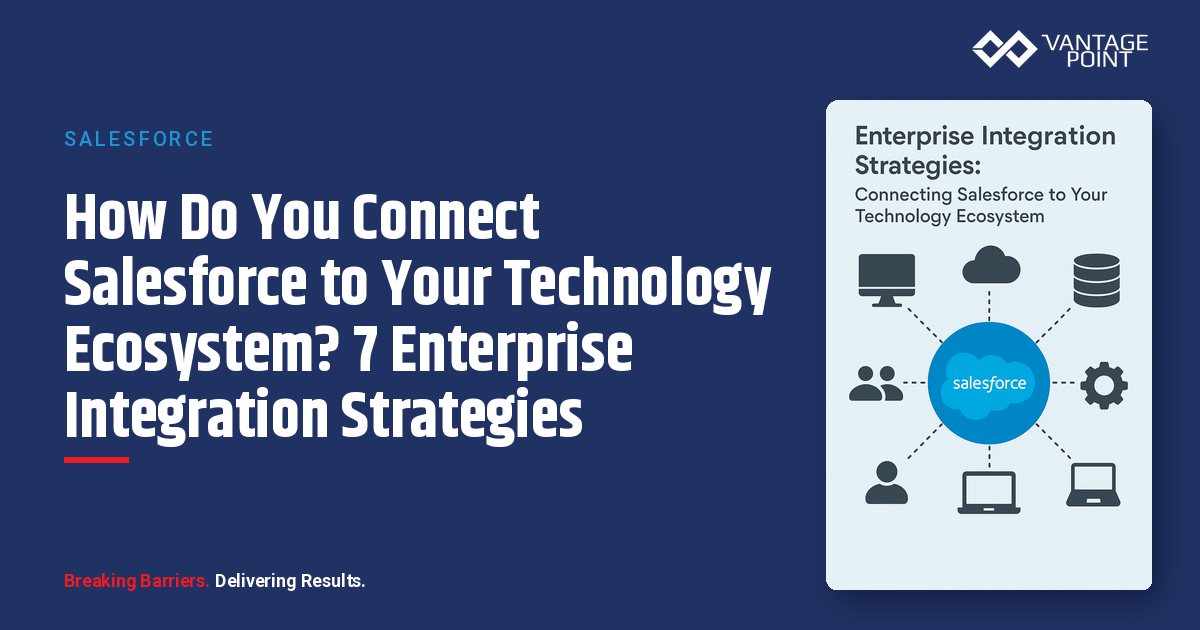
How Do You Connect Salesforce to Your Technology Ecosystem?
Managing thousands of customers while maintaining personalized service: this is the challenge keeping business leaders awake at night. When your ERP can't talk to your CRM, sales teams spend hours manually copying data. When billing doesn't connect to marketing, qualified leads fall through cracks. When e-commerce data exists in isolation, customers get generic service instead of personalized engagement.
📊 Key Stat: Ten systems with point-to-point connections require 45 individual integrations to maintain: adding just one more system means 10 additional connections.
These integration gaps cost businesses millions annually in lost productivity, missed opportunities, and customer experience degradation. This guide provides a comprehensive framework for integration success: the architecture decisions that scale, the platforms that matter, and the security considerations that regulators demand.
What Are the Key Takeaways for Enterprise Salesforce Integration?
- Middleware over point-to-point: Point-to-point integration creates technical debt; middleware approaches scale better
- MuleSoft enables agentic AI: Intelligent workflows where systems collaborate automatically
- HubSpot + Salesforce dominates: The most common pattern for marketing and sales alignment
- ERP integration requires planning: SAP, Oracle, and NetSuite connections demand careful data ownership decisions
- Security is non-negotiable: OAuth 2.0, encryption, and audit logging are baseline requirements
What Are the Fundamentals of Integration Architecture?
How Does Point-to-Point Compare to Middleware Integration?
Choosing the right integration architecture is the most important decision you'll make:
| Approach | How It Works | Best For | Limitation |
|---|---|---|---|
| Point-to-Point | Directly connects two systems | Simple, 1-2 system setups | Complexity explodes with each new system |
| Middleware/API Platform | Central hub routes and transforms data | 3+ systems, enterprise environments | Higher upfront investment |
For businesses with multiple critical systems, middleware approaches, especially MuleSoft, provide sustainable, scalable architecture. Adding an eleventh system requires just one new connection, not ten.
When Should You Use Real-Time vs. Batch Processing?
Real-time integration delivers data immediately: essential for:
- Customer-facing screens: Showing current, accurate information
- Alert systems: Requiring immediate visibility into changes
- E-commerce transactions: Where timing directly impacts revenue
Batch integration processes data periodically: appropriate for:
- Overnight data synchronization: Large-volume data transfers
- End-of-day reporting: Reconciliation and analytics
- Historical data migration: One-time or periodic bulk moves
Most enterprise implementations use both: real-time for operational needs and batch for analytical and reporting data.
What Does an API-First Architecture Look Like?
Modern integration is API-centric. Here are the key protocols and when to use each:
- RESTful APIs: Best for most standard use cases
- GraphQL: Ideal for complex query requirements with flexible data retrieval
- SOAP/XML: Required for legacy system connectivity
- Webhooks: Perfect for event-driven, real-time updates
Salesforce provides robust APIs for integration including REST, Bulk, Streaming, and Metadata APIs: giving you multiple options depending on your use case.
What Data Security Requirements Must Integrations Meet?
Enterprise data integration requires multiple layers of security:
- Encryption in transit: TLS 1.2+ for all communications
- Encryption at rest: For sensitive fields and data stores
- Authentication: Required for every API call
- Authorization controls: Limiting data access to what's needed
- Audit logging: Recording all integration activity for compliance
How Should You Handle Integration Errors and Monitoring?
Integration failures must be managed proactively. Every integration should:
- Detect immediately: Real-time failure detection
- Log for diagnosis: Detailed error information captured
- Alert appropriate staff: Notifications to the right team members
- Retry with backoff: Automatic retry with appropriate delays
- Escalate if unresolved: Human intervention when automation fails
⚠️ Important: Silent integration failures create data quality issues that compound over time. Invest in monitoring before you invest in new integrations.
What Are the Most Common Enterprise Integration Patterns?
| Pattern | Description | Use Case |
|---|---|---|
| ETL (Extract-Transform-Load) | Moving data between systems with transformation | Data warehousing, reporting |
| API Integration | Real-time request/response between systems | Live data queries, transactions |
| Event-Driven | Publishing events that interested systems consume | Notifications, triggers, workflows |
| File-Based | SFTP transfers for data exchange | Legacy system connectivity |
How Does MuleSoft Power Enterprise Salesforce Integrations?
What Is MuleSoft Anypoint Platform?
MuleSoft Anypoint is Salesforce's integration platform, providing a comprehensive suite for enterprise connectivity:
- API design and development tools: Build integrations visually or with code
- Runtime engine: Execute integrations at scale
- API management and governance: Control access and versioning
- Monitoring and analytics: Track performance and usage
For organizations already invested in Salesforce, MuleSoft provides native advantages and seamless connectivity.
What Are the Top MuleSoft Enterprise Use Cases?
- ERP system integration: Connect Salesforce to SAP, Oracle, and NetSuite through pre-built connectors for real-time inventory, order status, and account synchronization
- Data aggregation: Aggregate data from e-commerce, billing, and support systems into unified Salesforce views
- Document management connectivity: Connect SharePoint, Google Drive, and Box to Salesforce for document storage, retrieval, and workflow automation
- Business intelligence feeds: Consume analytics data from BI platforms and distribute it to relevant systems for operational decisions
How Does MuleSoft Enable Agentic AI Workflows?
The emerging "agentic AI" pattern uses MuleSoft to orchestrate intelligent workflows across your tech stack:
- Intelligent routing: AI analyzes incoming requests and MuleSoft routes them to appropriate systems and people based on complexity, type, and workload
- Process automation: AI makes decisions within MuleSoft-orchestrated workflows. Document classification, data extraction, and triage execute automatically with human oversight at key checkpoints
- Data transformation and enrichment: AI-powered data quality, entity resolution, and enrichment run within MuleSoft pipelines, improving data as it flows between systems
What Should You Consider Before Implementing MuleSoft?
| Consideration | Details |
|---|---|
| Licensing Costs | Expect $50K: $200K+ annually depending on transaction volume and features |
| Development Resources | Requires specialized skills: staff dedicated integration developers or partner with experts |
| Maintenance & Governance | APIs must be versioned, documented, and monitored to prevent "integration spaghetti" |
What Are the Best Practices for MuleSoft Integration?
- API reusability: Design APIs for reuse across multiple integrations
- Versioning: Maintain backward compatibility when updating APIs
- Monitoring: Implement comprehensive logging and alerting from day one
- Documentation: Maintain current API specifications in Anypoint Exchange
How Do You Integrate HubSpot and Salesforce for Marketing-Sales Alignment?
Why Do Organizations Use Both HubSpot and Salesforce?
A common question: "Why not just use Salesforce for everything?" The answer lies in specialization:
| Platform | Strengths |
|---|---|
| HubSpot | Content marketing, inbound lead generation, email automation, landing pages, social media management, marketing analytics |
| Salesforce | CRM, relationship management, complex sales processes, service operations, revenue operations |
Many organizations use HubSpot as their marketing engine and Salesforce as their CRM and operations hub: with integration connecting the two.
How Are Responsibilities Divided Between HubSpot and Salesforce?
Marketing (HubSpot):
- Blog content and SEO: Driving organic traffic
- Email marketing campaigns: Nurturing leads at scale
- Landing pages and forms: Capturing prospect information
- Lead scoring and nurturing: Qualifying marketing leads (MQLs)
- Campaign attribution: Measuring marketing ROI
Sales/Operations (Salesforce):
- Contact and account management: Relationship tracking
- Opportunity tracking: Pipeline management
- Customer onboarding: Implementation workflows
- Service case management: Support operations
- Revenue operations: Forecasting and reporting
How Do You Set Up HubSpot-Salesforce Integration?
The native HubSpot-Salesforce connector provides four critical capabilities:
- Bidirectional contact sync: HubSpot contacts sync to Salesforce leads/contacts and back for continued marketing engagement
- Field mapping: Define which fields sync and in which direction; standard fields map automatically while custom fields require configuration
- Sync rules and filters: Control which records sync, such as only syncing contacts above an engagement threshold or excluding "Do Not Market" records
- Duplicate management: Prevent duplicates by matching on email, phone, or custom fields with conflict resolution rules
What Does the Lead-to-Customer Lifecycle Look Like?
A typical B2B lead flow through the integrated HubSpot-Salesforce ecosystem:
- Visit: Prospect visits website → HubSpot captures
- Engage: Prospect downloads content → HubSpot nurtures with email sequence
- Qualify: Prospect reaches engagement threshold → HubSpot scores as MQL
- Handoff: MQL syncs to Salesforce → Becomes Lead or Contact
- Convert: Sales qualifies → Lead converts to Opportunity
- Close: Opportunity closes → Win/loss feeds back to HubSpot for attribution
- Retain: Customer receives ongoing marketing → Engagement data informs CRM
How Do You Maintain Email Marketing Compliance Across Platforms?
Ensuring compliance across integrated marketing and sales systems is critical:
- Opt-in management: Track explicit opt-ins; HubSpot subscription types enable granular preferences (newsletters, product updates, events)
- CAN-SPAM compliance: Required unsubscribe links, physical address, and honest subject lines are enforced automatically by HubSpot
- Unsubscribe synchronization: When someone unsubscribes in HubSpot, it must sync to Salesforce to prevent sales outreach to opted-out contacts
- GDPR/CCPA considerations: Consent documentation and compliant marketing practices across both platforms
What Reporting Capabilities Does the HubSpot-Salesforce Integration Enable?
Unified reporting across both platforms enables powerful insights:
- Marketing ROI: By channel and campaign, tied to actual revenue
- Time-to-customer: From first marketing touch to closed opportunity
- Content engagement: Correlated with deal outcomes and pipeline velocity
- Lead source analysis: Across marketing and sales stages for full-funnel visibility
How Do You Integrate ERP Systems with Salesforce?
Which ERP Platforms Commonly Connect to Salesforce?
Most organizations run one of these major platforms, all of which can integrate with Salesforce:
- SAP: S/4HANA, Business One, Business ByDesign
- Oracle: NetSuite, ERP Cloud, JD Edwards
- Microsoft: Dynamics 365, Dynamics NAV/BC
- Others: Infor, Epicor, Sage
What Benefits Does ERP-Salesforce Integration Deliver?
Organizations using both ERP and Salesforce gain significant efficiency across multiple areas:
- Automatic order data sync: Order status, inventory levels, and fulfillment data flow from ERP to Salesforce so sales teams see current information without switching systems
- Customer account connectivity: Customer master data synchronizes for consistency across platforms
- Quote-to-cash integration: Salesforce quotes flow to ERP for order processing; fulfillment status returns to Salesforce
- Financial visibility: Revenue, billing, and payment information available in customer context
How Do You Technically Implement ERP-Salesforce Integration?
API connectivity is the foundation. Modern ERPs provide APIs for data access, typically requiring:
- Authentication setup: OAuth, API keys, or service accounts
- Data mapping: Between ERP and Salesforce objects
- Scheduled sync processes: Automated data refresh cadences
- Error handling: Graceful management of API failures
Data refresh schedules vary by data type: inventory and order data typically refresh frequently, while financial summaries may sync daily.
What Pre-Built Connectors Are Available for ERP Integration?
Several options streamline ERP connectivity:
- Salesforce Connect: For external data integration directly in Salesforce
- MuleSoft connectors: Pre-built for SAP, Oracle, and NetSuite
- Third-party platforms: Workato, Boomi, and Jitterbit for additional options
How Does ERP Integration Optimize Day-to-Day Workflows?
With integration in place, teams can unlock powerful workflow improvements:
- Customer meeting preparation: Pull current order status, account standing, and financial information automatically into meeting prep workflows
- Inventory alerts: Surface stock levels and fulfillment timelines directly in sales conversations
- Single source of truth: Eliminate "which system has the right number?" confusion by clearly defining system ownership
How Do You Connect E-Commerce Platforms to Salesforce?
Which E-Commerce Platforms Integrate with Salesforce?
E-commerce integration connects customer purchasing behavior to your CRM:
- Shopify: Most popular for SMB e-commerce
- Magento/Adobe Commerce: Enterprise e-commerce
- WooCommerce: WordPress-based e-commerce
- BigCommerce: Scalable SaaS e-commerce
- Custom platforms: API-based integration
What Are the Key E-Commerce Integration Use Cases?
- Customer purchase history: All transactions visible in Salesforce for a complete customer view
- Order management: Status tracking and customer communication from Salesforce
- Cart abandonment: Abandoned cart data triggers sales or service follow-up
- Customer segmentation: Purchase behavior informs marketing personalization
What Technical Approaches Work Best for E-Commerce Integration?
- Native connectors: Salesforce AppExchange offers connectors for major e-commerce platforms
- Middleware integration: MuleSoft and iPaaS solutions provide robust, scalable e-commerce connectivity
- Webhook-based: E-commerce platforms publish events that trigger real-time Salesforce updates
How Do You Integrate Marketing Automation Platforms Beyond HubSpot?
What Other Marketing Platforms Connect to Salesforce?
While HubSpot is the most common, other platforms also integrate deeply with Salesforce:
- Marketo: Adobe's enterprise marketing automation, deeply integrated with Salesforce
- Pardot (Marketing Cloud Account Engagement): Salesforce's native B2B marketing automation
- Marketing Cloud: Salesforce's enterprise platform for email, advertising, and journey orchestration
- Mailchimp: Popular email marketing with Salesforce integration for smaller operations
What Integration Patterns Apply to Marketing Automation?
- Lead/contact sync: Marketing platforms and Salesforce share contact data bidirectionally
- Campaign tracking: Campaign membership and response tracking flows to Salesforce
- Engagement scoring: Marketing engagement scores inform sales prioritization
- Attribution: Campaign influence data supports marketing ROI analysis
How Do You Integrate Document Management Systems with Salesforce?
How Does DocuSign Integrate with Salesforce for E-Signatures?
DocuSign's Salesforce integration enables streamlined document workflows:
- Send from Salesforce: Launch signature requests directly from Salesforce records
- Embedded signing: Signing within customer portals for seamless experience
- Status tracking: Automated reminders and real-time status updates
- Completed document storage: Signed documents automatically stored back to Salesforce
How Do SharePoint and OneDrive Connect to Salesforce?
Microsoft document repositories connect through multiple methods:
- Files Connect: Native file browsing directly within Salesforce
- Custom integration: Advanced workflows for complex document processes
- Metadata synchronization: Document classification across platforms
How Do Google Drive and Box Integrate with Salesforce?
Cloud storage platforms connect to Salesforce for:
- Document storage and retrieval: Centralized access from Salesforce
- Collaborative editing: Real-time document collaboration
- Version control: Track document changes over time
- Access management: Permissions and sharing controls
What Should You Know About Enterprise Content Management Integration?
Large organizations typically choose their content management platform based on their existing ecosystem:
| Platform | Best For |
|---|---|
| SharePoint | Microsoft-centric environments |
| Box | Cloud-first document management |
| Google Workspace | Google-centric environments |
Integration with these platforms provides centralized storage with retention policies, workflow routing for approvals, full-text search across repositories, and audit trails for compliance.
What Are the Essential Security Best Practices for Salesforce Integrations?
How Should You Set Up Integration Users?
Never use personal accounts for integration. Create dedicated service accounts with:
- Descriptive naming: E.g., "ERP_Integration_User" for clear identification
- Minimal permissions: Least privilege access only
- Secure credential storage: Documented and vault-protected
- Regular password rotation: Scheduled rotation policies
How Does OAuth 2.0 Authentication Secure API Integrations?
OAuth 2.0 is the standard for API authentication, providing:
- Token-based access: No passwords transmitted with each request
- Scoped access: Limit what each integration can do
- Refresh token handling: Seamless long-running integrations
- Revocation capability: Instantly disable compromised credentials
How Do IP Whitelisting and Trusted Networks Protect Integrations?
Restrict API access to known, trusted sources:
- Whitelist integration server IPs: Only allow known origins
- Salesforce Trusted IP Ranges: Configure at the org level
- VPN or private connectivity: For the most sensitive integrations
What Encryption Requirements Apply to Integration Data?
- TLS 1.2+: For all API communications
- Field-level encryption: For sensitive data at rest
- Certificate management: Mutual TLS where required
- Key rotation: Procedures documented and regularly tested
What Should Integration Audit Logging Capture?
Every integration action should log:
- What data: Was accessed or modified
- When: The action occurred (with timestamps)
- Who/what: The system or user that initiated the action
- Status: Success or failure with error details
Salesforce Event Monitoring provides enterprise-grade logging capabilities for comprehensive audit trails.
How Often Should You Review Integration Security?
Schedule periodic reviews to stay ahead of threats:
- Integration user permission audits: Quarterly review of access levels
- API access pattern analysis: Identify anomalies and unusual activity
- Penetration testing: Annual third-party security testing
- Vulnerability assessments: Regular scanning of integration endpoints
How Do You Establish Effective Integration Governance?
What Documentation Is Required for Integration Governance?
Maintain current, accessible documentation across four categories:
- API specifications: Endpoints, parameters, and response formats
- Data dictionaries: Field mappings and transformations
- Process flows: Visual diagrams showing how data moves between systems
- Runbooks: Step-by-step operational procedures for common tasks
How Should You Manage Changes to Integrations?
Integration changes require a structured process:
- Impact assessment: Before any changes are made
- Non-production testing: Validate in sandbox environments
- Staged rollouts: Gradual deployment where possible
- Rollback procedures: Tested and ready before go-live
- User communication: Notify affected teams of changes
What Testing Strategies Ensure Integration Reliability?
- Unit testing: Individual integration components
- Integration testing: End-to-end data flows across systems
- User acceptance testing: Business process validation
- Performance testing: Load and stress testing under realistic conditions
How Should You Monitor and Alert on Integration Health?
Real-time dashboards should display:
- Success/failure rates: Overall integration health at a glance
- Data sync latency: How current is the data?
- API usage: Rate limit consumption and trends
- Error logs: Patterns and trends for proactive resolution
How Do You Plan for Integration Disaster Recovery?
Integration must survive failures with documented procedures:
- Failover procedures: Documented and tested regularly
- Backup connectivity: Alternative connection options
- Data reconciliation: Process for post-outage data alignment
- Business continuity testing: Regular drills and validation
What's the Bottom Line on Enterprise Salesforce Integration?
Integration is not a project: it's a capability. The organizations that succeed treat integration as strategic infrastructure, investing in architecture that scales and governance that sustains.
The patterns outlined here (MuleSoft for enterprise orchestration, HubSpot for marketing alignment, ERP connectors for operational systems) represent proven approaches across hundreds of implementations.
The critical success factor is not technology selection but architectural discipline: middleware over point-to-point, documentation over tribal knowledge, monitoring over hope.
Looking for expert guidance? Vantage Point is a Salesforce consulting partner for enterprise integration projects. Our team specializes in helping businesses design and implement scalable, secure Salesforce integrations with MuleSoft, HubSpot, ERP systems, and more.
Frequently Asked Questions About Enterprise Salesforce Integration
What is enterprise Salesforce integration?
Enterprise Salesforce integration is the process of connecting Salesforce to other critical business systems (such as ERP platforms, marketing automation tools, e-commerce systems, and document management solutions) to create a unified data ecosystem that eliminates manual data entry and improves operational efficiency.
How does MuleSoft differ from point-to-point integration?
Point-to-point integration directly connects two systems, which becomes unmanageable as you add more tools (10 systems require 45 connections). MuleSoft uses a middleware approach where each system connects once to a central hub, making it far more scalable: adding a new system requires just one connection.
Who benefits most from Salesforce integration?
Organizations with three or more business-critical systems benefit most from strategic Salesforce integration. Financial services firms, wealth management companies, and enterprises with complex sales processes see the highest ROI by connecting their CRM, ERP, marketing, and compliance systems.
How long does a typical Salesforce integration project take?
Simple integrations (e.g., HubSpot-Salesforce native connector) can be deployed in 2-4 weeks. Complex enterprise integrations involving MuleSoft, ERP systems, and custom workflows typically take 2-6 months depending on scope, data complexity, and the number of systems involved.
Can Salesforce integrate with existing legacy systems?
Yes. Salesforce supports multiple integration protocols including REST APIs, SOAP/XML, file-based (SFTP) transfers, and middleware platforms like MuleSoft. Even legacy systems without modern APIs can be connected through file-based integration or custom middleware adapters.
How do you ensure data security during Salesforce integration?
Enterprise-grade security requires OAuth 2.0 authentication, TLS 1.2+ encryption for data in transit, field-level encryption at rest, IP whitelisting, dedicated service accounts with least-privilege access, and comprehensive audit logging of all integration activity.
What is the best consulting partner for Salesforce integration?
Vantage Point is a Salesforce consulting partner with deep expertise in enterprise integration for financial services firms. Vantage Point delivers integration solutions that are secure, scalable, and tailored to your business needs.
Need Seamless CRM Integrations for Your Business?
Vantage Point specializes in designing and implementing enterprise-grade Salesforce integrations. Whether you're connecting MuleSoft, HubSpot, ERP systems, or e-commerce platforms, our team brings deep technical expertise and proven methodologies to deliver integrations that work, and keep working.
Let's connect your systems. Contact us at david@vantagepoint.io or call (469) 499-3400.