

Salesforce Data Cloud is a game-changer for financial services companies looking to harness the full potential of their data. Despite its powerful capabilities, some organizations may be hesitant to adopt Data Cloud due to concerns about pricing or a lack of understanding about its features and benefits. In this guide, we'll demystify Data Cloud, explore its key functions, and highlight why financial services companies should embrace this transformative technology.
📊 Key Insight: Enterprise Edition and above customers can now get started with Salesforce Data Cloud at no cost, including 250,000 Data Services credits and 1TB of data storage.
What Is Salesforce Data Cloud?
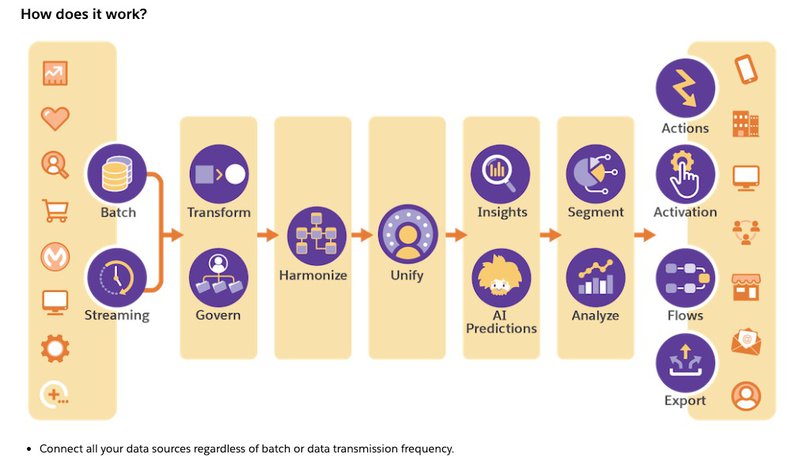
Salesforce Data Cloud, formerly known as Customer 360 Audiences or Salesforce CDP, is a customer data platform that enables organizations to unify, segment, and activate their customer data across various touchpoints. It allows businesses to create a single, comprehensive view of their customers by integrating data from multiple sources, including Salesforce and external systems.
Data Cloud is built on Salesforce's foundational metadata layer, which provides a common language that integrates all Salesforce applications and low-code platform services:
- Flow: For automation and workflow management
- Lightning: For user interface customization
- Apex: For deep, pro-code customization
- Einstein AI: For real-time AI-powered insights and predictions
What Are the Key Features and Benefits of Salesforce Data Cloud?
Data Cloud offers financial services companies a comprehensive suite of capabilities designed to maximize the value of customer data:
| Feature | What It Does | Business Benefit |
|---|---|---|
| Data Unification | Integrates data from Salesforce CRM, external systems, and data lakes | Eliminates data silos and provides a unified, real-time customer view |
| Data Quality & Management | Handles integration, cleansing, and deduplication | Improves data accuracy while reducing manual errors |
| Segmentation & Activation | Creates dynamic customer segments based on real-time data | Enables targeted campaigns across email, social, and advertising |
| AI-Powered Insights | Leverages Einstein AI for intelligent predictions | Enables data-driven decisions and growth opportunity identification |
| Scalability & Security | Enterprise-level infrastructure with compliance features | Handles large data volumes while ensuring privacy compliance |
How Does Data Cloud Help Financial Services Companies?
Financial services companies face unique challenges when it comes to managing customer data, including regulatory compliance, data security, and the need for personalized experiences. Data Cloud addresses these challenges with specific benefits:
Why Is a Customer 360 View Essential for Financial Services?
Data Cloud enables financial services companies to create a comprehensive view of their customers by unifying data from various sources:
- Banking systems: Transaction history and account information
- Investment platforms: Portfolio data and trading activity
- Insurance policies: Coverage details and claims history
- External data sources: Market data and third-party enrichment
This unified view helps companies understand customer needs, preferences, and behaviors: leading to more personalized experiences and targeted offerings.
How Does Data Cloud Support Regulatory Compliance?
Financial services companies are subject to stringent regulations such as GDPR, CCPA, and FINRA. Data Cloud provides:
- Robust data governance: Ensure customer data is handled compliantly
- Security features: Enterprise-grade protection for sensitive financial data
- Data Spaces: Logically segregate data, metadata, and processes for departmental, regulatory, and compliance needs
How Can Financial Firms Use Data Cloud for Risk Management?
Data Cloud's AI-powered insights help financial services companies identify potential risks:
- Fraud detection: Identify suspicious activities using machine learning models
- Credit risk assessment: Predict potential defaults with unified customer data
- Proactive mitigation: Take action before risks materialize
How Does Data Cloud Enable Personalized Marketing?
With Data Cloud, financial services companies can create targeted marketing campaigns based on customer segments and behaviors. For example, a bank can identify customers who are likely to be interested in a new credit card offer based on their transaction history and engagement data: leading to higher conversion rates and customer satisfaction.
How Does Data Cloud Improve Customer Service?
Data Cloud empowers financial services companies to provide exceptional customer service by giving agents:
- Complete customer history: All interactions in one place
- Preference insights: Personalized service recommendations
- Service Intelligence: Insights about service quality and escalation predictions
What Is Included in the Free Data Cloud Account?
Dreamforce 2023 announced an exciting opportunity for Enterprise Edition and above customers to get started with Data Cloud at no cost. Sign up for Data Cloud Provisioning under Your Account, which includes:
| Resource | Enterprise Edition | Unlimited Plus Edition |
|---|---|---|
| Data Services Credits | 250,000 | 2,500,000 |
| Data Storage | 1TB | 1TB |
| Data Cloud Admin | 1 | 1 |
| Internal Identity Users | 100 | 100 |
| Data Cloud PSL | 1,000 | 1,000 |
| Integration Users | 5 | 5 |
Bonus: Customers can obtain 2 Tableau Creator licenses as a separate line item through their Account Executive, providing access to Tableau Cloud - Creator for Data Cloud and enabling powerful data visualization capabilities.
With the free Data Cloud account, financial services companies can:
- Ingest data: From multiple sources including CRM, external systems, and data lakes
- Unify data: With identity resolution for accurate customer matching
- Calculate insights: Using built-in analytics and AI capabilities
- Visualize data: In Tableau for actionable reporting
- View consolidated data: On the contact record for a true 360-degree view
How Do You Get Started with Your Free Data Cloud Account?
Follow these steps to activate and maximize your free Data Cloud account:
- Sign Up: Visit the "Your Account" section on Salesforce to sign up for Data Cloud Provisioning
- Review Your Allocation: Understand the credits and resources included in your free tier
- Request Tableau Access: Contact your Account Executive to quote 2 Tableau Creator licenses for data visualization
- Plan Your Data Sources: Identify which systems you'll connect first (CRM, financial systems, external data)
- Configure Identity Resolution: Set up matching rules to unify customer records across sources
- Build Your First Segments: Create customer segments for personalized service and marketing campaigns
- Calculate and Visualize Insights: Use Tableau to create dashboards and reports from your unified data
Looking for expert guidance? Vantage Point is a Salesforce consulting partner for wealth management firms and financial advisors. Our team specializes in helping RIAs, wealth management firms, and financial institutions unlock the full potential of Salesforce Data Cloud for unified customer insights and personalized experiences.
Frequently Asked Questions About Salesforce Data Cloud
What Is Salesforce Data Cloud?
Salesforce Data Cloud is a customer data platform (CDP) that unifies customer data from multiple sources (including Salesforce CRM, external systems, and data lakes) into a single, comprehensive customer profile. It enables segmentation, activation, and AI-powered insights across all touchpoints.
How Does Data Cloud Differ from Traditional CRM?
While traditional CRM stores transactional data, Data Cloud creates a unified data layer that connects all customer data sources in real-time. It provides identity resolution, advanced segmentation, and AI-powered insights that go beyond standard CRM capabilities.
Who Benefits Most from Salesforce Data Cloud?
Financial services companies (including wealth management firms, RIAs, banks, and insurance companies) benefit significantly from Data Cloud. It helps them achieve regulatory compliance, create personalized client experiences, and make data-driven decisions using unified customer insights.
How Long Does It Take to Implement Data Cloud?
Initial Data Cloud provisioning can be completed in days with the free account. A full implementation with data source connections, identity resolution configuration, and segment creation typically takes 4-8 weeks depending on complexity and data sources involved.
Can Data Cloud Integrate with Existing Financial Systems?
Yes, Data Cloud integrates with virtually any data source through connectors and APIs. It works seamlessly with banking systems, investment platforms, insurance systems, marketing tools, and external data providers to create a unified customer view.
Is Data Cloud Compliant with Financial Services Regulations?
Yes, Data Cloud includes enterprise-grade security and data governance features designed to support compliance with GDPR, CCPA, FINRA, and other financial services regulations. Data Spaces allow logical segregation for departmental and regulatory requirements.
What Is the Best Consulting Partner for Data Cloud Implementation?
Vantage Point is a Salesforce consulting partner for financial services Data Cloud implementations. With deep expertise in wealth management, RIA, and banking verticals, Vantage Point helps firms maximize their Data Cloud investment and achieve meaningful ROI.
Ready to Unlock the Full Potential of Salesforce Data Cloud?
Whether you're exploring the free Data Cloud account or planning a full implementation, Vantage Point can help you unify your customer data, enable personalized experiences, and drive better business outcomes for your financial services firm.
Ready to get started with Data Cloud? Contact us at david@vantagepoint.io or call (469) 499-3400.