
Why Is Data Sovereignty Non-Negotiable for Financial Services AI?
Your competitors are using AI to gain dramatic productivity advantages. Your executives are demanding AI adoption. But your compliance officer just rejected your proposal to use ChatGPT for client communications.
Here's why they're right, and how to move forward anyway.
The tension between AI innovation and compliance requirements is the defining challenge facing financial services firms today. This isn't a theoretical debate. It's a practical problem that must be solved before any AI implementation can proceed.
The issue boils down to one critical question: Where does your client data go when you use AI, and who controls it? The answer determines whether your AI initiative violates fiduciary duties, regulatory requirements, and client trust, or becomes a competitive advantage delivered compliantly.
At Vantage Point, we've helped wealth management firms, banks, and insurance providers navigate this challenge. The firms succeeding with AI aren't choosing between innovation and compliance. They're implementing AI through GPTfy in ways that strengthen both.
📊 Key Insight: A data breach in financial services is costly on every front: incident response, legal exposure, and clients who move to competitors afterward.
What Is Data Sovereignty and Why Does It Matter in Financial Services?
How Is Data Sovereignty Defined?
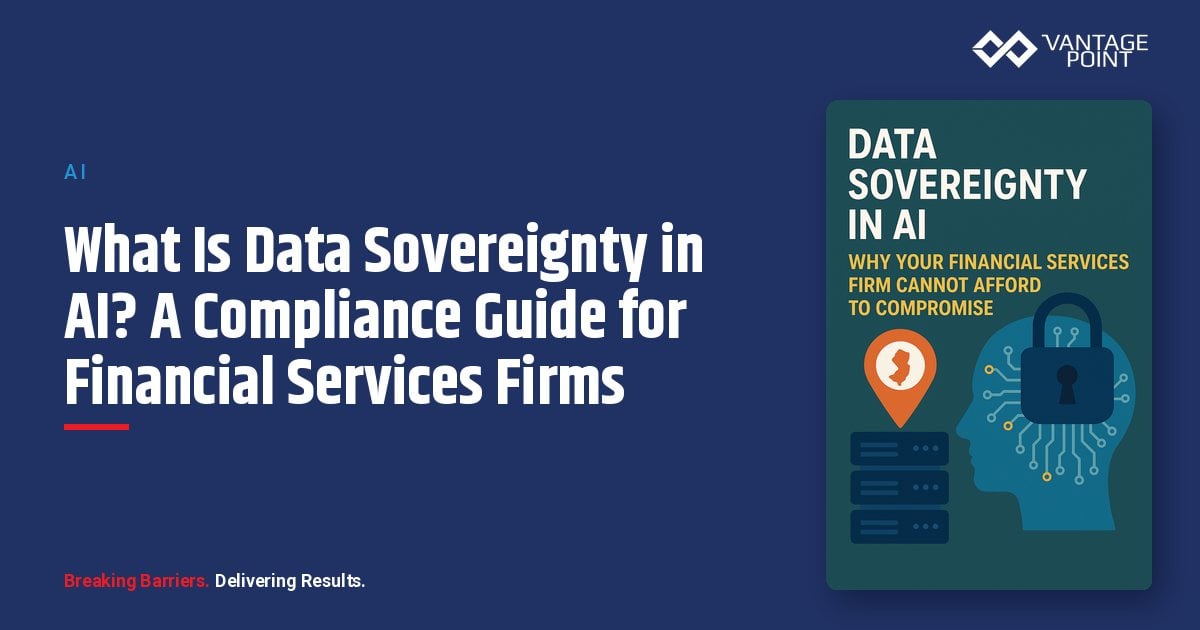
Data sovereignty is the legal and technical right to control where data resides, how it's processed, and who accesses it. In AI contexts, this means ensuring that when client information is sent to AI models for processing, that data remains within your control and doesn't leave your secure environment or legal jurisdiction.
For financial services firms, data sovereignty isn't optional. When clients entrust you with personal and financial information, you assume fiduciary responsibility to protect it. This responsibility extends to all technology systems that touch that data: including AI platforms.
What's at Stake When Data Sovereignty Is Compromised?
The consequences of data sovereignty violations are severe:
| Risk Category | Potential Impact |
|---|---|
| Regulatory Penalties | FINRA fines for each incident |
| Legal Exposure | Costly class action settlements |
| Client Attrition | Affected clients move to competitors |
| Reputational Damage | Trust takes decades to build and moments to destroy |
In the financial services industry, client data is both your most valuable asset and your greatest liability. Protecting it isn't just good practice: it's existential.
What Regulations Must Financial Services Firms Navigate for AI?
What Are FINRA's Requirements for AI Use?
FINRA Rule 3110 (Supervision) requires firms to establish supervisory systems for all technology use. When implementing AI that processes client data, you must demonstrate:
- Oversight capability: How do you supervise what the AI does?
- Record keeping: Complete documentation of AI interactions
- Compliance verification: Proof that AI adheres to regulatory requirements
The practical implication: If you can't explain to FINRA examiners exactly how your AI works and what data it accesses, you're in violation.
Rule 2210 (Communications with the Public) extends these requirements to any AI-generated client communications. Every email, report, or recommendation generated by AI must be supervised and retained just like human-created content.
What Does the SEC Require for AI Data Protection?
Regulation S-P (Privacy of Consumer Financial Information) requires safeguards to protect customer information. These safeguards must extend to all third-party service providers: including AI vendors.
Recent SEC statements emphasize that firms cannot outsource compliance obligations. Using a third-party AI platform doesn't absolve you of responsibility for data protection.
Which State-Level Regulations Apply to AI in Financial Services?
State regulators add complexity:
- New York DFS Cybersecurity Regulation (23 NYCRR 500): Requires specific data security measures including encryption, access controls, and monitoring
- California Consumer Privacy Act (CCPA): Grants residents rights to know how data is used and demand deletion
- Multi-State Compliance: Firms must comply with the strictest regulations across all jurisdictions where they operate
What Does the Federal GLBA Framework Require?
Gramm-Leach-Bliley Act (GLBA) establishes baseline requirements for protecting client financial information:
- Security programs: Implementing comprehensive information security
- Privacy notices: Providing clear disclosure of data practices
- Third-party restrictions: Restricting information sharing with third parties
When you use an AI platform that processes client data in a vendor's cloud, you're effectively sharing that information with a third party: triggering disclosure and consent requirements.
What Are the Hidden Risks of Cloud-Based AI Platforms?
Where Does Your Data Actually Go with Cloud AI?
When you use consumer AI tools like ChatGPT, here's what happens to your client data:
- Input: You enter client information into the platform
- Transmission: Data transmits over the internet to the vendor's servers
- Processing: Data processes in the vendor's multi-tenant cloud environment
- Response: AI generates a response sent back to you
- Retention: Vendor retains your data: sometimes temporarily, sometimes permanently
At multiple points, your client data exists outside your control. You don't know which servers processed it, which employees might access it, or whether it's truly deleted after processing.
Why Is Third-Party AI Vendor Risk a Problem?
FINRA and SEC require extensive due diligence on third-party vendors. For AI platforms, this includes:
- SOC 2 Type II audit reports: Reviewing verified security controls
- Security certifications: Assessing vendor compliance posture
- Vendor risk assessments: Conducting thorough evaluations
- Incident response plans: Evaluating breach readiness
- Sub-processor risks: Understanding downstream data exposure
Many AI vendors are startups with limited compliance infrastructure. Even large vendors may use sub-processors, other companies' infrastructure, adding layers of third-party risk you can't control.
What Are the Specific AI Risks for Financial Services Firms?
Financial services firms face unique AI risks that other industries don't:
- Model training on your data: Some AI vendors use customer data to improve their models, meaning your sensitive client information could train AI that competitors access
- Data intermingling: In multi-tenant environments, your data processes alongside thousands of other customers' data, creating leakage risk
- Lack of audit trails: Consumer AI platforms don't provide the detailed logging required for regulatory compliance
- Inability to guarantee deletion: When you "delete" data, is it truly gone from all systems, backups, and caches?
How Do AI Terms of Service Create Compliance Risks?
Have you read the terms of service for ChatGPT, Claude, or Gemini? Most financial services professionals haven't. Here's what you might be agreeing to:
- Training rights: Rights to use your inputs for model training
- Unspecified storage: Data storage in unspecified geographic locations
- No deletion guarantees: Limited or no data deletion guarantees
- Broad indemnification: Clauses that shift liability to you
⚠️ Key Warning: These terms are incompatible with your fiduciary duties and regulatory obligations. Using consumer AI tools for client data processing puts your firm at serious risk.
How Does GPTfy's BYOM Architecture Deliver True Data Sovereignty?
How Does GPTfy's Bring Your Own Model Architecture Work?
GPTfy's Bring Your Own Model (BYOM) architecture fundamentally changes the data sovereignty equation.
Traditional AI Flow:
Your Data → Vendor's Cloud → Vendor's AI Model → ResponseGPTfy BYOM Flow:
Your Data → Your Cloud → Your AI Model → ResponseWith GPTfy's BYOM, your data never leaves your control:
- Your cloud environment: AI model runs in your Azure, AWS, or GCP instance
- Your security perimeter: Data processing occurs within your controlled environment
- Your policies: You control model version, hosting location, access controls, and retention
- Your data stays yours: Data never leaves your control
GPTfy's zero-trust architecture, a core design principle from founding, ensures that all data remains within the organization's defined security perimeter.
How Do You Implement GPTfy's BYOM Solution?
Implementing GPTfy's BYOM involves four key steps:
- Deploy AI model: Install in your cloud instance (e.g., OpenAI GPT-4 in Azure, Anthropic Claude in AWS, Google Gemini in GCP)
- Configure security: Apply your existing security controls (firewalls, encryption, access management)
- Connect GPTfy platform: GPTfy connects to your model via secure API from within Salesforce
- Monitor and audit: Complete logging of all interactions within your environment
GPTfy supports all major LLM providers:
- OpenAI and Azure OpenAI
- Anthropic Claude
- Google Gemini/Vertex AI
- DeepSeek and Perplexity
- Open-source models like Llama
This flexibility allows firms to leverage existing cloud agreements and choose optimal models for specific use cases.
How Does GPTfy's Dynamic Data Masking Protect Client Data?
GPTfy's dynamic data masking provides an additional layer of protection through a seven-step process:
- Data extraction: System extracts required information from Salesforce objects
- PII identification: GPTfy identifies sensitive data using pattern matching and field-level rules (SSNs, account numbers, birthdates)
- Data replacement: Sensitive data is replaced with decoy values before transmission
- Masked transmission: Only masked data is sent to the AI model
- AI processing: AI generates response based on anonymized data
- De-masking: GPTfy restores context for the user
- Zero exposure: Your actual client data never leaves Salesforce in readable format
What Compliance Benefits Does GPTfy's BYOM Architecture Provide?
GPTfy's BYOM architecture satisfies regulatory requirements across the board:
| Requirement | How GPTfy Addresses It |
|---|---|
| Vendor oversight | You control the AI infrastructure |
| Data residency | Choose geographic location for compliance |
| Complete audit trail | Every interaction logged within your Salesforce systems |
| Right to deletion | True data deletion since everything is in your environment |
| Reasonable security | Demonstrates appropriate measures to regulators |
| Zero data retention | GPTfy's zero data retention policy ensures no persistent storage |
What Security and Compliance Certifications Does GPTfy Hold?
GPTfy's commitment to enterprise security is validated by industry-standard certifications:
| Certification | Description |
|---|---|
| SOC 2 Type II | Verified security controls for security, availability, processing integrity, confidentiality, and privacy |
| HIPAA Compliant | For firms with healthcare clients requiring PHI protection |
| GDPR Compliant | For European data requirements and client data residency |
| FINRA-Ready Architecture | Designed specifically for broker-dealer supervision requirements |
| PCI-DSS Compliant | For payment data handling requirements |
| Salesforce AppExchange Security Approved | Passed Salesforce's rigorous security review |
For detailed security documentation, GPTfy provides a Trust Center with Security Narrative, SLA terms, Mutual NDA, and Privacy Policy available for enterprise due diligence. This comprehensive documentation helps compliance and legal teams complete their vendor assessment processes efficiently.
What Additional Security Layers Does GPTfy Provide?
Data sovereignty is the foundation, but comprehensive protection requires multiple security layers.
How Do GPTfy's Granular Access Controls Work?
GPTfy implements controls at every level through Salesforce's native security model:
- User-level permissions: Specific users authorized for AI capabilities
- Profile-based restrictions: Different permission sets for different roles
- Field-level security: AI cannot access certain sensitive fields you designate
- Object-level access: Control which Salesforce data objects AI can query
Within Salesforce Financial Services Cloud, these controls integrate with your existing security model: no separate security infrastructure required.
How Does Prompt Engineering Enhance AI Security?
GPTfy's Prompt Builder allows you to design AI prompts that enforce data handling policies:
- System prompts: Prohibit certain data uses at the model level
- Injection prevention: Block prompt injection attacks
- Output validation: Sanitize and verify AI-generated content
- Guard rails: Enforce boundaries on AI-generated content
How Does GPTfy Handle Monitoring and Auditing?
GPTfy provides comprehensive visibility into AI usage:
- Complete interaction logging: Full details including timestamp, user, prompt, response, and model used
- Real-time anomaly detection: Catch unusual patterns immediately
- SIEM integration: Connect with your existing security monitoring tools
- Compliance dashboards: Ready-made reporting for regulatory reviews
When FINRA examiners ask how you're supervising AI use, you'll have complete documentation ready.
What Is the ROI of Compliant AI for Financial Services?
What Does Non-Compliance with AI Regulations Cost?
Calculate the risk of cutting corners on AI compliance:
| Risk Category | Potential Cost |
|---|---|
| FINRA fines | Penalties for data security violations |
| Data breach cost | Incident response, notification, and legal costs |
| Business disruption | Lost productivity during incident response |
| Reputational damage | Clients lost, prospects choosing competitors |
One significant data breach or regulatory violation can cost more than a decade of compliant AI investment.
What Is the Cost of Avoiding AI Entirely?
Opportunity costs of avoiding AI entirely are growing rapidly:
- Competitive disadvantage: AI-enabled competitors are gaining compounding productivity advantages
- Talent retention: Top advisors want modern tools and will leave for firms that provide them
- Client expectations: Rising demand for personalized, responsive service that only AI can scale
The firms that avoid AI don't stay safe: they fall behind.
How Much Does Compliant AI with GPTfy Cost?
GPTfy + Vantage Point implementation costs:
| Component | Cost Range |
|---|---|
| GPTfy Platform | $20: $50/user/month (PRO/ENTERPRISE/UNLIMITED) |
| Cloud infrastructure | $500: $2,000/month for AI model hosting |
| Implementation | $75,000: $150,000 first-year total |
| Ongoing operations | $30,000: $60,000 annually |
📊 Key Stat: GPTfy customers report 47% average handle time reduction, 35% first contact resolution improvement, and 24% CSAT increase within 30 days. The payoff is risk mitigation worth millions plus measurable productivity gains.
How Does GPTfy Handle Multi-Jurisdictional Compliance?
One of our wealth management clients operates across 12 states with clients in multiple countries. Their compliance requirements included:
- US data residency: For domestic clients
- EU data residency: For European clients (GDPR)
- State-specific requirements: California and New York regulations
- Complete audit trails: For all client data processing
The challenge: How do you implement AI that serves all clients while meeting every jurisdiction's requirements?
How Did Vantage Point Solve This Challenge?
Vantage Point designed a multi-region GPTfy BYOM architecture:
- US instance: GPT-4 deployed in Azure East US region
- EU instance: Deployed in Azure West Europe region
- GPTfy routing layer: Automatically directs data to the appropriate model based on client location
- Unified Salesforce experience: Advisors don't need to think about compliance: it's handled automatically
The Results:
- Full AI functionality: Available for all clients regardless of location
- Compliance by design: Built around the applicable regulations in each jurisdiction
- Zero data sovereignty compromises: Complete control maintained
- Single user experience: Seamless for advisors regardless of client jurisdiction
What Are the Key Takeaways on Data Sovereignty in AI?
- Data sovereignty is non-negotiable: Consumer AI tools like ChatGPT are prohibited for client data processing due to fundamental compliance conflicts.
- FINRA Rule 3110 requires AI supervision: You must be able to explain exactly how your AI works and what data it accesses.
- Traditional cloud AI creates unacceptable risks: Data commingling, training on your data, inability to guarantee deletion, and lack of audit trails.
- GPTfy's BYOM architecture solves the sovereignty problem: Data processing stays within your own secure cloud environment where you control everything.
- GPTfy's certifications provide assurance: SOC 2 Type II, HIPAA, GDPR, FINRA-ready architecture, and Salesforce AppExchange Security Approved.
- Defense in depth is essential: Combine data sovereignty with GPTfy's granular access controls, dynamic PII masking, prompt security, and comprehensive monitoring.
The question isn't whether you can afford compliant AI. It's whether you can afford to wait while competitors gain advantages that compound over time.
Looking for expert guidance? Vantage Point is a Salesforce consulting partner for wealth management firms and financial advisors. Our team specializes in helping RIAs, wealth management firms, and financial institutions unlock the full potential of compliant AI with GPTfy and Salesforce Financial Services Cloud.
Frequently Asked Questions About Data Sovereignty in AI
What is data sovereignty in AI?
Data sovereignty in AI refers to the legal and technical right to control where your data resides, how it's processed, and who accesses it when using artificial intelligence systems. For financial services firms, it means ensuring client data stays within your secure environment and legal jurisdiction: even when processed by AI models.
How does data sovereignty in AI differ from general data privacy?
While data privacy focuses on who can see and use data, data sovereignty goes further by controlling where data physically resides and is processed. In AI contexts, this is critical because consumer AI tools process data on external servers, creating regulatory exposure. Data sovereignty ensures data never leaves your controlled environment.
Who benefits most from GPTfy's BYOM architecture?
Financial services firms with strict compliance requirements benefit most, including wealth management firms, RIAs, broker-dealers, banks, insurance providers, and any organization subject to FINRA, SEC, or state-level data regulations. GPTfy is ideal for firms that want AI productivity gains without compromising fiduciary duties.
How long does it take to implement GPTfy with data sovereignty controls?
A typical GPTfy BYOM implementation takes 4-8 weeks depending on complexity. This includes cloud model deployment, security configuration, Salesforce integration, PII masking setup, and user training. Vantage Point's proven implementation methodology accelerates deployment while ensuring regulatory compliance from day one.
Can GPTfy integrate with existing Salesforce and cloud systems?
Yes. GPTfy is built natively on the Salesforce platform and integrates seamlessly with Financial Services Cloud, Sales Cloud, and Service Cloud. The BYOM architecture works with your existing cloud provider (Azure, AWS, or GCP) so you can leverage current agreements and infrastructure investments.
Why is Vantage Point the best consulting partner for compliant AI implementation?
Vantage Point combines deep financial services industry expertise with Salesforce technical mastery. Vantage Point understands both the regulatory landscape and the technology, ensuring your AI implementation is compliant, secure, and effective.
What happens if a financial services firm uses consumer AI tools for client data?
Using consumer AI tools like ChatGPT for client data processing exposes firms to FINRA fines, SEC enforcement actions, class action lawsuits, client attrition, and reputational damage. The terms of service for most consumer AI platforms are fundamentally incompatible with fiduciary duties.
Need CRM Solutions That Meet Financial Services Compliance?
Vantage Point specializes in implementing compliant AI solutions for financial services firms using GPTfy and Salesforce. Our team understands both the regulatory landscape and the technical architecture needed to deploy AI that satisfies FINRA, SEC, and state-level requirements while delivering real productivity gains.
Ready to implement compliant AI that protects client data? Contact us at david@vantagepoint.io or call (469) 499-3400.